Ably Alternatives in 2026: 8 Options Compared

- Pusher is our first pick for Live updates for web and mobile apps, because it covers the core job well without a narrow focus.
- PubNub is a strong second option for Global realtime messaging at scale, and it suits buyers who want a different balance of features and price.
- If you want to start free, look at Firebase, Supabase, Socket.IO first, then check what sits behind their paid plans.
- Supabase stands out for Postgres apps that need realtime sync, with open source Postgres platform as its clearest strength.
- Shortlist two or three options, test each with a real task, and compare the total cost and limits before you commit.
Quick comparison
| Product | Ideal for | Price from | Free version | |
|---|---|---|---|---|
 Pusher | Live updates for web and mobile apps | See website | Free trial | Visit |
 PubNub | Global realtime messaging at scale | See website | Free trial | Visit |
 Firebase | Apps that already use Google services | See website | Yes | Visit |
 Supabase | Postgres apps that need realtime sync | Free | Yes | Visit |
 Stream | In-app chat, feeds, and video | See website | Free trial | Visit |
 Sendbird | Enterprise chat and customer messaging | See website | Free trial | Visit |
 Socket.IO | Developers who want to self-host realtime | Free | Yes | Visit |
 Centrifugo | Self-hosted messaging at high connection counts | Free | Yes | Visit |
The best Ably alternatives
These 8 options cover the main ways to handle ably alternatives, from well-known leaders to smaller tools that suit a narrower job. We compared official feature pages, pricing, app-store listings, privacy policies, and public reviews to sort out where each one earns its place.
Pusher
Ideal for: Live updates for web and mobile apps
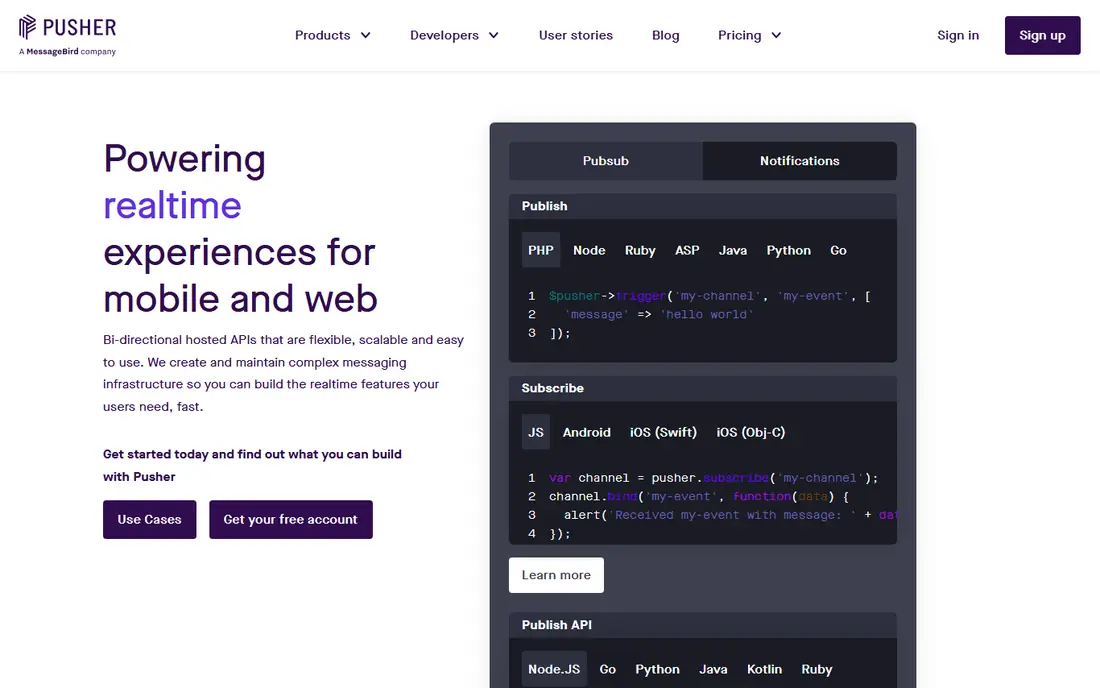
Pusher fits live updates for web and mobile apps. Pusher keeps the developer experience simple by treating realtime as hosted channels that apps publish to and subscribe from. Its strengths include hosted channels and events, broad SDK coverage, and push notifications in the same account.
The honest catch is usage-based costs can climb with scale, and advanced features sit on higher plans. That matters most when your team relies on that area every day, so weigh it against the strengths above before you decide. A tool can still be the right pick with a clear weakness, as long as that weakness sits outside your main job.
We would shortlist Pusher if live updates for web and mobile apps is your main priority. A free trial lets you test it with real work before you pay, so use that window properly. Start small, test it with a real workload, and compare the result with one other option on this list before you commit.
- Hosted channels and events
- Broad SDK coverage
- Push notifications in the same account
- Usage-based costs can climb with scale
- Advanced features sit on higher plans
PubNub
Ideal for: Global realtime messaging at scale

For global realtime messaging at scale, PubNub is a strong candidate. PubNub suits teams that need worldwide delivery with presence, history, and access controls handled by the network. Its strengths include low-latency publish and subscribe, message history and presence, and in-network functions for filtering.
The honest catch is pricing is usage based and needs careful forecasting, and smaller teams may use only a fraction of the platform. That matters most when your team relies on that area every day, so weigh it against the strengths above before you decide. A tool can still be the right pick with a clear weakness, as long as that weakness sits outside your main job.
We would shortlist PubNub if global realtime messaging at scale is your main priority. A free trial lets you test it with real work before you pay, so use that window properly. Start small, test it with a real workload, and compare the result with one other option on this list before you commit.
- Low-latency publish and subscribe
- Message history and presence
- In-network functions for filtering
- Pricing is usage based and needs careful forecasting
- Smaller teams may use only a fraction of the platform
Firebase
Ideal for: Apps that already use Google services
Firebase is built around apps that already use Google services. Firebase is a practical pick when realtime data is one part of a larger app rather than a standalone service. Its strengths include realtime database plus auth, hosting, and analytics in one platform, generous starter tooling, and strong mobile SDKs.
The honest catch is costs can be hard to predict as usage grows, and leaving the Google stack later takes work. That matters most when your team relies on that area every day, so weigh it against the strengths above before you decide. A tool can still be the right pick with a clear weakness, as long as that weakness sits outside your main job.
We would shortlist Firebase if apps that already use Google services is your main priority. A free plan lets you start without paying, though paid plans add depth. Start small, test it with a real workload, and compare the result with one other option on this list before you commit.
- Realtime database plus auth, hosting, and analytics in one platform
- Generous starter tooling
- Strong mobile SDKs
- Costs can be hard to predict as usage grows
- Leaving the Google stack later takes work
Supabase
Ideal for: Postgres apps that need realtime sync
If postgres apps that need realtime sync is the priority, Supabase deserves a close look. Supabase fits teams that want their database and their realtime layer in the same open system. Its strengths include open source Postgres platform, realtime subscriptions on database changes, and auth and storage included.
The honest catch is self-hosting adds operational work, and realtime is tied to a Postgres-centred design. That matters most when your team relies on that area every day, so weigh it against the strengths above before you decide. A tool can still be the right pick with a clear weakness, as long as that weakness sits outside your main job.
We would shortlist Supabase if postgres apps that need realtime sync is your main priority. It is free to use at the core level, which makes trying it low risk. Start small, test it with a real workload, and compare the result with one other option on this list before you commit.
- Open source Postgres platform
- Realtime subscriptions on database changes
- Auth and storage included
- Self-hosting adds operational work
- Realtime is tied to a Postgres-centred design
Stream
Ideal for: In-app chat, feeds, and video
Stream fits in-app chat, feeds, and video. Stream is the choice when the product itself is a chat or feed experience rather than a background event pipe. Its strengths include mature chat and feed components, moderation tooling, and SDKs for web, iOS, and Android.
The honest catch is chat-first pricing can feel heavy for simple broadcast use, and custom designs take time. That matters most when your team relies on that area every day, so weigh it against the strengths above before you decide. A tool can still be the right pick with a clear weakness, as long as that weakness sits outside your main job.
We would shortlist Stream if in-app chat, feeds, and video is your main priority. A free trial lets you test it with real work before you pay, so use that window properly. Start small, test it with a real workload, and compare the result with one other option on this list before you commit.
- Mature chat and feed components
- Moderation tooling
- SDKs for web, iOS, and Android
- Chat-first pricing can feel heavy for simple broadcast use
- Custom designs take time
Sendbird
Ideal for: Enterprise chat and customer messaging
For enterprise chat and customer messaging, Sendbird is a strong candidate. Sendbird fits customer-facing messaging where moderation, analytics, and support matter as much as delivery. Its strengths include chat APIs plus AI customer experience tooling, moderation and analytics, and enterprise support options.
The honest catch is enterprise pricing and contracts suit larger buyers, and small projects may find it more platform than they need. That matters most when your team relies on that area every day, so weigh it against the strengths above before you decide. A tool can still be the right pick with a clear weakness, as long as that weakness sits outside your main job.
We would shortlist Sendbird if enterprise chat and customer messaging is your main priority. A free trial lets you test it with real work before you pay, so use that window properly. Start small, test it with a real workload, and compare the result with one other option on this list before you commit.
- Chat APIs plus AI customer experience tooling
- Moderation and analytics
- Enterprise support options
- Enterprise pricing and contracts suit larger buyers
- Small projects may find it more platform than they need
Socket.IO
Ideal for: Developers who want to self-host realtime
Socket.IO is built around developers who want to self-host realtime. Socket.IO is the hands-on option for teams that prefer full control and no vendor bill for the core library. Its strengths include open source and widely documented, automatic fallback when WebSockets fail, and large community.
The honest catch is you run and scale the servers yourself, and presence and history need extra building. That matters most when your team relies on that area every day, so weigh it against the strengths above before you decide. A tool can still be the right pick with a clear weakness, as long as that weakness sits outside your main job.
We would shortlist Socket.IO if developers who want to self-host realtime is your main priority. It is free to use at the core level, which makes trying it low risk. Start small, test it with a real workload, and compare the result with one other option on this list before you commit.
- Open source and widely documented
- Automatic fallback when WebSockets fail
- Large community
- You run and scale the servers yourself
- Presence and history need extra building
Centrifugo
Ideal for: Self-hosted messaging at high connection counts
If self-hosted messaging at high connection counts is the priority, Centrifugo deserves a close look. Centrifugo suits infrastructure-minded teams that want a fast self-hosted broker without a per-message bill. Its strengths include self-hosted server with WebSocket and other transports, channel history and presence, and scalable design.
The honest catch is setup and monitoring are your job, and managed hosting is not the default path. That matters most when your team relies on that area every day, so weigh it against the strengths above before you decide. A tool can still be the right pick with a clear weakness, as long as that weakness sits outside your main job.
We would shortlist Centrifugo if self-hosted messaging at high connection counts is your main priority. It is free to use at the core level, which makes trying it low risk. Start small, test it with a real workload, and compare the result with one other option on this list before you commit.
- Self-hosted server with WebSocket and other transports
- Channel history and presence
- Scalable design
- Setup and monitoring are your job
- Managed hosting is not the default path
How we picked these
We started from the topic itself and kept only products that exist, work in October 2026, and truly fit the job in the title. For each option we checked official feature pages and pricing, app-store listings where relevant, privacy policies, and public reviews, and we left out products whose fit depended on stretching the definition. Where a price or free tier could not be verified from the vendor, we wrote See website rather than guessing a number.
We also weighed who each product is really for, not just its feature list. A broad platform can be the wrong pick for a small team, and a simple tool can be the wrong pick for a large operation, so the write-ups above name the audience, the strength, and the catch for each option. That is the comparison we would want before spending money or moving data.
How to choose a realtime platform
Start with your main job
Write down the one job you need done every week, then judge each option against that job first. Extra features look good in a demo, but they add cost, training, and admin work when they sit unused. If two options both cover your main job, pick the one with the clearer pricing and the simpler setup for your team.
Check pricing and limits
Compare the total cost for your team size and usage, not just the headline plan. Check seat pricing, usage limits, add-ons, and contract terms, and ask what happens when you grow past a tier. A free plan or trial is useful, but read what it excludes, since the feature you need most is often the one held back for paid plans.
Test before you commit
Run a short trial with real data and a real task, and involve the people who will use the tool daily. Check support response, data export, and how easy it is to leave, because switching costs are part of the price. If a trial feels hard to set up, treat that as useful evidence about the product, not just about your team.
Frequently asked questions
What are ably alternatives?
They are products and services that cover the same job as the original topic, in this case ably alternatives. The list above includes Pusher, PubNub, and Firebase, among others, each with a different balance of features, price, and audience. Start from your main job, then narrow the list to the two or three options that fit it best.
Which option is best for most people?
For most buyers, Pusher is a sensible starting point for Live updates for web and mobile apps, because it covers the core job well. If your priority is different, PubNub for Global realtime messaging at scale or Supabase for Postgres apps that need realtime sync may fit better. There is no single winner for every team, so match the pick to your size, budget, and workflow.
Is there a free option?
Yes, Firebase, Supabase, Socket.IO offer a free way to start, though paid plans add depth and support. Free tiers usually limit usage, seats, or advanced features, so check the limits against your real workload. A free start is still a good way to test fit before paying.
How much do these options cost?
Costs vary by plan, team size, and usage, and several vendors use quote-based pricing, which is why some entries say See website. Compare the total for your actual use, including seats, add-ons, and contract length, rather than the lowest headline price. Ask each vendor for a written quote before you decide.
How do I switch from my current tool?
Start by exporting your data and checking what the new tool can import, since migration quality varies a lot. Run both tools side by side for a short period, move one team or project first, and keep the old tool until the new one proves itself. Ask the vendor for migration help in writing before you sign.