Best Action1 Alternatives in 2026: 7 Patch and Endpoint Tools Compared

- NinjaOne and Atera suit IT teams and MSPs that need RMM plus patching in one tool.
- Automox and ManageEngine Patch Manager Plus suit teams focused mainly on patch automation.
- Datto RMM and ConnectWise Automate suit MSPs with larger client fleets.
- PDQ Deploy suits Windows shops that want simple, on-premises deployment.
- Check OS coverage, since some tools favor Windows over Mac and Linux.
Quick comparison
| Product | Ideal for | Price from | Free version | |
|---|---|---|---|---|
 NinjaOne | RMM and patching | See website | Free trial | Visit |
 Atera | All-in-one IT management | See website | Free trial | Visit |
 Automox | Cloud patch automation | See website | Free trial | Visit |
 ManageEngine Patch Manager Plus | Patch management | See website | Free trial | Visit |
 Datto RMM | MSP endpoint management | See website | No | Visit |
 PDQ Deploy | Windows software deployment | See website | Free trial | Visit |
 ConnectWise Automate | MSP automation | See website | No | Visit |
The best Action1 alternatives
Action1 is a cloud patch management and endpoint tool with a free tier for small fleets. The tools below cover similar ground, from full RMM platforms to focused patch automation. We compared official feature pages, pricing pages, and public documentation.
NinjaOne
Ideal for: RMM and patching
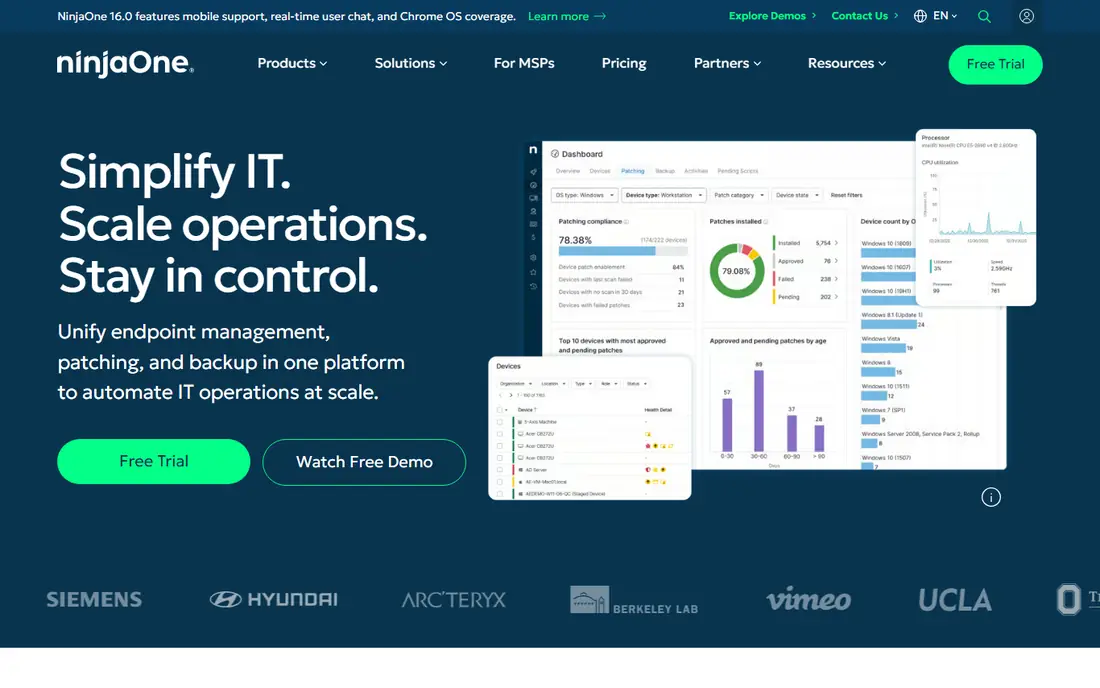
NinjaOne combines remote monitoring, patch management, software deployment, and remote access in one cloud dashboard. IT teams can automate patch policies by OS and device group, monitor health, and fix endpoints remotely. That breadth suits teams that want one tool instead of several.
Pricing is per device, so large fleets should model total cost carefully. For IT departments and MSPs that need patching plus day-to-day endpoint management, NinjaOne is our pick for breadth. Request a trial on a test device group first.
- Endpoint management with patching, monitoring, and remote access
- Clean dashboard
- Strong MSP and IT team features
- Pricing is per device and quoted
- Some features need higher tiers
Atera
Ideal for: All-in-one IT management
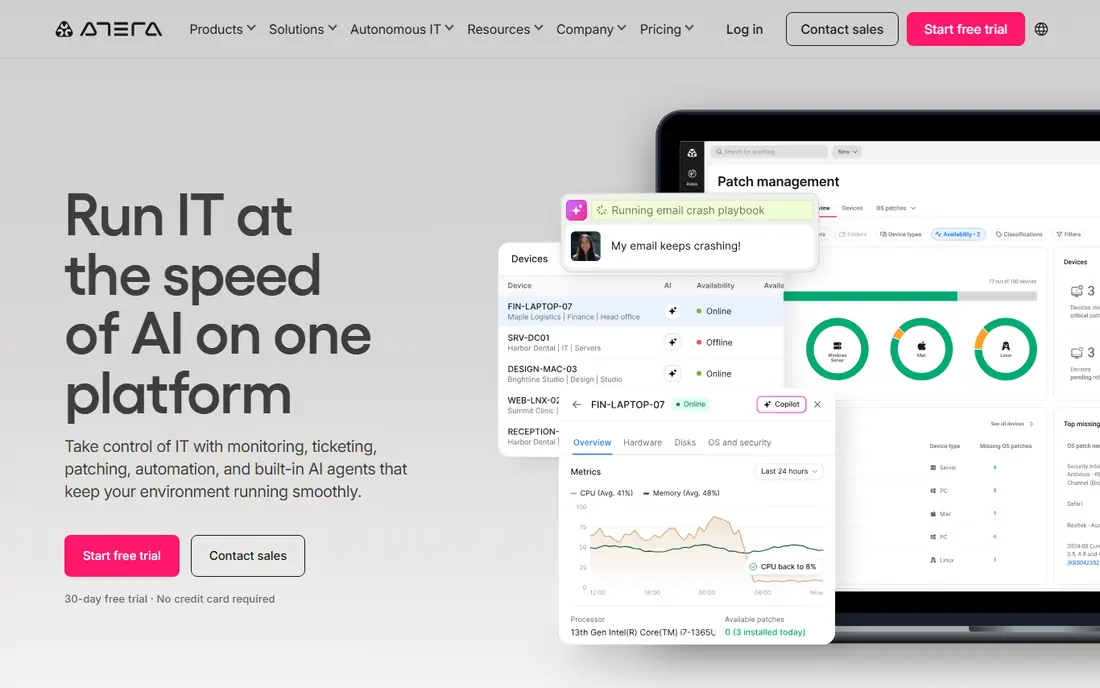
Atera bundles RMM, patch management, helpdesk ticketing, billing, and remote access, with pricing per technician rather than per device. That model appeals to MSPs and small IT teams that manage many endpoints with few staff. Its dashboard keeps tickets, devices, and patches in one view.
Large internal IT teams may prefer per-device pricing, and reporting depth varies by tier. For an MSP or small IT team that wants one platform for most daily work, Atera is a strong Action1 alternative. Check current plan limits for device counts.
- RMM, patching, ticketing, and remote access in one platform
- Per-technician pricing
- AI assistance features
- Per-technician model suits MSPs more than large internal teams
- Advanced reporting sits on higher tiers
Automox
Ideal for: Cloud patch automation
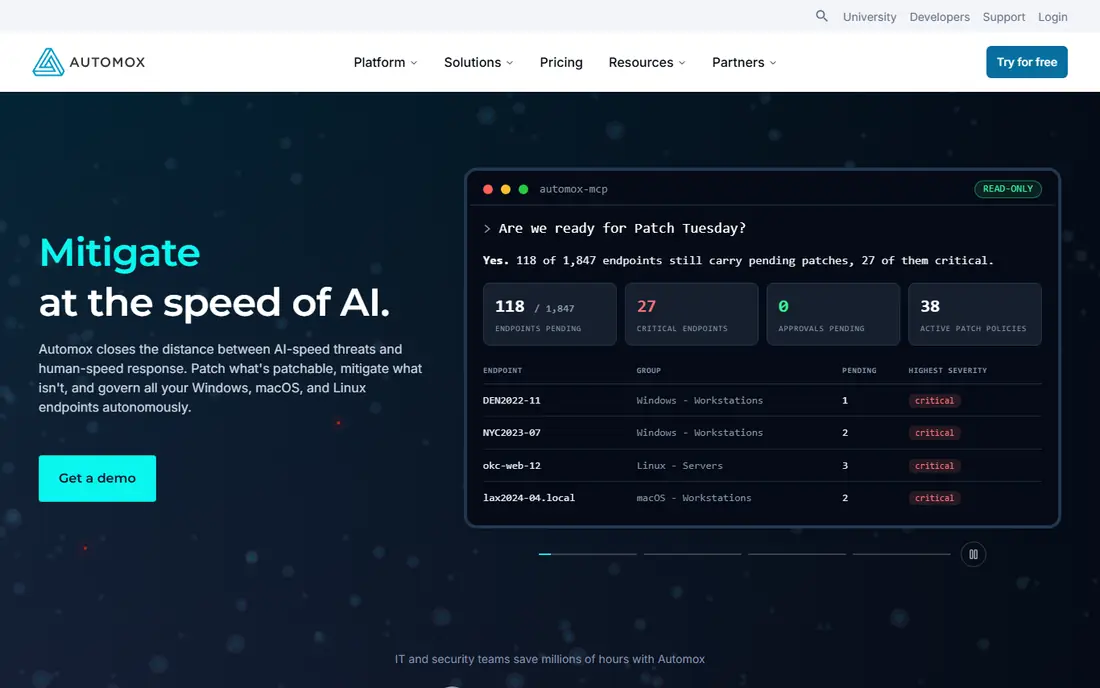
Automox focuses on automated patching across Windows, Mac, and Linux from the cloud, including third-party applications. Admins set policies once, and endpoints patch on schedule whether or not they sit on the office network. That cloud-native design suits remote and hybrid teams.
It is less of a full RMM suite than NinjaOne or Atera, so teams needing ticketing and monitoring may pair it with other tools. For patch-first teams, Automox is a focused, modern pick. Test third-party patch coverage for the apps your fleet actually runs.
- Cloud-native patch automation across Windows, Mac, and Linux
- Policy-based patching
- Third-party software patching
- Focused on patching, with less full RMM depth
- Pricing is per device
ManageEngine Patch Manager Plus
Ideal for: Patch management
ManageEngine Patch Manager Plus covers patching for major operating systems and many third-party applications, with both on-premises and cloud deployment options. Reports show missing patches, compliance status, and deployment results, which helps regulated teams prove patching happened. Its breadth suits mixed fleets.
The interface is less modern than cloud-native rivals, and initial setup needs care. For organizations that already use ManageEngine tools, or that need on-premises deployment, it is a strong, cost-conscious choice.
- Patching for Windows, Mac, Linux, and third-party apps
- On-premises and cloud options
- Detailed patch reports
- Interface feels dated
- Setup takes time for large fleets
Datto RMM
Ideal for: MSP endpoint management
Datto RMM gives MSPs remote monitoring, patching, software management, and remote access across many client sites. Policy automation keeps fleets consistent, and integration with Datto backup and security products suits MSPs that standardize on that stack. Multi-site management is a clear strength.
Small internal IT teams may find it more MSP-oriented than they need, and pricing is quoted. For an MSP managing many clients, Datto RMM is a proven Action1 alternative. Ask about onboarding help for migrating existing policies.
- RMM built for MSPs with policy automation
- Patching, monitoring, and remote access
- Integrates with Datto backup and security tools
- MSP focus means less fit for small internal teams
- Pricing is quoted
PDQ Deploy
Ideal for: Windows software deployment
PDQ Deploy focuses on deploying software and patches to Windows computers on a local network, with a large library of ready-made packages. Admins can push updates silently, schedule deployments, and track results without cloud complexity. For Windows shops, it is fast and easy to learn.
It does not cover Mac or Linux, and full patch management needs its companion product. Remote devices off the network need extra setup. For a Windows-only office that wants simple deployment, PDQ Deploy is a practical pick.
- Simple Windows package deployment
- Large package library
- Works well on-premises without cloud dependency
- Windows only
- Patch management is a separate PDQ product
- Less remote-device coverage
ConnectWise Automate
Ideal for: MSP automation
ConnectWise Automate is a long-standing RMM for MSPs, with deep scripting, patching, monitoring, and remote access. Experienced MSPs use its automation to manage large fleets with consistent policies, and its integrations cover PSA, backup, and security tools. Customization depth is a major strength.
That depth comes with a learning curve, and smaller teams may find it heavy. For an established MSP that wants powerful automation, ConnectWise Automate remains a strong choice. Plan training time before rollout.
- Deep automation and scripting for MSPs
- Patching, monitoring, and remote access
- Large integration ecosystem
- Steep learning curve
- Pricing and setup are enterprise oriented
How we picked these
We compared official feature pages, pricing pages, and public documentation, looking for patch management, endpoint management, or RMM features that match Action1. We favored tools that are actively maintained and work in October 2026, and we mixed cloud and on-premises options. We did not claim hands-on testing, and we note that pricing is often quoted, so request figures for your device count.
We also weighed practical details that matter after signup. That included how easy each product is to set up, whether support answers promptly, and whether pricing stays clear as usage grows. We read user complaints as well as praise, since repeated complaints about billing, onboarding, or missing features often signal a real weakness. Where a product had a known limitation, we said so in its write-up rather than smoothing it over. Our goal was a shortlist that a reader can trust for action1 alternatives, not a list of every vendor in the market. Readers with unusual needs should still test their top two choices, since fit depends on budget, team size, and the features used every day.
What to check before you choose
Start with your fleet: operating systems, device count, and how many devices work remotely. A Windows-only on-premises tool will disappoint a remote Mac fleet, while a cloud tool suits distributed teams. List the third-party apps you must patch, since coverage varies widely.
Next, test patch policies on a small group before wide rollout. Check reboot behavior, maintenance windows, and reporting, since a bad patch policy can disrupt work. Also confirm remote access security, including multi-factor authentication and audit logs, before granting a tool access to every endpoint.
Testing your shortlist before you commit
A short trial answers questions that no comparison table can settle. Sign up for your top two choices, run a real task from your own work, and watch how long it takes and where you get stuck. For action1 alternatives, that real task might be a weekly workflow you repeat, a report you need every month, or a setup step your team must repeat for new members. If a tool slows that task down, it will cost time every week, no matter how good its feature list looks.
Pay attention to support during the trial as well. Send a question through the normal support channel and note how long a useful answer takes. Check billing clarity too: confirm what the trial includes, when it ends, and what the first paid invoice will actually show. A tool that is hard to cancel, or that hides fees until checkout, deserves caution.
Finally, ask who else on your team must use the tool. A product that only one person likes will stall, while a product the whole team adopts will pay for itself. Gather quick feedback from the people who will use it daily, compare their notes with your own, and then choose. That small amount of trial discipline prevents most bad purchases, and it costs far less than switching tools again in six months.
Budgeting the full cost, not just the headline price
Headline prices rarely tell the full story. Add up per-user fees, add-on charges, implementation help, and any training your team needs, then compare that total across your shortlist. A cheaper plan that needs three paid add-ons can end up costing more than a fuller plan from a rival. Check renewal terms as well, since introductory discounts often expire after the first term and the second year price is the one you will actually live with.
Think about exit costs too. Before you commit, confirm how your data exports, whether your content or history moves cleanly, and what happens if you pause or cancel. A tool with clean exports gives you freedom later, while a tool that locks data in makes switching painful. Choosing with the full cost and the exit path in mind keeps your action1 alternatives decision sound for the long term, not just for the first month.
Frequently asked questions
Is Action1 free?
Action1 offers a free tier for smaller fleets, with paid plans for larger or more advanced use. Check its current pricing page for device limits and included features.
Which Action1 alternative is best for MSPs?
NinjaOne, Atera, Datto RMM, and ConnectWise Automate all target MSPs. Atera prices per technician, while others price per device, so model costs for your client count.
Do these tools patch Mac and Linux too?
Automox, NinjaOne, and ManageEngine Patch Manager Plus cover Mac and Linux beside Windows. PDQ Deploy is Windows only, so check OS coverage for your fleet.
Can I automate patching without disrupting users?
Yes, most tools support maintenance windows, reboot controls, and staged rollouts. Test policies on a pilot group and set clear reboot rules before full deployment.
What is the difference between patch management and RMM?
Patch management focuses on OS and app updates. RMM adds monitoring, remote access, scripting, and ticketing for broader endpoint management. Many tools now bundle both.