6 Strong AI Patent Tools with Best Reviews in 2026

- PatentPal is the opening pick, best for AI patent specification drafting.
- Check the limits for PatSnap before you commit: enterprise pricing with no published list.
- For PatentPal, PatSnap, XLSCOUT and Ambercite, you have to request a quote because no starting price is shown.
- For Citation-based prior art discovery, Ambercite is worth a look.
Direct answer
If you need AI patent specification drafting, PatentPal is the first tool to look at here. Lens.org is better for free patent and scholarly search, and Patentext is better for startup invention-to-filing workflow. All 6 tools are compared below on price, free plan and limits.
Quick comparison
| Product | Ideal for | Price from | Free version | |
|---|---|---|---|---|
 PatentPal | AI patent specification drafting | See website | No | Visit |
 Lens.org | Free patent and scholarly search | Free | Yes | Visit |
 Patentext | Startup invention-to-filing workflow | $2,700 per year | No | Visit |
 PatSnap | Patent analytics and landscaping | See website | No | Visit |
 XLSCOUT | AI prior art and invalidity search | See website | No | Visit |
 Ambercite | Citation-based prior art discovery | See website | No | Visit |
Every option for AI patent tools with best reviews explained
If you are comparing AI patent tools with best reviews, this page covers 6 tools in one place: what each is best for, what it costs to start, whether it has a free plan, and the main limit to know about.
PatentPal
Ideal for: AI patent specification drafting
In short, PatentPal is for AI patent specification drafting. PatentPal does one job and does it well. In daily use, if drafting speed is your bottleneck, this is the most targeted fix on the list.
Where it is weaker: not search or docketing.
For businesses and companies that draft at volume, that first draft is where most of the time goes, so automating it changes the economics of a filing program. As for the details, PatentPal will not search prior art, track deadlines, or run a portfolio. So it belongs inside a bigger workflow instead of replacing one. No starting price is listed for PatentPal here; confirm pricing on the vendor site. PatentPal has no free tier.
- Exports to Word and Visio
- Configurable drafting phrases
- Focused narrowly on drafting
Lens.org
Ideal for: Free patent and scholarly search
Lens.org is a good fit for free patent and scholarly search. It gives you patent and scholarly search with citation analysis, letting users trace how patents and papers link. For everyday use, lens.org does not draft applications, run deadlines, or supply the AI agents that premium systems now bundle.
Points against: Support and advanced analytics are restricted compared to premium tools.
It is a research tool, not a workflow system. As for the details, used that way, though, it is genuinely handy, and numerous professionals keep it open alongside a premium database for fast checks and citation exploration. Entry price for Lens.org: Free. You can start on Lens.org without paying.
- Free access to patent and scholarly records
- Citation network analysis
- No AI drafting or docketing features
Patentext
Ideal for: Startup invention-to-filing workflow
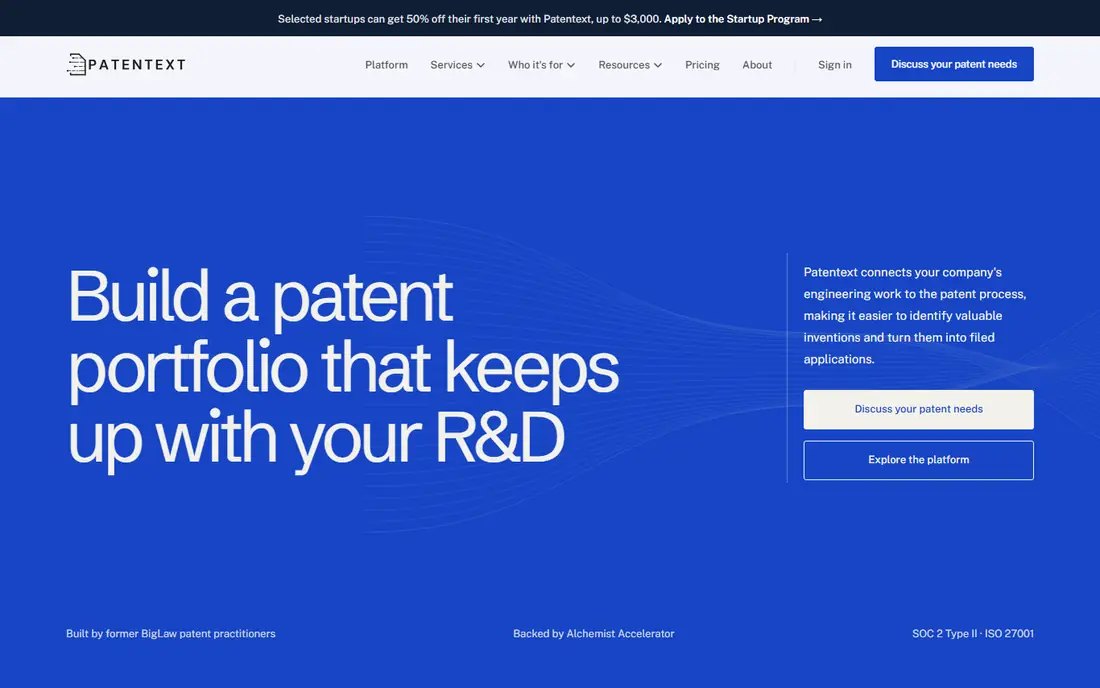
Where Patentext fits: startup invention-to-filing workflow. System pricing begins at $2,700 a year, with flat fees for provisional, non-provisional, and PCT applications published on its site. That transparency is rare in this market and a real advantage for startups budgeting their first filings.
Where it falls short: Service fees add up per application.
Beyond that, for an expanding company building a repeatable invention process, though, the combination of software and practitioner services in one workflow is genuinely convenient. Beyond that, Patentext links engineering work to the patent process in a way most tools here do not attempt. Its product helps businesses capture inventions from everyday technical work, evaluate them, and handle the pipeline, and its USPTO-registered agents then draft and file from the same record. Patentext starts at: $2,700 per year. Patentext has no permanent free option.
- Links to Google Drive and GitHub
- USPTO-registered agents manage filings
- Most useful for businesses, not individual filers
PatSnap
Ideal for: Patent analytics and landscaping
Pick PatSnap if this describes you: patent analytics and landscaping. Pricing is also quote-based, and published estimates put it firmly in enterprise territory. More specifically, for an R&D or strategy team asking where the white space is, who is filing what, and whether an invention looks novel, that combination is hard to beat.
As for the details, if your primary job is understanding the patent field instead of administering a portfolio, start here. It pulls together patents, scientific literature, and legal records, then layers AI agents on top for prior art research, patent-map building, and freedom-to-operate checks. More specifically, PatSnap will not handle your deadlines, renewals, or filings. So most teams pair it with a docketing system instead of replacing one. The honest catch is scope. Pricing for PatSnap is not stated here, so ask the vendor for current figures. PatSnap has no free plan.
Where it is weaker: Not a docketing system.
- Solid visualization for patent maps
- Task-specific AI agents for research and drafting support
- Enterprise pricing with no published list
XLSCOUT
Ideal for: AI prior art and invalidity search
In short, XLSCOUT is for AI prior art and invalidity search. XLSCOUT is an integrated innovation system built around large language models, and its modules include the full arc from idea validation to monetization.
The honest catch is that buying into the entire suite costs more than a single-purpose search tool, and new users need time to learn which module suits each task. This comparison lists no price for XLSCOUT; ask the vendor. XLSCOUT has no free plan.
The main drawbacks: Module-based pricing can add up.
Where XLSCOUT stands out: drafting modules in one suite.
- SOC 2 Type II certified
- LLM-powered novelty, invalidity
- The breadth of modules takes time to learn
Ambercite
Ideal for: Citation-based prior art discovery
Where Ambercite fits: Citation-based prior art discovery. Rather than relying on keywords or semantic matching, it examines citation networks across more than 175 million patent citations to rank the patents most similar to your starting set. That makes it a capable second check for freedom-to-operate and invalidity work, where a missed reference is the costly mistake.
Limits to weigh: A complement to standard databases, not a replacement.
Its interface is also more focused than a general system. For searchers who worry about what keyword searches miss, it is a smart buy. No starting price is listed for Ambercite here; confirm pricing on the vendor site. Ambercite does not include a free plan.
- Ranked results from citation networks
- Finds patents keyword and semantic search frequently misses
- Smaller vendor with a narrower feature set
How the list was put together
Each tool was reviewed on what its vendor publishes: price, plan limits, core features and stated drawbacks. We did not run hands-on tests. Prices and plan limits come from vendor pages and can change, so confirm them on the vendor site before you buy. Tools are placed by general fit for AI patent tools with best reviews, with price clarity and free access as tie-breakers. A different team can reasonably rank them differently.
Things to verify first
- Confirm the entry price on the vendor page. For PatentPal, PatSnap, XLSCOUT and Ambercite that means a quote rather than a fixed price.
- Test the free plan from Lens.org against your real workload before relying on it.
- Before choosing PatentPal, weigh its main limit: focused narrowly on drafting, not search or docketing.
- Before you load data into Patentext, check what an export looks like and who can run it.
- Involve the people who will use Ambercite daily; a short pilot beats a long feature checklist.
Frequently asked questions
Can I try these tools before paying?
Often, yes. Lens.org has a free plan. Use your own data and a real task during the test, and check what the free tier or trial limits before you rely on it.
How are the tools for AI patent tools with best reviews ordered?
The order follows typical fit for AI patent tools with best reviews, with PatentPal first and Ambercite last, then price clarity and free access. It is editorial judgement, not a score, so another team could rank the tools differently.
Are AI patent tools safe for confidential inventions?
Reputable vendors publish security certifications and data policies, but practices differ. Before uploading unpublished material, confirm whether inputs are used for model training, how long data is retained, and whether the vendor holds certifications for example SOC 2 or ISO 27001.
Do these tools publish their prices?
Not all of them. PatentPal, PatSnap, XLSCOUT and Ambercite publish no starting price, so expect a quote request for those. The rest, Lens.org included, show a starting price, though seats and billing terms still change the final cost.
Is PatentPal the right pick for everyone comparing AI patent tools with best reviews?
No single tool suits every team. PatentPal comes first because it fits AI patent specification drafting, while Lens.org suits free patent and scholarly search and Patentext suits startup invention-to-filing workflow. Match the tool to your own size, budget and workflow before deciding.