8 AlphaSense Alternatives for Research Teams

- 1
 AlphaSenseAI search across filings and transcriptsVisit
- 2
 KoyfinAffordable fundamentals and screeningVisit
- 3
 TegusExpert calls and call transcriptsVisit
- 4
 CB InsightsStartup and market trackingVisit
- 5
 FactSetDeep financial data for institutionsVisit
- AlphaSense is quote only, and so are most enterprise research platforms, so budget planning needs a sales conversation.
- Koyfin is the only priced alternative on this list, at $39 a month on annual billing, and it fits individual researchers.
- Tegus and AlphaSense both sell expert calls, so the choice comes down to transcript coverage and call pricing.
- CB Insights and PitchBook serve different questions, with CB Insights tracking startups and PitchBook tracking private deals.
- Check data licensing before you buy, since redistribution rights and seat limits drive the real cost of a research seat.
Quick comparison
| Product | Ideal for | Price from | Free version | |
|---|---|---|---|---|
| AlphaSense | AI search across filings and transcripts | quote only | No | Visit |
| Koyfin | Affordable fundamentals and screening | $39 per month (billed annually) | Yes | Visit |
| Tegus | Expert calls and call transcripts | quote only | No | Visit |
| CB Insights | Startup and market tracking | quote only | No | Visit |
| FactSet | Deep financial data for institutions | quote only | No | Visit |
 S&P Capital IQ | Company financials and screening | quote only | No | Visit |
 PitchBook | Private market deals and funds | quote only | No | Visit |
 Bloomberg Terminal | Real-time markets and news in one seat | $2,000 per user/month | No | Visit |
The best alphasense alternatives
AlphaSense
Ideal for: AI search across filings and transcripts

AlphaSense is the baseline for this list, and it is an AI research platform that searches company filings, earnings transcripts, press releases, and broker research from one box. Its main strength is the breadth of its document library, combined with search that understands synonyms and related terms, so a query for supply chain risk also finds mentions of logistics disruption and vendor delays. Smart summaries and table extraction pull numbers out of filings, which saves hours of reading for analysts who cover many companies.
Pricing is quote only, and AlphaSense sells to teams and enterprises rather than to individuals. The sales conversation sets the price based on seats, content sets, and add-ons such as expert calls, and that makes it hard to budget without engaging the vendor. The platform also competes with itself in a sense, since several alternatives below cover parts of the same workflow at lower cost. Teams that stay with AlphaSense usually do so for the document library and the AI search quality, and teams that leave usually do so because the quote does not fit the budget, or because they need only one slice of the coverage, such as transcripts or fundamentals.
- AI search across filings, transcripts, and broker research
- Smart summaries speed up reading
- No public price, so budgeting needs a sales call
- Enterprise focus leaves solo researchers out
Koyfin
Ideal for: Affordable fundamentals and screening
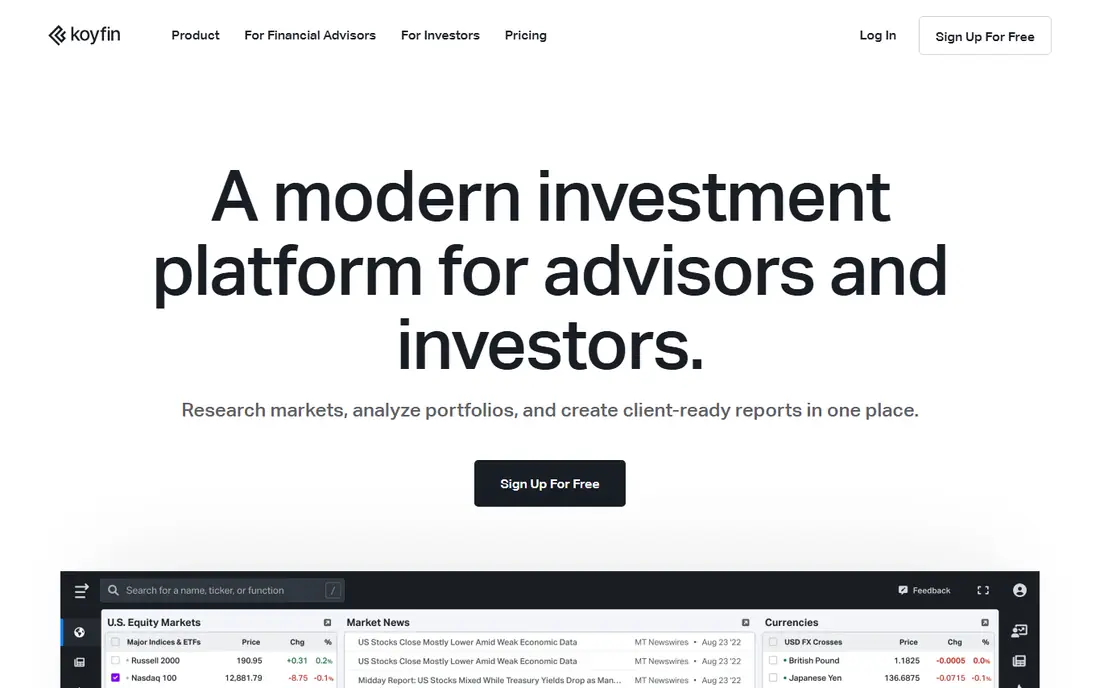
Koyfin is the most affordable alternative on this list, and it is the only one with a published price. The Plus plan costs $39 a month on annual billing, or $49 month to month, and it adds 10 years of financials and estimates, filings and transcripts, ETF screening, and unlimited watchlists, screens, and dashboards. Premium costs $79 a month on annual billing and adds custom formulas, portfolio risk analysis, and hypothetical performance. The free plan covers basic charts and two years of financials, which is enough to test the workflow before subscribing.
Koyfin suits individual investors, small funds, and analysts who need fundamentals, screening, and dashboards without broker research or expert calls. It does not replace AlphaSense for document search, since it has no broker research library and no expert network, and its transcript coverage is narrower. What it does well is give a single researcher a fast, browser-based terminal for a known monthly price, with no sales conversation required. For a team that spends most of its time on financial statements, estimates, and screens, Koyfin covers the core workflow at a fraction of an enterprise quote.
- Published pricing from $0 to $299 a month
- 10 years of financials on Plus
- No broker research or expert calls
- US and Canadian coverage is deeper than other regions
Tegus
Ideal for: Expert calls and call transcripts
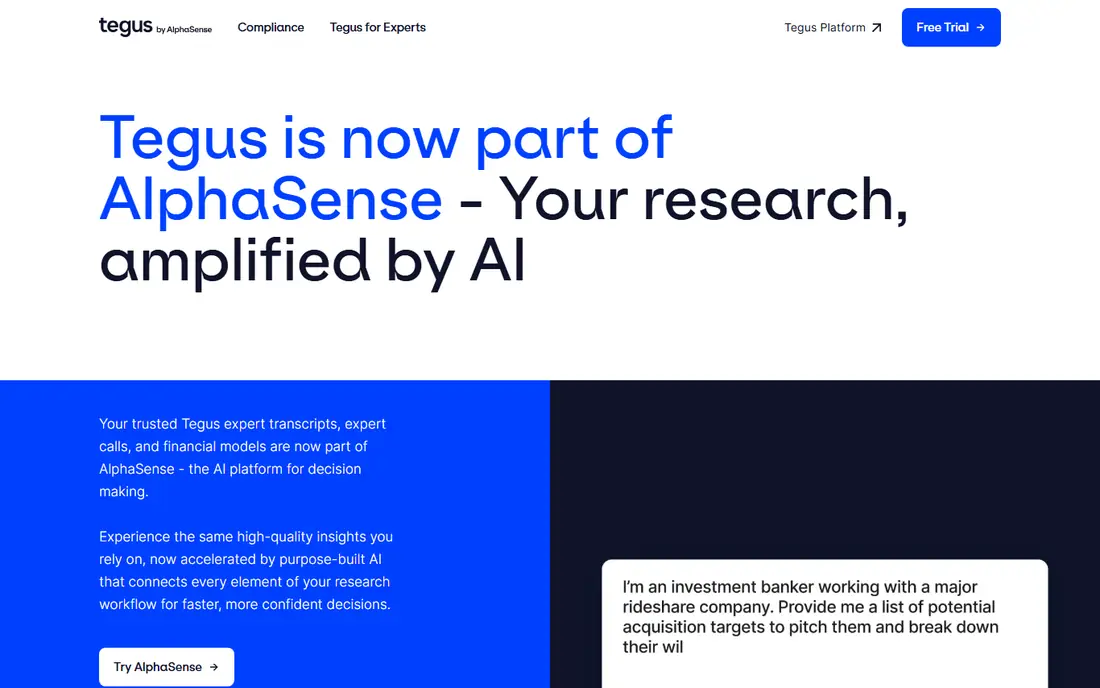
Tegus is the closest direct rival to AlphaSense on the expert research side, built around a network of experts who take compensated calls with investors and operators. The platform also holds a large library of call transcripts, so a researcher can often find an existing call on a topic before booking a new one. Search, screening, and AI summaries help analysts pull the useful passages out of long calls, and the company says its network covers thousands of companies across sectors.
Pricing is quote only, and the total cost has two parts: the platform subscription and the per-call expert fees. That structure makes Tegus flexible for teams that run a few calls a month and expensive for teams that run many, so buyers should ask for the call rate card during the sales conversation. Tegus does not cover filings and broker research the way AlphaSense does, so teams that need both document search and expert calls often buy both. For a team whose research starts with talking to operators, suppliers, and former employees, Tegus is the strongest pick on this list.
- Large expert network with fast call scheduling
- Transcript library grows with every call
- No public price
- Expert call costs add up on top of the platform fee
CB Insights
Ideal for: Startup and market tracking
CB Insights tracks private companies, startups, funding rounds, and emerging technology markets, which makes it a different kind of alternative from the rest of this list. Its database covers company profiles, investor activity, patents, and hiring signals, and its market maps show how a sector is organized and which companies are gaining ground. Teams use it to find acquisition targets, track competitors, and spot technology trends before they show up in public filings.
Pricing is quote only, and CB Insights sells annual subscriptions to corporate strategy, venture, and innovation teams. It is not a replacement for AlphaSense on public equity research, since it has little coverage of filings, transcripts, and broker research. The overlap is in company research and market intelligence, and a team that covers both public and private companies may run CB Insights alongside a filings platform. Buyers should ask which data sets are included in the quoted tier, since some signals, such as patent and hiring data, sit in higher tiers.
- Strong startup and private company data
- Market maps show competitive landscapes
- No public price
- Equity research and filings coverage is thin
FactSet
Ideal for: Deep financial data for institutions
FactSet is an institutional research platform that combines company financials, estimates, ownership, fixed income, and portfolio analytics in one workstation. It is one of the most widely used platforms in asset management and investment banking, and its data depth is the main reason teams choose it. Screening, charting, and Excel integration are strong, and the platform supports workflows from idea generation through portfolio construction and reporting.
Pricing is quote only, and FactSet sells by workstation and by data set, so the annual cost varies widely with the modules a team selects. The platform is built for professionals who use it every day, and new users face a learning curve that training helps with. FactSet does not match AlphaSense on AI document search, though it has added natural language search and summaries to its workstation. Teams that need deep, licensed data and analytics usually pick FactSet, and teams that need fast document search across filings usually add AlphaSense or a rival alongside it.
- Broad data coverage with strong analytics
- Widely used by institutional teams
- No public price
- Learning curve is steep for new users
S&P Capital IQ
Ideal for: Company financials and screening
S&P Capital IQ, from S&P Global Market Intelligence, is a research platform for company financials, estimates, transactions, and screening. Its data covers public and private companies, with financial statements, segment data, ownership, and credit information in one place. Screening tools let analysts filter thousands of companies by valuation, growth, and quality metrics, and the Excel plug-in pulls data straight into models. The platform also carries transcripts, filings, and news, which gives it overlap with AlphaSense on document coverage.
Pricing is quote only, and S&P sells Capital IQ by seat and by content set, so buyers should expect a sales conversation and a custom quote. The interface is dense, and new users need time to learn the screening and charting tools, though training and support are included in most contracts. Capital IQ suits teams that build models and screens from company financials every day, and it is weaker than AlphaSense on AI-powered document search and summarization. For a team that already licenses S&P data elsewhere, bundling Capital IQ can reduce the total cost.
- Deep company financials with S&P data
- Screening and charting are strong
- No public price
- Interface feels dense to new users
PitchBook
Ideal for: Private market deals and funds
PitchBook is the standard platform for private market research, covering venture capital, private equity, and mergers and acquisitions. Its database tracks companies, deals, funds, investors, and valuations, with profiles that show funding history, cap tables, and comparable transactions. Teams use it to source deals, benchmark valuations, and research limited partners, and its research reports and market maps give context on sectors and trends.
Pricing is quote only, and PitchBook sells annual subscriptions priced by seats and by the data sets a team needs. It is not a replacement for AlphaSense on public markets, since its public equity coverage is limited to what supports private market analysis. The overlap is in company research, and a team that covers both public and private companies may run PitchBook for deals and AlphaSense for filings. Buyers should confirm which modules are included in the quote, since add-ons for research reports and Excel tools can add to the annual cost.
- Best-in-class private market deal data
- Fund and investor profiles are deep
- No public price
- Public equity coverage is limited
Bloomberg Terminal
Ideal for: Real-time markets and news in one seat
The Bloomberg Terminal is the most complete research system on this list, and also the most expensive, at about $2,000 per user per month, or roughly $24,000 a year, based on widely reported pricing, since Bloomberg does not publish a list price. A single seat combines real-time market prices, news, company financials, fixed income analytics, and the Bloomberg chat network that market participants use to trade and share information. For a trading desk or a large fund, that combination is hard to replace, and the Terminal is often treated as a cost of doing business.
The price puts it out of reach for most small teams, and the learning curve is steep, since the Terminal uses a keyboard-driven interface with function codes that take weeks to learn. It also overlaps only partly with AlphaSense. Bloomberg covers markets and news in real time, while AlphaSense covers document search and AI summaries across filings and transcripts, and many large teams run both. A small team should only consider the Terminal if real-time prices and the chat network are central to the work, and should otherwise pick a cheaper tool from this list and spend the difference on data that fits the actual workflow.
- Real-time prices, news, and analytics in one system
- Chat network connects market participants
- Price is far above every other tool here
- Learning curve is steep
How we chose
We compared vendor product pages and pricing pages read on 13 November 2026, plus vendor pricing guides that cite the vendor page. Prices shown are the published annual-billing rates where the vendor publishes them, and quote only where the vendor does not. We checked document coverage, transcript and expert call libraries, screening and fundamentals, and private market data, and we weighed the research question each tool answers best. We did not test any platform with a live account, and we did not count reseller or press-reported prices as vendor list prices. Bloomberg Terminal pricing is a widely reported figure, not a vendor-published price, and it should be confirmed with Bloomberg before budgeting.
What to check before you buy
Define the research question before you shortlist a platform, since a tool built for private deals will not help an analyst who reads filings all day. Ask each vendor for the full first-year cost, including seats, content sets, and any per-call or per-report fees, because the headline quote often excludes the parts a team actually uses. Check data licensing and redistribution rights, since sharing charts or data outside the firm can breach the contract. Confirm how many seats the quote covers and what an extra seat costs, because research platforms price steeply per seat. Finally, run a trial with a real project from your own coverage list, and count how many of your questions the platform answers without a workaround.
| Research need | Best pick | Budget to plan |
|---|---|---|
| Fundamentals and screening on a budget | Koyfin Plus | $39 a month |
| Expert calls and transcripts | Tegus | quote only, plus per-call fees |
| Startup and market tracking | CB Insights | quote only |
| Private deals and funds | PitchBook | quote only |
| Deep institutional data | FactSet or S&P Capital IQ | quote only |
| Real-time markets and news | Bloomberg Terminal | about $2,000 per user a month |
Frequently asked questions
What is the best AlphaSense alternative for a small team?
Koyfin is the best pick for a small team, at $39 a month on annual billing for the Plus plan, because it covers fundamentals, screening, filings, and transcripts without a sales conversation. It lacks broker research and expert calls, so a team that needs those should ask Tegus and AlphaSense for quotes and compare the totals.
Is there a free AlphaSense alternative?
Koyfin has a free plan with basic charts and two years of financials, which is the only free tier on this list. The other platforms are quote only and sell to teams, so a free plan will not cover a real research workflow. A solo researcher can start on Koyfin free and upgrade to Plus when the two-year history runs out.
How much does AlphaSense cost?
AlphaSense does not publish a price, and the cost is set by quote based on seats, content sets, and add-ons such as expert calls. Press reports put enterprise contracts in the tens of thousands of dollars a year, but the only reliable figure is the quote for your own team, so request one with your seat count and content needs stated.
Which alternative is best for expert calls?
Tegus is the best pick for expert calls, because its network and transcript library are built for that workflow, and calls can be booked quickly. AlphaSense also sells expert calls as an add-on, so a team that already uses AlphaSense for documents should compare the call pricing before adding a second platform.
Can Koyfin replace AlphaSense?
Koyfin can replace AlphaSense for fundamentals, screening, and basic transcript reading, and it costs far less. It cannot replace the broker research library, the AI document search across filings, or the expert network, so a team that depends on those should keep AlphaSense or pair Koyfin with a document platform.
Do I need Bloomberg Terminal if I use AlphaSense?
Most research teams do not need both, since Bloomberg covers real-time markets and news while AlphaSense covers document search and AI summaries. Large funds and trading desks often run both, and smaller teams should pick the one that matches their daily work, then add the other only when a clear gap appears.