Alternatives to Perl in 2026: 7 Languages Compared

- Python suits most Perl users who want readable scripting, text work, and automation with a huge library base.
- Ruby suits web apps and scripting with a clean, expressive syntax close in spirit to Perl.
- PHP suits web backends that once ran on Perl CGI, while Go suits fast system tools and services.
- JavaScript with Node.js suits teams that want one language for web frontends and backends.
- Raku suits Perl fans who want a modern Perl-family language, while Lua suits embedding and small scripts.
Quick comparison
| Product | Ideal for | Price from | Free version | |
|---|---|---|---|---|
 Python | General scripting | Free | Yes | Visit |
 Ruby | Web and scripting | Free | Yes | Visit |
 PHP | Web backends | Free | Yes | Visit |
 Go | System tools and services | Free | Yes | Visit |
 JavaScript | Web backends with Node.js | Free | Yes | Visit |
 Raku | Modern Perl-family language | Free | Yes | Visit |
 Lua | Embedding and small scripts | Free | Yes | Visit |
The best alternatives to Perl
We compared official language pages, documentation, and public reviews for seven Perl alternatives. Our pick for most Perl users is Python for its readability and libraries, with Ruby close behind for web and scripting work.
Python
Ideal for: General scripting
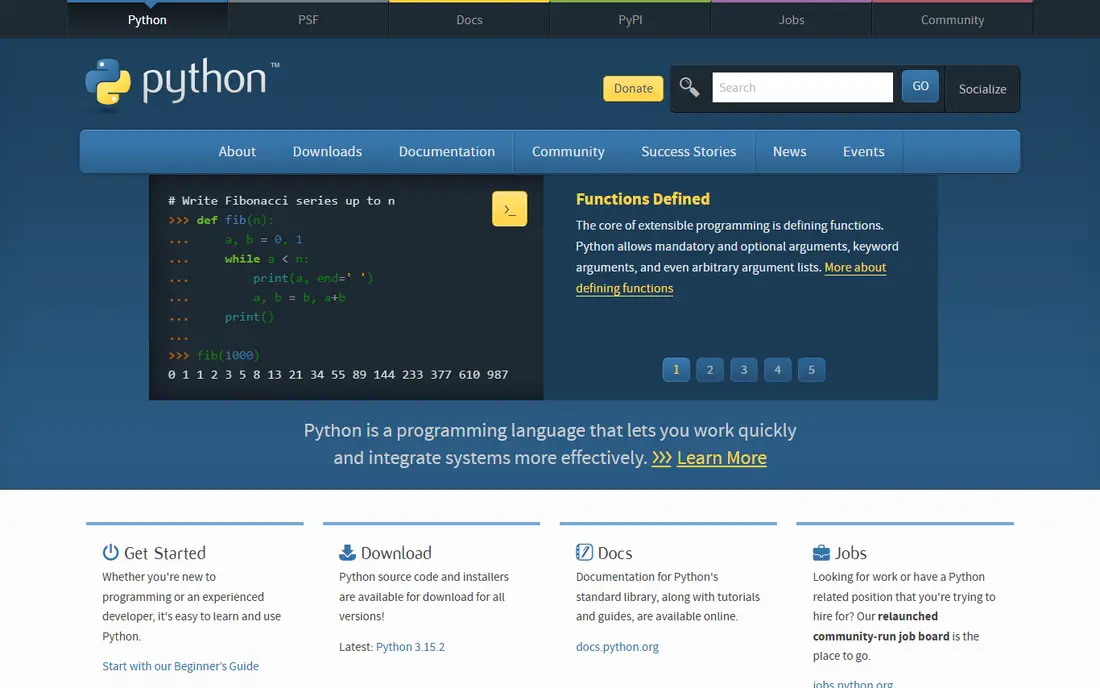
Python is the most common Perl replacement for scripting, automation, text processing, and web backends. Its readable syntax makes scripts easier to maintain than dense Perl one-liners, and its standard library covers files, text, networks, and data without extra installs. Frameworks like Django and FastAPI cover web work, while data tools cover analysis.
Python runs slower than Go or Rust, and Python 2 versus 3 differences still trip up old scripts, though new work should use Python 3. For most Perl scripting jobs, Python gives the best mix of ease, libraries, and hiring depth.
- Readable syntax
- Huge standard library
- Strong text and data tools
- Slower than compiled languages
- Version differences need care
Ruby
Ideal for: Web and scripting
Ruby shares Perl expressive, script-friendly spirit, with clean syntax and strong text handling. Ruby on Rails made Ruby famous for web apps, while plain Ruby scripts handle automation and file work well. Developers who liked Perl flexibility often enjoy Ruby readability and its friendly community.
Ruby runs slower than compiled languages, and its data and AI ecosystem is smaller than Python. For web apps and scripts where developer happiness matters, Ruby is a strong Perl alternative.
- Expressive syntax
- Rails for web apps
- Good text tools
- Slower runtime
- Smaller data ecosystem than Python
PHP
Ideal for: Web backends
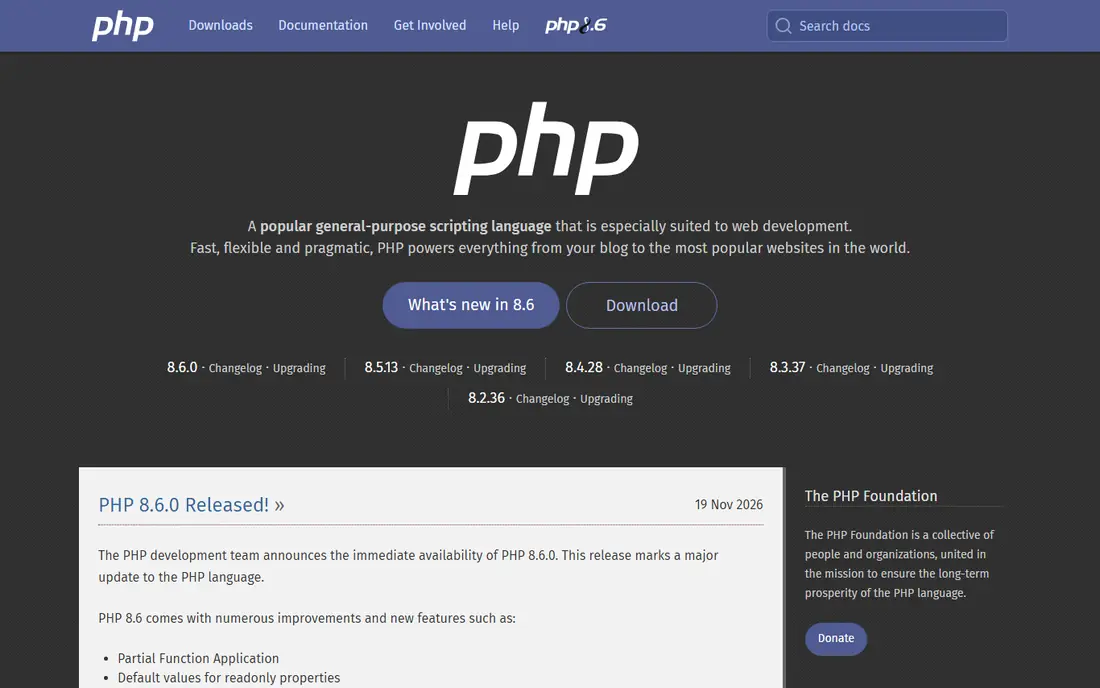
PHP is the natural Perl successor for web backends, since many sites once built with Perl CGI moved to PHP. It runs on almost every web host, powers WordPress and many CMS platforms, and modern PHP with Laravel or Symfony is clean and capable. That web focus makes PHP a practical choice for site backends.
PHP is less suited to general system scripting than Python, and older PHP code varies widely in quality. For web projects, especially content sites and small business backends, PHP remains a solid alternative.
- Web-native language
- Huge hosting support
- WordPress ecosystem
- Older codebases vary in quality
- Less suited to general scripting
Go
Ideal for: System tools and services
Go suits Perl users who wrote system tools, log processors, and network services and now want speed and simple deployment. A Go program compiles to a single binary, runs fast, and handles concurrency well, which helps for servers and command-line tools. That reliability suits operations teams.
Go has less text-processing sugar than Perl, so regex-heavy one-liners take more code. For system tools and services where speed matters, Go is an excellent modern alternative.
- Fast compiled tools
- Simple deployment
- Strong concurrency
- Less text-processing sugar than Perl
- Smaller script ecosystem
JavaScript
Ideal for: Web backends with Node.js
JavaScript with Node.js lets teams use one language for browser code and server backends, with a huge npm ecosystem for almost every task. Node handles APIs, real-time apps, and build tools well, and its runtime is fast for I/O-heavy work. Teams that already know JavaScript for the web gain the most from this path.
Async code and fast-moving tooling can confuse newcomers, and npm dependency management needs care. For web-focused teams, JavaScript with Node.js is a practical Perl alternative.
- One language for web front and back
- Huge npm ecosystem
- Fast runtime
- Callback and async complexity
- Tooling churn
Raku
Ideal for: Modern Perl-family language
Raku, formerly Perl 6, is the modern successor in the Perl family, with powerful grammars, advanced regex, concurrency, and object-oriented design. Perl developers will recognize its philosophy while gaining modern language features. That familiarity suits teams that liked Perl ideas but want a cleaner, newer language.
The ecosystem and hiring pool are far smaller than Python or JavaScript, so finding libraries and developers takes more effort. For Perl fans who want to stay in the family, Raku is the faithful modern choice.
- Perl-family design
- Powerful grammars and regex
- Modern features
- Smaller ecosystem and hiring pool
- Learning curve
Lua
Ideal for: Embedding and small scripts
Lua is a tiny, fast scripting language often embedded in games, tools, and devices, with simple syntax and a small core. It suits configuration, game scripting, and small automation tasks where a full language would be heavy. Lua runs fast and starts quickly, which helps for embedded use.
The standard library is small, so larger apps need extra libraries and care. For general scripting, Python suits better. For embedding and lightweight scripts, Lua is an elegant Perl alternative.
- Tiny and fast
- Easy embedding
- Simple syntax
- Small standard library
- Less suited to large apps
How we picked these
We compared official language pages, documentation, and public reviews for each language, and we favored languages that still work in October 2026 and cover real Perl jobs: scripting, text work, web backends, and system tools. We did not claim hands-on testing, and we weighed readability, libraries, ecosystem, and hiring. All languages here are free and open source, so price does not decide the choice.
What to check before you choose
Start with your Perl workload. Text and automation work favors Python, web backends favor PHP or Node.js, and system tools favor Go. Check library support for your specific tasks, such as database drivers, file formats, or web frameworks, since a missing library can stall migration. Test with a real script, not a toy example, to see how the new language handles your edge cases.
Next, plan migration in stages. Rewrite small, well-tested scripts first, keep Perl running for critical jobs, and compare outputs before switching. Document regex and text logic carefully, since Perl idioms do not always translate directly. Finally, check team skill: a language your team can maintain beats a fashionable one they cannot.
Also handle legacy Perl code with care, since a rushed migration can break systems that quietly run a business. Start by inventorying Perl scripts: what each one does, who owns it, what data it touches, and how often it runs. Add tests or at least output checks for critical scripts before rewriting, so you can compare old and new behavior side by side. Rewrite the smallest, least risky scripts first, and keep Perl running for complex or poorly understood jobs until their behavior is fully mapped. Watch for hidden dependencies: cron jobs, environment variables, file paths, and database permissions that a rewrite might miss. Log both old and new outputs during a parallel run period, and switch over only when outputs match for a full cycle.
Team skills and maintenance shape the long-term winner. A language your team already knows will be maintained better than a technically superior language nobody enjoys. Invest in code review and style guides for the new language, since Perl habits like dense one-liners can carry over badly into Python or Ruby. Keep scripts readable with clear names, comments for tricky logic, and tests for edge cases like empty files, bad input, and encoding problems. Schedule regular cleanups of old scripts, since automation code tends to accumulate and rot. Finally, document each script purpose and owner in a central list, so the next person who inherits the system does not have to reverse-engineer it from scratch.
One more migration aid is worth building early: a small set of golden tests that compare old and new script outputs on real data samples. Pick representative inputs, including edge cases like empty files, unusual characters, and large files, and store the expected outputs from the old script. Run the new script against those inputs during development, and require matching outputs before any production switch. That test set also serves as documentation, showing future maintainers what each script is supposed to do. Keep the test data free of sensitive information, using anonymized samples where needed. Teams that build golden tests migrate with confidence, while teams that rely on eyeballing outputs often discover differences only after a production failure.
Frequently asked questions
What are the best alternatives to perl?
Python is our pick for most Perl scripting, while Ruby suits web and scripting work. PHP suits web backends, Go suits system tools, and Node.js suits web teams. Raku suits Perl fans, while Lua suits embedding. Match the language to your Perl workload.
Is Python better than Perl?
Python suits most teams better today, thanks to readable code, a huge library base, and easier hiring. Perl still excels at dense text one-liners, but Python scripts are easier to maintain in teams. For new scripting work, Python is usually the better choice.
Can I still use Perl in 2026?
Yes, Perl still works and has a loyal community, especially for legacy systems and text work. New projects often choose Python or Go for hiring and libraries, but existing Perl systems can run for years with care. Migrate critical systems gradually rather than in a rushed rewrite.
What replaced Perl for web development?
PHP, Python with Django or Flask, Ruby on Rails, and Node.js largely replaced Perl CGI for web backends. Each suits different teams: PHP for CMS sites, Python for data-rich apps, Rails for fast product work, and Node for JavaScript teams. Choose based on your team and project type.
Is Raku the same as Perl?
Raku grew from Perl 6 and shares Perl philosophy, but it is a distinct language with its own syntax and features. It is not a drop-in Perl replacement, so code needs rewriting. Perl developers will find Raku familiar in spirit, but should treat it as a new language to learn.