Start with Databricks if you need data-centric AI on a unified analytics product. Listed starting prices: Cloudera from $0.04 per CCU per hour. H2O.ai fits Sovereign AI on your own infrastructure; IBM watsonx.ai fits hybrid enterprise AI development. The other 2 tools in the list cover narrower or pricier cases.
Ainotely compared 5 tools for Amazon SageMaker. The goal is a practical shortlist: published prices, free plan facts, best-fit use cases and honest limits for every entry.
Key takeaways
Number one here is Databricks, a fit for data-centric AI on a unified analytics platform.
Before buying H2O.ai, weigh this: self-managed infrastructure layers on operational work.
Databricks, H2O.ai, IBM watsonx.ai and Google Cloud Vertex AI: pricing is by quote only, so plan time for a sales conversation.
Cloudera is the one to check for hybrid data and AI at the edge.
Best for: Data-centric AI on a unified analytics system
Databricks makes the most sense for data-centric AI on a unified analytics system. Databricks provides a unified system for data, analytics and AI, emphasizing a data-centric approach.
If your priority is a narrow agent-building environment, a more specialized choice may be more straightforward. Teams with substantial data engineering needs are a natural fit. Databricks does not show a starting price in this comparison, so check the vendor site for current pricing. As for free access: Not stated.
Honest limits: Needs data engineering familiarity.
H2O.ai was built for Sovereign AI on your own infrastructure. H2O.ai presents a sovereign AI system for running predictive, generative and agentic AI on your own infrastructure, from the cloud to completely air-gapped environments.
In practice, choose H2O.ai when sovereignty and air-gapped operation are priorities. On top of that, teams without the capacity to handle deployments may prefer a cloud-native product. Pricing for H2O.ai is not stated here, so ask the vendor for current figures. Free plan details: Not stated.
IBM watsonx.ai makes the most sense for hybrid enterprise AI development. The hybrid orientation can add setup and integration work compared to a single-cloud service.
Watch-outs: Hybrid focus can add setup complexity.
On top of that, consider it when hybrid deployment and enterprise governance are firm requirements. This comparison lists no price for IBM watsonx.ai; ask the vendor. Free access: Free trial.
Best for: Gemini-centered agent development on Google Cloud
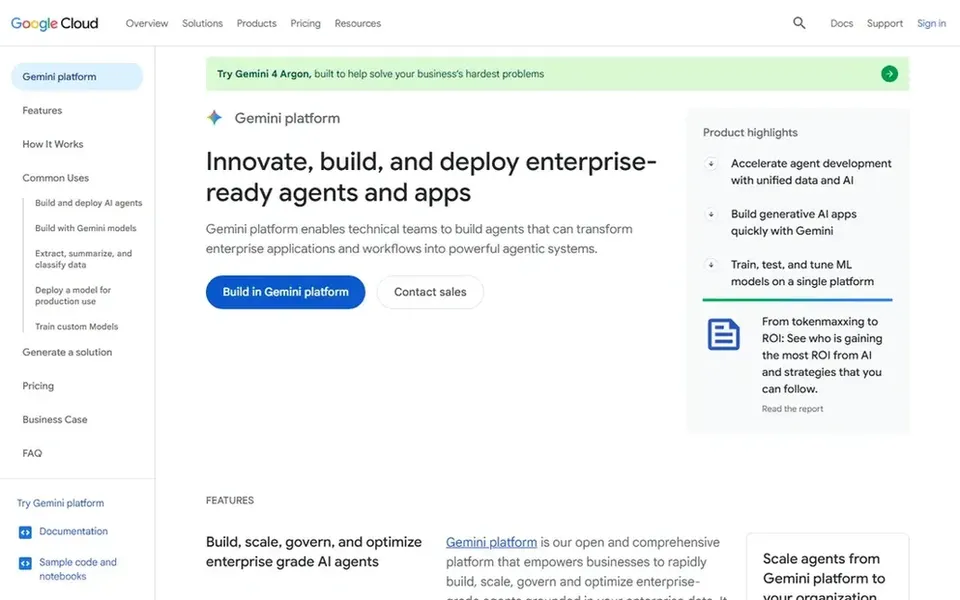
Choose Google Cloud Vertex AI for Gemini-centered agent development on Google Cloud. Google Cloud Vertex AI is presented as a Gemini system for developers who want to build, scale, govern and optimize agents. It bundles model access with tooling for the agent lifecycle, making it a fit for teams already working in Google Cloud or planning agent-based applications.
As for the details, the product is deeply tied to Google Cloud, so teams standardized on other clouds may find integration less natural. Its breadth can also mean a steeper ramp-up time for smaller teams. Worth adding: organizations that want one environment for model development and continuing governance should shortlist it. No starting price is listed for Google Cloud Vertex AI here; confirm pricing on the vendor site. On free options: Not stated.
Watch-outs: Tied closely to Google Cloud services.
Cloudera is designed for hybrid data and AI at the edge. Cloudera describes itself as a hybrid data and AI system that brings AI to data anywhere: in clouds, in data centers and at the edge. In practice, if your data sits in one cloud, a more straightforward managed service may be a better fit.
Teams managing edge or multi-site data should shortlist it. In daily use, hybrid and edge deployments need careful planning and specialist skills, which can slow smaller teams. In daily use, the product is wide, so expect a ramp-up time. Entry price for Cloudera: $0.04 per CCU per hour. Free plan details: Not stated.
Downsides: Wide system may need specialist skills.
Get a written quote from Databricks, H2O.ai, IBM watsonx.ai and Google Cloud Vertex AI; the list shows no starting price for them.
Run a trial of IBM watsonx.ai with real work before paying for a year; your own workflow is the best test.
Before choosing Databricks, weigh its main limit: system scope may exceed small team needs.
Check the integration list for Google Cloud Vertex AI against the tools you run today, and note which ones need a higher plan.
Compare total cost, not headline price: for Cloudera, add extra seats, add-ons and any usage-based charges.
How we picked
The comparison looks at four things: starting price, free access, how well the feature set matches Amazon SageMaker, and the main limit of each tool. Treat prices as a snapshot: vendors change plans often, so check the vendor site for the figure that applies today. We ordered the tools by general fit, then by how clearly pricing is shown, then by free access. A buyer with unusual needs may reorder them.
Every price and plan detail on this page comes from the vendors’ own websites. We did not run hands-on tests unless the text says so, and we do not publish star ratings or review scores. See how we score and our disclosure.
Keep your shortlist in one place
Paste prices, trial dates and notes from this guide into Ainotely, our AI note app. It files them into a topic and pulls out tasks like “cancel trial by Friday”. Free 7-day trial, no card needed.
Often, yes. IBM watsonx.ai offers a free trial. Use your own data and a real task during the test, and check what the free tier or trial limits before you rely on it. For the full picture, the cards above cover all 5 entries of this Amazon SageMaker alternatives list, including price, free plan and limits.
What is the best choice for air-gapped or sovereign AI?
Databricks is the pick this page puts first, mainly for data-centric AI on a unified analytics system. If your situation differs, H2O.ai suits Sovereign AI on your own infrastructure, and IBM watsonx.ai suits hybrid enterprise AI development. Compare price and limits before you decide.
Is Databricks the right pick for everyone comparing Amazon SageMaker?
No single tool suits every team. Databricks comes first because it fits data-centric AI on a unified analytics platform, while H2O.ai suits Sovereign AI on your own infrastructure and IBM watsonx.ai suits hybrid enterprise AI development. Match the tool to your own size, budget and workflow before deciding.
Which SageMaker alternative is a good match for agent development?
For most readers this guide would start with Databricks, built for data-centric AI on a unified analytics platform. H2O.ai is the alternative for Sovereign AI on your own infrastructure, and IBM watsonx.ai for hybrid enterprise AI development. The right answer depends on budget and workflow.
Do these tools publish their prices?
Not all of them. Databricks, H2O.ai, IBM watsonx.ai and Google Cloud Vertex AI publish no starting price, so expect a quote request for those. The rest, Cloudera included, show a starting price, though seats and billing terms still change the final cost.
How are the tools for Amazon SageMaker ordered?
The order follows typical fit for Amazon SageMaker, with Databricks first and Cloudera last, then price clarity and free access. It is editorial judgement, not a score, so another team could rank the tools differently.