Best Appian Alternatives in 2026: 7 Platforms Compared

- 1
 MendixEnterprise low-code platformVisit
- 2
 OutSystemsFull-stack low-code appsVisit
- 3
 Microsoft Power AppsMicrosoft-based low-codeVisit
- 4
 PegaComplex process automationVisit
- 5
 BonitaOpen process automationVisit
- Mendix is our pick for enterprises that want a full low-code platform with strong governance and app lifecycle tools.
- OutSystems suits teams that want fast, full-stack low-code development with strong mobile support.
- Microsoft Power Apps suits organizations already on Microsoft 365 and Dynamics, with low marginal cost.
- Pega suits complex process and case management, while Bonita, Camunda, and Kissflow cover open, process, and simple workflow needs.
- Always test a real process end to end, since low-code speed claims vary sharply by use case.
Quick comparison
| Product | Ideal for | Price from | Free version | |
|---|---|---|---|---|
| Mendix | Enterprise low-code platform | See website | Free trial | Visit |
| OutSystems | Full-stack low-code apps | See website | Free trial | Visit |
| Microsoft Power Apps | Microsoft-based low-code | See website | Free trial | Visit |
| Pega | Complex process automation | See website | See website | Visit |
| Bonita | Open process automation | See website | Free trial | Visit |
 Camunda | Process orchestration | See website | Free trial | Visit |
 Kissflow | Simple workflow apps | See website | Free trial | Visit |
The best Appian alternatives
Appian combines low-code app building with business process management, so a good replacement needs visual app design, process automation, case handling, and governance. We compared official feature pages, pricing pages, and public reviews, focusing on app building, process depth, integrations, deployment, and total cost.
Mendix
Ideal for: Enterprise low-code platform
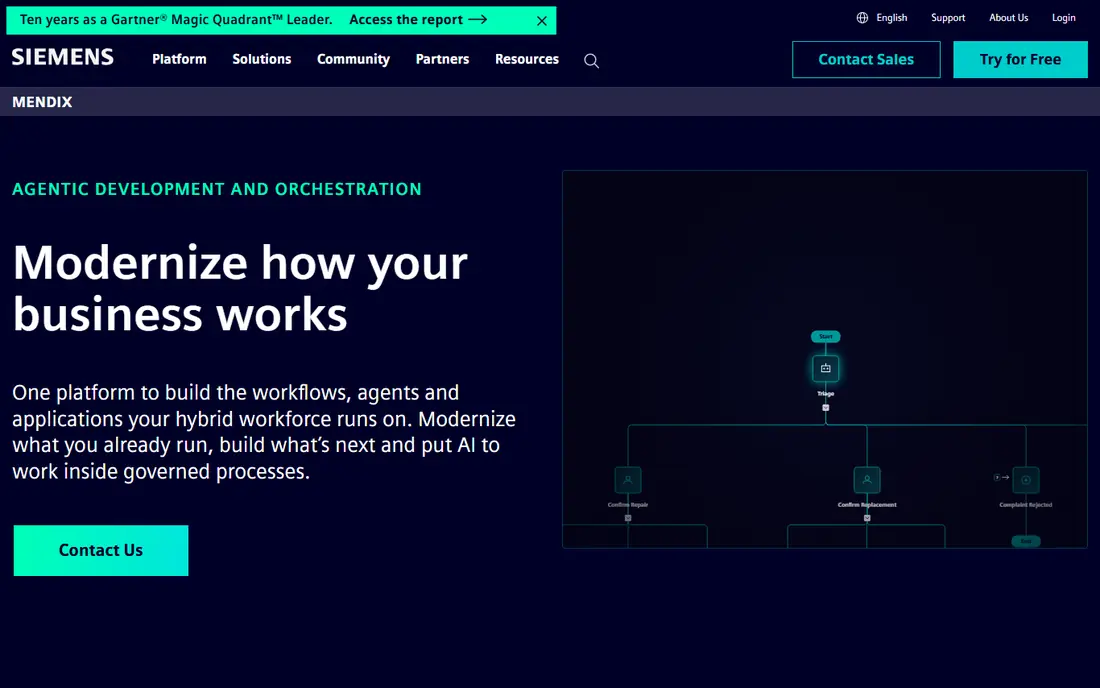
Mendix, from Siemens, is a full low-code platform covering app design, data modeling, process automation, deployment, and governance. Enterprises use it to build customer, employee, and operations apps with controls for security, versioning, and lifecycle management. Its marketplace and AI assistance speed up common app patterns.
Enterprise pricing and setup are barriers for small teams, and advanced features take learning. For organizations standardizing on low-code with governance needs, Mendix is our top Appian replacement.
- Full low-code app lifecycle
- Strong governance
- Good mobile and web support
- Enterprise pricing and setup
- Learning curve for advanced features
OutSystems
Ideal for: Full-stack low-code apps
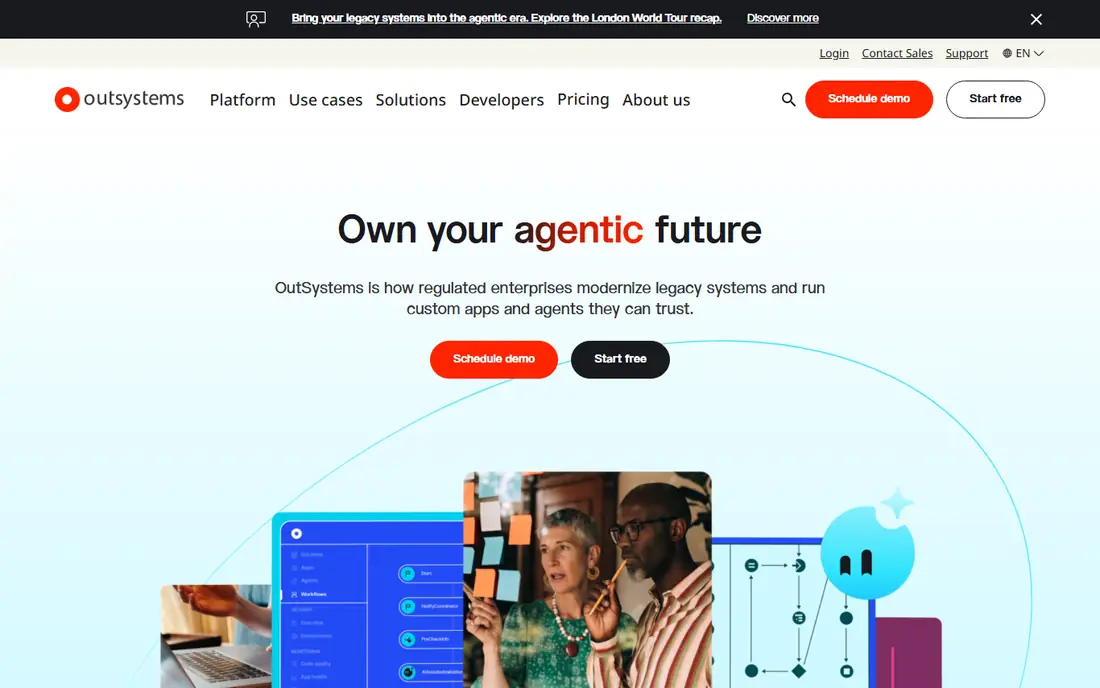
OutSystems offers fast full-stack low-code development for web and mobile apps, with visual modeling, integrations, and deployment tools that help teams ship production apps quickly. Its performance and scaling suit customer-facing apps as well as internal tools.
Pricing is quote-based, and teams should review platform lock-in, since apps are built for the OutSystems runtime. For teams that want speed and full-stack coverage, OutSystems is a strong Appian replacement.
- Fast full-stack development
- Strong mobile apps
- Good performance and scaling
- Pricing is quote-based
- Platform lock-in deserves review
Microsoft Power Apps
Ideal for: Microsoft-based low-code
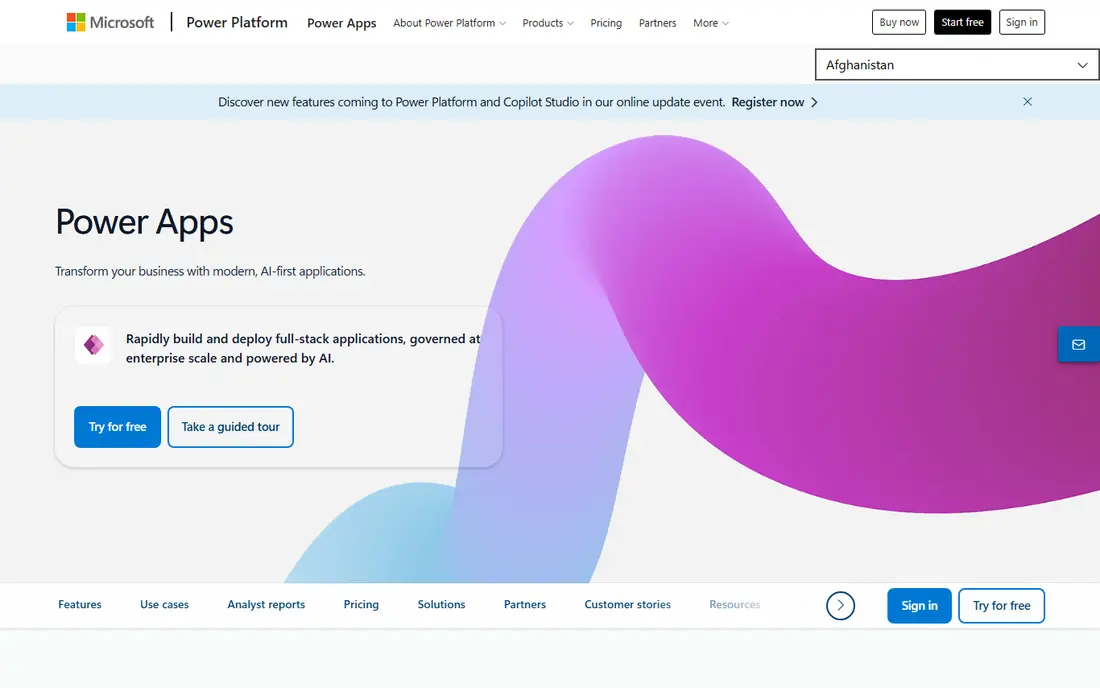
Microsoft Power Apps lets organizations build apps and workflows inside the Microsoft ecosystem, connecting to SharePoint, Dataverse, Dynamics, and hundreds of other data sources. For companies already paying for Microsoft 365, the marginal cost can be low, and internal apps for forms, approvals, and dashboards come together fast.
Outside the Microsoft ecosystem, the case weakens, and very complex apps need careful design. For Microsoft shops that want low-code without a new vendor platform, Power Apps is the natural Appian replacement.
- Low marginal cost inside Microsoft 365
- Strong data connectors
- Good for internal apps
- Best value only inside Microsoft ecosystem
- Complex apps need care
Pega
Ideal for: Complex process automation
Pega, formerly Pegasystems, excels at complex case management, process automation, and decisioning for large enterprises in finance, insurance, healthcare, and government. Its low-code tools plus AI-driven decisions help organizations automate end-to-end journeys with compliance and audit trails.
Enterprise pricing and implementation effort are high, and the learning curve is steep. For organizations with complex, regulated processes, Pega is a powerful Appian replacement. For simple workflow apps, Kissflow or Power Apps will be faster.
- Deep case and process management
- Strong AI and decisioning
- Enterprise scale
- Enterprise pricing and implementation
- Learning curve is steep
Bonita
Ideal for: Open process automation
Bonita, from Bonitasoft, offers open source business process automation with strong BPMN process design, plus app building for process-led projects. Teams can model, automate, and monitor processes, with connectors for common systems and a community edition for getting started.
App building depth is lighter than full low-code platforms such as Mendix or OutSystems, and enterprise support needs a paid plan. For process-led projects that value openness, Bonita is a practical Appian replacement.
- Open source core
- Strong BPMN process design
- Good for process-led projects
- App building depth is lighter than Mendix
- Enterprise support needs a paid plan
Camunda
Ideal for: Process orchestration
Camunda focuses on process orchestration with BPMN workflows and DMN decisions, orchestrating microservices, human tasks, and system steps at scale. Developers value its standards-based design, APIs, and observability for complex automation. It suits organizations modernizing processes across many systems.
Camunda is process-first, so app user interfaces usually need separate front-end tools, and setup needs technical skill. For engineering teams orchestrating complex processes, Camunda is a strong and focused Appian replacement.
- Strong BPMN and DMN orchestration
- Developer-friendly
- Good for microservices
- Process focus means app UI needs other tools
- Setup needs technical skill
Kissflow
Ideal for: Simple workflow apps
Kissflow is the simplest tool on this list for business users who want to build workflow apps, forms, and approvals without coding. Its visual builder, templates, and dashboards help operations, HR, and procurement teams digitize paper processes in days.
Depth is lighter than Mendix, OutSystems, or Pega, and very complex processes may outgrow it. For teams that want quick wins on everyday workflows, Kissflow is an accessible and affordable Appian replacement.
- Very easy workflow and app building
- Good for business users
- Fast setup
- Depth is lighter than enterprise platforms
- Complex processes may outgrow it
How we picked these
We compared official feature pages, pricing pages, and public reviews, and we checked that the homepages listed here belong to the products named. We favored platforms that combine low-code app building with process automation, case handling, or workflow orchestration. We left out form-only tools with no process engine, and we did not include Appian itself, since this list is about replacements.
We also checked how each product fits different team sizes, since a tool built for enterprises can overwhelm a small team, while a tool built for solo users can stall a growing company. We favored products that scale sensibly, with tiers that add depth without forcing a painful migration later. Free and trial access mattered in our scoring, because a team should be able to test real work before paying. Products that hide core features behind sales calls scored lower than products that let buyers try the actual workflow first.
What to check before you buy
Start with a real process. Pick one end-to-end workflow, such as an approval, onboarding, or claims process, and build it in each finalist, including forms, rules, integrations, and reporting. Low-code speed claims only hold for processes that match the platform strengths.
Next, check governance and integrations. Confirm version control, security roles, audit trails, and connections to your core systems, including CRM, ERP, and identity tools. A platform that cannot fit your IT standards will stall at approval stage.
Finally, price users and apps honestly. Count builders, end users, and any runtime or platform fees, and compare at your real app portfolio size. A low starter price can rise fast once every app and user is counted.
Pay attention to support and update pace before you commit. Read the help center, check whether guides match the current version of the product, and test support with a real question during the trial. A vendor that answers clearly and fixes problems quickly is worth more than a slightly lower price from a vendor that leaves you waiting. Also check how often the product changes and whether updates break existing workflows, since a tool that shifts under you every month can cost your team steady retraining time. Stability matters most for tools your whole team depends on daily, so favor vendors with a clear changelog and a reputation for careful releases.
Also confirm how the tool behaves when your needs change. A product that fits today may feel tight after a year of growth, a new team, or a shift in how you work, so ask whether higher tiers, extra seats, or added features arrive without a forced migration. Read recent user reviews for signs of price rises, support changes, or features being moved between tiers, since those patterns often predict what your second year will cost. A tool that grows with you, with clear upgrade paths and honest limits, is usually the better long-term choice even when a rival looks slightly cheaper in month one.
Frequently asked questions
What is the best Appian alternative for enterprises?
Mendix is our pick for enterprises that want a full low-code platform with governance. OutSystems suits teams that want fast full-stack development, while Pega suits complex case and process management.
Is there a free Appian alternative?
Bonita offers an open source core, and Camunda, Mendix, OutSystems, and others offer free trials or community editions. Full enterprise features usually need paid plans, so check tier details for production use.
Which alternative is best for Microsoft shops?
Microsoft Power Apps is the best pick for organizations already on Microsoft 365 and Dynamics, thanks to low marginal cost and strong data connectors. Teams outside Microsoft should look at Mendix or OutSystems first.
Do I need developers to use low-code platforms?
Business users can build simple apps and workflows on Kissflow and Power Apps, while complex apps on Mendix, OutSystems, and Pega still benefit from developers. Treat low-code as faster development, not zero-skill development.
How hard is it to move from Appian to another platform?
Processes, data models, and interfaces usually need rebuilding, since low-code platforms differ in design and runtime. Rebuild one core process first, migrate data carefully, and run old and new systems in parallel during cutover.
Can I use more than one of these tools together?
Yes, and many teams do, especially when one tool handles a core job well and another covers a niche need. The trick is to define which tool owns each job so records do not split across systems and confuse your team. Check integrations and data flow between the tools before committing, and name one system as the source of truth for each kind of record. Two tools that share data cleanly can beat one tool that does both jobs poorly, but two tools with no connection usually create duplicate work and errors.