5 Arize AI Alternatives Worth a Look in 2026

- Number one here is Galileo, a fit for LLM evals and guardrails.
- For self-hosted LLM tracing and evals, Langfuse is worth a look.
- One limit worth knowing about Braintrust: Pro plan from $249 a month.
- Free plans exist at 5 of 5 tools (Galileo, WhyLabs, Braintrust, LangSmith, Langfuse).
Direct answer
If you need LLM evals and guardrails, Galileo is the first tool to look at here. WhyLabs is better for privacy-first drift monitoring, and Braintrust is better for Evals with CI gates. All 5 tools are compared below on price, free plan and limits.
Quick comparison
| Product | Ideal for | Price from | Free version | |
|---|---|---|---|---|
 Galileo | LLM evals and guardrails | $100 per month | Yes | Visit |
 WhyLabs | Privacy-first drift monitoring | Free | Yes | Visit |
 Braintrust | Evals with CI gates | $249 per month | Yes | Visit |
 LangSmith | LangChain and LangGraph teams | $39 per seat a month | Yes | Visit |
 Langfuse | Self-hosted LLM tracing and evals | $29 a month | Yes | Visit |
5 options for Arize AI in detail
Short on time? The summary and table above give the quick view of 5 tools for Arize AI, and the profiles that follow give the detail behind each entry.
Galileo
Ideal for: LLM evals and guardrails

Galileo is a good fit for LLM evals and guardrails. Galileo is LLM-first, so it does not replace classic ML drift monitoring, and its ecosystem of integrations is smaller than LangSmith or Langfuse. Also, for teams whose primary risk is a bad LLM output reaching customers, Galileo hands you evaluation and guardrails in one place, and its evaluator pricing makes frequent evaluation budget-friendly instead of a luxury.
The main drawbacks: Smaller ecosystem than LangSmith.
In practice, Galileo links offline evaluation, production tracing, regression gates, and runtime guardrails for LLM apps. Its evaluators score outputs for quality, hallucinations, and policy issues at a lower cost than numerous rivals, which matters when you run evaluations on every release. The Pro plan opens at $100 a month, with a free level for smaller workloads. Runtime guardrails can block harmful or off-policy outputs before they reach users, and regression gates stop a release when evaluation scores drop below a threshold you set. Galileo starts at: $100 per month. Galileo offers a free plan.
- Low-cost evaluators
- Runtime guardrails
- Pro plan from $100 a month
WhyLabs
Ideal for: Privacy-first drift monitoring
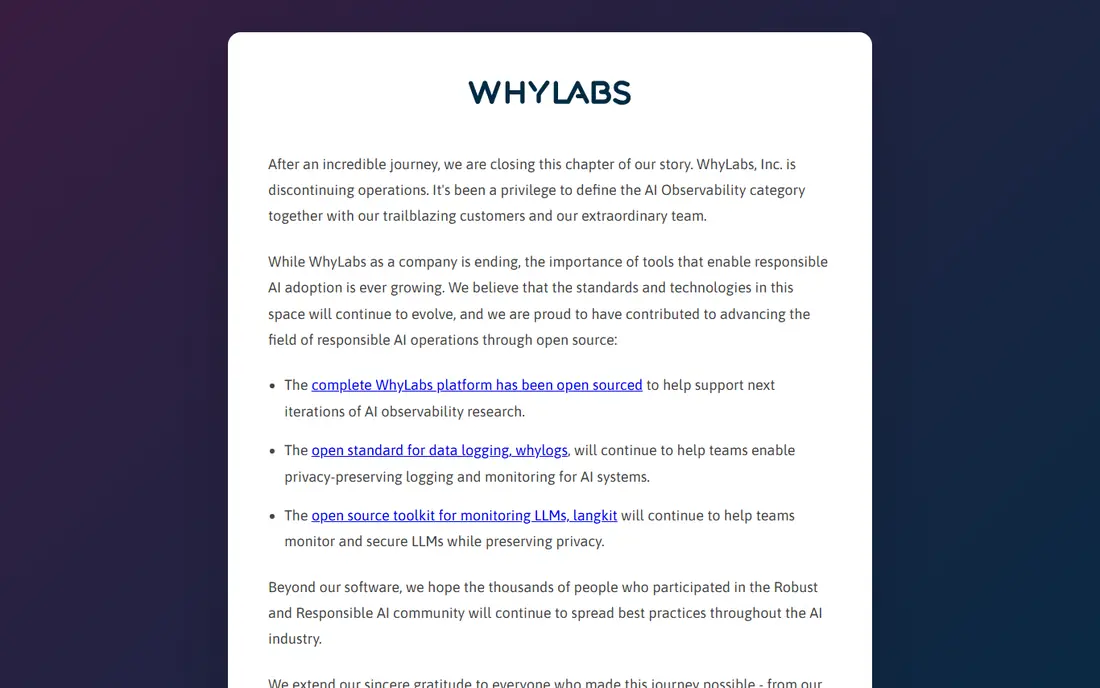
WhyLabs is designed for privacy-first drift monitoring. The free level spans one project with up to 10 million predictions a month. The Expert plan from $125 a month raises that to 100 million predictions across three projects.
As for the details, WhyLabs includes drift, data quality, and performance for classic models very well, and it has added LLM security and guardrail features. But its tracing and prompt management are not as deep as Langfuse or LangSmith. Starting cost for WhyLabs: Free. WhyLabs offers a free plan.
What to check first: Smaller community than open source rivals.
- Local profiling keeps raw data private
- Free level spans 10M predictions a month
- Less LLM tracing depth than Langfuse
Braintrust
Ideal for: Evals with CI gates

Braintrust works best for Evals with CI gates. Braintrust merges evaluations, tracing, and continuous integration gates for LLM apps, with a workflow that feels familiar to software engineers. In practice, the price is the central barrier.
Also, for teams that only need entry-level tracing, a less expensive tool spans the job. The Pro plan opens at $249 a month, which is higher than Langfuse or LangSmith for small teams, and Braintrust does not focus on classic ML drift monitoring. Tracing displays what happened in production, and failed traces feed back into datasets for the next round of evaluation, closing the loop between production problems and fixes. Entry price for Braintrust: $249 per month. Braintrust has a free plan.
Honest limits: Less drift monitoring.
- Solid for engineering-led teams
- Evals, tracing
- Pro plan from $249 a month
LangSmith
Ideal for: LangChain and LangGraph teams
Choose LangSmith for LangChain and LangGraph teams. LangSmith is the observability and evaluation product from the makers of LangChain. It is the natural choice if your app already uses LangChain or LangGraph.
Points against: Less focus on classic ML models.
On top of that, teams outside the LangChain stack can still use LangSmith. But they get less of the automatic integration that makes it shine, and per-seat pricing from $39 per seat a month grows with team size instead of with usage alone. LangSmith cost at the entry level: $39 per seat per month. LangSmith offers a free plan.
- Dataset-based evaluations
- Deep LangChain and LangGraph integration
- Best value only inside the LangChain stack
Langfuse
Ideal for: Self-hosted LLM tracing and evals
Langfuse was built for self-hosted LLM tracing and evals. Premium plans add higher trace limits and collaboration features that the free level caps. The trade-off is effort.
What to check first: Advanced features sit on premium plans.
Self-hosting provides you control, but you own upgrades, backups, and scaling, so small teams commonly start on the hosted cloud plan from $29 a month instead. For everyday use, you can then score those traces with evaluations, compare prompt versions side by side, and spot regressions before users do. From a buyer's view, the open source core can run on your own servers, which matters for teams that cannot send prompts and outputs to an external cloud. What you pay to start with Langfuse: $29 per month. Langfuse includes a free tier.
- Open source core
- Self-hosting choice
- Smaller enterprise footprint than Arize
How the list was put together
We compared the tools on published pricing, free plan or trial availability, feature coverage for Arize AI, and the limits each vendor documents. Seat minimums, billing terms and add-ons can move the real cost, so the starting prices here are a guide and not a quote. Tools are placed by general fit for Arize AI, with price clarity and free access as tie-breakers. A different team can reasonably rank them differently.
Things to verify first
- Check the vendor page for the current price: Langfuse starts at $29 per month here, and seats or billing terms can move it.
- Check what the free option really includes: Galileo, WhyLabs, Braintrust and others offer a free plan, and usage caps differ.
- Before choosing Galileo, weigh its main limit: less classic ML coverage.
- Ask Braintrust how an export works before you move any records in; an easy exit lowers the risk.
- Check the support hours and onboarding help LangSmith offers; smaller vendors vary a lot here.
Frequently asked questions
How do these tools price their plans?
Most price by seats, monthly traces, predictions monitored, or evaluation runs, and enterprise plans are frequently custom. Compare your real monthly volume against each pricing page, and use the free level to measure volume before you commit to a yearly plan.
Which tool is a good match for a regulated industry?
For most readers this guide would start with Galileo, built for LLM evals and guardrails. WhyLabs is the alternative for privacy-first drift monitoring, and Braintrust for Evals with CI gates. The right answer depends on budget and workflow.
What is the difference between tracing and drift monitoring?
Drift monitoring compares production data and predictions against a baseline over time, which helps you catch slow degradation that no single request reveals.
Do these tools publish their prices?
Yes. Every tool from Galileo to Langfuse shows a starting price, though seats, add-ons and billing terms still change the final cost.
Can I try these tools before paying?
Often, yes. Galileo, WhyLabs, Braintrust and others have a free plan. Use your own data and a real task during the test, and check what the free tier or trial limits before you rely on it.
Which options for Arize AI have a free plan?
On this list, Galileo, WhyLabs, Braintrust, LangSmith and Langfuse include a free plan. Caps on seats, usage or features are common, so test the free plan against your real workload.