7 Best Account Takeover Fraud Prevention Software Options for 2026

- 1
 SpyCloudSecurity teams that require to know which employee and customer credentialsVisit
- 2
 CastleDeveloper-first teams that want API-based ATO protection with published pricingVisit
- 3
 Transmit SecurityBanks and insurers replacing passwords with passkeys and risk-based authenticationVisit
- 4
 Arkose LabsBanks, fintech and large systems facing heavy credential stuffing at loginVisit
- 5
 KountEnterprise merchants and financial services teamsVisit
- Top of the list is SpyCloud, which targets Security teams that require to know which employee and customer credentials are already exposed.
- HUMAN Security is the one to check for large enterprises that require network-scale bot and ATO defence across web, mobile and APIs.
- A free plan is available from 2 of the 7 tools: Castle, Transmit Security.
- What to know about Castle first: the jump from Pro at $200 a month to Enterprise from $4,000 a month leaves no mid-market level. Its Rails Devise gem is still labelled beta with breaking-change warnings.
- The cheapest monthly starting price in the list is Pay as you go from $0.011 per Phone ID lookup, with SMS, offered by Telesign.
Direct answer
Start with SpyCloud if you need Security teams that need to know which employee and customer credentials are already. For a different need, Castle covers developer-first teams that want API-based ATO protection with published pricing and Transmit Security covers banks and insurers replacing passwords with passkeys and risk-based authentication.
Quick comparison
| Product | Ideal for | Price from | Free version | |
|---|---|---|---|---|
| SpyCloud | Security teams that require to know which employee and customer credentials | Quote. SpyCloud publishes no prices. Its MSSP program starts at $10,000 per month. A third-party source reports a mid-market tier of $500 to $3,000 a month, which conflicts with the enterprise-only pricing SpyCloud lists | No | Visit |
| Castle | Developer-first teams that want API-based ATO protection with published pricing | $200 a month for Pro, including $200 of usage, then $0.005 per Risk or Filter call. Enterprise starts from $4,000 per month. Figures are from the vendor pricing page as read on 10 October 2026. Price conflict: another third-party source reports starter pricing at $10,000 to $15,000 a year and says Castle publishes no pricing | Yes | Visit |
| Transmit Security | Banks and insurers replacing passwords with passkeys and risk-based authentication | Quote. The vendor pricing page lists no rates and says final pricing is provided within 24 hours, based on per month active users or event volume. Price conflict: a third-party report cites a $200,000 per year floor, which the vendor does not publish | Yes | Visit |
| Arkose Labs | Banks, fintech and large systems facing heavy credential stuffing at login | Quote. Arkose Labs publishes no price. Third-party reports conflict: entry pricing is put at $10,000 to $15,000 a year by one source and at $50,000 or more a year by another | No | Visit |
| Kount | Enterprise merchants and financial services teams | Quote. Equifax publishes no prices for Kount 360. Price conflict: third-party sources report Essentials at $0.07 per transaction with Advanced from $1,000 a month, while another reports typical pricing of $10,000 to $30,000 per year. These are legacy plan names | No | Visit |
 Telesign | Teams that require phone intelligence and step-up verification at login and signup | Pay as you go from $0.011 per Phone ID lookup, with SMS Verify at $0.0072 per message and Intelligence risk scoring at $0.15 per transaction, per third-party reporting of the vendor live pricing feed. Price conflict: another third-party source reports $5 per user a month | Free trial | Visit |
 HUMAN Security | Large enterprises that require network-scale bot and ATO defence across web | Quote. HUMAN Security publishes no price. Third-party reports conflict: starter pricing is put at $20,000 to $50,000 per year by one source and at $40,000 to $75,000 a year by another | No | Visit |
Account Takeover Fraud Prevention Software compared in detail
Ainotely compared 7 tools for account takeover fraud prevention software. The goal is a practical shortlist: published prices, free plan facts, best-fit use cases and honest limits for every entry.
SpyCloud
Ideal for: Security teams that require to know which employee and customer credentials
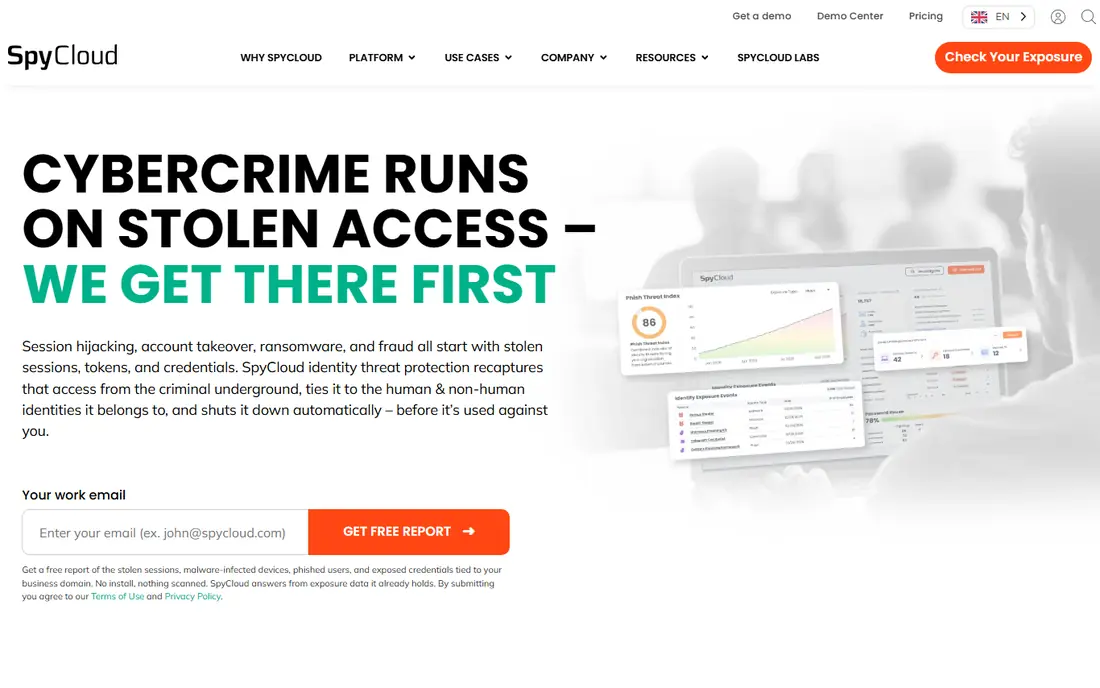
SpyCloud is built with Security teams that require to know which employee and customer credentials are already exposed in mind. Identity Guardians can reset exposed passwords automatically in Active Directory, Entra ID and Okta.
SpyCloud pricing: Quote. SpyCloud publishes no prices. Its MSSP program starts at $10,000 per. SpyCloud does not include a free plan.
- Entra ID and Okta
- Automatic password resets in Active Directory
- It spots exposed credentials but cannot stop a live bot attack at login on its own, so most buyers still need a second tool for real-time blocking. Pricing is enterprise only with no free level or trial
Castle
Ideal for: Developer-first teams that want API-based ATO protection with published pricing

Castle is built with developer-first teams that want API-based ATO protection with published pricing in mind. It guards the API edge against account takeover, credential stuffing and fake signups by scoring any user event you send it, from login to in-app actions.
Upsides: free evaluation level with no sales call needed.
More specifically, device fingerprinting claims 99.5 percent accuracy, and the rules engine lets your team allow, challenge or deny requests in live. Worth adding: integration is light, with a single API and SDKs for iOS and Android. Entry price for Castle: $200 per month for Pro, including $200 of usage, then $0.005 per. A free plan is available with Castle.
- Single API for device fingerprinting
- Bot detection and risk scoring
- The jump from Pro at $200 a month to Enterprise from $4,000 a month leaves no mid-market level. Its Rails Devise gem is still labelled beta with breaking-change warnings
Transmit Security
Ideal for: Banks and insurers replacing passwords with passkeys and risk-based authentication
Transmit Security serves banks and insurers replacing passwords with passkeys and risk-based authentication. The trade-off is complexity and cost, and migration of a live consumer identity base carries real churn risk.
More specifically, Mosaic scores hundreds of risk signals in live and supports passkeys and passwordless login. From a buyer's view, the product is designed for large regulated enterprises. Transmit Security pricing: Quote. The vendor pricing page lists no rates and says final pricing. Transmit Security includes a free tier.
What works well: risk-scored account recovery flows.
- Named a Leader in customer identity and access management
- Passwordless authentication and fraud detection in one system
- Pricing is quote only and frequently mixes per-user and per-transaction units, which makes early budgeting hard. Smaller deployments get less value from its models since they need traffic volume to learn
Arkose Labs
Ideal for: Banks, fintech and large systems facing heavy credential stuffing at login
In short, Arkose Labs is for banks, fintech and large platforms facing heavy credential stuffing at login. Its Titan product scores sessions using more than 200 risk signals and serves adaptive challenges only to suspicious traffic.
Points against: no free level and no public pricing.
Beyond that, a 24 by 7 security operations centre tunes the protection continuously. In practice, the trade-off is access: there is no trial and no published price. Arkose Labs cost at the entry level: Quote. Arkose Labs publishes no price. Third-party reports conflict: entry pricing is. Arkose Labs has no free tier.
- 24 by 7 security operations centre included
- Financial warranty of up to $1 million for SMS toll fraud and credential stuffing losses
- No self-serve access
Kount
Ideal for: Enterprise merchants and financial services teams
Kount was built for enterprise merchants and financial services teams that want account protection backed by Equifax identity data. Pricing has moved upmarket since the Equifax acquisition, and integration is substantial.
That data depth is the central reason to choose Kount over a standalone bot tool. Kount cost at the entry level: Quote. Equifax publishes no prices for Kount 360. Price conflict: third-party sources. Kount does not include a free plan.
Downsides: Kount.com now redirects to Equifax.
- Kount Control module made for account takeover protection and adaptive authentication
- Mature case management for manual review
- Current sales run on the consolidated Kount 360 product, so older plan names online no longer match what is sold. Pricing is frequently a percentage of approved order value, which grows with volume
Telesign
Ideal for: Teams that require phone intelligence and step-up verification at login and signup
Pick Telesign if this describes you: teams that require phone intelligence and step-up verification at login and signup. Coverage spans more than 230 countries.
Strengths: Carrier-grade phone data across more than 230 countries.
Watch-outs: It includes phone intelligence and verification, but it does not offer full bot protection on its own. SMS costs can climb quick at high volume. The limit is scope: Telesign does not detect bots or score devices. So it performs best as a verification layer inside a wider ATO stack. Telesign starts at: Pay as you go from $0.011 per Phone ID lookup, with SMS. On free options: Free trial.
- WhatsApp and silent verification
- Multi-channel verification including SMS, voice
- Multiple products are priced only through sales
HUMAN Security
Ideal for: Large enterprises that require network-scale bot and ATO defence across web
Think of HUMAN Security for large enterprises that need network-scale bot and ATO defence across web, mobile and APIs. HUMAN Security, formerly White Ops and now owned by Thales Group, is an enterprise bot and fraud prevention product designed for scale.
Its Decision Engine examines more than 2,500 signals per interaction, drawing on telemetry from over 3 billion unique devices. HUMAN Security starts at: Quote. HUMAN Security publishes no price. Third-party reports conflict: starter pricing is. HUMAN Security does not include a free plan.
- Dedicated Satori threat research team
- Verifies more than 20 trillion interactions per week
- No published pricing and multi-year minimum contracts are typical, which locks buyers in before they can judge renewal value. The system also needs a dedicated security or DevSecOps team to run it well
What account takeover fraud prevention software costs
Castle publishes its pricing, with Pro at $200 a month and Enterprise from $4,000 a month. In daily use, Telesign charges per transaction, from $0.011 per Phone ID lookup. Watch for multi-year minimums, per-transaction fees and SMS charges.
What to look for in account takeover fraud prevention software
Check where each tool sits in the login flow, which signals it scores, and how it acts on a risky session before you sign a contract. Ask whether it guards login only or also includes signup, password reset, account recovery and post-login sessions. Ask which data it uses, since each signal type catches different attacks.
On top of that, check how it responds to risk and how much control your team has over those rules.
What account takeover fraud prevention software does
Attackers automate the attempts with bots, testing thousands of credential pairs per minute against your login endpoint. Worth adding: detection tools score each attempt on device fingerprint, IP reputation, velocity, behaviour and breach data. When the score crosses a threshold, the tool can block the attempt, serve a challenge or trigger step-up authentication.
How we chose
The comparison looks at four things: starting price, free access, how well the feature set matches account takeover fraud prevention software, and the main limit of each tool. Treat prices as a snapshot: vendors change plans often, so check the vendor site for the figure that applies today. The order reflects how well each tool fits the most common buying scenario for account takeover fraud prevention software, then price clarity, then free plan access. It is a starting point, not a verdict.
What to check before you buy
- Confirm the entry price on the vendor page: Telesign starts at Pay as you go from $0.011 per Phone ID lookup, with SMS, but seat counts and billing terms change the total.
- Read the fine print on the free plans from Castle and Transmit Security; seat, project and feature caps differ.
- Run a trial of Telesign with real work before paying for a year; your own workflow is the best test.
- Look at the renewal terms for Telesign: auto-renewal, notice periods and price changes can matter more than the first-year price.
- Check how data leaves Transmit Security: formats, limits and whether exports are available on every plan.
Frequently asked questions
Which options for account takeover fraud prevention software have a free plan?
On this list, Castle and Transmit Security include a free plan. Caps on seats, usage or features are common, so test the free plan against your real workload. One other tool offers a trial instead.
Does account takeover prevention need breached password data?
Yes, breached password data is one of the most handy signals in ATO prevention, since most takeovers start with credentials stolen in an earlier breach. A tool that only scores behaviour can miss a login that uses valid credentials from a normal-looking device.
Can I try these options before paying?
Often, yes. Castle and Transmit Security have a free plan and Telesign offers a free trial. Use your own data and a real task during the test, and check what the free tier or trial limits before you rely on it.
How are the tools for account takeover fraud prevention software ordered?
SpyCloud sits first and HUMAN Security last because the order follows typical fit for account takeover fraud prevention software, then price clarity and free access. It is a judgement call, so read each profile for fit and limits.
Is SpyCloud the right pick for everyone comparing account takeover fraud prevention software?
No single tool suits every team. SpyCloud comes first because it fits Security teams that need to know which employee and customer credentials are already exposed, while Castle suits developer-first teams that want API-based ATO protection with published pricing and Transmit Security suits banks and insurers replacing passwords with passkeys and risk-based authentication. Match the tool to your own size, budget and workflow before deciding.
What is the best account takeover fraud prevention software?
SpyCloud is the pick this page puts first, mainly for Security teams that require to know which employee and customer credentials are already exposed. If your situation differs, Castle suits developer-first teams that want API-based ATO protection with published pricing, and Transmit Security suits banks and insurers replacing passwords with passkeys and risk-based authentication. Compare price and limits before you decide.