Best Active Metadata Management Software in 2026: 8 Tools Compared

- 1
 AtlanActive data catalogVisit
- 2
 AlationIntelligence and governanceVisit
- 3
 CollibraEnterprise governanceVisit
- 4
 data.worldKnowledge graph catalogVisit
- 5
 OpenMetadataOpen source catalogVisit
- Atlan and Alation lead for teams that want an active catalog that updates itself as pipelines change.
- Collibra suits large enterprises that need governance, lineage, and AI controls in one platform.
- OpenMetadata is the strongest open source option for teams that want control without a large license bill.
- Active metadata means the catalog changes with your data, so check connector coverage for your actual stack before buying.
- A catalog that nobody maintains will go stale, so pick the tool your data owners will actually use week to week.
Quick comparison
| Product | Ideal for | Price from | Free version | |
|---|---|---|---|---|
| Atlan | Active data catalog | See website | Free trial | Visit |
| Alation | Intelligence and governance | See website | Free trial | Visit |
| Collibra | Enterprise governance | See website | Free trial | Visit |
| data.world | Knowledge graph catalog | See website | Free trial | Visit |
| OpenMetadata | Open source catalog | Free | Yes | Visit |
 Ataccama | Data trust and quality | See website | Free trial | Visit |
 Select Star | Automated lineage | See website | Free trial | Visit |
 Secoda | AI-ready data catalog | See website | Free trial | Visit |
The best active metadata management software
Active metadata management goes beyond a static list of tables. An active platform collects metadata automatically from pipelines, warehouses, and dashboards, then uses it to update lineage, flag changes, and help people and AI tools find trusted data. The tools below all promise that living view, but they differ in depth, price, and the teams they serve.
Atlan
Ideal for: Active data catalog
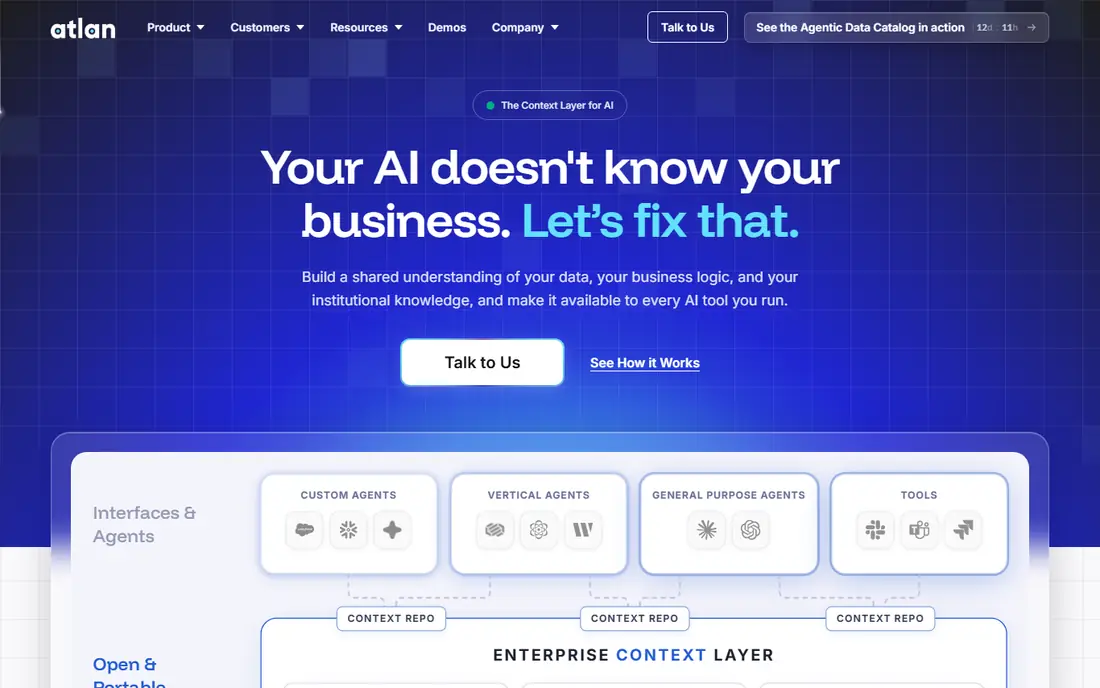
Atlan presents itself as a context layer for AI, and that framing fits the active metadata idea well. Instead of a catalog that someone updates by hand, Atlan pulls metadata from sources across the stack and keeps lineage and ownership current as things change. Its homepage highlights large enterprise customers and analyst recognition, which gives buyers confidence in its staying power.
The trade-off is cost and scope. Atlan is aimed at teams with a real data platform to govern, not a single warehouse with a handful of tables. If your team is building AI features on top of governed data, though, Atlan is a natural first demo.
- Modern interface that data teams enjoy using
- Active metadata from many sources
- Strong focus on AI-ready context
- Enterprise pricing needs a quote
- Smaller teams may not need the full governance depth
Alation
Ideal for: Intelligence and governance

Alation is one of the original data catalog vendors, and it has grown into what it calls an intelligence operating system for data and AI. The pitch is that it helps teams see whether a bad answer came from the data, the context, or the agent, and then fix the right part. That diagnostic view is useful when AI tools start answering questions from your warehouse.
For smaller teams, Alation can feel like a large platform for a modest problem. For organizations with many sources, many users, and compliance needs, its depth and history make it a safe choice, provided you budget time for rollout.
- Long history in data catalogs
- Machine learning assisted stewardship
- Governance and AI controls in one system
- The platform has grown wide, so implementation takes planning
- Pricing is quote based
Collibra
Ideal for: Enterprise governance
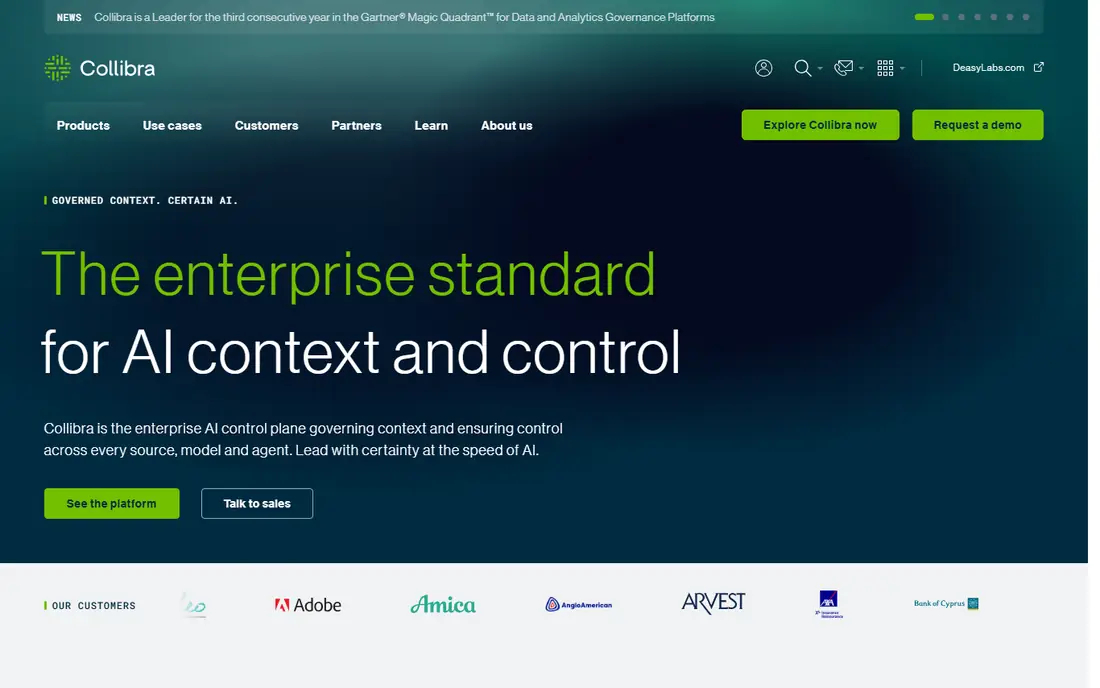
Collibra describes itself as an enterprise AI control plane, governing context and control across sources, models, and agents. In practice, that means a governed catalog, business glossary, lineage, and policy controls in one platform, built for organizations where data mistakes carry regulatory or financial cost. Its homepage lists many large customers across banking, health, and retail.
The honest catch is effort. Collibra rewards organizations that invest in data ownership and governance processes, and it will feel heavy for a team that just wants a searchable catalog. If governance is the job, though, few tools match its depth.
- Deep governance and lineage for large estates
- Ontology-based business context
- AI governance controls
- Enterprise price and implementation effort
- Overkill for a small data team
data.world
Ideal for: Knowledge graph catalog
data.world builds its catalog on a knowledge graph, which means it models relationships between datasets, terms, and people rather than just listing tables. That approach helps analysts ask questions in business terms and find related data they might otherwise miss. Its homepage stresses AI-ready search and governance, and notes that the company is now part of ServiceNow.
Buyers should ask how the ServiceNow ownership affects roadmap and pricing, since acquisitions often change bundles. On product merit alone, data.world is a strong pick for teams that think in terms of business meaning rather than raw tables.
- Knowledge graph approach to relationships between data
- Enterprise search that understands business meaning
- Now part of ServiceNow
- The ServiceNow acquisition may change packaging over time
- Pricing is quote based
OpenMetadata
Ideal for: Open source catalog
OpenMetadata is the open source option in this list, and it has grown into a serious catalog with connectors for many data services, lineage, glossary terms, and an API-first design. Its homepage claims thousands of enterprise deployments and a large contributor community, which matters for an open source tool because it signals ongoing maintenance.
The cost is not zero, even though the license is free. Someone on your team must deploy, upgrade, and support it, and that time has a price. For teams with engineering capacity and a wish to avoid vendor lock-in, OpenMetadata is an excellent choice.
- Free open source core with a large connector range
- Knowledge graph and lineage
- Active community and frequent releases
- Self-hosting needs engineering time
- Enterprise support and some features sit in paid tiers
Ataccama
Ideal for: Data trust and quality
Ataccama pairs metadata management with data quality, observability, and master data tools, under a data trust banner. That breadth matters because a catalog that lists bad data is only half useful. Its trust scoring and quality checks help teams know which datasets are safe to use, not just where they live.
If you only need a catalog, Ataccama may be more platform than you need. If your team is also fighting duplicate records and quality complaints, the combined approach can save buying and integrating a second tool.
- Catalog plus data quality and observability in one platform
- Trust scoring for datasets
- Strong partner ecosystem
- Broader than a pure catalog, so the catalog-only buyer may pay for extra depth
- Pricing is quote based
Select Star
Ideal for: Automated lineage
Select Star focuses on automated data documentation, lineage, and semantic models, built for teams that want AI-ready data without heavy manual upkeep. Its homepage stresses auto-generated documentation and complete lineage, which are the two features that most often decide whether a catalog stays useful after the first month.
The main check is connector coverage. Smaller vendors can be excellent for common warehouses and BI tools but thinner on niche sources, so confirm your exact stack is covered before a trial. For teams on a standard modern stack, Select Star is a focused and capable pick.
- Automated lineage and documentation
- Semantic models for AI use
- Clear focus on accuracy at scale
- Smaller vendor than Atlan or Collibra, so check connector coverage for your stack
- Pricing is quote based
Secoda
Ideal for: AI-ready data catalog
Secoda builds its catalog around AI agents that help with search, documentation, monitoring, and governance. Its homepage presents agents for analysis, automation, search, memory, observability, governance, documentation, visualization, and cataloging, all drawing on lineage and metadata. For analysts who want answers in plain language, that approach can lower the barrier to finding trusted data.
The caution is to test the agents, not just the catalog. AI features vary in quality across vendors, and a demo on polished sample data will not show how the tool handles your messy real tables. Run a trial on your own warehouse and judge the answers you get.
- AI agents for search, documentation, and monitoring
- Lineage and governance in one place
- Friendly interface for analysts
- The AI agent framing is newer, so test the agents on your own data
- Pricing is quote based
How we picked these
We compared official feature pages, pricing pages, and public reviews for metadata platforms that actively collect and update metadata from connected sources. We kept tools with a catalog, lineage, and governance or quality features, and we left out static documentation tools, tools with no clear vendor homepage, and single-purpose lineage viewers. We favored tools with a trial, demo, or open source edition, since connector coverage and usability can only be judged on your own stack.
What to check in a trial
Start with your three most important sources, such as your warehouse, your BI tool, and your main pipeline orchestrator. Connect them first and check whether lineage appears without manual work, whether owners and descriptions carry over, and whether search finds tables by business terms as well as technical names. A tool that needs heavy manual setup for those three sources will struggle at scale.
Next, bring in the people who will own the data. A catalog succeeds when data owners update descriptions, approve terms, and answer questions in it, and fails when only the platform team logs in. Ask owners to complete a small task in the trial, such as finding a table and checking its lineage, and watch where they get stuck. Their friction points will predict adoption better than any feature checklist.
Finally, check the exit path. Ask how metadata exports, what happens to your glossary and lineage if you leave, and whether the tool supports open standards. A catalog holds your institutional knowledge, and you should be able to take that knowledge with you.
Frequently asked questions
What is active metadata management?
Active metadata management means the catalog updates itself from your data stack instead of waiting for manual edits. When a pipeline changes, a table is renamed, or a dashboard breaks, the metadata reflects that change. The goal is a catalog that stays current without a team spending all its time maintaining it.
How is active metadata different from a data catalog?
A traditional catalog is often a static inventory that goes stale. An active metadata platform adds automation: it collects metadata continuously, builds lineage, flags anomalies, and can trigger actions such as alerts or access reviews. In practice, the best modern catalogs are active, and the term marks that shift.
Do small teams need active metadata software?
Small teams with one warehouse and a few dashboards may manage with documentation and naming conventions. The case for a platform grows when sources multiply, when new analysts join often, or when AI tools start querying your data. At that point, a catalog that updates itself saves more time than it costs.
Is OpenMetadata really free?
The open source core is free to download and run, but self-hosting takes engineering time for deployment, upgrades, and support. Paid tiers add managed hosting, support, and some enterprise features. For teams with engineering capacity, the total cost can still be far below a commercial license.
What should we check before buying?
Check connector coverage for your exact sources, test lineage on a real pipeline, and confirm who will own the catalog after rollout. Also check pricing for your user count and data volume, since metadata platforms often price by users, sources, or assets. A short paid pilot on your own stack is worth more than a long sales demo.