Best AEO Tracking Tools in 2026: 7 Platforms Compared

- Profound is the most complete enterprise option, but its public pricing now centers on a free trial and custom enterprise plans, so ask for a quote before budgeting.
- Peec AI and Otterly offer the most accessible starting prices for small teams and agencies.
- Scrunch adds site audits and agent experience checks alongside monitoring, which suits technical teams.
- AEO numbers differ between tools because each samples different prompts and engines, so track trends rather than single scores.
Quick comparison
| Product | Ideal for | Price from | Free version | |
|---|---|---|---|---|
 Profound | Enterprise AI visibility | See website | Free trial | Visit |
 Peec AI | Agencies and mid-market teams | $95 per month | Free trial | Visit |
 Scrunch | Monitoring plus site audits | $250 per month | No | Visit |
 AthenaHQ | Sentiment and hallucination monitoring | See website | Free trial | Visit |
 Otterly AI | Budget AI citation monitoring | $29 per month | Free trial | Visit |
 Goodie | End-to-end AEO execution | $295 per month | No | Visit |
 Semrush AI Visibility Toolkit | SEO teams already using Semrush | $99 per month | Free trial | Visit |
The best AEO tracking tools
AEO tracking tools, also called AI visibility tools, watch how AI answers from ChatGPT, Perplexity, Gemini and Google AI Overviews mention, cite or describe your brand. Traditional SEO tools cannot see most of that, since AI answers are generated per prompt. The seven platforms below all track AI answers today, but they differ in engines covered, prompt volume and price.
Profound
Ideal for: Enterprise AI visibility

Profound is the benchmark name in AI visibility, used by large brands to track how they appear across AI answers. Its prompt data shows which questions real users ask in a category, and its agent analytics show how AI crawlers visit your site, which helps teams connect visibility to site changes.
The catch is price transparency. Profound now offers a free trial with custom enterprise pricing rather than a published monthly plan, so budget holders should request a quote based on engines and prompt volume. For an enterprise team that reports AI visibility to leadership, that depth is worth it; for a small site, a cheaper tracker may cover the essentials.
- Covers many AI surfaces including ChatGPT, Claude, Perplexity and Gemini
- Prompt demand data shows what buyers actually ask
- Agent analytics track AI crawlers
- No public monthly price for full plans
- Enterprise focus may be more than a small site needs
Peec AI
Ideal for: Agencies and mid-market teams
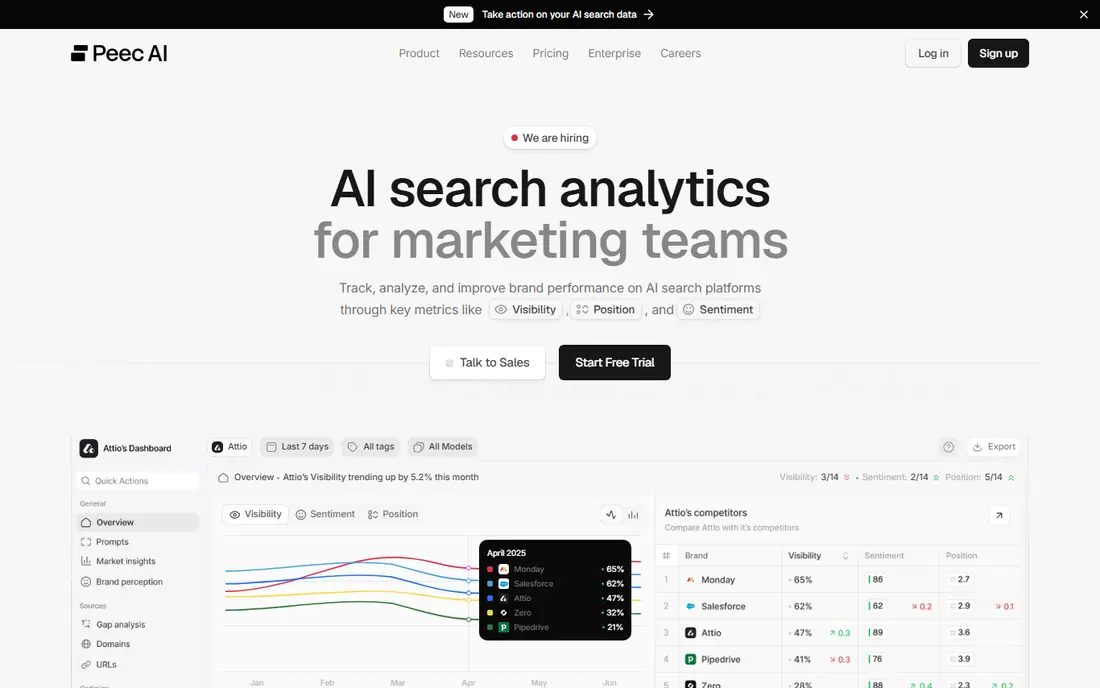
Peec AI focuses on doing the core job well: tracking prompts, citations and sentiment across AI engines, with competitor comparisons and alerts when visibility drops. Its interface is clean enough for agency reporting, and geography breakdowns help teams that operate in more than one market.
Starting at around $95 per month, it is one of the more accessible serious options, though entry plans cover fewer engines than the full enterprise tier. For agencies running several client brands, Peec is a practical middle ground between budget trackers and enterprise suites.
- Clean analytics with sentiment and geography breakdowns
- Competitor benchmarking
- Sensible starting price for the coverage
- Entry plan covers fewer engines than enterprise plans
- Smaller feature set than the biggest platforms
Scrunch
Ideal for: Monitoring plus site audits

Scrunch covers the full loop from monitoring AI answers to auditing your site for AI readiness and checking how agents experience your pages. That breadth suits technical marketing teams that want to act on findings, not just read reports, and its Sitecore ownership gives larger buyers confidence in its future.
The starting price of around $250 per month billed yearly puts it above budget tools, and small sites may not use the deeper features. For mid-market and enterprise teams that treat AI visibility as a channel to manage, Scrunch is one of the strongest shortlist options.
- Covers observation, understanding, action and agent delivery
- Site audits check AI readiness
- Now part of Sitecore
- Higher starting price than budget trackers
- More platform than a small site needs
AthenaHQ
Ideal for: Sentiment and hallucination monitoring
AthenaHQ stands out for what it watches: not just whether your brand appears, but how AI systems describe it, including sentiment shifts, crisis signals and hallucinations that misstate facts about your products. That focus matters for brands where a wrong AI answer can cost trust or sales.
It also connects with GA4, Search Console and Shopify, tying AI visibility to traffic and store data. Pricing is less public than rivals, so expect a demo and quote. For revenue-focused teams worried about brand accuracy, AthenaHQ deserves a look alongside the bigger names.
- Focus on sentiment, crisis signals and hallucinations
- Connects with GA4, Search Console and Shopify
- Actionable recommendations
- Pricing is not fully public
- Newer brand with a smaller track record than Profound
Otterly AI
Ideal for: Budget AI citation monitoring
Otterly AI is the cheapest credible entry point for AI visibility, starting at around $29 per month with several engines included. It tracks brand mentions and citations across AI answers daily, which is enough for a small business that mainly wants to know whether it shows up and how that changes week to week.
It lacks the depth of Profound or Scrunch on prompt demand and enterprise reporting, and agencies with many clients may outgrow it. But as a first AEO tool, it is easy to justify, and its low price makes it a good way to learn what AI visibility data actually looks like before spending more.
- Lowest credible entry price on this list
- Covers several engines on the entry plan
- Simple daily monitoring
- Fewer enterprise features and integrations
- Less depth on prompt demand data
Goodie
Ideal for: End-to-end AEO execution
Goodie aims beyond monitoring: it measures AI visibility, recommends optimizations, and ties results back to outcomes, which is why enterprise buyers rate it highly in 2026 comparisons. Its core plan starts at around $295 per month billed yearly, with up to 14 engines on enterprise plans.
That price puts it out of reach for hobby sites, and small teams may find the execution layer more than they need at first. For brands treating AI search as a core growth channel with budget to act, Goodie is one of the most complete options on this list.
- Closed loop from measurement to optimization and attribution
- Covers many engines on higher plans
- Expert support included on some plans
- Entry price is high for small sites
- Full engine coverage needs higher tiers
Semrush AI Visibility Toolkit
Ideal for: SEO teams already using Semrush
If your team already lives in Semrush, its AI Visibility Toolkit is the lowest-friction way to add AEO tracking. It reports AI mentions and citations per domain alongside the keyword, backlink and traffic data your team already uses, so AI visibility joins existing reports instead of living in a separate tool.
The toolkit is priced from around $99 per month per domain as an add-on, with prompt limits on entry tiers. It is less specialized than Profound or Scrunch, but for SEO teams that want one workflow, that integration is a genuine advantage.
- Sits inside a familiar SEO suite
- Per-domain pricing is easy to understand
- Pairs AI data with keyword and backlink data
- Add-on pricing on top of a Semrush subscription
- Prompt limits on the entry tier
How we picked these
We compared official product pages, pricing pages and recent independent comparisons of AI visibility tools, focusing on engines covered, prompt allowances, citation tracking and whether pricing is public. We favored tools that are actively sold today and publish enough detail for a buyer to compare plans without a sales call.
We also treated reported scores with care. Different tools sample different prompts and engines, so their numbers for the same brand often disagree. That is why we recommend tracking trends inside one tool over time rather than comparing absolute scores across tools.
How to buy an AEO tracker without wasting money
Start by listing the engines your buyers actually use. If most of your traffic comes from Google, AI Overviews coverage matters most. If buyers research in ChatGPT or Perplexity, those engines matter more. A tool that covers ten engines you do not need is worse value than a cheaper tool that covers your three well.
Check prompt counts, not just engine counts
Each plan includes a number of tracked prompts, and that limit decides how many products, topics and competitors you can follow. Ask vendors how prompts are counted, whether you can add more, and what happens when you hit the limit. A plan that looks cheap at 25 prompts can get expensive fast at 200.
Compare scores carefully
Because tools sample different prompts, their visibility scores are not directly comparable. Pick one tool as your source of truth, record a baseline, and judge progress by movement in that tool over months. Use a second tool only for spot checks, not for mixing numbers into one report.
Decide whether you need action or just measurement
Budget trackers report what AI answers say. Platforms like Scrunch and Goodie also help you fix the site and content behind those answers. If your team has nobody to act on recommendations, start with measurement only and upgrade when you have capacity to act.
Frequently asked questions
What is the best AEO tracking tool?
For enterprises, Profound is the most widely used benchmark, while Scrunch and Goodie offer deeper action layers. For small teams, Otterly at around $29 per month is the most accessible credible start, and Peec AI suits agencies at around $95 per month.
What is AEO tracking?
AEO tracking, also called AI visibility tracking, monitors how AI answers from tools like ChatGPT, Perplexity, Gemini and Google AI Overviews mention, cite or describe your brand. It tracks prompts, citations, sentiment and competitor visibility that traditional SEO tools cannot see.
Why do AEO tools report different numbers for the same brand?
Each tool samples different prompts, asks them at different times, and covers different engines, so their scores naturally differ. Use one tool consistently and watch trends over time rather than comparing absolute numbers across tools.
Do I need an AEO tool if I already use Ahrefs or Semrush?
SEO tools measure keywords and backlinks, while AEO tools measure AI-generated answers, which follow different rules. Semrush now offers an AI Visibility Toolkit that bridges the two, but dedicated AEO platforms still go deeper on prompts, citations and sentiment.
How much does AEO tracking cost?
Entry prices in 2026 range from around $29 per month for Otterly to around $95 for Peec AI and $99 for Semrush add-ons, with mid-market plans around $250 to $295 and enterprise plans, including Profound, custom priced. Prompt counts and engine coverage drive the real cost, so compare those before price alone.