7 Best Agentic Analytics Tools for Data Analysis Options for 2026

- 1
 AnswerRocketCustom AI analysts on company dataVisit
- 2
 SigmaSpreadsheet-style analysis on warehouse dataVisit
- 3
 HexData teams that want notebooks plus AI workflowsVisit
- 4
 ThoughtSpotEnterprises adopting agentic BI at scaleVisit
- 5
 Julius AIIndividuals and small teams analyzing filesVisit
- AnswerRocket takes the first slot, best suited to custom AI analysts on company data.
- The lowest published monthly entry price here is $25 per user/month, from ThoughtSpot.
- Domo fits consolidating plenty of sources into one product.
- One limit worth knowing about Sigma: no public pricing makes budgeting harder.
Direct answer
If you need custom AI analysts on company data, AnswerRocket is the first tool to look at here. For a different need, Sigma covers spreadsheet-style analysis on warehouse data and Hex covers data teams that want notebooks plus AI workflows. Details, prices and limits for the rest of the 7 tools are below.
Quick comparison
| Product | Ideal for | Price from | Free version | |
|---|---|---|---|---|
| AnswerRocket | Custom AI analysts on company data | See website | No | Visit |
| Sigma | Spreadsheet-style analysis on warehouse data | See website | Free trial | Visit |
| Hex | Data teams that want notebooks plus AI workflows | See website | Yes | Visit |
| ThoughtSpot | Enterprises adopting agentic BI at scale | $25 per user/month (Essentials, billed annually) | Free trial | Visit |
| Julius AI | Individuals and small teams analyzing files | Free; Pro from $16/month (billed annually) | Yes | Visit |
 Count | Visual, canvas-style collaborative analysis | See website | Yes | Visit |
 Domo | Consolidating plenty of sources into one product | See website | Free trial | Visit |
Tool-by-tool breakdown
If you are comparing agentic analytics tools for data analysis, this page covers 7 tools in one place: what each is best for, what it costs to start, whether it has a free plan, and the main limit to know about.
AnswerRocket
Ideal for: Custom AI analysts on company data
In short, AnswerRocket is for custom AI analysts on company data. It builds custom AI analysts trained on a company's own data, metrics, and vocabulary, so answers reflect how the business actually talks about itself. That customization is the reason regulated and complicated organizations consider it: a generic agent guesses at terminology, whereas AnswerRocket's agents are taught it.
What to check first: Custom pricing means a long sales cycle.
Everything about the product is enterprise-shaped, from the onboarding to the pricing, which is quoted per deployment. For everyday use, if your need is a dashboard with a chat box on top, the lighter tools here will get you there quicker and less expensive. AnswerRocket shows no starting price here, so confirm the cost on the vendor site. AnswerRocket does not include a free plan.
- Capable fit for complicated or regulated domains
- Custom AI agents trained on company data and terminology
- Overkill for teams that require straightforward self-serve dashboards
Sigma
Ideal for: Spreadsheet-style analysis on warehouse data
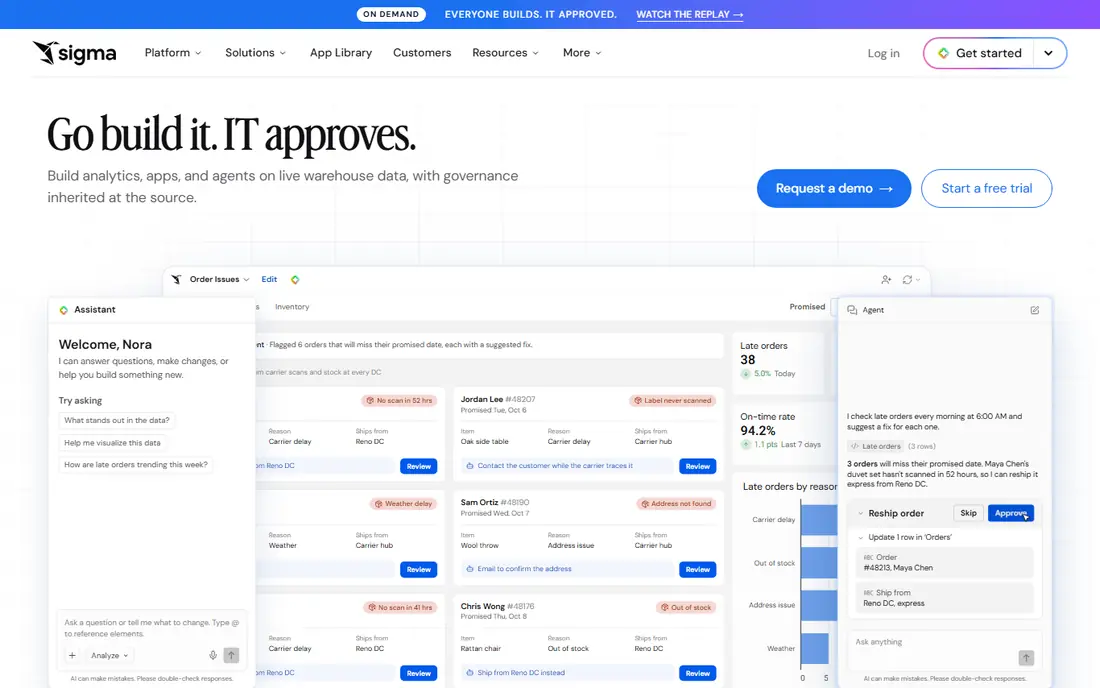
In short, Sigma is for spreadsheet-style analysis on warehouse data. There are no extracts to refresh and no data to move: formulas and pivot-style operations run as warehouse queries. Worth adding: buyers should also plan for the warehouse bill.
Where it falls short: Heavy usage needs warehouse cost discipline.
The vendor provides a free trial but publishes no pricing, which is usual for warehouse-native BI sold to mid-market and enterprise teams. Sigma's insight is that most business users already think in spreadsheets. So it puts a spreadsheet interface straight on top of cloud data warehouses. Check the vendor site for Sigma pricing; none is listed in this comparison. Trial and free access: Free trial.
- Familiar spreadsheet interface running on cloud warehouses
- Governed metrics with live data and no extracts
- No public pricing makes budgeting harder
Hex
Ideal for: Data teams that want notebooks plus AI workflows
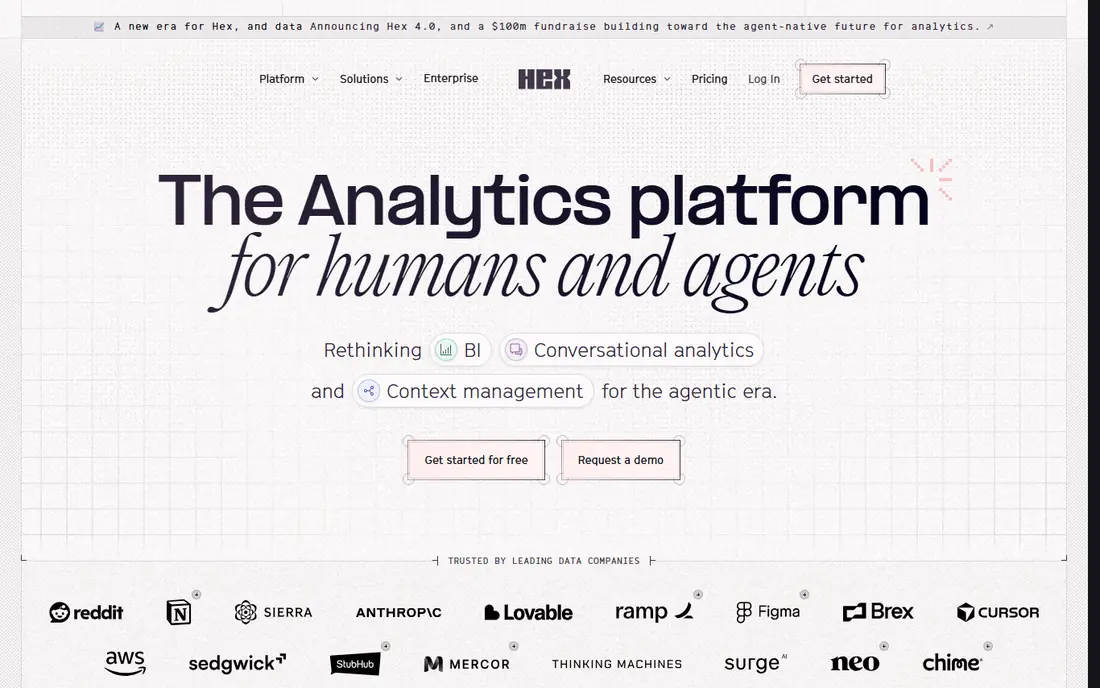
Pick Hex if this describes you: data teams that want notebooks plus AI workflows. Data teams write SQL and Python in collaborative notebooks, and Magic AI helps generate and debug code along the way.
The central friction is on the business-user side: Hex rewards people who are comfortable with data, and non-technical users may still prefer a pure search or chat interface. The free Community plan is enough to learn the product, whereas Professional and Team levels add the collaboration and governance features a company needs. Pricing for Hex is not stated here, so ask the vendor for current figures. A free plan is available with Hex.
What to check first: Pricing is not published on the vendor site.
- Magic AI assists with SQL and Python inside notebooks
- Links well with modern data stacks
- Casual business users face a ramp-up time
ThoughtSpot
Ideal for: Enterprises adopting agentic BI at scale
ThoughtSpot works best for enterprises adopting agentic BI at scale. ThoughtSpot built its reputation on search-driven analytics, and its agentic push is the most mature in this lineup. Worth adding: Spotter, its AI analyst, takes a plain-language question and returns an answer with visualizations, working from governed data models instead of raw tables.
Limits to weigh: well-modeled data to perform well.
That design matters: when the definitions are approved in advance, the agent's answers stay consistent with what finance and leadership already trust. Teams should also be honest about data readiness. Starting cost for ThoughtSpot: $25 per user/month. Free plan details: Free trial.
- Search-driven interface business users actually adopt
- Embedded analytics choices for SaaS products through StartupSpot
- Needs clean
Julius AI
Ideal for: Individuals and small teams analyzing files
Think of Julius AI for individuals and small teams analyzing files. You upload a file, ask a question in plain English, and get charts, statistics, and written explanations back.
Limits to weigh: Restricted depth for advanced data modeling.
Beyond that, the tradeoff is governance. The free plan covers light usage, and Pro opens at $16 a month billed yearly, which keeps it low-cost for freelancers and small teams. On cost, Julius AI starts like this: Free. Julius AI offers a free plan.
- Genuinely handy free level for light work
- Works straight on uploaded files with no setup
- Not a governed BI system for company-wide reporting
Count
Ideal for: Visual, canvas-style collaborative analysis
Count is built with visual, canvas-style collaborative analysis in mind. Count takes a different visual approach from the dashboard grid. Its canvas lets analysts lay out SQL queries, visualizations, and written notes on one free-form surface, which mirrors how analysis actually happens: messy, iterative, and full of context.
Worth adding: the vendor is also smaller than the enterprise names here, which means a thinner integration ecosystem and fewer public case studies to learn from. More specifically, external directories list a free version and premium plans around $34 per editor a month, but Count does not publish pricing we could verify on its own site, so treat that figure as unconfirmed. No starting price is listed for Count here; confirm pricing on the vendor site. Count has a free plan.
Main advantages: notes together.
- Collaborative by design for data teams
- Free-form canvas lets analysts arrange queries, charts
- Smaller ecosystem than the big BI vendors
Domo
Ideal for: Consolidating plenty of sources into one product
Domo serves consolidating plenty of sources into one system. Pricing is credit-based and quoted, with a 30-day free trial to evaluate the product.
Where it falls short: Enterprise rollouts need careful planning.
Domo does not show a starting price in this comparison, so check the vendor site for current pricing. Free plan details: Free trial.
- Data prep
- AI features across dashboards, alerts
- Credit-based pricing can surprise buyers
What went into this list
Selection started from tools commonly considered for agentic analytics tools for data analysis, then narrowed to 7 that have clear pricing information or a clear quote process. Seat minimums, billing terms and add-ons can move the real cost, so the starting prices here are a guide and not a quote. Order on the page follows fit for the typical buyer first, then price transparency and free access. Your own requirements should decide the final pick.
Questions to settle before buying
- Ask AnswerRocket, Sigma, Hex and others for a written quote, since no starting price is shown.
- Read the fine print on the free plans from Hex, Julius AI and Count; seat, project and feature caps differ.
- Use real work to test the free trial from Sigma, ThoughtSpot and Domo, rather than a demo project.
- Read the limits listed for AnswerRocket first: custom pricing means a long sales cycle.
- Before rolling out AnswerRocket, verify the integrations your workflow depends on.
- Let daily users try Sigma on real work; their feedback beats any feature checklist.
Frequently asked questions
How are the tools for agentic analytics tools for data analysis ordered?
AnswerRocket sits first and Domo last because the order follows typical fit for agentic analytics tools for data analysis, then price clarity and free access. It is a judgement call, so read each profile for fit and limits.
Do I still need a data team if I buy an agentic analytics tool?
Yes, though the team's work shifts. The agent removes the ticket queue for routine questions; it does not remove the need for trustworthy data underneath.
Which options for agentic analytics tools for data analysis have a free plan?
Hex, Julius AI and Count offer a free plan in this list. Free plans usually cap users, projects or features, so check the limits on the vendor page. Several others offer a trial instead.
Can I try these tools before paying?
Often, yes. Hex, Julius AI and Count have a free plan and Sigma, ThoughtSpot and Domo offer a free trial. Use your own data and a real task during the test, and check what the free tier or trial limits before you rely on it.
What is agentic analytics?
Agentic analytics refers to AI agents that perform analysis tasks on their own: interpreting a question, querying data, choosing a visualization, and explaining the result. Unlike a general chatbot, it works against your company's data with guardrails.
Do these tools publish their prices?
Not all of them. AnswerRocket, Sigma, Hex and others publish no starting price, so expect a quote request for those. The rest, ThoughtSpot included, show a starting price, though seats and billing terms still change the final cost.