Top 7 AI Call Center Software Options for 2026, Compared

- 1
 NICE CXoneContact centers that require workforce management baked into the sameVisit
- 2
 8x8SMBs that want unified communications and a contact centerVisit
- 3
 TalkdeskLarge enterprises with industry-specific compliance and workflow needsVisit
- 4
 RingCX (RingCentral)Firms already running RingCentral phoneVisit
- 5
 AircallSmall sales and support teamsVisit
- NICE CXone sits first on this list: contact centers that require workforce management baked into the same product.
- Dialpad fits mid-sized teams that want phone, contact center, and meetings in one app.
- Just one of the 7 tools, Amazon Connect, has a free plan.
- Aircall is the lowest-priced starter here at $30-$50/user/month.
Direct answer
Our first pick is NICE CXone, best for contact centers that need workforce management baked into the same product. 8x8 fits SMBs that want unified communications and a contact center from one vendor; Talkdesk fits large enterprises with industry-specific compliance and workflow needs. The other 4 tools in the list cover narrower or pricier cases.
Quick comparison
| Product | Ideal for | Price from | Free version | |
|---|---|---|---|---|
| NICE CXone | Contact centers that require workforce management baked into the same | See website | No | Visit |
| 8x8 | SMBs that want unified communications and a contact center | See website | No | Visit |
| Talkdesk | Large enterprises with industry-specific compliance and workflow needs | See website | No | Visit |
| RingCX (RingCentral) | Firms already running RingCentral phone | $65/user/month | No | Visit |
| Aircall | Small sales and support teams | $30-$50/user/month | No | Visit |
 Amazon Connect | AWS-native firms and teams with seasonal or spiky call volume | $0.038/minute of voice (pay as you go) | Yes | Visit |
 Dialpad | Mid-sized teams that want phone | See website | No | Visit |
The best AI call center software
This Ainotely guide covers 7 options for AI call center software. Each profile lists a starting price, free plan details, strengths and drawbacks, so you can drop poor fits quickly.
NICE CXone
Ideal for: Contact centers that require workforce management baked into the same
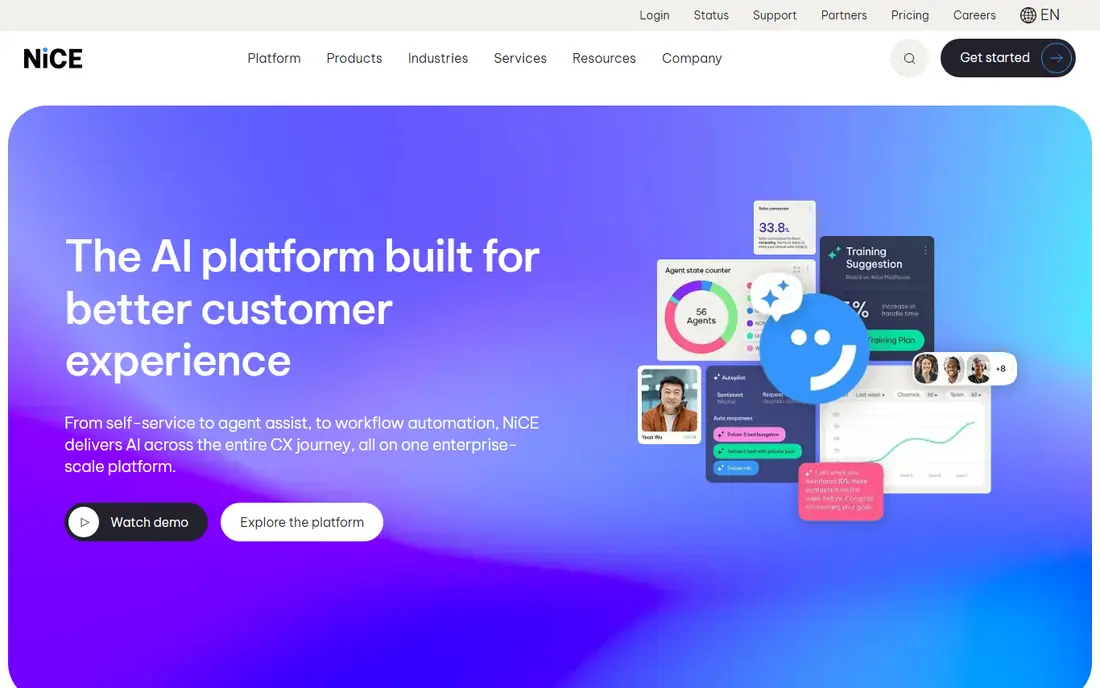
In short, NICE CXone is for contact centers that require workforce management baked into the same product. NICE rebuilt CXone around AI after acquiring Cognigy, and the homepage now reads as an AI-first product: agentic AI agents, self-service, agent assist, workflow automation, and domain-specific AI, all on one enterprise-scale foundation.
NICE CXone does not show a starting price in this comparison, so check the vendor site for current pricing. No free plan comes with NICE CXone.
Honest limits: No public pricing.
- 25B+ interactions per year per the vendor
- Cognigy conversational AI folded into the product
- System breadth can overwhelm smaller teams
8x8
Ideal for: SMBs that want unified communications and a contact center
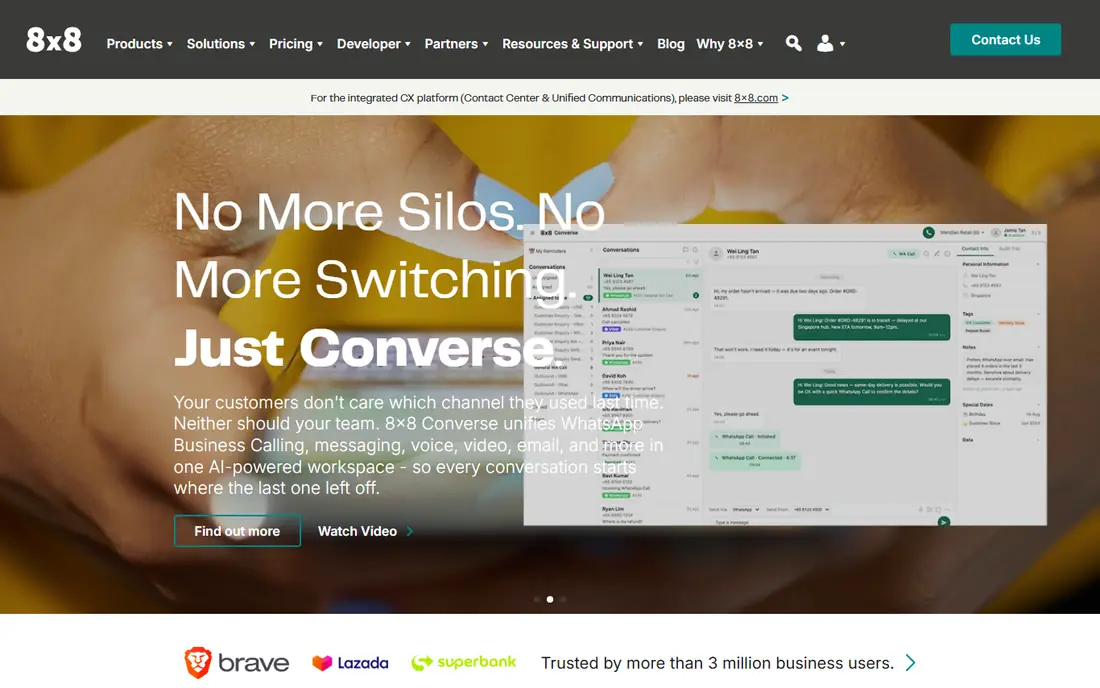
In short, 8x8 is for SMBs that want unified communications and a contact center from one vendor. Newer additions contain 8x8 AI Routing, which pairs customers with the best available expert rather than relying on rigid IVR trees.
It is the pragmatic pick for teams that value one throat to choke over best-of-breed everything. 8x8 shows no starting price here, so confirm the cost on the vendor site. 8x8 has no permanent free option.
Downsides: Contact center depth trails the pure-play leaders.
- 8x8 Work brings together voice, video, chat
- Messaging in one app
- Fewer AI-agent capabilities than the top level
Talkdesk
Ideal for: Large enterprises with industry-specific compliance and workflow needs
Talkdesk is built with large enterprises with industry-specific compliance and workflow needs in mind. Talkdesk positions its CX Cloud as a full customer experience suite instead of a phone system. As for the details, no-code tools let admins configure routing and workflows without starting from scratch.
Where it falls short: Enterprise-first complexity for smaller teams.
Also, for a bank or insurer with strict compliance requirements, that matters more than generic AI transcription. Beyond that, the trade-off is cost and weight. In daily use, the differentiator is vertical depth: Talkdesk ships Industry Experience Clouds for financial services, insurance, healthcare, retail, travel, and government, each with prebuilt workflows and AI trained for that sector's vocabulary and processes. Talkdesk shows no starting price here, so confirm the cost on the vendor site. There is no free plan with Talkdesk.
- Industry Experience Clouds for finance, insurance, healthcare, retail
- AI-powered omnichannel engagement
- Quote-only pricing
RingCX (RingCentral)
Ideal for: Firms already running RingCentral phone
RingCX (RingCentral) makes the most sense for companies already running RingCentral phone that want to add a contact center. RingCX is RingCentral's AI-first contact center, and it has one advantage none of the heavyweight rivals share: a public starting price of $65 per user a month with unlimited minutes, bundling core contact center features and AI tools in one license.
Beyond that, the newer AIR Pro builder lets teams design conversational AI agents across voice, SMS, chat, and social using natural language prompts, with no coding required. Entry price for RingCX (RingCentral): $65/user/month. RingCX (RingCentral) does not include a free plan.
Points against: Newer product than Genesys or Five9.
- Tight integration with RingEX
- Public starting price of $65 a user per month
- No free level
Aircall
Ideal for: Small sales and support teams
Aircall makes the most sense for small sales and support teams that require a working phone system today. It is a cloud phone system and call center designed for teams that require to start calling today: shared inboxes, live coaching, call transcription, sentiment analysis, and automatic CRM updates are all present, and the vendor claims 23,000+ businesses and 250+ integrations with Salesforce, HubSpot, Zendesk, and the rest.
From a buyer's view, AI Assistants support live conversations with real-time guidance, transcription, and automatic follow-ups, whereas AI Agents answer immediately and resolve routine requests around the clock, escalating with full context when a human is needed. Worth adding: pricing is public at $30 to $50 per user a month. Starting cost for Aircall: $30-$50/user/month. No free plan comes with Aircall.
Limits to weigh: Restricted workforce management depth.
- AI agents plus live AI assistants
- 250+ native integrations
- Support quality gets mixed reviews
Amazon Connect
Ideal for: AWS-native firms and teams with seasonal or spiky call volume
Amazon Connect makes the most sense for AWS-native businesses and teams with seasonal or spiky call volume. Amazon Connect throws out the seat-license model entirely. On top of that, the current system centers on agentic AI: business users design conversational experiences on a no-code visual canvas, and AI agents resolve requests end to end whereas working alongside human agents in live.
This is the choice for teams whose volume fluctuates. The trade-off is operational: Link assumes AWS competence, and contact flow design, analytics, and compliance (HIPAA-eligible, PCI DSS, FedRAMP, SOC, ISO, GDPR) are yours to configure. You pay per interaction by channel ($0.038 per minute of voice, $0.010 per chat message, $0.014 per SMS, $0.080 per email), with no minimums, no long-term contracts, and no separate AI license fees. From a buyer's view, if your team already lives in AWS, the fit is natural. If not, expect a steeper climb than a SaaS contact center. What you pay to start with Amazon Connect: $0.038/minute of voice. A free plan is available with Amazon Connect.
Trade-offs to know: Needs real AWS expertise to run well.
- Pay-per-interaction with no seat licensing
- No-code visual canvas for contact flows
- Reporting needs building instead of buying
Dialpad
Ideal for: Mid-sized teams that want phone
Dialpad works best for mid-sized teams that want phone, contact center, and meetings in one app. For an expanding company that does not want to stitch together several vendors, that simplicity is worth a lot. Beyond that, the product merges a business phone system, contact center, video meetings, and messaging with an AI layer that takes notes, flags sentiment, and coaches agents in live.
Where it is weaker: Contact center features sit on higher levels.
Its newer Resolve product adds agentic AI that takes care of tasks like scheduling, refunds, and order processing across voice and digital channels. Dialpad's pitch is that customer context should live in one place. Dialpad does not show a starting price in this comparison, so check the vendor site for current pricing. No free plan comes with Dialpad.
- Resolve AI agents for autonomous resolution
- Unified voice, video, messaging
- Less depth than pure CCaaS vendors at large scale
What went into this list
Ainotely used vendor pricing pages and product documentation as the base, then compared plans, free access and documented limits for 7 tools. Treat prices as a snapshot: vendors change plans often, so check the vendor site for the figure that applies today. We ordered the tools by general fit, then by how clearly pricing is shown, then by free access. A buyer with unusual needs may reorder them.
Things to verify first
- Ask NICE CXone, 8x8, Talkdesk and Dialpad for a written quote, since no starting price is shown.
- Look at the free plan from Amazon Connect closely: its caps decide whether it is usable for real work.
- Before choosing NICE CXone, weigh its main limit: no public pricing.
- Read the plan comparison for Amazon Connect carefully; key features often start on a higher tier.
- Get the contract term, renewal terms and any onboarding fees from NICE CXone in writing.
Frequently asked questions
How much does AI call center software cost?
It relies on the pricing model. Amazon Connect charges $0.038 per minute of voice with no seats, which can be less expensive for fluctuating volumes. Always model your real call volume against the model, not the headline price.
Is NICE CXone the right pick for everyone comparing AI call center software?
No single tool suits every team. NICE CXone comes first because it fits contact centers that need workforce management baked into the same platform, while 8x8 suits SMBs that want unified communications and a contact center from one vendor and Talkdesk suits large enterprises with industry-specific compliance and workflow needs. Match the tool to your own size, budget and workflow before deciding.
Do these tools publish their prices?
Not all of them. NICE CXone, 8x8, Talkdesk and Dialpad publish no starting price, so expect a quote request for those. The rest, RingCX (RingCentral) included, show a starting price, though seats and billing terms still change the final cost.
Will these tools work with my CRM?
The depth varies: entry-level integrations log calls, whereas deeper ones screen-pop customer records, write AI summaries into tickets, and sync conversation data automatically. Confirm the specific integration depth for your CRM before buying.
Can I try these options before paying?
Often, yes. Amazon Connect has a free plan. Use your own data and a real task during the test, and check what the free tier or trial limits before you rely on it.
Can AI agents completely replace human agents?
Not for most companies. Plan for a blend: AI for the repeatable work, people for judgment calls and sensitive situations.