Best AI Chatbots for Customer Service in 2026: 8 Tools Compared

- 1
 IntercomSaaS and digital-first teamsVisit
- 2
 Zendesk AILarge support teamsVisit
- 3
 FreshdeskSmall businesses wanting valueVisit
- 4
 HubSpot Service HubTeams already on HubSpotVisit
- 5
 TidioSmall teams on a budgetVisit
- Intercom and Zendesk AI are the safest picks for most teams, since they pair a strong AI agent with a full help desk behind it.
- Small teams on a budget should start with Tidio or Freshdesk, which offer usable AI features at much lower entry prices.
- Ecommerce brands on Shopify will get more from Gorgias, which is built around order data and ticket volume.
- B2B companies that care about booking meetings should look at Drift, while regulated or high-volume teams should shortlist Ada.
- Watch the pricing model closely: some tools charge per seat, some per AI resolution, and some do both, so the cheapest headline price is not always the cheapest bill.
Quick comparison
| Product | Ideal for | Price from | Free version | |
|---|---|---|---|---|
| Intercom | SaaS and digital-first teams | $29 per seat per month | No | Visit |
| Zendesk AI | Large support teams | $19 per agent per month | No | Visit |
| Freshdesk | Small businesses wanting value | $19 per agent per month | Yes | Visit |
| HubSpot Service Hub | Teams already on HubSpot | $10 per seat per month | Yes | Visit |
| Tidio | Small teams on a budget | $24.17 per month | Yes | Visit |
 Gorgias | Shopify and ecommerce brands | $10 per month | No | Visit |
 Drift | B2B conversational marketing | See website | No | Visit |
 Ada | High-volume enterprises | See website | No | Visit |
The best ai chatbots for customer service
These eight tools cover the range from small-team chat widgets to enterprise AI agents. We compared official pricing pages, feature pages and public reviews, with attention to how each tool charges for AI resolutions and how it hands off to a human.
Intercom
Ideal for: SaaS and digital-first teams
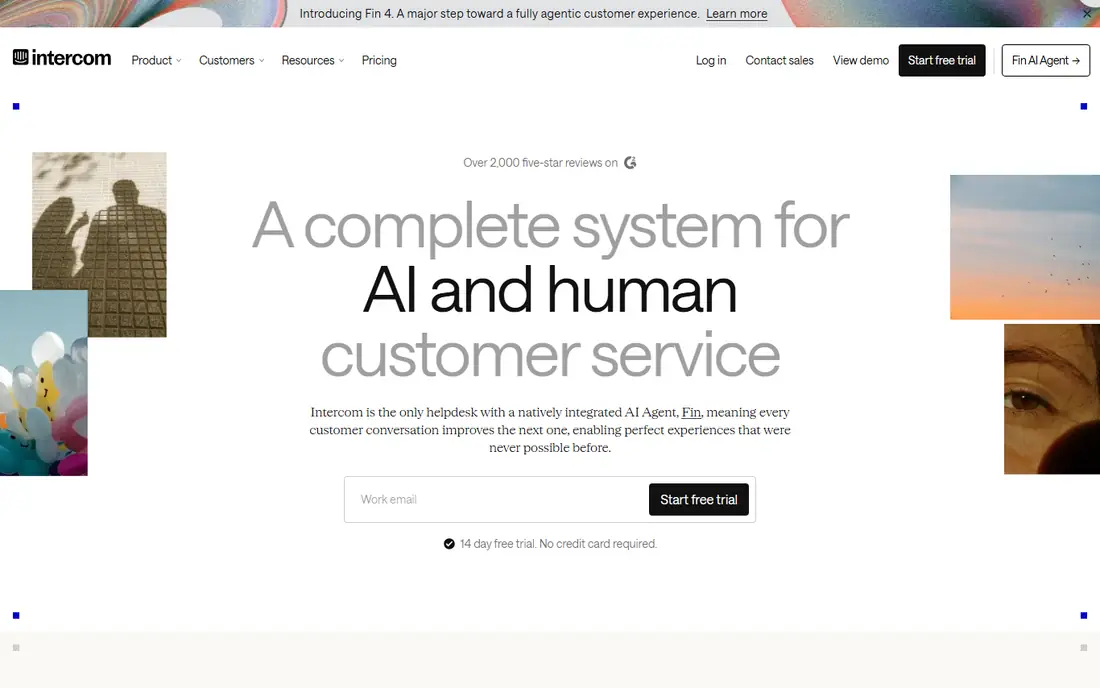
Intercom is the most complete pick for a software or online business that lives on chat. Its Fin AI agent answers from your help center and past conversations, scores its own confidence, and hands off to a human with full context when it is unsure. That combination keeps response times short without leaving customers stuck in a bot loop.
The pricing needs care. Seats start at $29 per month, and AI resolutions are billed separately at around $0.99 each, so a high-volume inbox can grow expensive. For a team that already runs support through Intercom, though, the integration is hard to beat, and the automation tools for onboarding and proactive messages add real value beyond the bot.
- Fin AI agent resolves common questions
- Unified inbox for chat, email and social
- Strong automation
- Costs rise quickly with seats and resolutions
- Smaller teams may pay for features they never use
Zendesk AI
Ideal for: Large support teams
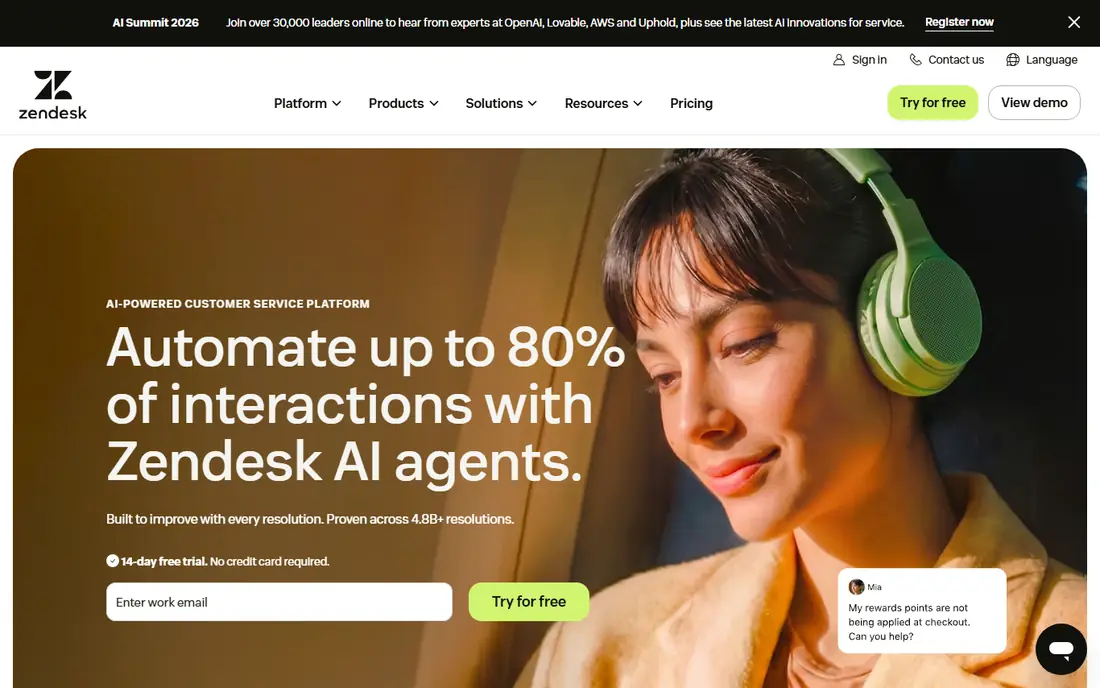
Zendesk AI suits support teams that already handle tickets at scale. Its AI tools route tickets, summarize long threads, suggest replies and resolve common questions, all inside a help desk that already covers chat, email, phone and social. For a large team, that depth matters more than a flashy demo.
The trade-off is complexity. Zendesk has many settings, and smaller teams can find the setup heavy for a simple FAQ bot. AI resolutions are also billed on top of seat prices, starting around $1.00 each. If your team runs on Zendesk already, adding its AI is the natural move. If you are starting fresh with a small team, a simpler tool may serve you better.
- Deep ticket workflows
- AI routing, summaries and replies
- Multichannel coverage
- Setup can feel complex for small teams
- AI features add per-resolution costs
Freshdesk
Ideal for: Small businesses wanting value
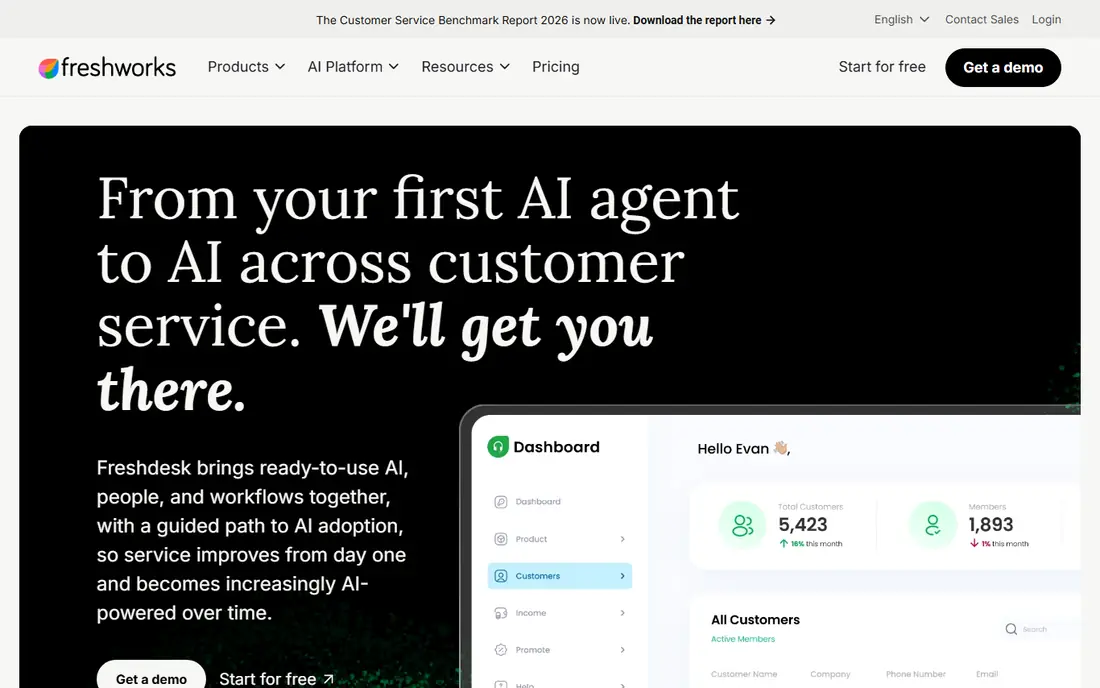
Freshdesk, with its Freddy AI assistant, is the value pick in this list. The free tier covers basic ticketing, and paid plans from $19 per agent per month add AI features such as suggested replies and self-service help. For a small business that needs a real help desk without an enterprise bill, it is a sensible starting point.
The catch is depth. Freddy helps agents and answers common questions, but it does not match the autonomous resolution ability of the top AI agents for complex queries. Teams with very high volumes or tricky workflows may outgrow it. For most small and mid-size teams, though, the balance of price and capability is strong.
- Good value for small teams
- Freddy AI assists agents and customers
- Free tier to start
- AI depth is thinner than Intercom or Zendesk
- Advanced automation sits on higher tiers
HubSpot Service Hub
Ideal for: Teams already on HubSpot
HubSpot Service Hub makes sense when your customer data already lives in HubSpot. Its chatbot builder creates rule-based and AI-assisted flows, and because the CRM holds purchase and conversation history, replies can be personal without manual lookup. The free tier covers basic chat and ticketing, which is enough to test the fit.
The limit is scope. AI features run on credits, so heavy use adds cost, and teams outside HubSpot will not get the same benefit from the CRM link. If you already use HubSpot for sales or marketing, this is an easy addition. If you do not, a standalone help desk may be simpler.
- Chatbot builder included
- CRM data powers replies
- Free tools to start
- AI credits add cost
- Best value only inside the HubSpot ecosystem
Tidio
Ideal for: Small teams on a budget
Tidio is built for small businesses that want a chatbot running this week. Its Lyro AI agent answers common questions from your help content, and the drag-and-drop flow builder makes it easy to design conversations without code. Plans start at $24.17 per month, and a free tier covers basic live chat.
The honest limit is complexity. Lyro handles a large share of routine questions, but it is not designed for deep, multi-step workflows or heavy ticket routing. For a small store or service business with repeatable questions about shipping, pricing and hours, that is usually enough, and the price is hard to argue with.
- Lyro AI agent included on paid tiers
- Visual flow builder
- Easy setup
- Best for simpler queries
- Reporting is thinner than enterprise tools
Gorgias
Ideal for: Shopify and ecommerce brands
Gorgias is the ecommerce specialist here. It pulls order, shipping and customer data from Shopify, Magento or WooCommerce into the ticket view, so agents and the AI can answer "where is my order" questions without switching tools. Pricing starts at $10 per month for a small ticket volume, with AI interactions billed separately.
The model suits stores with clear seasonal swings, since you pay for the volume you handle. Very high-volume stores will see the bill rise, and companies outside ecommerce will find much of the value irrelevant. For a Shopify brand, though, the fit is close, and the AI features are tuned to the questions stores actually get.
- Deep Shopify integration
- AI interactions priced per use
- Unified inbox for email, chat and social
- Ticket-based pricing can grow with volume
- Less suited to non-ecommerce support
Drift
Ideal for: B2B conversational marketing
Drift, now part of Salesloft, is less a support bot and more a revenue tool. Its chat qualifies visitors, routes high-value accounts to sales, and books meetings on the spot, which is why B2B companies use it alongside a help desk rather than instead of one. The conversational AI handles the opening exchange and hands off cleanly.
Pricing is the barrier. Plans are quote-based and sit at the enterprise end of this list, so small teams will find better value elsewhere. If your goal is turning website visitors into booked meetings, Drift is built for exactly that. If your goal is answering support questions cheaply, pick a help desk first.
- Strong lead qualification
- Instant meeting booking
- GPT-powered chat
- Pricing is quote-based and high
- Overkill for simple support FAQs
Ada
Ideal for: High-volume enterprises
Ada targets large companies with high volumes and strict requirements. Its AI agent automates answers across web, chat and voice, supports many languages, and is designed for regulated sectors such as finance and healthcare, where accuracy and control matter. That focus shows in its reasoning and escalation design.
The cost is custom, and setup takes real work, including training on your knowledge base and defining guardrails. Small teams should not start here. For an enterprise handling thousands of conversations a day, Ada's automation rate and compliance features can justify the effort and the price.
- Strong multilingual AI automation
- Built for regulated industries
- Voice and chat coverage
- Quote-based pricing
- Implementation takes more effort than plug-and-play tools
How we picked these
We compared official pricing pages, feature pages and public reviews for the leading AI customer service platforms, focusing on tools that are live in October 2026 and serve US customers. We weighed AI resolution ability, handoff quality, channel coverage and the true cost of seats plus AI usage. Tools that only offer rule-based scripts with no AI understanding were left out.
What to check before you choose an AI chatbot
Start with your ticket data, not the demo. Look at your most common questions over the past three months and check which tools can answer those from your existing help center without heavy custom work. A bot that handles your top ten questions well will save more time than one with impressive features you never configure.
Price the full bill. Add seat costs, AI resolution charges and any credit packs, then estimate them at your real monthly volume. A tool that looks cheap per seat can become expensive at scale, and a tool with per-resolution pricing can be cheap for a low-volume team. Ask for a trial with your own content, and measure the resolution rate and escalation quality before you sign.
Finally, plan the handoff. Customers judge a bot by what happens when it fails, so test the transfer to a human, check that conversation history carries over, and set clear rules for sensitive topics such as billing disputes and account access. A bot that says it does not know and connects you quickly beats one that guesses confidently.
Frequently asked questions
What is the best AI chatbot for customer service?
For most teams, Intercom or Zendesk AI are the strongest overall picks, since they pair a capable AI agent with a full help desk. Small teams should consider Tidio or Freshdesk for lower costs, while Shopify stores should look at Gorgias first.
How much does an AI customer service chatbot cost?
Entry prices in this list run from $10 per month to around $29 per seat per month, but many tools also charge per AI resolution, typically around $0.75 to $1.00 each. Always estimate the total at your real conversation volume before choosing.
Can an AI chatbot replace human support agents?
No, it reduces their load rather than replacing them. AI handles repeatable questions and routes the rest with context, but billing disputes, complex troubleshooting and sensitive cases still need people. The best setups treat the bot as a first responder, not the whole team.
Which AI chatbot is best for small businesses?
Tidio and Freshdesk are the best small-business picks here, thanks to free tiers and low entry prices. HubSpot Service Hub is also worth a look if you already use HubSpot, since its free tools cover basic chat and ticketing.
Do AI chatbots work for ecommerce stores?
Yes, and Gorgias is built for that use, with order and shipping data inside the ticket view. Tidio and Intercom also serve stores well, especially when most questions are about orders, shipping and returns.