AI Cloud Platform Compared: 5 Tools, Prices and Limits
- 1
 DatabricksAI on governed enterprise dataVisit
- 2
 CoreWeaveLarge-scale training reliabilityVisit
- 3
 Google CloudCost-efficient inference and data integrationVisit
- 4
 AWSBroadest model choice and ecosystemVisit
- 5
 NebiusAdaptable GPU cloud with solid supportVisit
- Number one here is Databricks, a fit for AI on governed enterprise data.
- One limit worth knowing about Databricks: usage-based Databricks Units pricing is notoriously hard to forecast.
- Pricing across the list, from Databricks to Nebius, is by quote only.
- Free plans exist at 3 of 5 tools (Databricks, Google Cloud, AWS).
Direct answer
For AI on governed enterprise data, Databricks is where this list starts. CoreWeave fits large-scale training reliability; Google Cloud fits cost-efficient inference and data integration. The remaining 2 options are covered below with prices and limits.
Quick comparison
| Product | Ideal for | Price from | Free version | |
|---|---|---|---|---|
| Databricks | AI on governed enterprise data | See website | Yes | Visit |
| CoreWeave | Large-scale training reliability | See website | No | Visit |
| Google Cloud | Cost-efficient inference and data integration | See website | Yes | Visit |
| AWS | Broadest model choice and ecosystem | See website | Yes | Visit |
| Nebius | Adaptable GPU cloud with solid support | See website | No | Visit |
AI Cloud Platform profiles
Ainotely put together this guide to AI cloud platform for readers who want a clear shortlist without reading every vendor page. It compares 5 tools on starting price, free plans, who each one suits and where each one falls short.
Databricks
Ideal for: AI on governed enterprise data
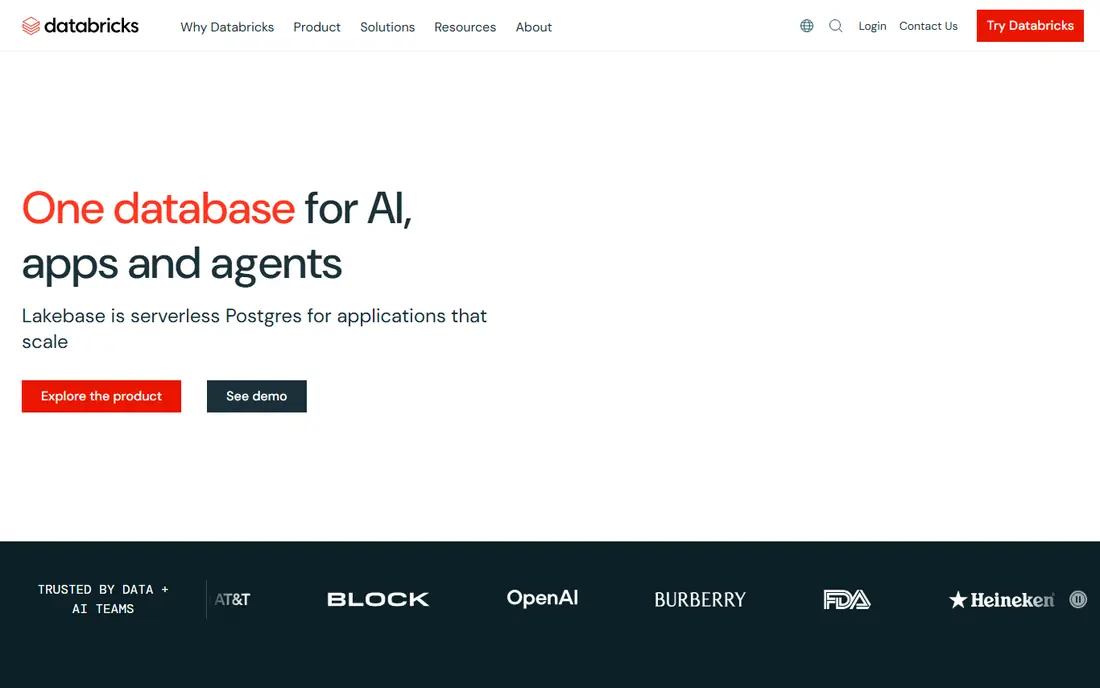
Pick Databricks if this describes you: AI on governed enterprise data. Databricks answers a different question from the model products: what if your AI could run where your data already lives? As for the details, Unity Catalog governs data and models under one roof, which is what regulated enterprises actually need.
More specifically, the Data Intelligence Platform brings together data engineering, analytics, and AI on the lakehouse, with Mosaic AI handling model training, fine-tuning, deployment, and governance. Beyond that, with over 60 percent of the Fortune 500 as customers and a five-time Gartner Magic Quadrant leadership position, the enterprise credibility is unmatched in the data-AI space. No starting price is listed for Databricks here; confirm pricing on the vendor site. Databricks has a free plan.
Where it is weaker: Most solid for data teams.
- Mosaic AI handles the full model lifecycle
- Used by over 60 percent of the Fortune 500
- Less so for pure app developers
CoreWeave
Ideal for: Large-scale training reliability
CoreWeave works best for large-scale training reliability. Nine of ten leading foundation model providers run on it, and it holds the industry's only Platinum ClusterMAX rating, earned three times.
What to check first: Premium pricing compared with other neoclouds.
That reliability is the product: when a training run costs millions, the infrastructure that does not fail is worth more than the cheapest hourly rate. As for the details, CoreWeave is for serious training at scale, not for experimenting with one GPU. Check the vendor site for CoreWeave pricing; none is listed in this comparison. No free plan comes with CoreWeave.
- Only Platinum-rated AI cloud on SemiAnalysis ClusterMAX
- Purpose-built for massive training runs
- Node-locked pricing penalizes small workloads
Google Cloud
Ideal for: Cost-efficient inference and data integration
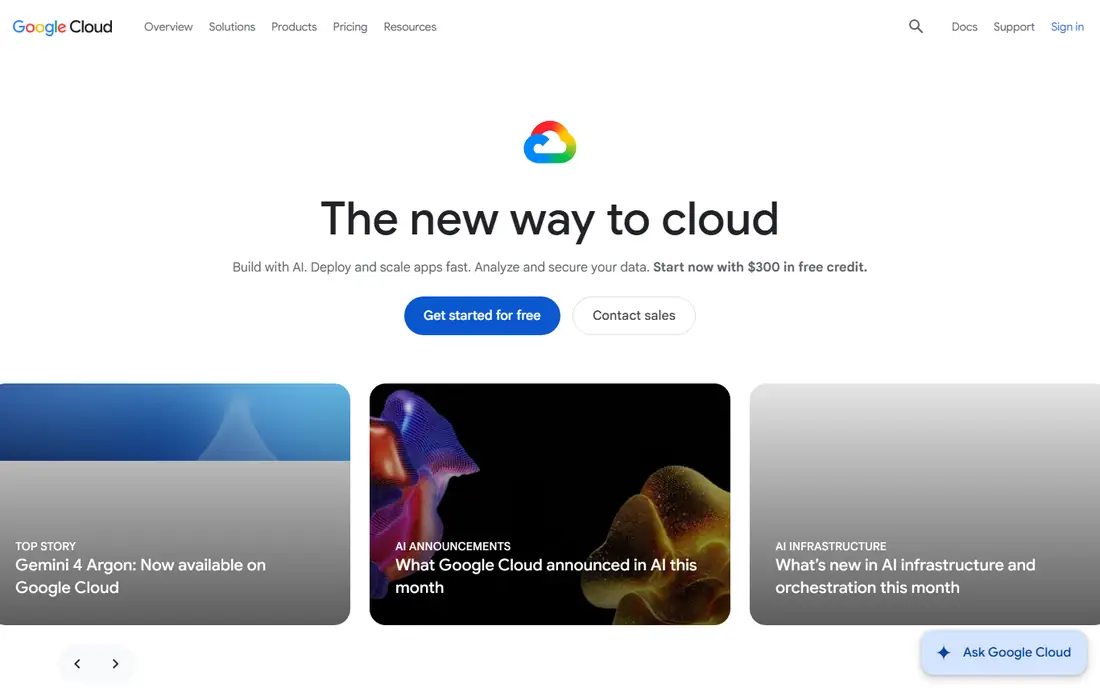
Google Cloud works best for cost-efficient inference and data integration. BigQuery ML lets you run models straight on warehouse data without moving it. On top of that, Vertex AI provides you Gemini models with industry-leading context windows, and Gemini Flash pricing makes high-volume inference dramatically less expensive than the alternatives, at times by an order of magnitude.
The honest catch is enterprise gravity. In practice, for data-heavy AI workloads, particularly on BigQuery, it is the natural home. Google Cloud shows no starting price here, so confirm the cost on the vendor site. A free plan is available with Google Cloud.
Where it is weaker: GPU quota can be hard to secure.
- $300 in free credits for new customers
- BigQuery-native AI workflows
- Smaller enterprise AI footprint than AWS or Azure
AWS
Ideal for: Broadest model choice and ecosystem
AWS makes the most sense for broadest model choice and ecosystem. AWS remains the default AI cloud for one reason: choice. Worth adding: the honest catch is cost and complexity.
AWS is the product for organizations that value breadth and already run on AWS. With 28 percent of global cloud infrastructure spend, the capacity is there when you need it. On-demand H100 pricing around $55 per hour for an 8-GPU node is roughly double the neoclouds. The sheer number of overlapping AI services means teams waste months picking wrong before they pick right. Worth adding: Bedrock puts Claude, Llama, Mistral, Cohere, Stability, and Amazon's own Nova models behind a single provider-neutral API, so you can swap models without re-architecting. This comparison lists no price for AWS; ask the vendor. A free plan is available with AWS.
Where it falls short: The service catalog's breadth produces real complexity.
- Deepest ecosystem of AI services from SageMaker to Trainium
- 124 availability zones of global capacity
- GPU pricing is the highest among major choices
Nebius
Ideal for: Adaptable GPU cloud with solid support
Nebius serves adaptable GPU cloud with solid support. Nebius has emerged as the neocloud that merges competitive pricing with genuine service. More specifically, the SemiAnalysis Platinum rating puts its infrastructure quality in the top level, and customers like Revolut and Shopify run serious production AI on it.
More specifically, the honest catch is maturity. H100s at $3.85 per GPU-hour on-demand sit at the low end of the market. The company claims meaningfully better total cost of ownership than AWS for both fine-tuning and inference. For everyday use, what users consistently praise is the support: 500-plus AI experts, 24/7 support by default, and free white-glove proof-of-concept engagements. Nebius shows no starting price here, so confirm the cost on the vendor site. Nebius has no permanent free option.
Downsides: Enterprise procurement processes less mature.
- White-glove support with real AI experts
- Competitive $3.85 per GPU-hour H100 pricing
- Younger system than CoreWeave
How the list was put together
Pricing pages, product documentation and feature lists were the main sources, and every entry carries at least one honest drawback. Prices and plan limits come from vendor pages and can change, so confirm them on the vendor site before you buy. The ranking is editorial: typical fit first, then clear pricing, then free access. If your needs are unusual, read the profiles rather than relying on position.
A buyer's checklist
- Confirm the entry price with every vendor: no tool from Databricks to Nebius shows a fixed starting price.
- Read the fine print on the free plans from Databricks, Google Cloud and AWS; seat, project and feature caps differ.
- Before choosing Databricks, weigh its main limit: usage-based Databricks Units pricing is notoriously hard to forecast.
- Map your must-have features to a specific Nebius plan before you compare prices.
- Verify that exporting from AWS is possible on your plan and covers all your records.
Frequently asked questions
Can I try these tools before paying?
Often, yes. Databricks, Google Cloud and AWS have a free plan. Use your own data and a real task during the test, and check what the free tier or trial limits before you rely on it.
Which options for AI cloud platform have a free plan?
On this list, Databricks, Google Cloud and AWS include a free plan. Caps on seats, usage or features are common, so test the free plan against your real workload.
Is Databricks the right pick for everyone comparing AI cloud platform?
No single tool suits every team. Databricks comes first because it fits AI on governed enterprise data, while CoreWeave suits large-scale training reliability and Google Cloud suits cost-efficient inference and data integration. Match the tool to your own size, budget and workflow before deciding.
How are the tools for AI cloud platform ordered?
Databricks sits first and Nebius last because the order follows typical fit for AI cloud platform, then price clarity and free access. It is a judgement call, so read each profile for fit and limits.
How much does AI cloud computing cost?
Model API pricing is per token and varies enormously: budget models cost cents per million tokens whereas frontier models cost dollars. GPU compute ranges from around $3.85 per H100 GPU-hour at neoclouds to $12-plus at hyperscalers.