How to Pick AI Cold Calling Software: 6 Tools Compared

- 1
 VapiDevelopers and product teams building custom voice agentsVisit
- 2
 Retell AITeams that want production-quality voice agents with minimal frictionVisit
- 3
 OrumSDR and BDR teams that want AI agents multiplying humanVisit
- 4
 GoodcallSmall firms that want an AI phone agent on predictableVisit
- 5
 SynthflowCompanies that want to build agents free and payVisit
- Vapi takes the first slot, best suited to developers and product teams building custom voice agents.
- One limit worth knowing about Goodcall: made for small-business answering and lead capture, not high-volume outbound SDR campaigns.
- The cheapest monthly starting price in the list is $79/month, offered by Goodcall.
- For enterprises running high-stakes, regulated voice AI at scale, Bland AI is worth a look.
- Synthflow stands alone as the one tool in this list with a free plan.
Direct answer
Our first pick is Vapi, best for developers and product teams building custom voice agents. For a different need, Retell AI covers teams that want production-quality voice agents with minimal friction and Orum covers SDR and BDR teams that want AI agents multiplying human calling output. All 6 tools are compared below on price, free plan and limits.
Quick comparison
| Product | Ideal for | Price from | Free version | |
|---|---|---|---|---|
| Vapi | Developers and product teams building custom voice agents | See website (usage-based) | Developer credits to start | Visit |
| Retell AI | Teams that want production-quality voice agents with minimal friction | $0.07-$0.31/min (depending on models, voice and add-ons) | $10 in free credits at signup, no contract | Visit |
| Orum | SDR and BDR teams that want AI agents multiplying human | See website (per user, billed annually; Launch and Ascend plans) | No | Visit |
| Goodcall | Small firms that want an AI phone agent on predictable | From $79/month | No | Visit |
| Synthflow | Companies that want to build agents free and pay | Pay-as-you-go (see website) | Yes | Visit |
 Bland AI | Enterprises running high-stakes, regulated voice AI at scale | Per-minute pricing (see website); enterprise plans by volume | No | Visit |
Every option for AI cold calling software explained
If you are comparing AI cold calling software, this page covers 6 tools in one place: what each is best for, what it costs to start, whether it has a free plan, and the main limit to know about.
Vapi
Ideal for: Developers and product teams building custom voice agents

For developers and product teams building custom voice agents, Vapi is a natural candidate. The vendor reports 1 billion calls supported, 2.5 million-plus agents launched and 1 million-plus developers.
Downsides: the prompts and the integrations yourself.
Pricing is usage-based; check the vendor's current rates. Vapi shows no starting price here, so confirm the cost on the vendor site. Free options: Developer credits to start.
- The builder's system: configure voice
- 1 billion calls supported and 2.5M+ agents launched per the vendor
- It is infrastructure
Retell AI
Ideal for: Teams that want production-quality voice agents with minimal friction
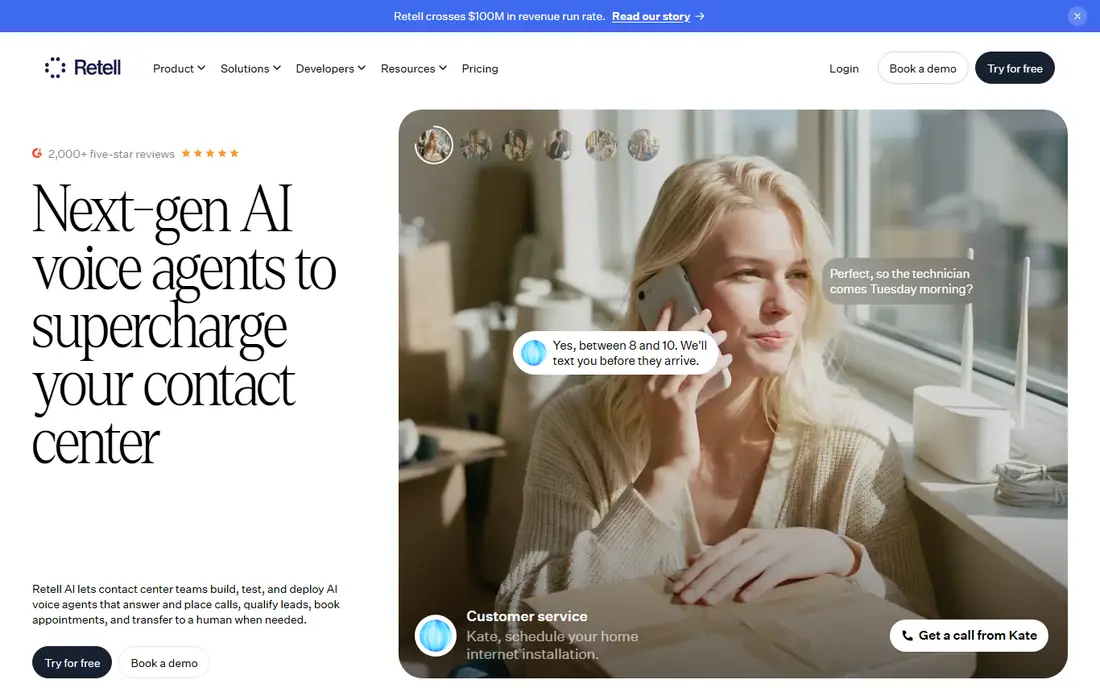
Retell AI works best for teams that want production-quality voice agents with minimal friction. Retell AI is the low-friction entry point into serious voice agents. The FAQ is unusually honest about compliance: AI voice is legal in the U.S. But regulated, with TCPA consent requirements and state disclosure rules.
Downsides: Enterprise features need the higher plans.
Strengths: ~600ms latency with natural turn-taking; Outbound campaign tooling (pacing, retries, voicemail handling) built in. Worth adding: the product substance is solid: a no-code studio with visual call-flow design, ~600ms latency, interruption handling, outbound campaigns with pacing and retry logic, live call monitoring with human takeover, and CRM writeback. For everyday use, the vendor's own pricing guidance puts voice agents at $0.07 to $0.31 per minute based on the models, voice and extras selected. From a buyer's view, sign up, get $10 in free credits with full product access, build an agent, run simulation tests and make live test calls, all without a contract. Entry price for Retell AI: $0.07-$0.31/min. On free options: $10 in free credits at signup, no contract.
- Transparent per-minute pricing with a real free level
- HIPAA
- The per-minute range is broad: your actual cost depends heavily on model and voice choices
Orum
Ideal for: SDR and BDR teams that want AI agents multiplying human

Orum is designed for SDR and BDR teams that want AI agents multiplying human calling output. Orum's 2026 positioning is "a crew of AI agents that supercharge every sales rep," and the three-agent model is concrete: Scout finds the right number from your dialing history, Operator manages phone trees and voicemails and links the rep only when a live person answers, and Coach listens to every call for objection handling, battlecards and practice sessions.
The main drawbacks: Pricing not published.
For everyday use, pricing is per user billed yearly across Launch and Ascend plans; get the quote from the vendor. Orum does not show a starting price in this comparison, so check the vendor site for current pricing. No free plan comes with Orum.
- International dialing across 160+ countries
- Owned telephony stack
- It supercharges human reps rather than replacing them: teams wanting completely autonomous agents should look elsewhere
Goodcall
Ideal for: Small firms that want an AI phone agent on predictable
Where Goodcall fits: small firms that want an AI phone agent on predictable flat pricing. The use case is inbound-heavy: answering every call 24/7, triaging and qualifying callers, booking appointments and pushing leads to the CRM by text and email. In practice, the predictable bill is the differentiator in a category priced by the minute.
Goodcall is the outlier that small firms should know about. On top of that, for a small business missing calls today, that is the entire problem. Starting cost for Goodcall: From $79/month. Goodcall does not include a free plan.
Watch-outs: not high-volume outbound SDR campaigns.
- No per-minute charges: flat monthly pricing by customers helped, so long calls never change the bill
- Every call recorded and transcribed
- Aimed at small-business answering and lead capture
Synthflow
Ideal for: Companies that want to build agents free and pay
Synthflow is aimed squarely at firms that want to build agents free and pay only for calls. Synthflow's model is the friendliest in the category for experimentation: build your AI agent free using templates or the visual flow designer, configure voicemail detection and integrations, and only start paying when you launch real calls on pay-as-you-go. The product includes inbound and outbound across industries, with enterprise features (SOC 2, HIPAA, PCI, GDPR) and 200-plus integrations.
Worth adding: the BELL framework (Build, Evaluate, Launch, Learn) structures the agent lifecycle from testing through continuous improvement. Beyond that, for teams that want to prototype without a credit card conversation, Synthflow and Retell are the two to compare. Price to start with Synthflow: Pay-as-you-go. You can start on Synthflow without paying.
Drawbacks to consider: The enterprise positioning means smaller teams should confirm the fit.
- Build agents free with industry templates and a visual flow designer
- Own telephony network with sub-100ms latency claimed
- Pay-as-you-go pricing details need the pricing page
Bland AI
Ideal for: Enterprises running high-stakes, regulated voice AI at scale
In short, Bland AI is for enterprises running high-stakes, regulated voice AI at scale. The technical differentiator is vertical integration: Bland built its own speech-to-text, language model and text-to-speech layers instead of assembling external vendors, which it argues removes outside points of failure and unexpected model changes. For everyday use, smaller teams should start with the trial-friendly options below.
Where it falls short: Enterprise-focused: pricing and deployment are designed for scale.
As for the details, the pricing model is refreshingly straightforward for the category: one per-minute rate including the language model, speech-to-text, text-to-speech and telephony, with no per-token charges, no per-feature surcharges and no separate vendor invoices. From a buyer's view, enterprise plans contract on volume, dedicated infrastructure and compliance needs. Worth adding: Bland pitches itself as the voice AI product for "the calls that can't go wrong": regulated, complicated conversations where a mistake means a lawsuit or a patient in danger. Bland AI cost at the entry level: Per-minute pricing. No free plan comes with Bland AI.
- SOC 2
- Runs entirely on its own models (no external STT/LLM/TTS stitching)
- Not for a three-person sales team testing the waters
AI Cold Calling Software: more detail
Every tool below falls into one of two camps, and buying the wrong one is the classic mistake. Worth adding: AI voice agents make the calls themselves: the software dials, holds a natural conversation, qualifies the prospect and books the meeting, with humans handling only edge cases. In daily use, neither architecture is better in the abstract.
How we built this list
The comparison looks at four things: starting price, free access, how well the feature set matches AI cold calling software, and the main limit of each tool. Treat prices as a snapshot: vendors change plans often, so check the vendor site for the figure that applies today. Order on the page follows fit for the typical buyer first, then price transparency and free access. Your own requirements should decide the final pick.
Things to verify first
- Get a written quote from Vapi and Orum; the list shows no starting price for them.
- Test the free plan from Synthflow against your real workload before relying on it.
- Read the limits listed for Vapi first: it is infrastructure, not a finished product: you build the agent, the prompts and the integrations yourself.
- Ask the daily users to test Orum on a live task before you roll it out to everyone.
- Confirm that Retell AI connects to the apps your team already uses, on the plan you would actually buy.
Frequently asked questions
Can I try these options before paying?
Often, yes. Synthflow has a free plan. Use your own data and a real task during the test, and check what the free tier or trial limits before you rely on it.
Is Vapi the right pick for everyone comparing AI cold calling software?
No single tool suits every team. Vapi comes first because it fits developers and product teams building custom voice agents, while Retell AI suits teams that want production-quality voice agents with minimal friction and Orum suits SDR and BDR teams that want AI agents multiplying human calling output. Match the tool to your own size, budget and workflow before deciding.
Which options for AI cold calling software have a free plan?
Synthflow is the only tool in this list with a free plan. Free plans usually cap users, projects or features, so check the limits on the vendor page.
How are the tools for AI cold calling software ordered?
The order follows typical fit for AI cold calling software, with Vapi first and Bland AI last, then price clarity and free access. It is editorial judgement, not a score, so another team could rank the tools differently.
Will AI replace SDRs?
The teams getting the best results run hybrid models: agents manage the routine volume and hand off to people with full context when judgment or empathy is needed.