Comparing 8 AI Contract Management Software Options in 2026

- 1
 SirionProcurement and supplier contract managementVisit
- 2
 IcertisLarge enterprises with complicated contractingVisit
- 3
 PandaDocSales teams and small firms that require contracts quickVisit
- 4
 AgiloftTeams that want to configure CLM without codeVisit
- 5
 IroncladLegal teams automating the full contract lifecycleVisit
- Top of the list is Sirion, which targets procurement and supplier contract management.
- Before buying Icertis, weigh this: quote-only pricing geared toward enterprise budgets.
- Just one of the 8 tools, PandaDoc, has a free plan.
- Every tool from Sirion to Luminance works by quote, with no list price shown.
- Luminance fits legal teams that negotiate in Microsoft Word.
Direct answer
Sirion is the first pick on this list for procurement and supplier contract management. For a different need, Icertis covers large enterprises with complicated contracting and PandaDoc covers sales teams and small companies that require contracts quick. The full list of 8 tools follows, with prices and free plan facts.
Quick comparison
| Product | Ideal for | Price from | Free version | |
|---|---|---|---|---|
| Sirion | Procurement and supplier contract management | See website | No | Visit |
| Icertis | Large enterprises with complicated contracting | See website | No | Visit |
| PandaDoc | Sales teams and small firms that require contracts quick | See website | Yes | Visit |
| Agiloft | Teams that want to configure CLM without code | See website | Free trial | Visit |
| Ironclad | Legal teams automating the full contract lifecycle | See website | No | Visit |
 CobbleStone | Organizations that want deep configurability and US-based support | See website | Free trial | Visit |
 Juro | Business teams that want to self-serve contracts | See website | No | Visit |
 Luminance | Legal teams that negotiate in Microsoft Word | See website | Free trial (14 days) | Visit |
8 options for AI contract management software in detail
Short on time? The summary and table above give the quick view of 8 tools for AI contract management software, and the profiles that follow give the detail behind each entry.
Sirion
Ideal for: Procurement and supplier contract management
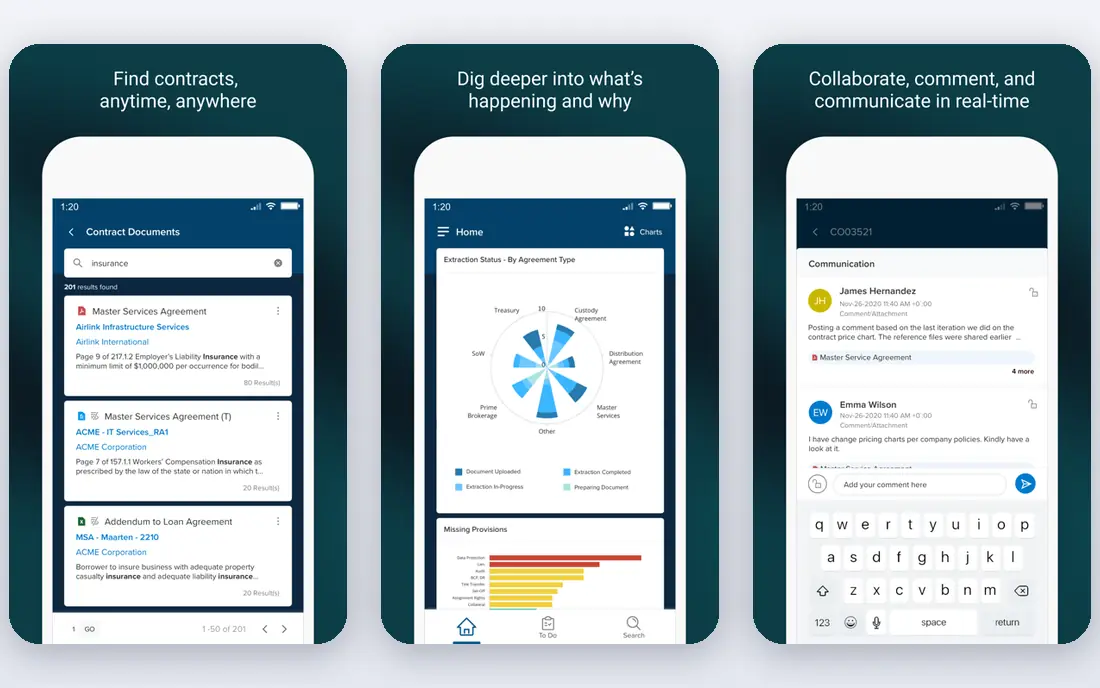
Sirion works best for procurement and supplier contract management. Sirion built its reputation on the buy side: procurement teams managing supplier contracts, tracking obligations, and measuring performance against commitments. In daily use, for procurement and vendor management teams at large businesses, it is one of the strongest AI choices available.
Upsides: Excels at obligation and performance management on buy-side contracts.
Where it is weaker: Enterprise pricing with no public numbers.
In daily use, the vendor reports managing over 7 million contracts worth nearly $800 billion, which tells you the scale it is aimed at. That scale is also the filter: Sirion is an enterprise purchase with enterprise pricing and no public numbers. This comparison lists no price for Sirion; ask the vendor. Sirion has no free tier.
- Recognized as a leader by Gartner, IDC
- AI-native product with capable extraction and conversational search
- Buy-side focus means sell-side workflows are less central
Icertis
Ideal for: Large enterprises with complicated contracting
Icertis is a good fit for large enterprises with complicated contracting. Icertis plays at the top of the market: global enterprises managing tens of thousands of contracts across procurement, sales, and legal. Its product structures every agreement into searchable data, then applies AI to surface obligations, flag compliance risks, and track performance against commitments.
Downsides: Implementations are measured in months, not weeks.
For everyday use, smaller firms will find the system overpowered and the cost unjustifiable. Expect a long sales cycle, a custom quote, and an implementation project with services hours. Pricing for Icertis is not stated here, so ask the vendor for current figures. No free plan comes with Icertis.
- Solid compliance and obligation management for regulated industries
- AI-powered contract intelligence across buy-side and sell-side agreements
- Quote-only pricing pitched at enterprise budgets
PandaDoc
Ideal for: Sales teams and small firms that require contracts quick
PandaDoc is built with sales teams and small firms that require contracts quick in mind. The free plan handles the basics, and premium levels add CPQ, advanced analytics, and integrations.
Where it falls short: AI features are lighter than the dedicated CLM systems.
No starting price is listed for PandaDoc here; confirm pricing on the vendor site. PandaDoc includes a free tier.
- Template library and CPQ features designed for sales workflows
- Quick setup with no implementation project
- Not designed for complex legal negotiation workflows
Agiloft
Ideal for: Teams that want to configure CLM without code
Agiloft makes the most sense for teams that want to configure CLM without code. For legal ops teams that hate being locked into a vendor's idea of a process, that configurability is the entire pitch. As for the details, pricing is custom with a free trial available.
It is the tinkerer's CLM. In practice, Agiloft's differentiator is control: a no-code product where your own team can configure workflows, approval chains, and data models without waiting on the vendor. Its Astra AI layer reviews contracts, extracts terms, and surfaces risks, and the company claims integrations with more than a thousand systems. Worth adding: Agiloft suits organizations with a legal ops or IT owner who will shape the system to their process. Teams that want software to work perfectly from day one will find the setup work annoying. Pricing for Agiloft is not stated here, so ask the vendor for current figures. On free options: Free trial.
Watch-outs: The adaptability means you need someone to own configuration.
- No-code system lets admins build custom workflows and fields
- Links up with over 1,000 systems per the vendor
- Pricing is quote-based
Ironclad
Ideal for: Legal teams automating the full contract lifecycle
Ironclad serves legal teams automating the full contract lifecycle. It deals with the whole lifecycle: business users request contracts through guided intake, legal reviews with AI-suggested redlines, and everything lands in a searchable repository with obligation tracking.
From a buyer's view, the AI layer summarizes contracts, extracts key terms, and drafts first passes, which is why legal operations teams defend the price tag. This comparison lists no price for Ironclad; ask the vendor. There is no free plan with Ironclad.
Where it is weaker: Implementation takes planning and legal-team buy-in.
- End-to-end workflows from intake to signature to renewal on one product
- Deep integrations with Salesforce, Slack, DocuSign
- Enterprise pricing with no public numbers
CobbleStone
Ideal for: Organizations that want deep configurability and US-based support
CobbleStone is a good fit for organizations that want deep configurability and US-based support. A free trial lets you evaluate before the sales process.
Downsides: Pricing is quote-based.
It gives you AI-powered contract review, clause extraction, and obligation tracking inside a deeply customizable product, plus vendor management and e-sourcing modules that procurement teams use alongside CLM. Check the vendor site for CobbleStone pricing; none is listed in this comparison. Trial and free access: Free trial.
- Free trial available
- Highly customizable workflows with AI-assisted review and extraction
- The interface prioritizes function over modern design
Juro
Ideal for: Business teams that want to self-serve contracts
Juro is a good fit for business teams that want to self-serve contracts. Juro flips the CLM model: rather than software for lawyers, it is software that lets sales, HR, and procurement produce contracts themselves inside guardrails legal sets. Beyond that, pricing is custom with no public levels.
Honest limits: Custom pricing.
Beyond that, for scale-ups where legal is one person and sales needs to move, Juro's self-serve model beats a legal-only product that nobody outside the department will touch. Templates, approval workflows, and AI-assisted drafting live in the browser, and the dynamic repository provides instant visibility into contract data. That business-user focus means Juro is weaker on the heavy analytics and obligation tracking that enterprise legal teams demand. Check the vendor site for Juro pricing; none is listed in this comparison. There is no free plan with Juro.
- AI drafting and negotiation guardrails for business users
- Solid adoption beyond the legal department
- Lighter on deep legal analytics than the enterprise systems
Luminance
Ideal for: Legal teams that negotiate in Microsoft Word
Luminance is aimed squarely at legal teams that negotiate in Microsoft Word. The system learns from how your senior lawyers negotiate, so the review quality compounds over time.
Luminance, from Cambridge, UK, takes the most lawyer-centric approach here: its AI reads an incoming contract and produces a first-pass review straight in Microsoft Word, marking clauses as acceptable, non-standard, or risky, with your preferred fallback language one click away. No starting price is listed for Luminance here; confirm pricing on the vendor site. As for free access: Free trial (14 days).
Where it falls short: Quote-based pricing with no public numbers.
- AI learns from your lawyers' preferred positions over time
- Multi-language contract support
- Best value needs enough review volume to train the models
How the list was put together
Ainotely looked at what each vendor publishes: pricing, plan limits, feature coverage for AI contract management software and stated drawbacks. No hands-on testing is claimed. Seat minimums, billing terms and add-ons can move the real cost, so the starting prices here are a guide and not a quote. We ordered the tools by general fit, then by how clearly pricing is shown, then by free access. A buyer with unusual needs may reorder them.
Pre-purchase checklist
- Confirm the entry price with every vendor: no tool from Sirion to Luminance shows a fixed starting price.
- Test the free plan from PandaDoc against your real workload before relying on it.
- Use real work to test the free trial from Agiloft, CobbleStone and Luminance, rather than a demo project.
- Before choosing Sirion, weigh its main limit: enterprise pricing with no public numbers.
- Find out what support Icertis includes on your plan, and whether onboarding help costs extra.
- Get the contract term, renewal terms and any onboarding fees from Sirion in writing.
Frequently asked questions
Is Sirion the right pick for everyone comparing AI contract management software?
No single tool suits every team. Sirion comes first because it fits procurement and supplier contract management, while Icertis suits large enterprises with complex contracting and PandaDoc suits sales teams and small businesses that need contracts fast. Match the tool to your own size, budget and workflow before deciding.
How are the tools for AI contract management software ordered?
Sirion sits first and Luminance last because the order follows typical fit for AI contract management software, then price clarity and free access. It is a judgement call, so read each profile for fit and limits.
Which options for AI contract management software have a free plan?
PandaDoc is the only tool in this list with a free plan. Free plans usually cap users, projects or features, so check the limits on the vendor page. Several others offer a trial instead.
What is AI contract management software?
It is software that handles contracts across their lifecycle whereas using artificial intelligence to read, summarize, and analyze agreements. Usual AI features bundle clause extraction, automatic redlining suggestions, risk scoring, obligation tracking, and natural-language search across your contract repository.
Can I try these options before paying?
Often, yes. PandaDoc has a free plan and Agiloft, CobbleStone and Luminance offer a free trial. Use your own data and a real task during the test, and check what the free tier or trial limits before you rely on it.
How much does AI contract management software cost?
Most vendors price by custom quote based on users, contract volume, and modules, which makes public pricing rare. Expect five to six figures annually for enterprise CLM.