Best AI Customer Service Platforms in 2026: 8 Platforms Compared

- Intercom and Zendesk lead for established support teams, but both now charge per AI resolution on top of seat fees.
- Tidio and Freshdesk offer the cheapest entry for small teams, with free plans and lower seat prices.
- Gorgias suits Shopify brands, because ticket pricing and ecommerce integrations fit that workflow.
- Model total cost at your real ticket volume, because a $19 seat can become thousands a month once AI resolutions scale.
Quick comparison
| Product | Ideal for | Price from | Free version | |
|---|---|---|---|---|
 Intercom | Messenger-first support with Fin AI agent | $19 per seat per month | Free trial | Visit |
 Zendesk | Ticketing-first support with AI agents | $55 per agent per month | Free trial | Visit |
 Tidio | Small ecommerce sites wanting cheap AI support | Free | Yes | Visit |
 Freshdesk | Budget helpdesk with Freddy AI | $19 per agent per month | Yes | Visit |
 Gorgias | Shopify brands with ticket-based support | $10 per month | Free trial | Visit |
 HubSpot Service Hub | Teams already on HubSpot CRM | $9 per seat per month | Yes | Visit |
 Ada | High-volume enterprise automation | See website | No | Visit |
 Decagon | Enterprise chat, voice and email agents | See website | No | Visit |
The best AI customer service platforms
We compared official feature pages, pricing pages, app store listings, privacy policies and public reviews to build this list of 8 options for best ai customer service platforms. Prices were checked in October 2026 and can change, so confirm the current price on the vendor site before you buy. Our pick for most people is the first option that fits your budget and workflow, not necessarily the most expensive tool on the list. Read the quick comparison first to narrow the field, then read the full write-ups for the two or three options that fit your needs best.
Intercom
Ideal for: Messenger-first support with Fin AI agent

Intercom pairs a polished messenger and inbox with Fin, an AI agent that answers routine questions first. The $0.99 per resolution price is predictable, and Shopify order lookups and help center integration make it practical for digital-first teams. For chat-led support, Intercom is a leader.
There is no free plan, and AI costs grow with resolution volume, so a successful AI rollout raises the bill. Advanced workflows also need higher tiers. For messenger-first teams, Intercom is still a strong pick, with volume modeled in advance.
- Fin AI agent resolves routine chats
- Strong messenger and inbox
- Predictable $0.99 per resolution
- No free plan
- AI costs scale with volume
- Advanced features need higher tiers
Zendesk
Ideal for: Ticketing-first support with AI agents
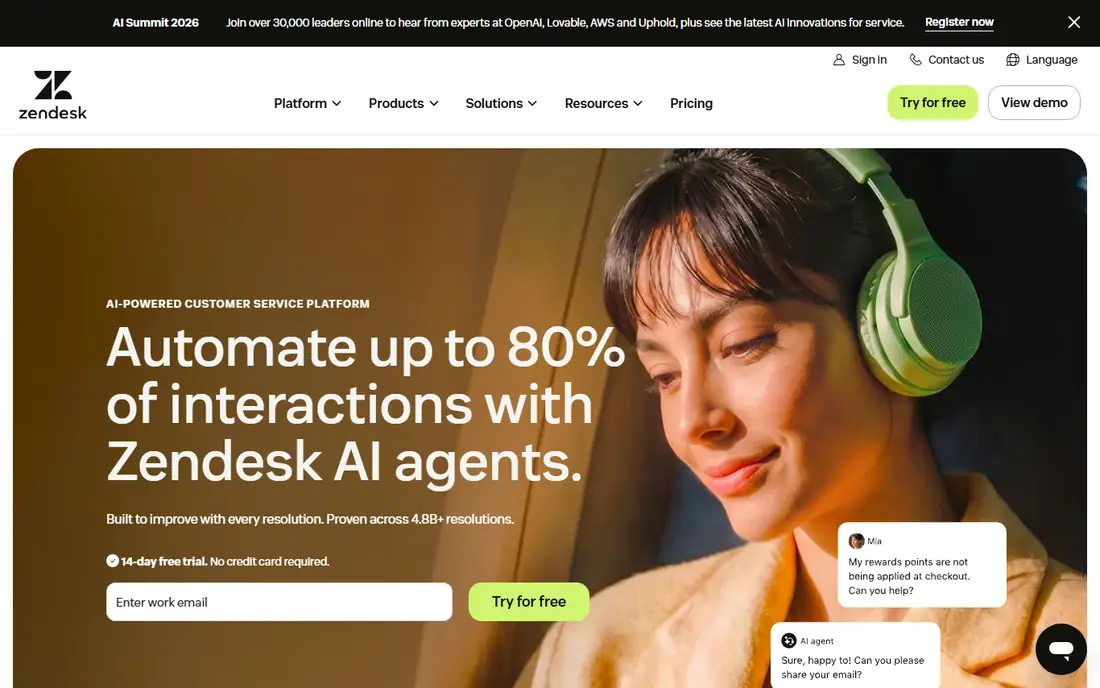
Zendesk is the ticketing standard for larger support teams, covering email, chat, voice and social tickets in one queue. AI agents handle routine resolutions, and Copilot assists human agents. The integration library suits firms with complex workflows and CRM needs.
AI resolutions add $1.50 committed or $2.00 pay-as-you-go per resolution on top of seat fees, so total cost needs modeling. Setup also takes time for complex routing. For ticket-led teams, Zendesk remains the safe enterprise choice.
- Mature ticketing, email and voice
- AI agents and Copilot
- Huge integration library
- AI resolutions cost $1.50 to $2.00 each
- Entry AI tier is $55
- Setup takes time
Tidio
Ideal for: Small ecommerce sites wanting cheap AI support

Tidio suits small stores that need live chat and an AI chatbot without enterprise pricing. The free plan covers basic chat, and Lyro answers routine questions as a paid add-on. Setup is fast, and Shopify and WordPress integrations cover most small shops.
The free plan caps conversations, and Lyro costs extra on top of paid plans. Reporting is also basic compared with Zendesk or Intercom. For small ecommerce support on a budget, Tidio is the cheapest credible start.
- Free plan
- Lyro AI add-on
- Live chat and chatbot in one tool
- Free plan caps conversations
- Lyro is an extra cost
- Reporting is basic
Freshdesk
Ideal for: Budget helpdesk with Freddy AI
Freshdesk offers a free plan for up to ten agents, with paid plans adding Freddy AI, automation and reporting. That makes it the budget helpdesk for small teams that need ticketing, chat and phone without enterprise prices. Freshworks integrations also help existing users.
Freddy AI sessions cost extra beyond base plans, and AI depth lags Intercom Fin. The interface is simpler than Zendesk, which some large teams will miss. For budget-conscious teams, Freshdesk is strong value.
- Free plan for up to 10 agents
- Freddy AI assistance
- Ticketing, chat and phone
- Freddy sessions cost extra
- Interface is simpler than Zendesk
- AI depth lags Intercom
Gorgias
Ideal for: Shopify brands with ticket-based support
Gorgias is built for Shopify brands, with ticket-based pricing instead of per-seat fees and deep order, shipping and refund integrations. Its AI agent is included on every plan, and agents can act on orders without switching tools. For ecommerce support, that fit is hard to beat.
AI interactions cost about $0.90 to $1.00 each, plus ticket fees, so high volume still adds up. Non-ecommerce teams get less value from its integrations. For Shopify support teams, Gorgias is a top pick.
- Ticket-based pricing with no seat fees
- Shopify integrations
- AI agent on every plan
- AI interactions cost about $0.90 to $1.00 each
- Ticket fees can add up
- Less suited outside ecommerce
HubSpot Service Hub
Ideal for: Teams already on HubSpot CRM
HubSpot Service Hub suits teams already on HubSpot CRM, because tickets, knowledge base and Customer Agent AI sit on the same customer record. Free tools cover two users, and paid seats stay cheap at entry level. For HubSpot shops, the CRM integration is the point.
AI depth and enterprise features cost more through credits and higher tiers, and non-HubSpot teams get less value. Setup also takes time to connect knowledge and workflows. For HubSpot users, Service Hub is the natural support pick.
- Free tools for two users
- Customer Agent AI
- CRM-native tickets and knowledge base
- AI credits and enterprise features cost more
- Best value needs HubSpot CRM
- Setup takes time
Ada
Ideal for: High-volume enterprise automation
Ada focuses on high-volume enterprise automation, with AI agents handling chat, voice and email under guardrails. Analytics and controls suit regulated and large-scale operations. For firms automating thousands of conversations, Ada is built for that scale.
Pricing is custom only, and implementation needs real resources, so small teams should look elsewhere. The platform is also overkill for simple chatbots. For enterprise automation at volume, Ada is a credible leader.
- Enterprise AI automation across chat, voice and email
- Strong guardrails
- Analytics
- Custom pricing only
- Overkill for small teams
- Implementation needs resources
Decagon
Ideal for: Enterprise chat, voice and email agents
Decagon builds enterprise AI agents for chat, voice and email, with deep integrations into support and business systems. Its outcome-focused design suits large firms that want AI to resolve, not just answer, customer issues. For complex enterprise support, it is a serious contender.
There is no public pricing, and the platform is enterprise only, so small and mid-size teams cannot simply sign up. Implementation also needs technical and support resources. For large firms, Decagon deserves a demo alongside Ada.
- Enterprise agents across chat, voice and email
- Deep integrations
- Outcome-focused design
- No public pricing
- Enterprise only
- Needs technical and support resources
How we picked these
We started from the topic and shortlisted products that exist and work today, then checked each vendor homepage, pricing page and free tier. We compared feature pages, app store listings, privacy policies and public reviews, and we dropped any product whose homepage could not be verified or whose price could not be checked. Where a price was unclear or varied by region, we wrote See website rather than guessing a number. That rule kept the list honest, even where a neat price would have made the comparison table look tidier.
We also weighed fit over fame. A well-known product stayed on the list only if it truly fits the topic, and smaller tools earned a place when they served a clear use case better. No product here was tested hands-on for this article, and no vendor paid for placement.
Price and free-tier details matter most when plans change often, so we favoured products with clear published pricing and a trial or free tier where one exists. If a vendor changed a plan after our check, the vendor site is the correct source, and the ranking here still reflects fit, not just price. That check takes extra time, but it prevents a shortlist built on outdated pricing or a product that no longer exists.
Choosing an AI customer service platform by ticket volume and channel
Start with channels and volume, not AI claims. List where customers contact you, how many tickets arrive monthly, and what share are routine questions. Then model seat fees plus per-resolution AI fees at that volume, and test the AI on your hardest routine questions, not your easiest ones.
Before you pay, run a trial on a real task from your own work, not a demo file. Check export formats, mobile access and support hours, because those details decide whether a tool survives daily use. Also check renewal terms and cancellation steps, since a cheap first year can become an expensive second year if renewal jumps. Finally, ask who will own setup and training, because a tool nobody is responsible for tends to fall out of use within a few months. Keep a short note on why you picked the winner, so a future review can judge it against the same criteria instead of starting from scratch.
A useful final test is to imagine the tool in six months, when the first excitement has faded and the work is routine. If the daily steps are still quick, the cost is still clear, and the support route is still obvious, the choice is likely sound. If any of those three answers is unclear, use the trial period to get a clear answer before committing to an annual plan.
Frequently asked questions
What is the best AI customer service platform for small businesses?
Tidio suits small ecommerce sites with a free plan and low-cost AI add-on. Freshdesk suits small teams that want a fuller helpdesk at $19 per agent a month.
How much does AI customer service cost per resolution?
Intercom charges $0.99 per Fin resolution, Zendesk charges about $1.50 committed or $2.00 pay-as-you-go, and Gorgias charges about $0.90 to $1.00 per AI interaction. Always add seat fees to the total.
Should I pick Intercom or Zendesk?
Pick Intercom if support happens mainly in a messenger and you want an AI agent answering first. Pick Zendesk if tickets, email and voice are the backbone of your support.
Do AI agents replace support staff?
No. AI agents handle routine questions and triage, while humans handle complex, sensitive and high-value cases. Plan for human review, escalation paths and quality checks.