For external threat and brand defense, ZeroFox is where this list starts. Cyberint is the stronger choice for continuous internal and external exposure management, while Palo Alto Networks Cortex Xpanse suits automatic attack surface management. Details, prices and limits for the rest of the 6 tools are below.
Short on time? The summary and table above give the quick view of 6 AI digital risk protection platforms, and the profiles that follow give the detail behind each entry.
Key takeaways
Number one here is ZeroFox, a fit for external threat and brand defense.
None of the 6 tools, from ZeroFox to Constella Intelligence, has a free plan, so budget for a subscription or use a trial.
A fair warning about Palo Alto Networks Cortex Xpanse: wide product scope may exceed straightforward needs.
Pricing across the list, from ZeroFox to Constella Intelligence, is by quote only.
ZeroFox is designed for external threat and brand defense. Teams with a public-facing brand presence are the natural audience.
In practice, if your priority is deep dark web data instead of brand-facing threats, a specialized provider may be a closer match. No starting price is listed for ZeroFox here; confirm pricing on the vendor site. Free plan details: Not stated.
Points against: Disruption workflows need clear ownership.
Best for: Continuous internal and external exposure management
Cyberint is a good fit for continuous internal and external exposure management. It suits teams that want one program including both inside-out and outside-in exposure, especially where Check Point is already part of the security stack and consolidation is a goal.
From a buyer's view, the rebrand means buyers should verify current feature naming and support paths straight with the vendor. Pricing for Cyberint is not stated here, so ask the vendor for current figures. As for free access: Not stated.
Honest limits: Brand transition may complicate documentation review.
Drawbacks to consider: Wide system scope may exceed straightforward needs.
Since the emphasis is attack surface discovery, teams looking primarily for dark web monitoring or brand takedowns may find it an indirect fit. It also assumes you can act on findings with existing processes. Pricing for Palo Alto Networks Cortex Xpanse is not stated here, so ask the vendor for current figures. On free options: Not stated.
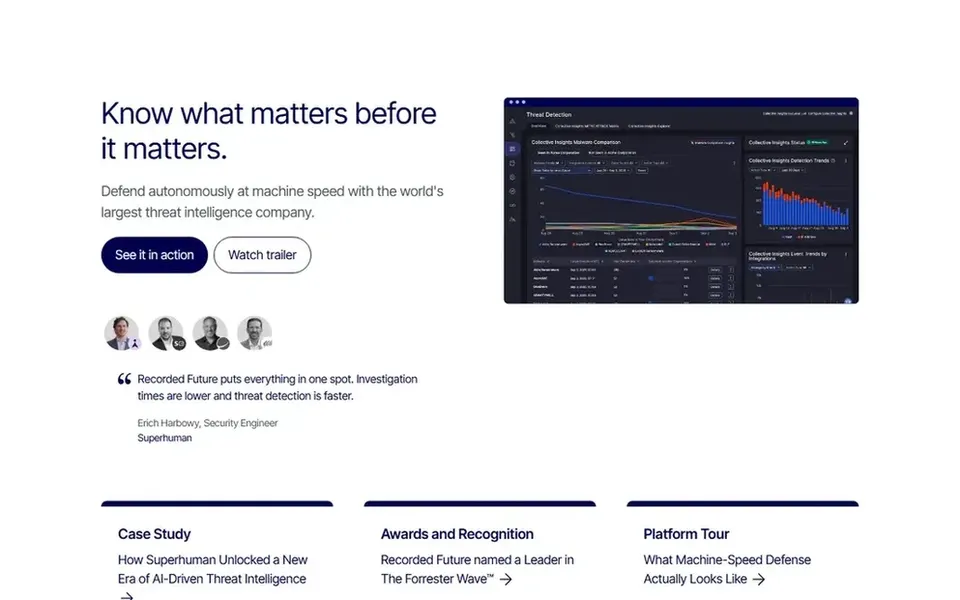
Choose Recorded Future for Intelligence-led risk prioritization. Recorded Future positions itself around advanced cyber threat intelligence. Its homepage describes live, actionable intelligence that helps mitigate cyber risk, prioritize threats and secure the organization proactively.
In daily use, smaller teams without analysts to consume intelligence may struggle to convert feeds into action. On top of that, pick it when prioritization and context are the gap, and pair it with a discovery-focused product if you also need asset mapping. This comparison lists no price for Recorded Future; ask the vendor. Trial and free access: Not stated.
What Recorded Future does well: Helps prioritize threats to the organization. Limits to weigh: Value relies on how findings feed workflows.
Proofpoint Digital Risk Protection was built for people, data and AI protection. Proofpoint presents agentic security for people, data and AI, with intent-based protection for every person and AI agent, per its homepage. Since the homepage leads with the broader system, buyers should confirm the specific digital risk capabilities they need during evaluation.
What to check first: Portfolio breadth can complicate scoping.
Also, choose Proofpoint when portfolio consolidation and people-centric protection matter more than a single-purpose tool. Within that portfolio, digital risk protection addresses external threats to people and data. This comparison lists no price for Proofpoint Digital Risk Protection; ask the vendor. Free access: Not stated.
Constella Intelligence is designed for identity risk and dark web monitoring. Choose Constella when credential and identity exposure is the primary risk you are trying to cut.
The main drawbacks: Identity-centric scope.
Constella gives curated identity risk intelligence that powers dark web monitoring, infostealer detection and account takeover prevention, per its homepage. No starting price is listed for Constella Intelligence here; confirm pricing on the vendor site. Free options: Not stated.
Request quotes from ZeroFox, Constella Intelligence and the others; the list shows no fixed prices.
Read the limits listed for ZeroFox first: external focus may leave internal gaps.
Map your must-have features to a specific ZeroFox plan before you compare prices.
Find out what support Palo Alto Networks Cortex Xpanse includes on your plan, and whether onboarding help costs extra.
Let daily users try Recorded Future on real work; their feedback beats any feature checklist.
How we picked
The comparison looks at four things: starting price, free access, how well the feature set matches AI digital risk protection platforms, and the main limit of each tool. Seat minimums, billing terms and add-ons can move the real cost, so the starting prices here are a guide and not a quote. Tools are placed by general fit for AI digital risk protection platforms, with price clarity and free access as tie-breakers. A different team can reasonably rank them differently.
Every price and plan detail on this page comes from the vendors’ own websites. We did not run hands-on tests unless the text says so, and we do not publish star ratings or review scores. See how we score and our disclosure.
Keep your shortlist in one place
Paste prices, trial dates and notes from this guide into Ainotely, our AI note app. It files them into a topic and pulls out tasks like “cancel trial by Friday”. Free 7-day trial, no card needed.
How do attack surface tools differ from threat intelligence tools?
Attack surface tools like Cortex Xpanse map what you expose externally, whereas intelligence tools like Recorded Future add context about threats and prioritization. Numerous organizations use both together.
Can I try these options before paying?
Not by default. None of the tools, from ZeroFox to Constella Intelligence, lists a free plan or a free trial here, so ask each vendor for a demo before committing.
Do these tools publish their prices?
No. None of the tools, from ZeroFox to Constella Intelligence, shows a fixed starting price here, so budget time for quotes.
Can these products replace an internal security team?
No. They surface and prioritize risk, but validation, response and takedown decisions still need people and process. Confirm analyst requirements and workflow fit during evaluation.
How are the tools for AI digital risk protection platforms ordered?
ZeroFox sits first and Constella Intelligence last because the order follows typical fit for AI digital risk protection platforms, then price clarity and free access. It is a judgement call, so read each profile for fit and limits.
Is ZeroFox the right pick for everyone comparing AI digital risk protection platforms?
No single tool suits every team. ZeroFox comes first because it fits external threat and brand defense, while Cyberint suits continuous internal and external exposure management and Palo Alto Networks Cortex Xpanse suits automated attack surface management. Match the tool to your own size, budget and workflow before deciding.