7 Strong AI Document Processing Tools in 2026

- 1
 Amazon TextractAWS native extraction at page pricesVisit
- 2
 RossumInvoice and accounts payable automationVisit
- 3
 Google Document AIGoogle Cloud teams using managed parsersVisit
- 4
 HyperscienceHigh compliance back office processingVisit
- 5
 Microsoft Azure Document IntelligenceMicrosoft centric organisationsVisit
- Number one here is Amazon Textract, a fit for AWS native extraction at page prices.
- 4 of 7 tools offer a free plan: Amazon Textract, Google Document AI, Microsoft Azure Document Intelligence, Nanonets.
- Expect to ask for a quote from Rossum, Hyperscience and ABBYY Vantage; the other tools show a starting price.
- Check the limits for Rossum before you commit: the specialism is the limit: claims, contracts and forms belong on other tools, annual contracts start at a level small AP teams cannot justify, pricing is not published on its own site.
- Nanonets suits mid market automation with quick setup.
Direct answer
Amazon Textract comes first here, mainly for AWS native extraction at page prices. For a different need, Rossum covers invoice and accounts payable automation and Google Document AI covers Google Cloud teams using managed parsers. All 7 tools are compared below on price, free plan and limits.
Quick comparison
| Product | Ideal for | Price from | Free version | |
|---|---|---|---|---|
| Amazon Textract | AWS native extraction at page prices | $1.50 per 1,000 pages for text | Yes | Visit |
| Rossum | Invoice and accounts payable automation | See website | No | Visit |
| Google Document AI | Google Cloud teams using managed parsers | $10 per 1,000 pages for invoice parsing | Yes | Visit |
| Hyperscience | High compliance back office processing | See website | No | Visit |
| Microsoft Azure Document Intelligence | Microsoft centric organisations | $10 per 1,000 pages for prebuilt forms | Yes | Visit |
 ABBYY Vantage | Enterprise document operations | See website | No | Visit |
 Nanonets | Mid market automation with quick setup | Free tier, then usage based | Yes | Visit |
AI Document Processing Tools, one by one
If you are comparing AI document processing tools, this page covers 7 tools in one place: what each is best for, what it costs to start, whether it has a free plan, and the main limit to know about.
Amazon Textract
Ideal for: AWS native extraction at page prices
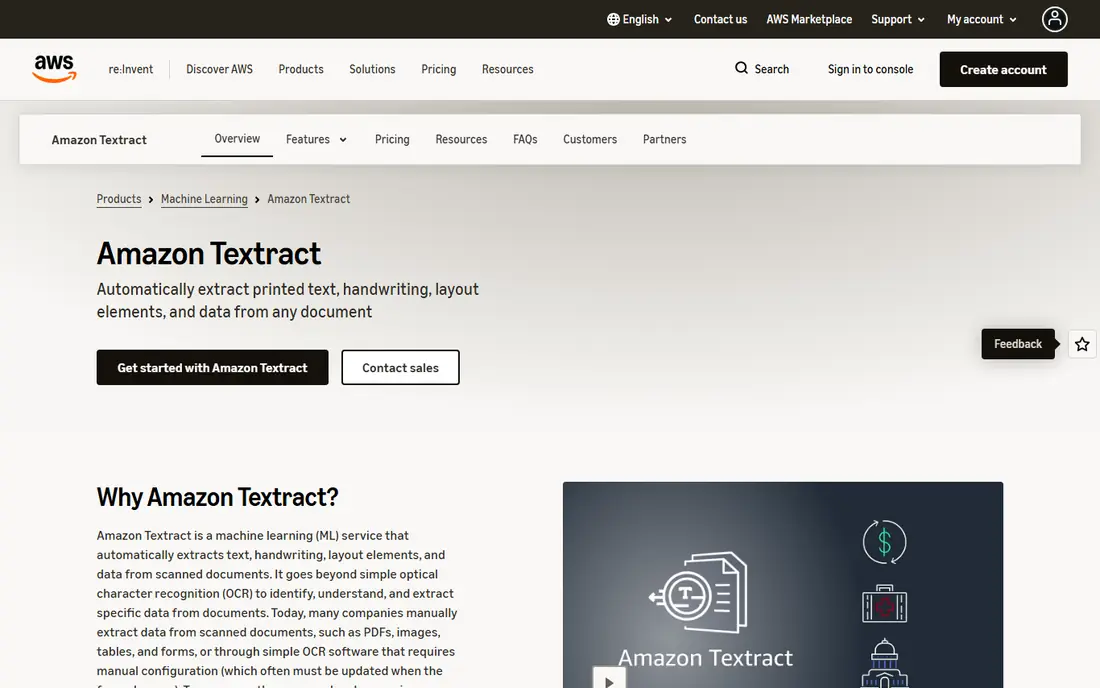
Amazon Textract targets AWS native extraction at page prices. Textract is the builder's choice on AWS. As for the details, the API returns data.
Everything an AP clerk touches, the exception queue, the matching, the audit trail, is your project. Be honest about the build. Worth adding: the pricing is public and tiny per page, and for a team with engineers it is commonly the cheapest route to a working extraction pipeline. Also, at low volume that trade wins easily; at enterprise volume, compare it against a product's total cost, not its page price. The starting price for Amazon Textract: $1.50 per 1,000 pages for text. Amazon Textract includes a free tier.
Main advantages: expense and invoice analysis is purpose built. Limits to weigh: It is an API; costs are low per page but the engineering around it is not.
- Scales without contracts or minimums
- Published per page pricing with a restricted free level: text detection starts around 1.50 dollars per 1,000 pages and form and expense features around 10 dollars per 1,000 pages in October 2026 reporting
- Not a workflow: review screens
Rossum
Ideal for: Invoice and accounts payable automation

In short, Rossum is for invoice and accounts payable automation. Ask what happens to the invoices it cannot read, since that queue is your team's new job. In practice, buy it for AP and judge it on straight through processing rates against your real invoice mix, including your worst suppliers.
What to check first: annual contracts start at a level small AP teams cannot justify; pricing is not published on its own site.
Also, Rossum is the specialist pick for the most typical document job in business: the supplier invoice. Its extraction, validation and approval flow assume an accounts payable team and an ERP. It is better at that one job than general systems typically run. Pricing for Rossum is not stated here, so ask the vendor for current figures. There is no free plan with Rossum.
- Purpose made for invoices and purchase orders instead of documents in general
- Review screens made for AP clerks
- The specialism is the limit: claims
Google Document AI
Ideal for: Google Cloud teams using managed parsers
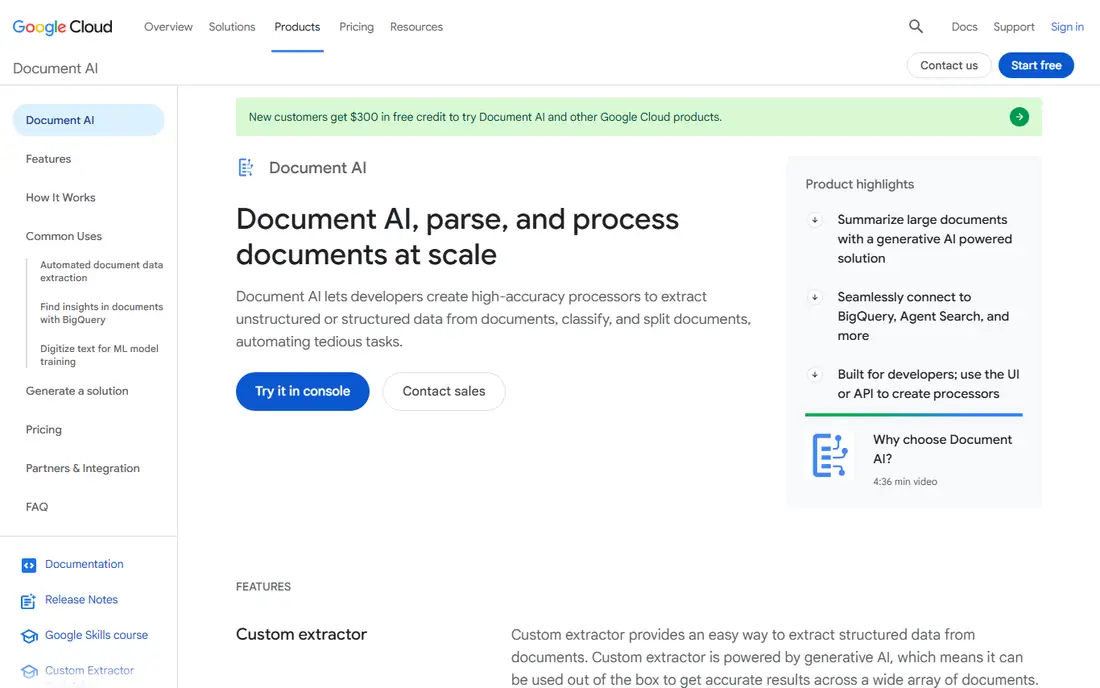
In short, Google Document AI is for Google Cloud teams using managed parsers. Google Document AI closes the cloud trio.
Their prices cluster together; your integration costs will not. Starting cost for Google Document AI: $10 per 1,000 pages for invoice parsing. Google Document AI offers a free plan.
What to check first: Same build it yourself reality as the other cloud APIs; pricing differs per processor, so costs need modelling per document type.
- BigQuery and Vertex AI integration fits teams building wider AI pipelines
- A library of specialised parsers
- Parser quality varies by document type and language
Hyperscience
Ideal for: High compliance back office processing
Hyperscience was built for high compliance back office processing. Hyperscience sells supervision as much as extraction.
What to check first: smaller ecosystem than ABBYY or UiPath; Custom enterprise pricing with no public figures.
Where it shines: capable record in government; Built around human in the loop supervision.
This comparison lists no price for Hyperscience; ask the vendor. Hyperscience has no free tier.
- Insurance and banking back offices
- Takes care of handwriting and poor quality scans better than most
- Not a pilot you run alone
Microsoft Azure Document Intelligence
Ideal for: Microsoft centric organisations
Microsoft Azure Document Intelligence is built with Microsoft centric organisations in mind. Azure Document Intelligence is Textract's mirror for Microsoft shops, with one practical edge: the Power Platform connection.
What Microsoft Azure Document Intelligence does well: Prebuilt models for invoices, receipts.
The main drawbacks: Still an API and studio; per page prices for some features run higher.
A finance team can go from scanned invoice to an approval flow with little code, which no raw API matches. Microsoft Azure Document Intelligence pricing: $10 per 1,000 pages for prebuilt forms. A free plan is available with Microsoft Azure Document Intelligence.
- Custom models train on your own forms
- Sits naturally inside Azure and Power Platform, so extracted data can drive Power Automate flows without code
- Up to about 50 dollars per 1,000 pages for complicated extraction in 2026 comparisons
ABBYY Vantage
Ideal for: Enterprise document operations
Where ABBYY Vantage fits: enterprise document operations. ABBYY is the incumbent.
Drawbacks to consider: more product than a single use case needs.
Pricing is by committed page volume, services are part of most deals. The payoff arrives at scale across plenty of document types instead of on the first invoice flow. ABBYY Vantage shows no starting price here, so confirm the cost on the vendor site. ABBYY Vantage has no free tier.
- Handles the core features described above
- Implementation normally needs professional services and takes months
Nanonets
Ideal for: Mid market automation with quick setup
For mid market automation with quick setup, Nanonets is a natural candidate. Upload samples, train a model, link the workflow, and you are processing in days. Worth adding: at tens of thousands of pages a month, 30 cents a page becomes a serious line item.
The cloud APIs below undercut it by an order of magnitude for teams willing to build. Beyond that, do the volume maths early. Nanonets is where mid size teams start. Entry price for Nanonets: Free tier, then usage based. Nanonets has a free plan.
Trade-offs to know: accuracy relies on training samples you offer; enterprise governance is lighter than ABBYY or Hyperscience.
- Workflows and approvals included
- Receipts and orders
- Costs need watching since usage billing rewards nobody for inefficiency
Our selection method
For each of the 7 tools we noted price, free plan or trial, fit for AI document processing tools and the main limit, using vendor pages and documentation. Prices and plan limits come from vendor pages and can change, so confirm them on the vendor site before you buy. Tools are placed by general fit for AI document processing tools, with price clarity and free access as tie-breakers. A different team can reasonably rank them differently.
What to confirm before you sign up
- Get a written quote from Rossum, Hyperscience and ABBYY Vantage; the list shows no starting price for them.
- Look at free plan limits closely: Amazon Textract, Google Document AI, Microsoft Azure Document Intelligence and Nanonets have one, and the caps decide whether it is usable for real work.
- Total up the real monthly cost of Google Document AI, including add-ons, extra users and usage-based fees.
- A short pilot of ABBYY Vantage with your real workflow tells you more than a feature table.
- Find out whether the entry plan of Hyperscience covers your must-haves or only a trimmed-down version.
Frequently asked questions
Can I try these options before paying?
Often, yes. Amazon Textract, Google Document AI, Microsoft Azure Document Intelligence and Nanonets have a free plan. Use your own data and a real task during the test, and check what the free tier or trial limits before you rely on it.
How accurate are these tools?
On poor scans, handwriting and unusual layouts, much less so, and vendor percentages are measured on their own samples. The only figure that matters is performance on your documents, which is why every serious evaluation uses your files.
Which options for AI document processing tools have a free plan?
Amazon Textract, Google Document AI, Microsoft Azure Document Intelligence and Nanonets offer a free plan in this list. Free plans usually cap users, projects or features, so check the limits on the vendor page.
Do these tools publish their prices?
Not all of them. Rossum, Hyperscience and ABBYY Vantage publish no starting price, so expect a quote request for those. The rest, Amazon Textract included, show a starting price, though seats and billing terms still change the final cost.
How much does document processing cost?
Mid market systems charge per page at higher rates with workflow included, around 30 cents per page pay as you go at Nanonets.
Can these tools deal with handwriting?
ABBYY and Azure contain handwriting recognition, and Hyperscience built its name partly on hard documents, but neat print will always beat cursive scrawl. Test handwriting specifically if it matters to your workflow, and plan human review for it.