Best AI Evaluation Tools for Production in 2026: 8 Tools Compared

- LangSmith and Langfuse are the most popular tracing and evaluation platforms for LLM apps, with LangSmith strongest inside LangChain and Langfuse strongest as an open-source option.
- Arize AI and Galileo suit teams that need deeper evaluation, guardrails and root-cause analysis in production.
- Weights and Biases Weave fits teams already tracking experiments in Weights and Biases.
- Promptfoo and Evidently AI are the best open-source starting points for prompt testing and monitoring.
Quick comparison
| Product | Ideal for | Price from | Free version | |
|---|---|---|---|---|
 LangSmith | LangChain apps in production | See website | Yes | Visit |
 Langfuse | Open-source LLM observability | See website | Yes | Visit |
 Arize AI | Evaluation and root-cause analysis | See website | Free trial | Visit |
 Galileo | Agent evaluation and guardrails | See website | Free trial | Visit |
 Weights and Biases Weave | Teams already using Weights and Biases | See website | Yes | Visit |
 Promptfoo | Open-source prompt testing | Free | Yes | Visit |
 Evidently AI | Open-source monitoring and drift | Free | Yes | Visit |
 Braintrust | Evaluation-driven development | See website | Free trial | Visit |
The best AI evaluation tools for production
AI evaluation tools watch LLM applications in production: tracing prompts and responses, scoring quality, catching hallucinations and drift, and alerting when behavior changes. The eight tools below cover tracing, evaluation and monitoring for teams shipping AI features, and we compared official product pages, pricing pages and documentation.
LangSmith
Ideal for: LangChain apps in production
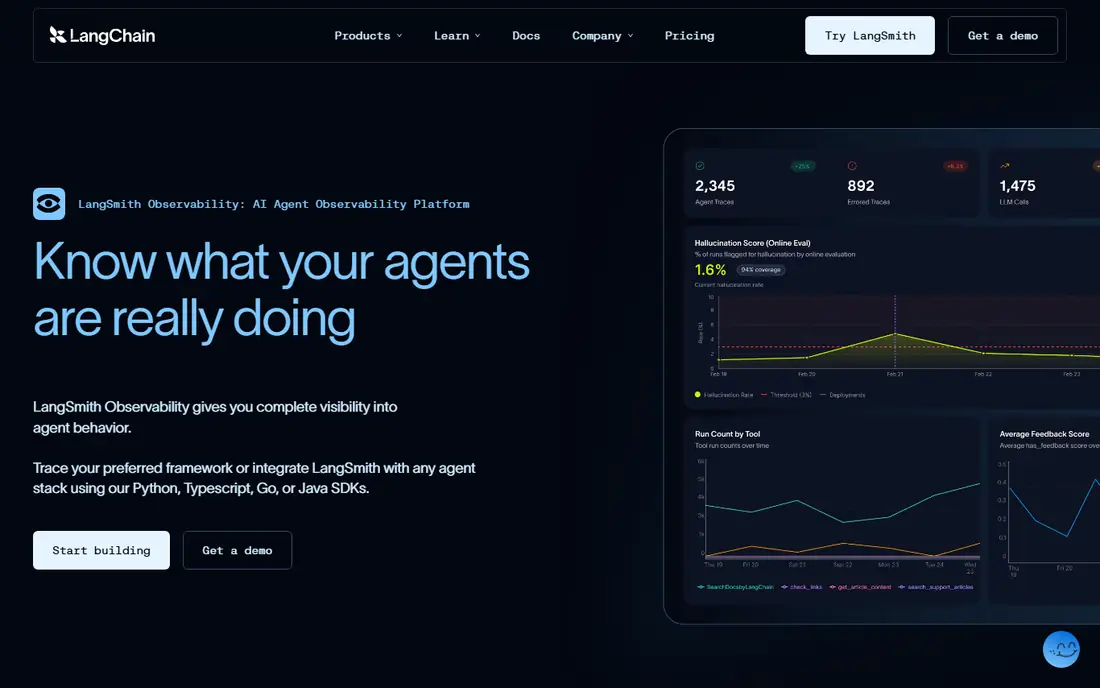
LangSmith is LangChain's platform for debugging, testing and monitoring LLM applications, with detailed traces of prompts, tool calls and agent steps, plus datasets for offline evaluation and online monitors for production quality. Teams building with LangChain or LangGraph get the deepest integration here.
The free tier covers small projects, with paid plans scaling by traced runs. For a team already committed to LangChain, LangSmith is the natural evaluation and observability choice, and its prompt hub helps version prompts safely.
- Deep tracing for LangChain and LangGraph apps
- Evaluation datasets and online monitors
- Prompt hub for versioning
- Most value inside the LangChain ecosystem
- Pricing scales with traced runs
Langfuse
Ideal for: Open-source LLM observability
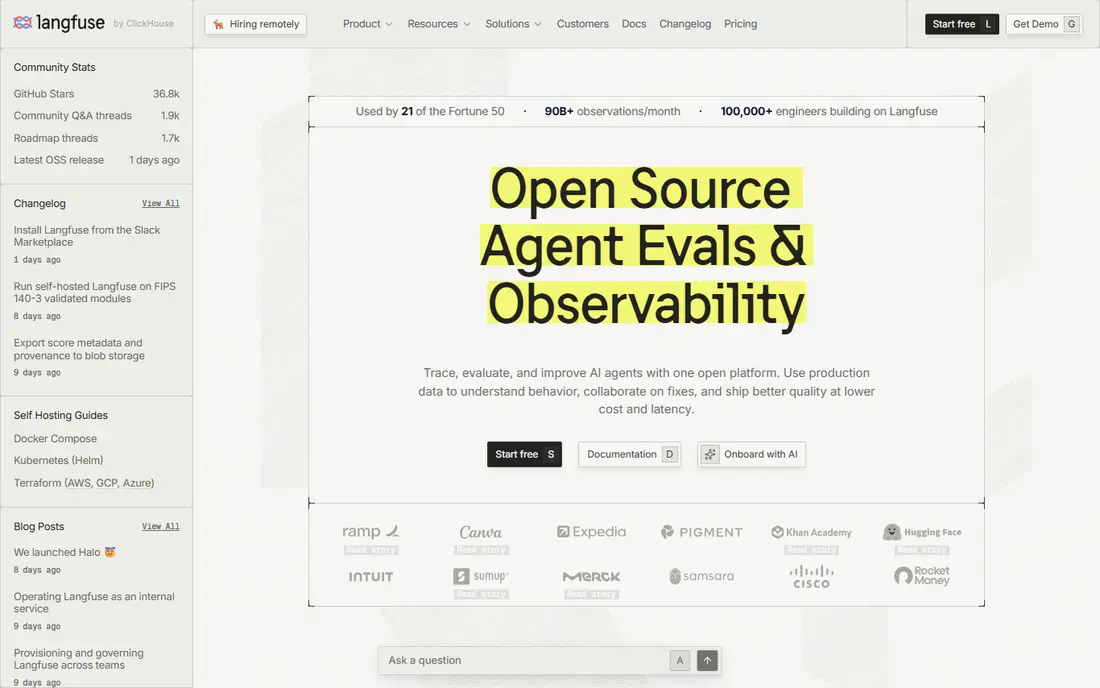
Langfuse is an open-source LLM engineering platform covering tracing, evaluations, prompt management and metrics, with SDKs for major languages and frameworks. Teams can self-host for full data control or use Langfuse Cloud for a managed service.
Self-hosting means owning upgrades and scaling, while cloud pricing scales with usage. For teams that value open source and control, or want evaluation without vendor lock-in, Langfuse is the leading option.
- Open source with self-hosting
- Tracing, evaluations and prompt management
- Good SDK coverage
- Self-hosting needs operations skill
- Some enterprise features need paid plans
Arize AI
Ideal for: Evaluation and root-cause analysis

Arize AI, including its Phoenix tracing project, covers LLM evaluation, tracing, monitoring and guardrails, with tools to find why a failure happened, not just that it happened. That root-cause focus suits teams running agents and complex LLM workflows in production.
Pricing is quoted for enterprise use, and the platform's breadth takes learning. For a team whose AI features are business-critical, Arize offers one of the deepest evaluation stacks available.
- Strong evaluation, tracing and guardrails
- Root-cause analysis for failures
- Good for agent workflows
- Enterprise pricing is quoted
- Breadth takes time to learn
Galileo
Ideal for: Agent evaluation and guardrails
Galileo focuses on evaluating AI agents, retrieval-augmented generation and chat applications, with metrics for hallucination, context quality, tool use and safety, plus guardrails that can block or correct bad outputs before users see them. That combination suits teams shipping customer-facing AI.
Pricing is quoted and the community is smaller than LangSmith's, but evaluation depth is strong. For agent-heavy products, Galileo deserves a place on the shortlist.
- Evaluation for agents, RAG and chat apps
- Guardrails to block bad outputs
- Clear quality metrics
- Pricing is quoted
- Newer platform with a smaller community than LangSmith
Weights and Biases Weave
Ideal for: Teams already using Weights and Biases
Weave is Weights and Biases' toolkit for LLM tracing and evaluation, letting model teams track prompts, outputs, scores and versions alongside the experiment tracking they may already use. That continuity suits research and applied AI teams that live in Weights and Biases.
Teams outside that ecosystem may find Langfuse or LangSmith simpler as standalone tools. For a Weights and Biases shop adding LLM evaluation, Weave is the natural extension.
- Tracing and evaluation inside the W and B ecosystem
- Good experiment tracking heritage
- Strong for model development teams
- Most value inside Weights and Biases
- Production monitoring depth varies by plan
Promptfoo
Ideal for: Open-source prompt testing
Promptfoo is an open-source tool for testing prompts: define test cases, run them across models and prompt versions, and compare outputs with assertions and scores, including in continuous integration. It is the best free starting point for prompt evaluation before shipping.
It is command-line focused and less of a hosted production dashboard, so teams pair it with a tracing tool for live monitoring. For prompt quality gates in development, Promptfoo is excellent and free.
- Open source and free
- Tests prompts against many models and cases
- Good CI integration
- Command-line focus, less of a hosted dashboard
- Production monitoring needs other tools
Evidently AI
Ideal for: Open-source monitoring and drift
Evidently AI is an open-source platform for monitoring machine learning and LLM systems, generating reports on data drift, output quality and performance changes over time. Teams can self-host it and schedule regular evaluations of production data.
Setup takes technical skill, and LLM-specific evaluation is part of a wider ML monitoring story. For teams that already monitor models and want LLM coverage in the same stack, Evidently is a solid open-source choice.
- Open source monitoring for ML and LLM outputs
- Drift and quality reports
- Self-hostable
- Setup needs technical skill
- LLM evaluation is one part of a wider ML platform
Braintrust
Ideal for: Evaluation-driven development
Braintrust centers development on evaluation: build datasets, run experiments across prompts and models, score results, and monitor production with the same framework. That workflow helps teams improve prompts systematically instead of by anecdote.
Pricing is quoted for larger use, and the ecosystem is smaller than LangSmith's. For a team that wants evaluation to drive development, Braintrust offers a clean and focused platform.
A further practice is versioning prompts and datasets together. When a prompt changes, the evaluation dataset should record which version it tested, so a later regression can be traced to the exact prompt, model or retrieval change that caused it. Without that linkage, teams argue about what changed instead of fixing it, and prompt improvements become hard to repeat reliably.
- Strong evaluation datasets and experiments
- Tracing and monitoring included
- Good developer experience
- Pricing is quoted for larger use
- Smaller ecosystem than LangSmith
How we picked these
We compared official product pages, pricing pages and documentation, focusing on tracing depth, evaluation methods, guardrails, prompt management and production monitoring. We favored tools that are actively developed today and support real production workloads, not just demos.
We also distinguished offline evaluation from live monitoring: prompt testing before release and drift detection after release are different jobs, and the best stacks cover both, whether in one tool or two.
How to evaluate AI in production without drowning in dashboards
Start with the failures that cost you most. For a support bot, that may be wrong answers and hallucinations. For an agent, it may be failed tool calls and loops. For a RAG app, it may be poor retrieval. Pick metrics for those failures first, and add others only when someone will act on them.
Build a golden dataset early
Collect real user prompts and expected answers, including edge cases and past failures, into a versioned dataset. Run every prompt change against it before shipping, and treat regressions as release blockers. Without that dataset, evaluation is opinion, not measurement.
Monitor a sample, not everything
Scoring every production trace with an LLM judge is expensive and slow. Score a representative sample continuously, plus all traces that trigger alerts like errors, low confidence or user complaints. That balance gives timely signals without runaway cost.
Close the loop from alert to fix
An alert that nobody owns is noise. Assign each monitor an owner, a threshold and a fix path: prompt change, retrieval fix, model change or guardrail. Review evaluation trends weekly, and retire monitors that never trigger action.
Frequently asked questions
What is the best AI evaluation tool for production?
LangSmith leads for LangChain apps, Langfuse leads as an open-source option, and Arize AI and Galileo lead for deep evaluation and guardrails. Promptfoo is the best free starting point for prompt testing.
What does an AI evaluation tool measure?
It measures output quality, hallucinations, retrieval accuracy, tool-use success, latency, cost and safety, using a mix of code checks, human labels and LLM judges. Good tools trace the full prompt and response so failures can be diagnosed.
Do I need evaluation if I already test prompts manually?
Manual testing catches obvious problems but misses regressions and drift over time. Automated evaluation with a golden dataset catches prompt changes that break previously working cases, which manual checks routinely miss.
What is the difference between LangSmith and Langfuse?
LangSmith is LangChain's hosted platform with deep LangChain integration, while Langfuse is open source and framework agnostic with self-hosting. Both cover tracing and evaluation, so the choice often follows your stack and hosting needs.
How much do AI evaluation tools cost?
Open-source tools like Langfuse, Promptfoo and Evidently are free to self-host, while hosted plans scale with traced runs or usage. Enterprise platforms are often quoted. Start free or on a trial, and price at your real trace volume.
How do I stop prompt changes from breaking my AI app?
Build a golden dataset of real prompts and expected answers, run it automatically before every prompt or model change, and block releases that regress. Version prompts with their test results, so any breakage traces to a specific change.