6 Top AI Grading App for Pokemon Cards Compared (2026)

- 1
 PokemonCardCheckerCondition check plus market pricesVisit
- 2
 SlabLineageSubmit-or-skip mathVisit
- 3
 SwapLoomGrading plus collection trackingVisit
- 4
 CardMintAIQuick first estimateVisit
- 5
 GradeonIn-depth defect breakdownsVisit
- PokemonCardChecker takes the first slot, best suited to condition check plus market prices.
- GemGrader suits confidence bands and centering detail.
- Before buying CardMintAI, weigh this: free level handles only one grade.
- PokemonCardChecker, SwapLoom, CardMintAI, Gradeon, GemGrader: these are the 5 tools out of 6 that offer a free plan.
Direct answer
PokemonCardChecker leads the list, best for condition check plus market prices. If your case is different, SlabLineage suits submit-or-skip math and SwapLoom suits grading plus collection tracking. The other 3 tools in the list cover narrower or pricier cases.
Quick comparison
| Product | Ideal for | Price from | Free version | |
|---|---|---|---|---|
| PokemonCardChecker | Condition check plus market prices | See website | Yes | Visit |
| SlabLineage | Submit-or-skip math | See website | Not stated | Visit |
| SwapLoom | Grading plus collection tracking | $12.90 per month | Yes | Visit |
| CardMintAI | Quick first estimate | $10 a month | Yes | Visit |
| Gradeon | In-depth defect breakdowns | See website | Yes | Visit |
 GemGrader | Confidence bands and centering detail | See website | Yes | Visit |
AI Grading App for Pokemon Cards, one by one
This Ainotely guide covers 6 AI grading app for pokemon cards. Each profile lists a starting price, free plan details, strengths and drawbacks, so you can drop poor fits quickly.
PokemonCardChecker
Ideal for: Condition check plus market prices
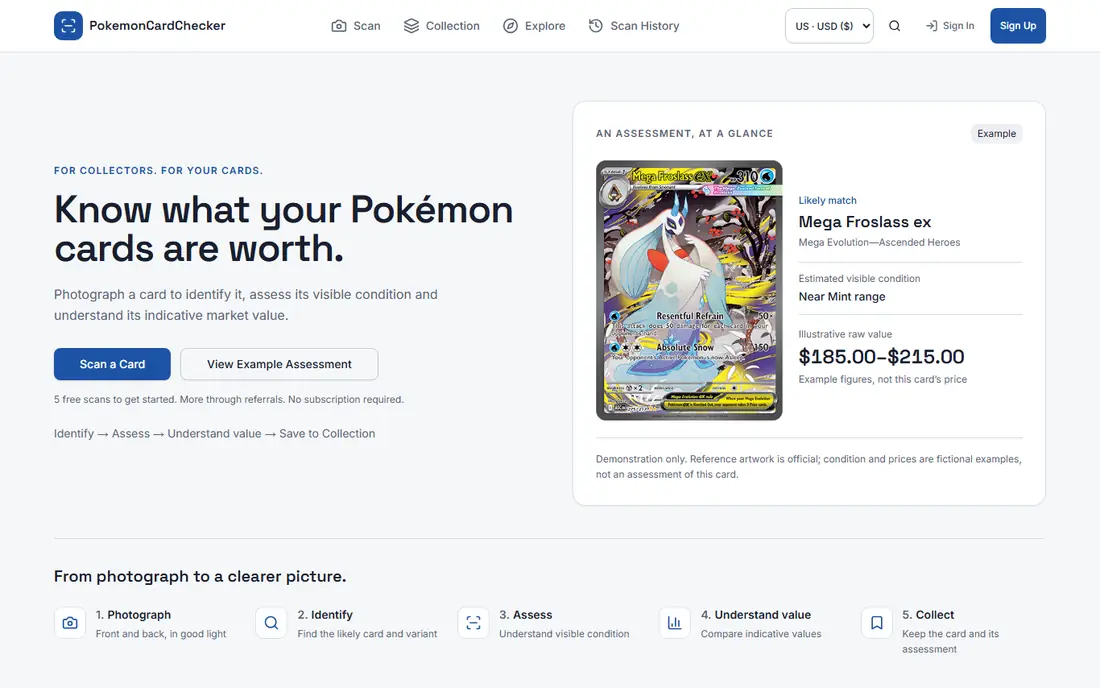
PokemonCardChecker is aimed squarely at condition check plus market prices. Upload a photo, and the AI spots the card, assesses condition as near mint, lightly played, moderately played, heavily played, or damaged, and produces raw and PSA-graded price estimates. That low barrier makes it a decent first tool for a new collector sorting a binder or a recent purchase.
Also, the trade-off is depth. Results also depend heavily on photo quality, with clear, well-lit photos of both sides giving the most handy estimates. More specifically, use PokemonCardChecker to triage a collection and estimate value rapidly, then run the most solid candidates through a more in-depth grader before paying to submit. This comparison lists no price for PokemonCardChecker; ask the vendor. Free access exists with PokemonCardChecker.
Where PokemonCardChecker stands out: AI condition labels from near mint to damaged.
- Raw and graded price estimates
- 5 free scans on signup with no credit card
- Pricing for additional scans is not shown on the primary page
SlabLineage
Ideal for: Submit-or-skip math
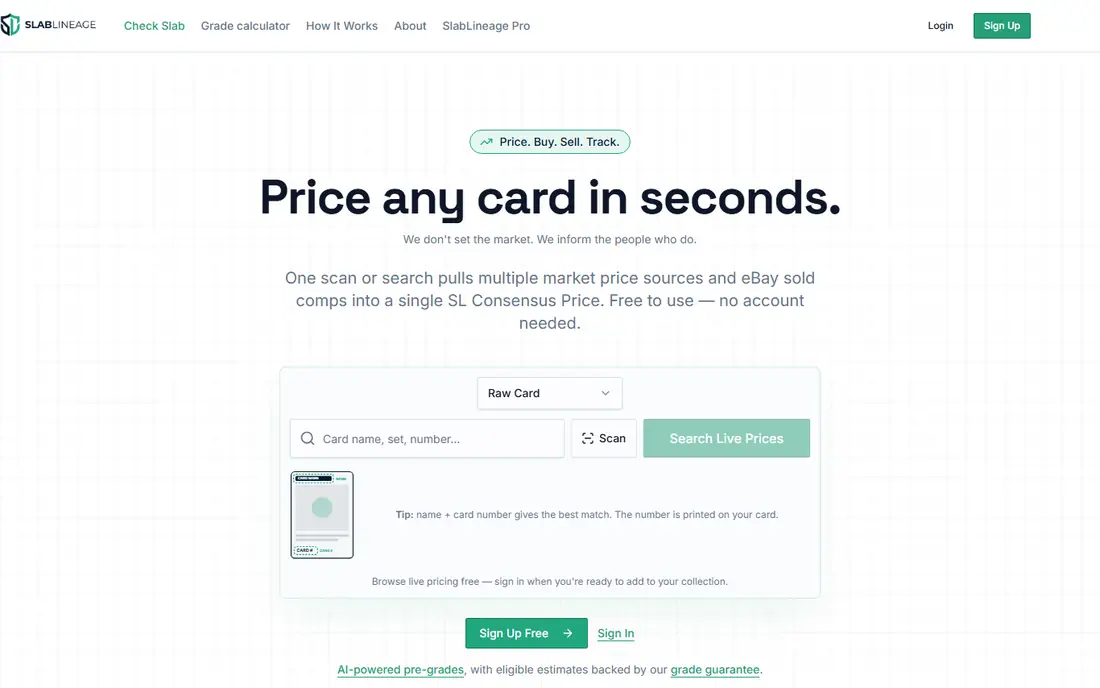
Where SlabLineage fits: submit-or-skip math. Take two photos, front and back, and the AI reviews centering, corners, edges, and surface on each side, returning an estimated grade range for PSA and TAG in about 60 seconds. More specifically, the main limit is transparency on price.
In daily use, the calculator then compares what a 9 or a 10 would be worth against the raw price, minus the grading fee. So you can see whether submission is likely to pay. In practice, the central pre-grade page does not present a straightforward price list. So you have to check the checkout or account pages before committing to a batch. As for the details, use SlabLineage when the decision is financial, and use a second app when you want an in-depth defect report. SlabLineage does not show a starting price in this comparison, so check the vendor site for current pricing. Free options: Not stated.
Where it is weaker: Pricing is not shown plainly on the central pre-grade page.
- PSA and TAG pre-grade ranges from two photos
- Pre-grade guarantee for eligible estimates
- Guarantee terms apply only to eligible estimates
SwapLoom
Ideal for: Grading plus collection tracking
Where SwapLoom fits: grading plus collection tracking. For everyday use, the honest limit is stated on the SwapLoom site itself: AI grades go up to 8.5 a maximum of, since grades of 9 and 10 need physical inspection by certified graders. That cap is actually a strength for decision-making, since it stops the app from flattering a near-mint card into a false 10.
Watch-outs: AI grades are capped at 8.5 on the vendor site.
Beyond that, the free Starter plan contains 2 credits a month, whereas Collector at $12.90 a month brings 70 credits and quicker price updates. Casual collectors may find the trading features unnecessary, but organized collectors will use the full workspace. Also, support for French, English, Japanese, German, Italian, Spanish, and Portuguese cards helps collectors with international sets. The starting price for SwapLoom: $12.90 per month. You can start on SwapLoom without paying.
- Multi-language card support
- Prices from PriceCharting and Cardmarket
- Trading and pricing features add complexity for casual users
CardMintAI
Ideal for: Quick first estimate
CardMintAI targets quick first estimate. Worth adding: treat the predicted grade as a screening tool, not a promise, and re-check any borderline card with a second photo in better light. In daily use, if you grade only a handful of cards before each submission, the pay-once credit packs may cost less than a monthly plan, since unused credits do not expire.
Where it is weaker: Higher plans are needed for batch grading and analytics.
The free level is narrow by design: one grade on signup, with no credit card required. A visual defect map shows where points were lost, so you can learn what graders look for on your own cards. On top of that, upload a photo, and the AI scores centering, corners, edges, and surface, then returns a predicted PSA grade from 1 to 10 with individual subgrades. On cost, CardMintAI starts like this: $10 per month. CardMintAI includes a free tier.
- One free grade on signup
- Credit packs that never expire
- Free level spans only one grade
Gradeon
Ideal for: In-depth defect breakdowns
Gradeon targets in-depth defect breakdowns. Use it when a card is valuable enough to deserve a careful look. Photograph the front and back, add close-ups of a corner or edge if needed, and Gradeon measures borders, scores surface, corners, edges, and centering, and returns a PSA-comparable pre-grade from 1 to 10 in half steps.
That detail costs time. Confirming centering pins and reviewing defects takes longer than a single scan, and the standard check takes about one to two minutes. Gradeon shows no starting price here, so confirm the cost on the vendor site. Gradeon includes a free tier.
Drawbacks to consider: The manual defect step takes longer than a one-tap scan.
- 3 free full grades every week
- Centering checked with user-confirmed pins
- Premium pricing is not shown on the central landing page
GemGrader
Ideal for: Confidence bands and centering detail
Think of GemGrader for confidence bands and centering detail. On top of that, GemGrader is unusually candid about limits.
More specifically, since the app is in open beta, expect changes to features and pricing, and treat early results as a second opinion alongside another grader. In daily use, the result is an estimated PSA grade with subgrades, a confidence level, and a plain-English analysis, plus a probability distribution across grades so you can see whether a card sits firmly at one grade or straddles two. This comparison lists no price for GemGrader; ask the vendor. GemGrader has a free plan.
What to check first: Still in open beta, so features and prices may change.
- Confidence bands display uncertainty
- Auto-identification for English and Japanese cards
- Token and subscription prices are listed in pounds
Our selection method
Ainotely looked at what each vendor publishes: pricing, plan limits, feature coverage for AI grading app for pokemon cards and stated drawbacks. No hands-on testing is claimed. Seat minimums, billing terms and add-ons can move the real cost, so the starting prices here are a guide and not a quote. Tools are placed by general fit for AI grading app for pokemon cards, with price clarity and free access as tie-breakers. A different team can reasonably rank them differently.
Questions to settle before buying
- Confirm the entry price on the vendor page. For PokemonCardChecker, SlabLineage, Gradeon and GemGrader that means a quote rather than a fixed price.
- Look at free plan limits closely: PokemonCardChecker, SwapLoom, CardMintAI and others have one, and the caps decide whether it is usable for real work.
- Before choosing PokemonCardChecker, weigh its main limit: pricing for additional scans is not shown on the primary page.
- Price Gradeon for your actual team size; headline prices rarely include add-ons or overage.
- List the apps you already depend on and check that SlabLineage supports each one on the plan you would buy.
Frequently asked questions
Which options for AI grading app for pokemon cards have a free plan?
On this list, PokemonCardChecker, SwapLoom, CardMintAI, Gradeon and GemGrader include a free plan. Caps on seats, usage or features are common, so test the free plan against your real workload.
Which AI grading app is a good match for beginners?
PokemonCardChecker is the pick this page puts first, mainly for condition check plus market prices. If your situation differs, SlabLineage suits submit-or-skip math, and SwapLoom suits grading plus collection tracking. Compare price and limits before you decide.
What is the cheapest option for AI grading app for pokemon cards in this list?
On published monthly entry prices, CardMintAI is the lowest here at $10 per month. Entry price is only part of the cost, because seats, add-ons and billing terms can change the total.
Is PokemonCardChecker the right pick for everyone comparing AI grading app for pokemon cards?
No single tool suits every team. PokemonCardChecker comes first because it fits condition check plus market prices, while SlabLineage suits submit-or-skip math and SwapLoom suits grading plus collection tracking. Match the tool to your own size, budget and workflow before deciding.
How are the tools for AI grading app for pokemon cards ordered?
PokemonCardChecker sits first and GemGrader last because the order follows typical fit for AI grading app for pokemon cards, then price clarity and free access. It is a judgement call, so read each profile for fit and limits.