6 AI Healthcare Analytics Software for Payers Ranked for 2026

- 1
 Clarify HealthHealth plans that require provider network analytics and value-based contract managementVisit
- 2
 Milliman MedInsightHealth plans that want a payer data warehouse with capable benchmarkingVisit
- 3
 OptumLarge health plans that want the broadest payer analytics and workflow suiteVisit
- 4
 CotivitiLarge health plans that want payment integrity, risk adjustment and quality analytics from one vendorVisit
- 5
 Centauri Health SolutionsMedicare Advantage and Medicaid plans centred on risk adjustment and quality programsVisit
- The list opens with Clarify Health, aimed at Health plans that require provider network analytics and value-based contract management.
- MedeAnalytics is the one to check for Health plans that want cross-domain analytics across cost, utilization, quality and risk.
- Check the limits for Clarify Health before you commit: product breadth can mean a long setup for plans that only need one use case.
- No starting price is shown for any of the 6 tools, Clarify Health and MedeAnalytics included, so plan time for sales calls.
- Neither Clarify Health nor MedeAnalytics, nor any of the other 4 tools, has a permanent free plan; trials and quotes are the norm.
Direct answer
If you need Health plans that require provider network analytics and value-based contract management, Clarify Health is the first tool to look at here. Milliman MedInsight fits Health plans that want a payer data warehouse with strong benchmarking; Optum fits large health plans that want the broadest payer analytics and workflow suite.
Quick comparison
| Product | Ideal for | Price from | Free version | |
|---|---|---|---|---|
| Clarify Health | Health plans that require provider network analytics and value-based contract management | Quote | No | Visit |
| Milliman MedInsight | Health plans that want a payer data warehouse with capable benchmarking | Quote | No | Visit |
| Optum | Large health plans that want the broadest payer analytics and workflow suite | Quote | No | Visit |
| Cotiviti | Large health plans that want payment integrity, risk adjustment and quality analytics from one vendor | Quote | No | Visit |
| Centauri Health Solutions | Medicare Advantage and Medicaid plans centred on risk adjustment and quality programs | Quote | No | Visit |
 MedeAnalytics | Health plans that want cross-domain analytics across cost, utilization, quality and risk | Quote | No | Visit |
Our 6 AI healthcare analytics software for payers
If you are comparing AI healthcare analytics software for payers, this page covers 6 tools in one place: what each is best for, what it costs to start, whether it has a free plan, and the main limit to know about.
Clarify Health
Ideal for: Health plans that require provider network analytics and value-based contract management
Clarify Health serves Health plans that need provider network analytics and value-based contract management. Clarify Contracts helps plans design value-based contracts, track financial performance and settle payments with providers. Its Clara IQ generative AI layer lets users ask questions of the data in plain language.
Also, the system is wide, so a plan that only needs risk adjustment may find a narrower tool quicker to deploy. Worth adding: Clarify Health is the pick for plans that care most about their provider networks and their value-based contracts. Its Atlas Platform maps more than 300 million longitudinal patient journeys. Its Performance IQ Suite applies machine learning to cost, quality and utilization so plans can rank providers and find real savings. Clarify Health sells by quote instead of a published price. Clarify Health does not include a free plan.
Drawbacks to consider: No public pricing.
- Named Best in KLAS for Data Analytics Platform (Payers)
- Performance IQ Suite for cost
- System breadth can mean a long setup for plans that only need one use case
Milliman MedInsight
Ideal for: Health plans that want a payer data warehouse with capable benchmarking
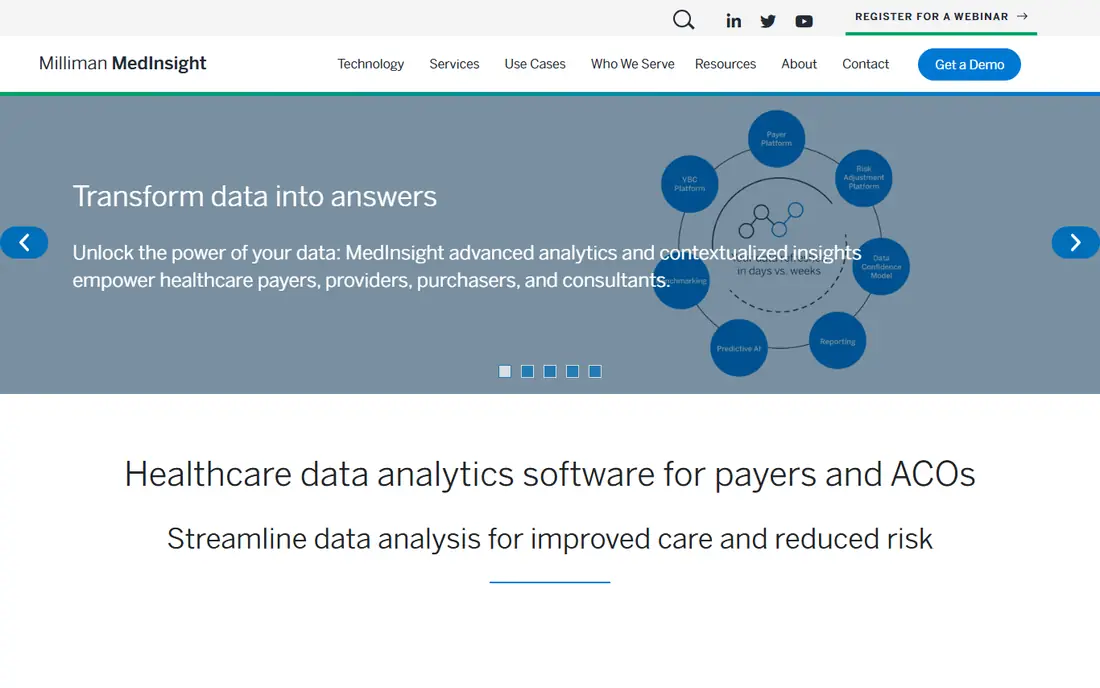
For Health plans that want a payer data warehouse with strong benchmarking, Milliman MedInsight is a natural candidate. Milliman MedInsight is the pick for a plan that wants a solid payer data warehouse with trusted benchmarks behind it. Its Payer Insights application brings claims and clinical data into one store, then hands finance, clinical and operations teams the same view of cost drivers, utilization trends and quality performance.
What Milliman MedInsight does well: Milliman benchmarking data.
Watch-outs: The system is most solid on reporting and benchmarking, so plans that require deep AI fraud or NLP risk coding may need a second tool. From a buyer's view, MedInsight is most solid on reporting, benchmarking and data warehousing. So a plan that needs NLP chart review or AI fraud detection will likely pair it with a second tool. It runs on Milliman data standards, a plus for plans that already use Milliman actuarial work. Milliman MedInsight does not publish a starting price; ask for a quote. No free plan comes with Milliman MedInsight.
- Six years running
- Payer Insights brings together claims and clinical data
- Implementation relies on Milliman data standards
Optum
Ideal for: Large health plans that want the broadest payer analytics and workflow suite
Optum serves large health plans that want the broadest payer analytics and workflow suite. Its Value Connect suite brings payer and provider data together with more than 1,600 predictive models. Its Symmetry Suite is used by nine of the ten largest payers.
Optum is part of UnitedHealth Group, so a plan that competes with UnitedHealthcare should weigh that relationship in its vendor review. Beyond that, pricing is by quote, and the suite is large enough that a buyer should scope the modules carefully. From a buyer's view, Optum Insight works with about 300 health plans, and Frost and Sullivan named Optum a market leader in its 2025 payer-provider collaboration radar. Optum does not show a fixed starting price, so you request a quote. Optum has no free plan.
Downsides: The suite is large and pricing is not public.
- About 300 health plan clients
- Value Connect suite with more than 1,600 predictive models
- Optum is part of UnitedHealth Group, so plans that compete with UnitedHealthcare may want to weigh that relationship
Cotiviti
Ideal for: Large health plans that want payment integrity, risk adjustment and quality analytics from one vendor
Cotiviti serves large health plans that want payment integrity, risk adjustment and quality analytics from one vendor. In September 2026 it added itemized bill review and inpatient coding validation to its Payment Accuracy suite.
On top of that, the company says it works with more than 200 payers, including all of the top 25 national health plans, and that its payment integrity work spots and corrects about $10 billion in medical spend each year. In daily use, Everest Group named it a leader for market impact in its 2026 pre-payment integrity assessment. Pricing for Cotiviti is quote based, so budget talks start with the vendor. Cotiviti has no free tier.
Downsides: Pricing is not published, which makes early budgeting hard.
- Prepay and postpay payment integrity in one suite
- Serves more than 200 payers including all top 25 national plans
- Aimed at large plans, so smaller plans may find the scope and the implementation effort heavy
Centauri Health Solutions
Ideal for: Medicare Advantage and Medicaid plans centred on risk adjustment and quality programs
Choose Centauri Health Solutions for Medicare Advantage and Medicaid plans concentrated on risk adjustment and quality programs. Its end-to-end risk adjustment service includes medical record retrieval, coding, analytics and RAPS and EDPS submissions.
What to check first: Services and software are bundled, so buyers should separate the technology fee from the managed service fee.
Its Centauri Insights Suite targets member conditions, risk gaps and quality gaps with machine learning. The trade-off is that services and software come bundled, so buyers should ask for the technology fee and the managed service fee as separate lines. Centauri Health Solutions sells by quote instead of a published price. There is no free plan with Centauri Health Solutions.
- End-to-end risk adjustment with retrieval
- Coding and analytics
- Smaller footprint than the national products above
MedeAnalytics
Ideal for: Health plans that want cross-domain analytics across cost, utilization, quality and risk
MedeAnalytics makes the most sense for Health plans that want cross-domain analytics across cost, utilization, quality and risk. The pitch is wide by design, so buyers should confirm which modules sit inside the quoted price and which are priced apart.
More specifically, advisory services are part of the offer, which can help a thin team but also lifts the total cost. There is no list price for MedeAnalytics, so a quote is the way in. MedeAnalytics has no free plan.
Limits to weigh: The product pitch is wide, so plans should confirm which modules are included in the quote.
- Financial and social risk data
- Medicare Advantage Insights and Employer Group Performance modules
- Advisory services are bundled, which can raise the total cost
What to expect to pay for AI healthcare analytics software for payers
Compare vendors on the use cases they prove with your own data, not on feature lists, since every system in this market is priced by custom quote. Ask each vendor to run a pilot on a sample of your claims and present the savings, the false positive rate, and the staff time saved. Beyond that, ask how the model was trained, how commonly it is updated, and whether your team can see why a claim was flagged.
From a buyer's view, ask for the full price: license, implementation, data feeds, and any per-claim or per-member fee. Ask for two reference clients in your line of business and your size band. As for the details, get the quote in writing with the modules listed, so you can compare like with like.
Pricing patterns for AI healthcare analytics software for payers
Payment integrity and risk adjustment typically pay back fastest, since they recover or protect revenue on claims the plan already processes. Risk adjustment pays back when better coding lifts the accuracy of the risk scores that set plan revenue for Medicare Advantage and ACA lines. From a buyer's view, utilization management comes next, since prior authorization and care management change the cost of care straight.
Network analytics pays back more slowly, since contract changes take a full cycle to present in claims.
Selecting AI healthcare analytics software for payers: the practical checks
Check data ownership, model transparency, audit support and exit terms before you sign, since payer analytics contracts run for years and touch regulated data. From a buyer's view, confirm the vendor signs a business associate agreement and meets HIPAA and HITRUST expectations. Worth adding: ask what happens to your data if you leave, and how long the vendor keeps it.
How these tools were picked
For each of the 6 tools we noted price, free plan or trial, fit for AI healthcare analytics software for payers and the main limit, using vendor pages and documentation. Plan names, prices and limits change often. Treat the figures here as a starting point and verify them with the vendor. The order reflects how well each tool fits the most common buying scenario for AI healthcare analytics software for payers, then price clarity, then free plan access. It is a starting point, not a verdict.
Pre-purchase checklist
- Confirm the entry price with every vendor: no tool from Clarify Health to MedeAnalytics shows a fixed starting price.
- Before choosing Clarify Health, weigh its main limit: system breadth can mean a long setup for plans that only need one use case.
- Verify that exporting from Milliman MedInsight is possible on your plan and covers all your records.
- Add up seats, add-ons and usage charges for Optum before comparing it with cheaper entries.
- Find out what support Clarify Health includes on your plan, and whether onboarding help costs extra.
Frequently asked questions
Do these tools publish their prices?
No. None of the tools, from Clarify Health to MedeAnalytics, shows a fixed starting price here, so budget time for quotes.
How are the tools for AI healthcare analytics software for payers ordered?
The order follows typical fit for AI healthcare analytics software for payers, with Clarify Health first and MedeAnalytics last, then price clarity and free access. It is editorial judgement, not a score, so another team could rank the tools differently.
Is Clarify Health the right pick for everyone comparing AI healthcare analytics software for payers?
No single tool suits every team. Clarify Health comes first because it fits Health plans that need provider network analytics and value-based contract management, while Milliman MedInsight suits Health plans that want a payer data warehouse with strong benchmarking and Optum suits large health plans that want the broadest payer analytics and workflow suite. Match the tool to your own size, budget and workflow before deciding.
Does any tool for AI healthcare analytics software for payers here have a free plan?
No tool in this list, Clarify Health and MedeAnalytics included, has a permanent free plan. Trials and quotes are the usual route, so plan a short evaluation period.
How much does AI healthcare analytics software for payers cost?
Price relies on member count, lines of business, modules bought, and whether the vendor also runs the work. Ask for license, implementation and per-member fees as separate lines, and ask about year two and year three prices.