Best AI Platforms for Web Search for Agents

- 1
 TavilyAI agents that need search, extract and research in one APIVisit
- 2
 ExaNeural search with page text included in the resultVisit
- 3
 Brave Search APIIndependent index results without Google or BingVisit
- 4
 SerpAPIStructured results from Google and other enginesVisit
- 5
 You.com APIFast web search with full page content bundled inVisit
- Tavily is the most agent focused option, with search, extract, crawl and research behind one key and a free tier of 1,000 credits a month.
- Exa and Parallel give the lowest entry cost per search, from $1 to $4 per 1,000 requests, with free credit each month.
- SerpAPI is the pick when you need real Google results pages, with many engines and verticals, at the highest entry price in this list.
- The Bing Search API is retired and the Google Custom Search JSON API is closed to new customers, so new builds should not start on either one.
- Match the tool to the job: raw results when your own model does the reasoning, or a written answer when the agent should not do the synthesis itself.
Quick comparison
| Product | Ideal for | Price from | Free version | |
|---|---|---|---|---|
| Tavily | AI agents that need search, extract and research in one API | $30 per month (Project plan, 4,000 API credits) | Yes | Visit |
| Exa | Neural search with page text included in the result | $4 per 1,000 requests (Lite search, pay as you go) | Yes | Visit |
| Brave Search API | Independent index results without Google or Bing | $5 per 1,000 requests (Search plan) | Yes | Visit |
| SerpAPI | Structured results from Google and other engines | $25 per month (Starter plan, 1,000 searches) | Yes | Visit |
| You.com API | Fast web search with full page content bundled in | $5 per 1,000 calls (Web Search API Standard) | Yes | Visit |
 Parallel | Low cost search for high volume agent workloads | $1 per 1,000 requests (Turbo or Fast search) | Yes | Visit |
 Google Programmable Search | Google results across sites you choose | $5 per 1,000 queries (ad-free element API) | Yes | Visit |
 Perplexity API | Raw search results or a written answer with citations | $5 per 1,000 requests (Search API) | No | Visit |
Best AI Platforms for Web Search for Agents
Tavily
Ideal for: AI agents that need search, extract and research in one API
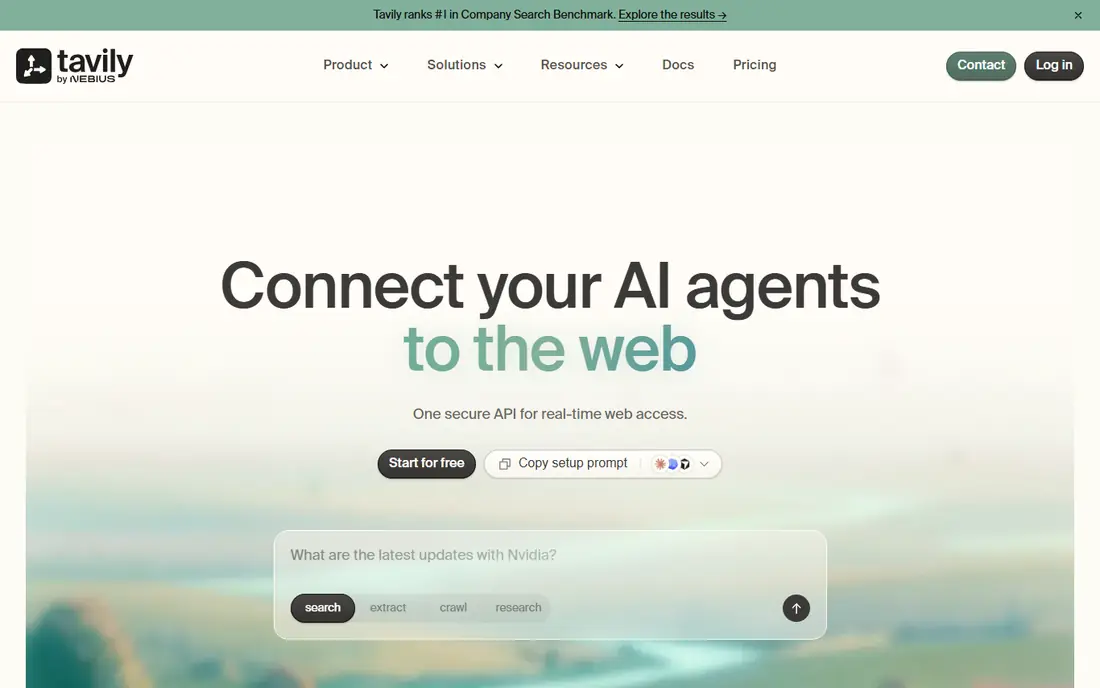
Tavily is built for agents and retrieval pipelines rather than for people typing queries into a search box. One API key covers search, extract, crawl, map and research, so an agent can find pages and pull their text without a second vendor. A basic search costs 1 credit and an advanced search costs 2, which keeps simple lookups cheap.
The free Researcher plan gives 1,000 credits a month with no card required, and credits reset on the first day of each month. Pay as you go costs $0.008 per credit, while the Project plan is $30 a month for 4,000 credits. Larger monthly plans run from Bootstrap at $100 for 15,000 credits to Growth at $500 for 100,000 credits. Tavily was acquired by Nebius in February 2026 and still runs under its own brand.
- One key covers search, extract, crawl and research
- Free Researcher plan with 1,000 credits a month and no card required
- Research calls can burn 4 to 250 credits each, so costs rise fast on deep research
- No annual discount is listed on the pricing page
Exa
Ideal for: Neural search with page text included in the result
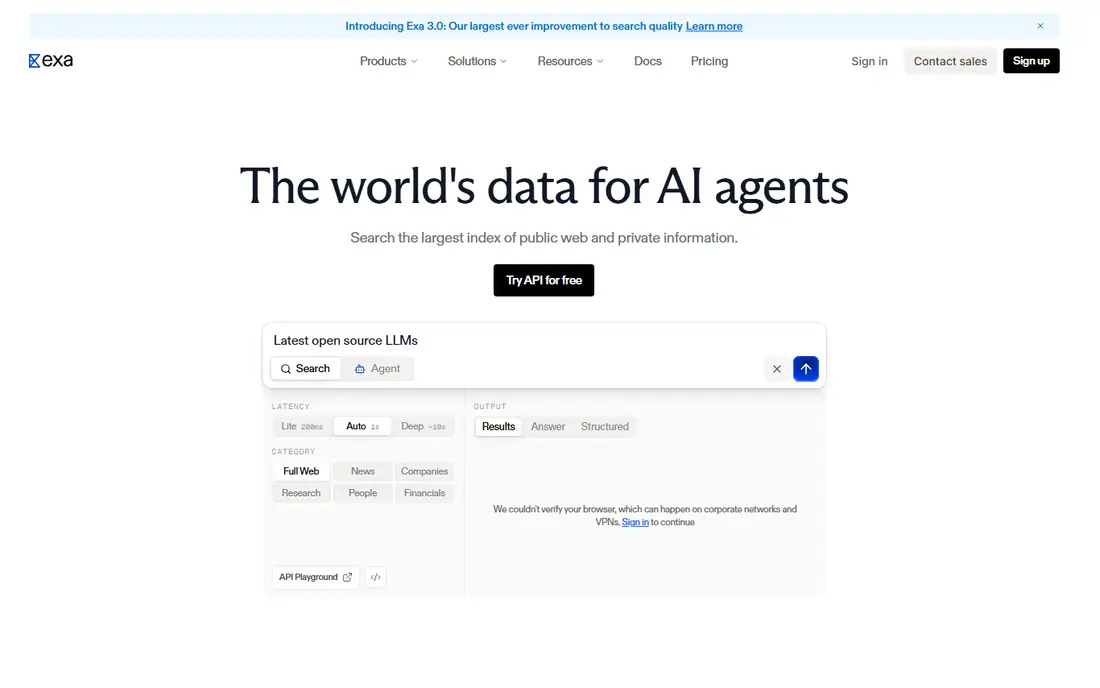
Exa runs its own search index and ranks pages by meaning rather than by keyword match, which suits agents that ask questions in plain language. Search latency runs from about 450 milliseconds on Lite to about 1 second on Auto, and the API also offers contents, answer, monitors and a multi-step Agent endpoint. Official SDKs cover Python and JavaScript.
Pricing is pay as you go with no subscription and no minimum spend. Lite search costs $4 per 1,000 requests and Auto search costs $7, while Deep Search runs $12 to $15 per 1,000 requests. The free Starter tier gives $10 in credits each month plus a one-time $10 onboarding bonus, with no card required. Enterprise plans are custom and add zero data retention, SSO and higher rate limits.
- Own search index with semantic ranking, not a relay of another engine
- Page text and highlights included in the base search price since March 2026
- Results above 10 per request cost extra, at $1 per 1,000 results
- Free credit is $10 a month, which covers about 1,400 to 2,500 searches
Brave Search API
Ideal for: Independent index results without Google or Bing
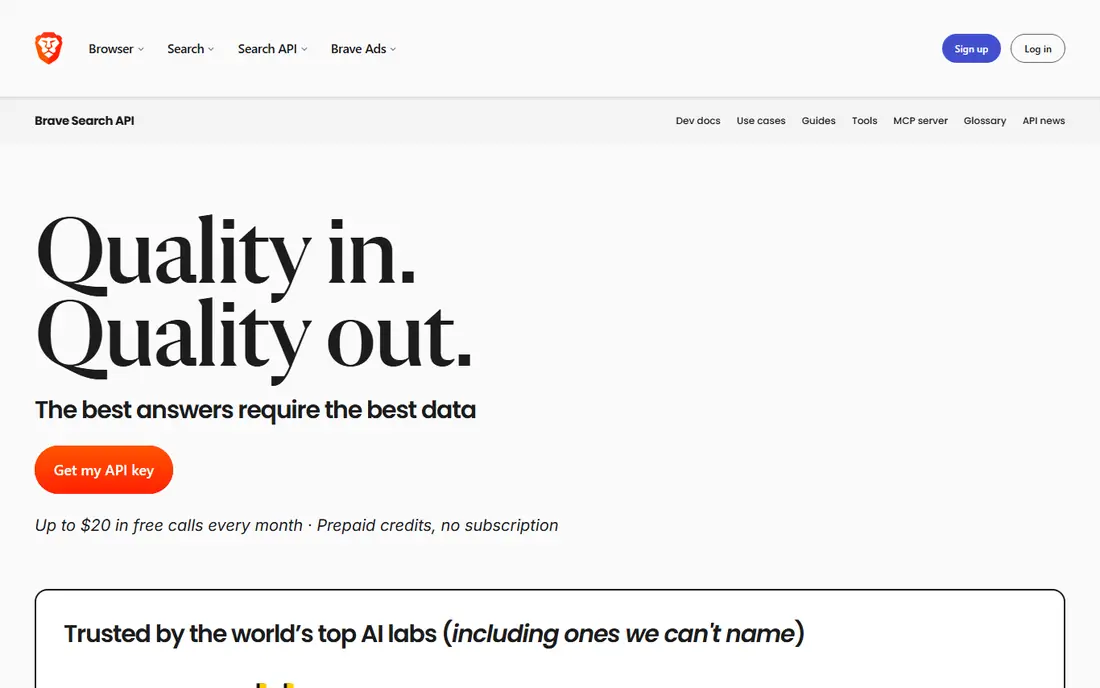
Brave runs its own web index, which is the main reason to pick it: results come from Brave crawling rather than from Google or Bing ranking. The Search plan covers web, news, images, videos and the LLM Context endpoint at $5 per 1,000 requests, with a limit of 50 requests per second and up to 20 results per request. A separate Answers plan returns a written, cited answer at $4 per 1,000 queries plus $5 per million input and output tokens, capped at 2 requests per second.
Each plan includes $5 of credit every month, which covers about 1,000 Search requests, and a card is required to activate a plan. The storage rule matters for agent builders: the terms forbid storing results beyond the transient storage an application needs to run.
- Independent web index, so results do not mirror Google or Bing
- LLM Context endpoint returns page text shaped for models
- Web search returns no full page text, only snippets, so a second call is needed for page content
- Terms forbid storing results beyond transient storage
SerpAPI
Ideal for: Structured results from Google and other engines
SerpAPI returns structured JSON of what a search engine shows for a query, which is the right shape when an agent needs real results pages rather than a semantic index. Coverage spans Google, Bing, Baidu and many verticals, and the API returns up to 10 results per request with optional page content as Markdown for the top results.
Plans are monthly buckets of searches. The free plan gives 250 searches a month at up to 50 an hour. Starter costs $25 a month for 1,000 searches, Developer $75 for 5,000, Production $150 for 15,000 and Big Data $275 for 30,000, with larger Cloud plans running to 54 million searches a month. Each plan also sets an hourly throughput limit, from 200 searches an hour on Starter to 640,000 on the largest Cloud plan.
- Covers Google, Bing, Baidu and many verticals such as Maps, Shopping, Flights and YouTube
- Only successful searches count, while cached, errored and failed searches do not
- Highest entry cost per search in this list, at $25 per 1,000 on Starter
- No overage rate, so you must move to a larger plan when the monthly quota runs out
You.com API
Ideal for: Fast web search with full page content bundled in
You.com runs its own AI-native search index and sells a usage billed API suite for agents and retrieval systems. The Web Search API costs $5 per 1,000 calls, returns up to 100 results per call, and includes news results and query-relevant highlights. With livecrawl turned on, calls also return full page content in Markdown or HTML at no extra charge.
Latency is quick, with a median of about 0.4 seconds on the search endpoint. New accounts get $10 in API credit on signup and $90 more on verifying the account, with no card required, and a free MCP profile allows 100 queries a day without a key. The Research API runs multi-step research on its own, from $12 per 1,000 calls on Lite to $1,200 on Frontier, so check that price before routing deep research through it.
- Full page content in Markdown or HTML is bundled into the $5 search price through livecrawl
- Free MCP profile gives 100 queries a day with no key or signup
- Free signup credits expire after 60 days
- Research API tiers run far higher, from $12 to $1,200 per 1,000 calls
Parallel
Ideal for: Low cost search for high volume agent workloads
Parallel runs its own index built for agents. A search call takes a natural-language objective plus one to three short keyword queries and returns ranked URLs with excerpts pulled from page bodies, sized for a model context window. Four modes set the speed and depth trade-off: Turbo at about 200 milliseconds and Fast at about 700 milliseconds, both $1 per 1,000 requests, then Basic at about 1 second and Advanced at about 3 seconds, both $5 per 1,000.
Each request includes 10 results, with extra results at $1 per 1,000, and the Extract API fetches full pages at $1 per 1,000 URLs. New accounts get up to $80 in credits at signup plus $5 more each month, and the monthly credit alone covers 5,000 Fast searches. The same key also covers the Task API for deep research, FindAll for list building and Monitor for always-on web checks.
- Cheapest search in this list, at $1 per 1,000 requests on Turbo and Fast
- One key also covers Extract, Task research, FindAll and Monitor
- No SERP features, local packs or Google verticals
- Default search mode is Advanced at $5 per 1,000, so you must set the mode explicitly to get the $1 rate
Google Programmable Search
Ideal for: Google results across sites you choose
Google Programmable Search Engine lets you build a search experience for one site or a group of sites, using Google core search technology. The ad-free element API costs $5 per 1,000 queries, and the JSON API for programmatic access carries the same rate: 100 free queries a day, then $5 per 1,000, with a hard cap of 10,000 queries a day.
The warning matters more than the price. Google closed the Custom Search JSON API to new customers and set 1 January 2027 as the end date for existing customers, pointing new users toward Vertex AI Search for searching up to 50 domains. The embeddable search element is not part of the shutdown, but an agent that needs a JSON feed should treat Google as a short-term bridge, not a long-term base.
- Results come from Google core search technology across up to 50 domains you designate
- Free standard element with ads for a search box on your own site
- The JSON API is closed to new customers and ends on 1 January 2027, so new agent builds cannot rely on it
- Results come from a custom engine you configure, not the full Google.com index by default
Perplexity API
Ideal for: Raw search results or a written answer with citations
Perplexity API gives agents two routes to live web information. The Search API is one endpoint that returns ranked web results as JSON, with title, URL, snippet and date, and no generated answer or token billing. It costs $5 per 1,000 successful requests, or $1 per 1,000 with Fast Search, and failed or rate-limited requests are not billed.
The Agent API is the second route: it combines models from Perplexity and other providers with built-in tools, billed per token plus a tool fee of $0.0025 per web search call. The Sonar model runs $0.25 per million input tokens and $2.50 per million output tokens. API billing is separate from Perplexity Pro and Max subscriptions and runs on credits bought in advance in the API console.
- One key covers Search, Agent, Embeddings, Router and Decisions APIs
- A request with up to five queries counts as one billing unit
- No free tier is listed, so every call draws on credits bought in advance
- Sonar Chat Completions support ended on 27 September 2026, so older Sonar code needs migration
How we chose
We read each vendor pricing page on 12 November 2026 and checked the docs for endpoints, rate limits, free tiers and result counts. We kept only tools an agent can call today with a key, which is why the Bing Search API is not in the list: Microsoft retired it on 11 August 2025. Parallel takes its place as the eighth tool. Google Programmable Search stays in the list with a clear warning, because its search element still works even though its JSON API is closing. We ran no benchmarks and did no hands-on testing, so every figure here is a vendor list price, not a measured bill.
What to check before you buy
Check the billing unit first, because the same headline price can mean different things. Tavily bills in credits, Exa, Brave, You.com, Parallel and Perplexity bill per request or call, SerpAPI bills per monthly bucket of searches, and Google bills per query. A tool that looks cheap per call can cost more once you count the extra calls for page text, extra results or a second search round.
Check result counts, rate limits and storage terms next. Most tools include 10 results per request, Brave allows 20, and You.com allows 100, while extra results cost more on Exa and Parallel. Hourly and per-second caps decide whether a research agent stalls at scale, and Brave forbids storing results beyond transient use. Finally, check free credit expiry and migration risk: You.com signup credits last 60 days, and both Microsoft and Google have retired or closed the search APIs in this category, so a vendor with a live roadmap matters more than a low headline rate.
| Team size and budget | Pick | Why |
|---|---|---|
| Solo builder, under $10 a month | Tavily Researcher or Parallel | Free credits cover early testing |
| Small team, under $100 a month | Exa or You.com | Low cost per search with page text included |
| Growing product, 100,000 searches a month | Parallel Fast or Exa Auto | $100 to $700 a month at list rates |
| Enterprise or regulated work | Exa Enterprise or You.com Enterprise | Zero data retention, SSO and SLAs |
| Google results pages specifically | SerpAPI | Real results data across engines and verticals |
Frequently asked questions
Which search API is cheapest for AI agents?
Parallel is cheapest in this list, at $1 per 1,000 requests on Turbo or Fast search, with $5 of free credit each month covering 5,000 Fast searches. Exa Lite is next at $4 per 1,000 requests, and Brave, You.com and Perplexity all start at $5 per 1,000. Remember that the cheapest rate only helps when the mode is set correctly, since Parallel defaults to Advanced at $5.
What is the best free tier for testing a search agent?
Tavily gives the most generous free tier for agent work, with 1,000 credits a month and no card required. You.com gives 100 free queries a day through its MCP profile with no key or signup, plus $10 in credit on signup. Exa gives $10 in credit a month, while Brave and Parallel each give $5 a month. Perplexity lists no free tier, so budget for credits from the first call.
Should I still use the Bing Search API for a new agent?
No. Microsoft retired the Bing Search APIs on 11 August 2025, closed new signups and switched off existing keys. The replacement is Grounding with Bing Search inside Azure AI Agents, at $14 per 1,000 transactions, but it returns a written answer with citations rather than raw results your code can use. For raw Bing results, pick a live API from this list instead.
Can a new project use Google Programmable Search?
Only in part. The embeddable search element still works, and the ad-free element costs $5 per 1,000 queries. The Custom Search JSON API, which is the programmatic route agents need, is closed to new customers and ends on 1 January 2027. New agent builds should choose another API from this list and treat Google as a short-term bridge only.
Do agents need raw search results or a written answer?
It depends on where the reasoning happens. Raw results suit agents that rank, filter and synthesize results themselves, which is what Tavily, Exa, Brave, SerpAPI, You.com, Parallel and Perplexity Search API return. A written answer suits agents that need a cited reply in one call, which is what Perplexity Agent API, You.com Answer and Research, and Brave Answers provide, with token costs added on top.
How do I keep search costs predictable as volume grows?
Set a monthly budget cap in the vendor dashboard where one exists, and log the billing unit per call in your own code. Cap results per request at 10 unless you need more, since extra results cost more on Exa and Parallel. Use the fast or lite mode for routine lookups and save deep or advanced modes for questions that need them, then review the invoice after the first month at real volume.