8 Best AI Powered Marketing Automation Platforms for 2026

- 1
 Marketo EngageEnterprise B2B demand generationVisit
- 2
 KlaviyoEcommerce email and SMSVisit
- 3
 Customer.ioBehavior-triggered product messagingVisit
- 4
 HubSpotAll-in-one CRM and marketingVisit
- 5
 Salesforce Marketing Cloud Account EngagementSalesforce-based B2B teamsVisit
- Marketo Engage takes the first slot, best suited to enterprise B2B demand generation.
- One limit worth knowing about Marketo Engage: setup and admin effort is high.
- Mailchimp is the one to check for straightforward email marketing at small scale.
- For the cheapest start, look at Brevo: $9 per month.
- Free plans exist at 4 of 8 tools (Klaviyo, HubSpot, Brevo, Mailchimp).
Direct answer
Marketo Engage leads the list, best for enterprise B2B demand generation. If your case is different, Klaviyo suits ecommerce email and SMS and Customer.io suits behavior-triggered product messaging. The remaining 5 options are covered below with prices and limits.
Quick comparison
| Product | Ideal for | Price from | Free version | |
|---|---|---|---|---|
| Marketo Engage | Enterprise B2B demand generation | See website | No | Visit |
| Klaviyo | Ecommerce email and SMS | $20 per month | Yes | Visit |
| Customer.io | Behavior-triggered product messaging | $100 per month | Free trial (14 days) | Visit |
| HubSpot | All-in-one CRM and marketing | $20 per seat/month | Yes | Visit |
| Salesforce Marketing Cloud Account Engagement | Salesforce-based B2B teams | See website | No | Visit |
 ActiveCampaign | Deep email automation for small teams | $15 a month (billed yearly) | Free trial (14 days) | Visit |
 Brevo | Low-cost multichannel sending | $9 a month | Yes | Visit |
 Mailchimp | Straightforward email marketing at small scale | $13 per month | Yes | Visit |
The full AI powered marketing automation platforms list
Choosing AI powered marketing automation platforms usually comes down to price, fit and limits. This Ainotely guide sets 8 tools side by side on those three points, with the facts kept short and checkable.
Marketo Engage
Ideal for: Enterprise B2B demand generation
Marketo Engage targets enterprise B2B demand generation. Marketo Engage, part of Adobe, fits B2B teams running long, multi-touch programs across plenty of segments and regions.
Upsides: Mature reporting for long sales cycles.
The main drawbacks: Setup and admin effort is high.
Implementation takes planning, and daily admin rewards experience with the system. For smaller teams, that depth is also the cost. Check the vendor site for Marketo Engage pricing; none is listed in this comparison. Marketo Engage has no permanent free option.
- Capable lead scoring
- Nurture programs
- Pricing is quote-based and scales with database size
Klaviyo
Ideal for: Ecommerce email and SMS
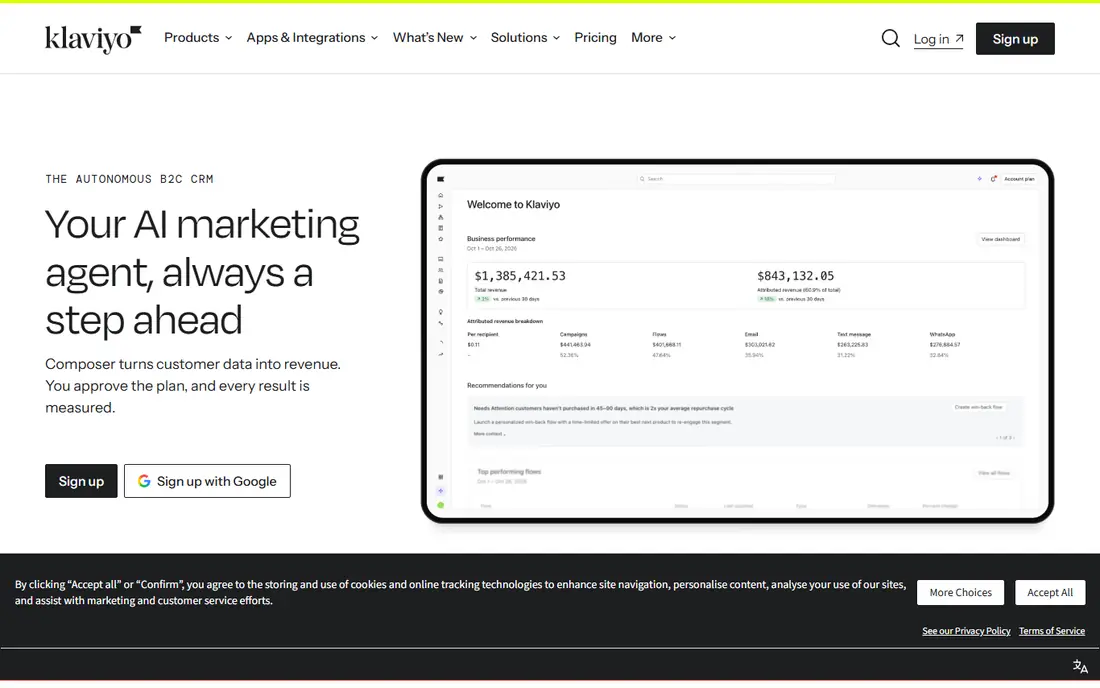
Klaviyo is a good fit for ecommerce email and SMS. In practice, the trade-off is billing discipline.
Drawbacks to consider: SMS and add-ons sit on top of the email price.
More specifically, keeps that suppress dormant profiles on a routine and keep flows tied to revenue tend to get the best return, whereas keeps that import every past buyer and never prune will feel the cost first. On top of that, predictive analytics estimate customer value and likely churn, which helps a store decide who deserves a discount and who only needs a reminder. Starting cost for Klaviyo: $20 per month. You can start on Klaviyo without paying.
- Email, SMS
- Predictive analytics for value and churn risk
- Even for contacts who seldom engage
Customer.io
Ideal for: Behavior-triggered product messaging
Customer.io is aimed squarely at behavior-triggered product messaging. A trial start, a feature use, a billing event, or a period of inactivity can trigger the next message.
The visual builder keeps those branches in one place. Teams without developer time for instrumentation should plan that work before launch, and note that Essentials opens at $100 per month, which is higher than a basic newsletter tool. Starting cost for Customer.io: $100 per month. Free access: Free trial (14 days).
Watch-outs: No permanent free plan.
- Unlimited push and in-app volume on Essentials
- Visual workflow builder
- Needs developer help for event setup
HubSpot
Ideal for: All-in-one CRM and marketing
HubSpot targets all-in-one CRM and marketing. A workflow can read a lifecycle stage, a deal value, or a recent sales activity and then change what a contact receives next, which keeps handoffs inside one record.
Drawbacks to consider: Contact levels add cost as lists grow.
HubSpot pricing: $20 per seat/month. HubSpot has a free plan.
- Breeze AI tools handle drafting
- Lead scoring, insights
- Costs rise sharply at Professional and Enterprise levels
Salesforce Marketing Cloud Account Engagement
Ideal for: Salesforce-based B2B teams
Choose Salesforce Marketing Cloud Account Engagement for Salesforce-based B2B teams. Account Engagement, formerly Pardot, makes most sense when Salesforce is already the system of record.
Leads, campaign membership, and scores sync without a fragile middleware layer, and sales teams see marketing activity inside the CRM record they already use. On top of that, teams that do not use Salesforce CRM will pay for native sync they cannot use, and the system still needs careful setup for grading, scoring, and lifecycle stages. This comparison lists no price for Salesforce Marketing Cloud Account Engagement; ask the vendor. Salesforce Marketing Cloud Account Engagement has no free tier.
Watch-outs: Pricing is quote-based and higher levels add up rapidly.
- Engagement Studio for multi-step nurture
- Native Salesforce CRM sync for leads, campaigns, scoring
- Value depends heavily on Salesforce adoption
ActiveCampaign
Ideal for: Deep email automation for small teams
ActiveCampaign is built with deep email automation for small teams in mind. The honest limit is that Starter is a starting point, not the full product.
Pricing also scales with contacts, including unsubscribed contacts on newer accounts in some reports, so list hygiene matters as much as plan choice. What you pay to start with ActiveCampaign: $15 per month. Free options: Free trial (14 days).
Where it is weaker: Starter limits automation actions, so most teams need Plus.
- Predictive sending on higher plans
- Visual automation builder with deep branching
- No permanent free plan
Brevo
Ideal for: Low-cost multichannel sending
Brevo is aimed squarely at low-cost multichannel sending. The free plan supports testing and small sends, and the built-in CRM, chat, and forms cut the need for additional tools at the start. In practice, the limit is that the cheapest premium level is primarily a sending level.
Points against: Branding removal and some features are premium extras.
Beyond that, full marketing automation, advanced reporting, and send-time optimization arrive on Standard, so buyers who require deep journeys should price Standard, not Starter. Also, branding removal on Starter and dedicated IP choices are also extras, so check the checkout total, not only the headline price. Brevo cost at the entry level: $9 per month. Brevo includes a free tier.
- On premium plans
- Charges by sends
- Marketing automation sits on Standard and above
Mailchimp
Ideal for: Straightforward email marketing at small scale
Mailchimp is built with straightforward email marketing at small scale in mind. Mailchimp remains a sensible pick for small teams that primarily need newsletters, welcome flows, and straightforward ecommerce follow-up. The builder is fast to learn, the template set is wide, and integrations include most typical keeps, CRMs, and form tools.
The main drawbacks: Contact-based pricing grows rapidly and counts unsubscribed contacts toward limits.
premium plans add scheduling, testing, and deeper automation flows, and Standard brings more flow steps and audiences for expanding teams. Essentials caps flows at a small number of steps, and deeper branching and journey logic sit higher up the ladder. Contact pricing also punishes messy lists, since unsubscribed contacts can count toward the audience limit, so archiving contacts you will never email again is an entry-level cost control. Mailchimp pricing: $13 per month. Mailchimp offers a free plan.
- Simple builder and large template library
- Intuit Assist drafting help on premium plans
- Automation depth is restricted on lower levels
How we built this list
Selection started from tools commonly considered for AI powered marketing automation platforms, then narrowed to 8 that have clear pricing information or a clear quote process. Figures are shown as the vendors publish them. Billing terms, seat minimums and add-ons can change the real cost. Order on the page follows fit for the typical buyer first, then price transparency and free access. Your own requirements should decide the final pick.
Pre-purchase checklist
- Ask Marketo Engage and Salesforce Marketing Cloud Account Engagement for a written quote, since no starting price is shown.
- Check what the free option really includes: Klaviyo, HubSpot, Brevo and Mailchimp offer a free plan, and usage caps differ.
- Take the trial from Customer.io and ActiveCampaign and push a live task through it before you pay.
- Read the limits listed for Marketo Engage first: setup and admin effort is high.
- Look at the help docs and support options for ActiveCampaign before you commit.
- Ask the daily users to test Marketo Engage on a live task before you roll it out to everyone.
Frequently asked questions
What is the cheapest option for AI powered marketing automation platforms in this list?
On published monthly entry prices, Brevo is the lowest here at $9 per month. Entry price is only part of the cost, because seats, add-ons and billing terms can change the total.
Do these tools publish their prices?
Not all of them. Marketo Engage and Salesforce Marketing Cloud Account Engagement publish no starting price, so expect a quote request for those. The rest, Klaviyo included, show a starting price, though seats and billing terms still change the final cost.
Do I need HubSpot or Marketo for B2B marketing automation?
HubSpot fits teams that want CRM and marketing together, whereas Marketo Engage fits bigger B2B teams with dedicated marketing operations and long sales cycles. More specifically, smaller B2B teams frequently do well on ActiveCampaign or Customer.io and upgrade later.
What happens to pricing as my list grows?
Send-based tools rise with volume instead, and user-based tools rise with active users. Pruning dormant contacts, archiving unsubscribed contacts where the vendor lets it, and reviewing levels each quarter keep growth costs under control.
Can I try these options before paying?
Often, yes. Klaviyo, HubSpot, Brevo and Mailchimp have a free plan and Customer.io and ActiveCampaign offer a free trial. Use your own data and a real task during the test, and check what the free tier or trial limits before you rely on it.
Which AI powered marketing automation platforms have a free plan?
On this list, Klaviyo, HubSpot, Brevo and Mailchimp include a free plan. Caps on seats, usage or features are common, so test the free plan against your real workload. Several others offer a trial instead.