Best AI Recruiting Tools in 2026: 8 Tools Compared

- Workable and Manatal suit smaller teams that want an AI-enabled ATS at a clear price, while Greenhouse and Ashby suit structured hiring at scale.
- HireVue and Paradox suit high-volume hiring, where screening and scheduling automation save the most time.
- AI screening tools need bias and compliance checks, including local laws such as New York City Local Law 144 where it applies.
- Most enterprise tools use custom pricing, so budget on a quote and check whether AI features are metered separately.
- Our pick for most growing teams is Workable, with Manatal as the budget pick.
Quick comparison
| Product | Ideal for | Price from | Free version | |
|---|---|---|---|---|
 Workable | All-in-one ATS with AI | $299 per month | Free trial | Visit |
 Manatal | Budget AI ATS for small teams | $15 per user per month | Free trial | Visit |
 Greenhouse | Structured hiring at scale | See website | No | Visit |
 HireVue | Video interviewing and assessments | See website | No | Visit |
 Paradox | High-volume conversational hiring | See website | No | Visit |
 Ashby | Data-led in-house teams | $400 per month | No | Visit |
 Zoho Recruit | Small business recruiting | $25 per recruiter per month | Yes | Visit |
 Fetcher | Automated sourcing | $115 per month | Free trial | Visit |
The best AI recruiting tools
AI recruiting tools help with sourcing, screening, scheduling, assessments and analytics, but no single tool does all of it best. The list below separates ATS platforms with AI features from point tools for sourcing, screening and scheduling. We compared official pricing pages, feature lists and public reviews. Hiring teams should also check compliance and bias audit duties that apply in their locations.
Workable
Ideal for: All-in-one ATS with AI

Workable is our pick for a growing team that wants one system for job posts, applicants, AI sourcing and hiring workflows. It posts to job boards, screens with AI help, schedules interviews, and adds HR features for smaller companies that do not want a separate HR suite. Setup is faster than an enterprise ATS, which matters for a team hiring now.
Pricing starts around $299 per month for the smallest headcount band and rises with headcount, and some AI features use separate credits. Price the headcount band you will be in next year, not just today, and confirm which AI features are included in the base plan.
- Full ATS plus AI sourcing and screening
- Easy setup
- HR features included
- Entry price is per headcount band
- AI agent credits may cost extra
Manatal
Ideal for: Budget AI ATS for small teams
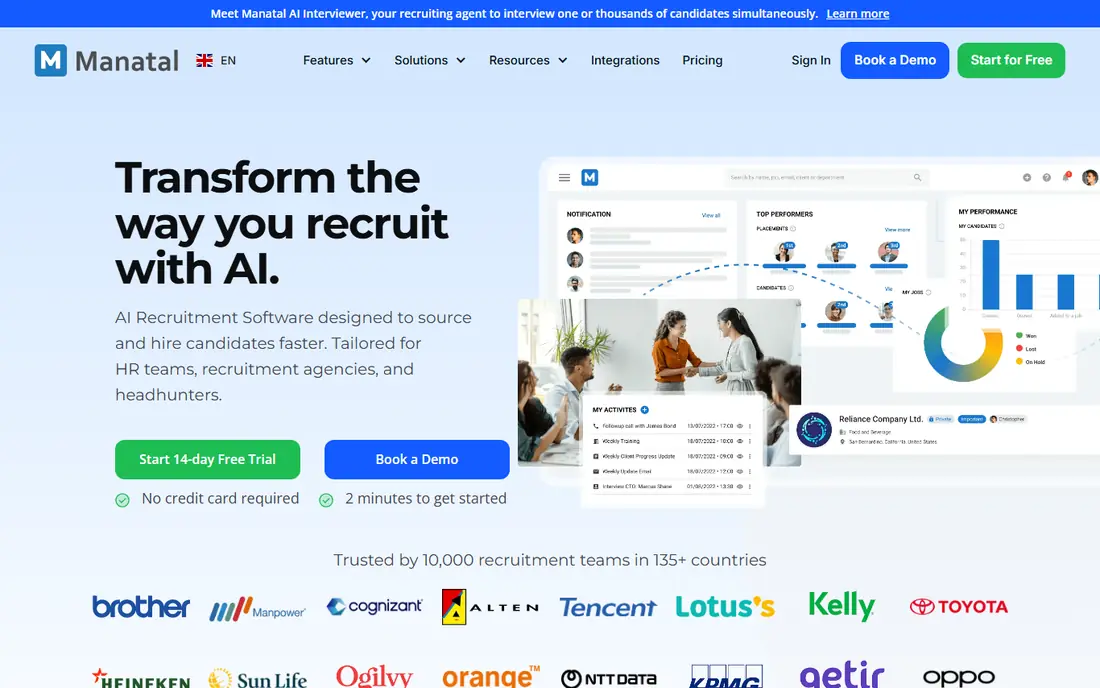
Manatal is the budget pick for agencies and small teams that want an AI-enabled ATS without enterprise pricing. It starts around $15 per user per month, with AI candidate recommendations, a CRM for agencies, and integrations with job boards and LinkedIn. Small teams can run a full pipeline on it from day one.
Depth is thinner than Greenhouse or Ashby on structured hiring analytics, and some AI features, such as the AI interviewer, are add-ons. For a small team that needs affordable AI help with sourcing and screening, Manatal is the best value starting point.
- Lowest entry price in this list
- AI candidate recommendations
- Agency-friendly
- Less depth than Greenhouse or Ashby
- AI interviewer is an add-on
Greenhouse
Ideal for: Structured hiring at scale

Greenhouse suits a mid-size or larger company that wants structured, fair hiring at scale. Interview plans, scorecards and structured feedback reduce guesswork, integrations cover HR, assessment and sourcing tools, and AI features assist with job posts, screening and summaries. Companies that care about hiring consistency usually standardize on Greenhouse.
Pricing is custom, with contract values often well above small-team budgets, and onboarding can be a paid add-on. For a company hiring steadily across many roles, that investment buys consistency. For a team hiring a few roles a year, Workable or Manatal will be cheaper and faster.
- Structured interviews and scorecards
- Strong integrations
- AI features across the hiring flow
- Custom pricing
- Onboarding is a paid add-on for many teams
HireVue
Ideal for: Video interviewing and assessments
HireVue serves large employers screening high volumes of candidates with video interviews and assessments. On-demand interviews let candidates record answers on their schedule, AI-assisted scoring helps recruiters prioritize, and integrations cover major HR and ATS platforms. For graduate, retail or call-center hiring at scale, it saves many recruiter hours.
Pricing is custom and enterprise-level, and scheduling features may cost extra at entry tiers. Smaller teams should consider Spark Hire or Manatal for video screening at a lower price. Large teams should also review bias audit and transparency duties that apply to automated hiring tools in their locations.
- On-demand video interviews
- AI-assisted assessments
- Strong enterprise integrations
- Custom enterprise pricing
- Scheduling is an add-on at entry tiers
Paradox
Ideal for: High-volume conversational hiring
Paradox, now part of Workday, offers Olivia, a conversational assistant that screens candidates, answers questions and books interviews by chat and text at any hour. It suits high-volume hourly and frontline hiring, where speed matters and recruiters cannot call every applicant promptly. Support for many languages helps global employers.
Pricing is not published and is aimed at enterprise volumes, so small teams will find it out of reach. For a company hiring hundreds of frontline staff a year, Paradox can cut time-to-fill sharply. For occasional hiring, an ATS with scheduling features is enough.
- Conversational assistant screens and schedules around the clock
- Strong for hourly hiring
- Many languages
- No published pricing
- Best for high-volume employers, not occasional hiring
Ashby
Ideal for: Data-led in-house teams
Ashby suits a data-led in-house recruiting team that wants analytics as a first-class feature, not a report bolt-on. It covers sourcing, scheduling, structured interviews and offer management, with dashboards that show funnel conversion, source quality and interviewer load. Teams that manage recruiting as a measurable pipeline will like it.
The entry plan starts around $400 per month for the smallest headcount band, so it is priced for teams hiring regularly. Agencies and very small teams will find Manatal or Workable cheaper. For an in-house team that lives by its hiring data, Ashby is a strong choice.
- Strong analytics and reporting
- Structured hiring
- Modern interface
- Entry price starts around $400 per month
- Best for in-house teams, not agencies
Zoho Recruit
Ideal for: Small business recruiting
Zoho Recruit is a solid budget ATS for a small business already using Zoho products. It starts around $25 per recruiter per month, with a free tier for basic use, job board posting, resume parsing and workflow automation. For a small team that needs an ATS without a large bill, it covers the basics well.
AI features are lighter than in Workable or Manatal, and the interface packs a lot in. If AI sourcing and screening are the main need, Manatal offers more AI depth at a similar price. If you already run Zoho for CRM or HR, Zoho Recruit fits the stack neatly.
- Low price
- Free tier available
- Integrates with Zoho suite and job boards
- AI features are lighter than dedicated tools
- Interface feels busy
Fetcher
Ideal for: Automated sourcing
Fetcher suits a team that struggles to find candidates rather than to screen them. It automates sourcing across profiles, sends personalized outreach sequences, and surfaces interested candidates for recruiters to engage. Pricing starts around $115 per month, which is cheaper than hiring a sourcer for many teams.
It is not a full ATS, so it pairs with Greenhouse, Workable or Ashby rather than replacing them. Sourcing quality depends on clear target profiles and good outreach copy, so invest time in both before judging results.
- Automated sourcing and outreach
- Saves sourcer time
- Email sequences included
- Sourcing only, not a full ATS
- Quality depends on target profiles
How we picked these
We compared official pricing pages, feature lists and public reviews for AI recruiting tools available in October 2026. We favored tools with real deployments, clear AI features for sourcing, screening or scheduling, and a working official homepage. We left out tools we could not verify as live products.
What to check before you buy
Start with the bottleneck. If sourcing is the problem, buy sourcing help such as Fetcher. If screening volume is the problem, buy HireVue or Paradox. If scheduling eats recruiter time, an ATS with scheduling may be enough. Buying a full suite for one bottleneck wastes money.
Compliance and fairness
Automated screening tools face growing legal duties, including bias audits and candidate notices in some US cities and states, plus EEOC guidance on AI hiring tools. Ask vendors for bias audit documentation, explainability of scores, and human review options, and involve legal or HR compliance before automating rejection decisions.
Frequently asked questions
What is the best AI recruiting tool?
Workable is our pick for most growing teams, because it combines a full ATS with AI sourcing and screening at a clear price. Manatal is the budget pick, Greenhouse suits structured hiring at scale, and HireVue suits high-volume video screening.
How much do AI recruiting tools cost?
Small-team tools start around $15 per user per month for Manatal and $25 per recruiter for Zoho Recruit, while Workable starts around $299 per month and Ashby around $400 per month. Enterprise tools such as Greenhouse and HireVue use custom pricing.
Can AI recruiting tools replace recruiters?
No. AI tools speed up sourcing, screening and scheduling, but humans should still review shortlists, interview candidates and make final decisions. Automated rejection without human review also raises legal and fairness risks.
Are AI hiring tools biased?
They can be, if trained or applied without checks. Ask vendors for bias audit results, test outcomes by demographic group where lawful, keep a human in the loop, and follow local laws on automated hiring tools.
Do I need an ATS and a point tool?
Many teams use both: an ATS as the system of record, plus a point tool for sourcing, video screening or scheduling where the ATS is weak. Start with the ATS, add a point tool only when a specific bottleneck justifies it.