Best AI Recruitment Platforms in 2026: 8 Platforms Compared

- Paradox and HireVue lead for automation, with Paradox stronger on scheduling and HireVue stronger on video screening.
- Workable and Greenhouse suit teams that want AI inside a full applicant tracking system.
- Eightfold and SeekOut suit larger employers focused on internal mobility and sourcing depth.
- AI screening raises fairness questions, so check bias controls and human review steps before adopting any tool.
Quick comparison
| Product | Ideal for | Price from | Free version | |
|---|---|---|---|---|
 Paradox | High-volume hiring automation | See website | No | Visit |
 HireVue | Video screening and assessments | See website | No | Visit |
 Workable | AI inside a full ATS | See website | Free trial | Visit |
 Greenhouse | Structured hiring at scale | See website | Free trial | Visit |
 Lever | Recruiter-friendly ATS with AI | See website | Free trial | Visit |
 Eightfold | Internal mobility and talent intelligence | See website | No | Visit |
 Fetcher | Automated sourcing | See website | Free trial | Visit |
 SeekOut | Deep sourcing and talent search | See website | Free trial | Visit |
The best ai recruitment platforms
We compared AI recruitment platforms on sourcing, screening, scheduling, integrations and fairness controls. The best platform depends on whether your bottleneck is finding candidates, screening them, or scheduling interviews. Our pick for most teams is Workable for balanced AI inside an ATS, with Paradox as the automation leader.
Paradox
Ideal for: High-volume hiring automation

Paradox, known for its Olivia assistant, automates screening conversations and interview scheduling at high volume. That automation saves recruiters hours on repetitive coordination, especially in retail, hospitality and healthcare hiring. Pricing targets larger employers, so small teams should trial it against their actual volume before committing.
For most readers, the deciding question with Paradox is fit rather than raw feature count. Check the plan limits that matter to you, such as seats, usage caps and what happens when a trial ends, before you commit to a paid tier. If the free tier or trial covers your core task, use it for a full week of real work before paying, and keep an eye on renewal terms and cancellation steps. That short test usually tells you more than any feature list, and it keeps the choice grounded in how you actually work day to day.
- AI assistant for screening and scheduling
- High-volume support
- Integrations
- Enterprise pricing
- Smaller teams may find it heavy
HireVue
Ideal for: Video screening and assessments
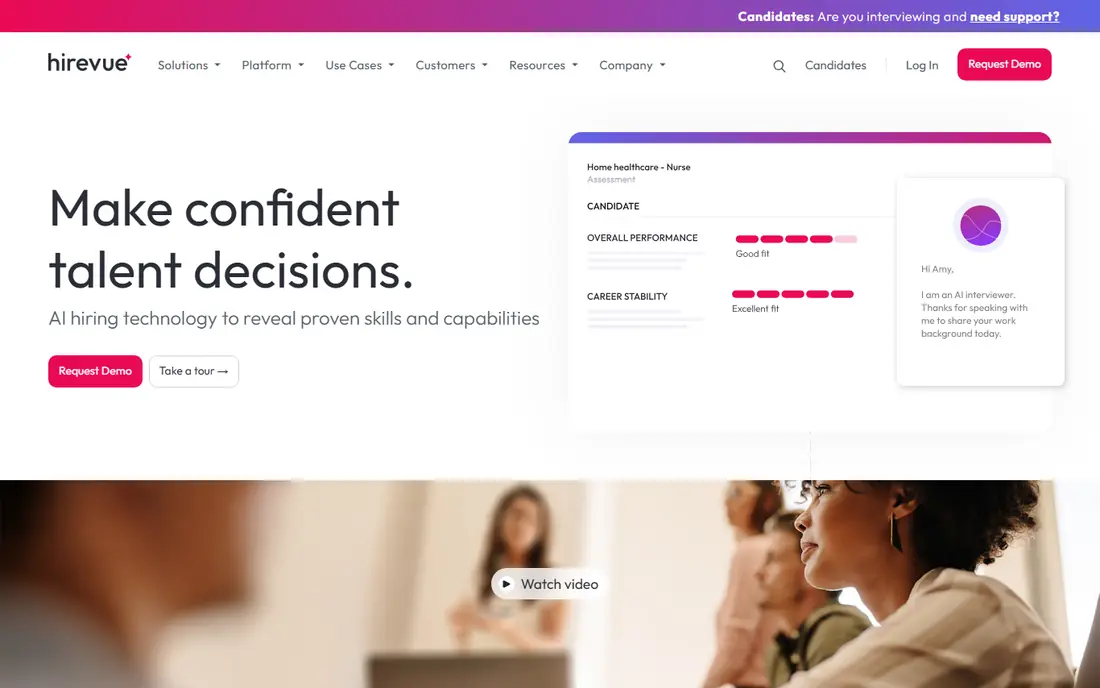
HireVue offers video interviews and assessments with structured evaluation, helping teams compare candidates consistently. That structure suits regulated and high-volume hiring. Pricing is quote-based, and video screening demands careful fairness and candidate-experience review, so involve HR and legal before rolling it out broadly.
For most readers, the deciding question with HireVue is fit rather than raw feature count. Check the plan limits that matter to you, such as seats, usage caps and what happens when a trial ends, before you commit to a paid tier. If the free tier or trial covers your core task, use it for a full week of real work before paying, and keep an eye on renewal terms and cancellation steps. That short test usually tells you more than any feature list, and it keeps the choice grounded in how you actually work day to day.
- Video interviews
- Assessments
- Structured evaluation tools
- Pricing is quote-based
- Video screening needs careful fairness review
Workable
Ideal for: AI inside a full ATS

Workable combines a full applicant tracking system with AI sourcing, screening and job posting, so smaller teams get one system instead of several tools. Reporting covers the hiring funnel clearly. AI depth varies by plan, so check which features sit in your tier, and note that pricing scales with team size.
For most readers, the deciding question with Workable is fit rather than raw feature count. Check the plan limits that matter to you, such as seats, usage caps and what happens when a trial ends, before you commit to a paid tier. If the free tier or trial covers your core task, use it for a full week of real work before paying, and keep an eye on renewal terms and cancellation steps. That short test usually tells you more than any feature list, and it keeps the choice grounded in how you actually work day to day.
- Applicant tracking plus AI sourcing and screening
- Job board posting
- Reporting
- AI depth varies by plan
- Pricing scales with seats
Greenhouse
Ideal for: Structured hiring at scale
Greenhouse is built around structured hiring, with scorecards, interview plans and integrations that keep evaluation consistent. That discipline helps teams reduce bias and compare candidates fairly. Pricing is quote-based and setup takes time, so it suits teams ready to standardise hiring rather than teams wanting a quick fix.
For most readers, the deciding question with Greenhouse is fit rather than raw feature count. Check the plan limits that matter to you, such as seats, usage caps and what happens when a trial ends, before you commit to a paid tier. If the free tier or trial covers your core task, use it for a full week of real work before paying, and keep an eye on renewal terms and cancellation steps. That short test usually tells you more than any feature list, and it keeps the choice grounded in how you actually work day to day.
- Structured hiring workflows
- Scorecards
- Integrations
- Pricing is quote-based
- Setup takes time
Lever
Ideal for: Recruiter-friendly ATS with AI
Lever combines candidate relationship management with applicant tracking and automation, helping recruiters nurture candidates over time. Analytics show where hiring slows down. Pricing is quote-based, and AI feature depth varies by tier, so confirm the tools you need are included before signing.
For most readers, the deciding question with Lever is fit rather than raw feature count. Check the plan limits that matter to you, such as seats, usage caps and what happens when a trial ends, before you commit to a paid tier. If the free tier or trial covers your core task, use it for a full week of real work before paying, and keep an eye on renewal terms and cancellation steps. That short test usually tells you more than any feature list, and it keeps the choice grounded in how you actually work day to day.
- Candidate relationship tools
- Automation
- Analytics
- Pricing is quote-based
- AI features vary by tier
Eightfold
Ideal for: Internal mobility and talent intelligence
Eightfold uses talent intelligence to match people to roles, including internal candidates, based on skills and experience. That internal mobility focus helps large employers retain staff and fill roles faster. Pricing and implementation target enterprises, so smaller employers will find lighter tools a better fit.
For most readers, the deciding question with Eightfold is fit rather than raw feature count. Check the plan limits that matter to you, such as seats, usage caps and what happens when a trial ends, before you commit to a paid tier. If the free tier or trial covers your core task, use it for a full week of real work before paying, and keep an eye on renewal terms and cancellation steps. That short test usually tells you more than any feature list, and it keeps the choice grounded in how you actually work day to day.
- Talent intelligence
- Internal mobility
- Skills matching
- Enterprise pricing
- Implementation takes time
Fetcher
Ideal for: Automated sourcing
Fetcher automates sourcing by finding candidates and handling initial outreach, which suits teams whose bottleneck is top-of-funnel volume. Diversity-focused search options help broaden pipelines. It is a sourcing tool, not a full ATS, so pair it with your existing system, and check pricing against your hiring volume.
For most readers, the deciding question with Fetcher is fit rather than raw feature count. Check the plan limits that matter to you, such as seats, usage caps and what happens when a trial ends, before you commit to a paid tier. If the free tier or trial covers your core task, use it for a full week of real work before paying, and keep an eye on renewal terms and cancellation steps. That short test usually tells you more than any feature list, and it keeps the choice grounded in how you actually work day to day.
- Automated candidate sourcing
- Outreach
- Diversity-focused search
- Sourcing only, not a full ATS
- Pricing scales
SeekOut
Ideal for: Deep sourcing and talent search
SeekOut offers deep talent search across public profiles, with diversity filters and recruiter analytics that help teams find hard-to-reach candidates. That depth suits technical and specialised hiring. The learning curve is real, and pricing scales with use, so trial it on your hardest roles first.
For most readers, the deciding question with SeekOut is fit rather than raw feature count. Check the plan limits that matter to you, such as seats, usage caps and what happens when a trial ends, before you commit to a paid tier. If the free tier or trial covers your core task, use it for a full week of real work before paying, and keep an eye on renewal terms and cancellation steps. That short test usually tells you more than any feature list, and it keeps the choice grounded in how you actually work day to day.
- Deep talent search
- Diversity filters
- Recruiter analytics
- Learning curve
- Pricing scales with use
How we picked these
We compared official feature pages, pricing pages, app store listings, privacy policies and public reviews for each option below. We kept only products that exist and work now, that fit the topic directly, and whose official homepage we could confirm. Where a price was not published clearly, we wrote See website rather than guessing, and we favoured options with a free tier or trial where one exists.
Using AI hiring tools fairly and effectively
Keep a human in the loop for every rejection. AI can rank and shortlist, but final decisions should involve a person who can spot context the model missed. That habit protects candidates and protects your employer brand.
Audit for bias before and after launch. Check whether screening tools disadvantage any group, review candidate feedback, and ask vendors for fairness documentation. A tool that speeds hiring while narrowing your pipeline is a poor bargain.
Measure time-to-hire and quality-of-hire together. Faster hiring means little if new hires leave quickly or perform poorly. Track both for at least two quarters after adopting a tool, and compare against your pre-AI baseline before expanding its use.
Frequently asked questions
What is the best AI recruitment platform?
For most teams, Workable offers balanced AI inside a full ATS. Paradox leads for high-volume automation, HireVue for video screening, and Eightfold for large employers focused on internal mobility.
How does AI help recruitment?
AI helps by sourcing candidates, screening applications, scheduling interviews and ranking matches, which saves recruiter time. Human review remains essential for fairness and final decisions.
Is AI recruitment fair?
It can be, if teams audit tools, keep humans in the loop, and check outcomes by group. Unchecked screening tools can reproduce bias, so ask vendors for fairness documentation and monitor results.
Do AI recruitment tools replace recruiters?
No, they handle repetitive tasks such as scheduling and initial screening, freeing recruiters for conversations, evaluation and candidate experience. The best results come from AI plus human judgement, not AI alone.
How much do AI recruitment platforms cost?
Many are quote-based or scale with seats and hiring volume, with trials available on several. Request a quote based on your team size and expected hires, and trial the tool on real roles first.