Best AI Sales Automation Tools in 2026: 8 Tools Compared

- Apollo is the best value entry point for most teams, combining a large contact database with enrichment and sequencing from a free tier.
- Clay suits revenue operations teams building custom lead lists, with a waterfall across many data providers.
- Outreach and Salesloft are the enterprise sequencing standards, with quote-based pricing for larger teams.
- Gong and Clari solve different problems: conversation coaching and forecasting, rather than outbound sending.
- Fix your data before you buy a sequencer: a costly tool running on stale contacts will lose to a cheaper tool running on verified data.
Quick comparison
| Product | Ideal for | Price from | Free version | |
|---|---|---|---|---|
 Apollo | All-in-one data and outreach | Free | Yes | Visit |
 Clay | Enrichment workflows | Free | Yes | Visit |
 Outreach | Enterprise sequencing | See website | No | Visit |
 Salesloft | Revenue orchestration | See website | No | Visit |
 HubSpot Sales Hub | CRM-native sales automation | Free | Yes | Visit |
 Gong | Conversation intelligence | See website | No | Visit |
 Clari | Forecasting and pipeline | See website | No | Visit |
 Lavender | Email coaching for reps | Free | Yes | Visit |
The best ai sales automation tools
These eight tools cover data, enrichment, sequencing, coaching and forecasting. We compared official pricing pages, feature pages and public reviews, focusing on the job each tool owns, since buying the wrong category wastes more than buying the wrong vendor.
Apollo
Ideal for: All-in-one data and outreach

Apollo is the best starting point for most sales teams because it bundles the two things outbound needs: contacts and sending. Its database covers hundreds of millions of contacts, enrichment fills in missing details, and built-in sequences, dialer and deliverability controls let a small team run outbound without buying three tools. A free tier lets you test before paying, with paid plans from $49 per user per month on annual billing.
Data quality varies by industry and region, so verify contacts for your market before scaling a campaign. For a team that wants data and outreach in one place at an accessible price, Apollo is the clearest value in this list.
- Large contact database
- Enrichment plus sequencing in one tool
- Free tier to start
- Paid plans from $49 per user per month
- Data quality varies by segment
Clay
Ideal for: Enrichment workflows

Clay solves a different problem from Apollo: building precise, enriched lead lists. It orchestrates more than 150 data providers in a waterfall, so a lookup only falls through to expensive sources when cheaper ones fail, and since March 2026 it charges nothing for enrichments that return no result. AI research and programmatic personalization turn those lists into tailored outreach.
Launch plans start from $167 per month on annual billing, and building custom workflows takes time to learn. For a revenue operations team that lives on list quality, Clay's waterfall approach saves money and improves targeting in a way a single database cannot.
- Waterfall across 150-plus providers
- AI research and personalization
- No charge for empty enrichments since March 2026
- Launch plans from $167 per month
- Learning curve for custom workflows
Outreach
Ideal for: Enterprise sequencing
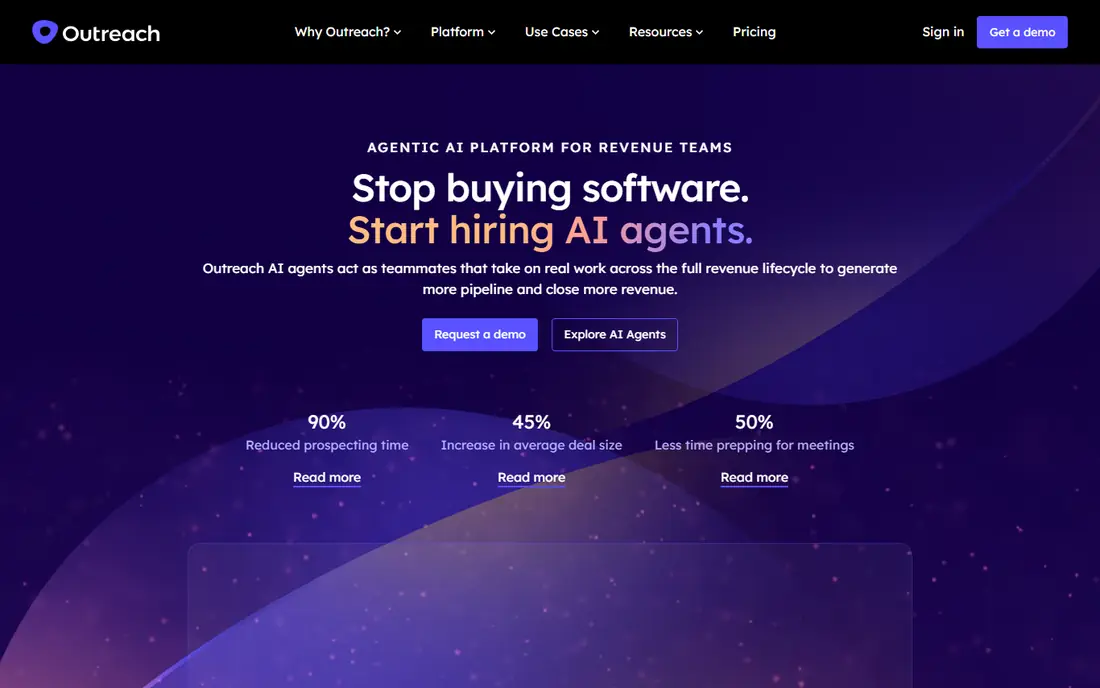
Outreach is the enterprise standard for sales engagement. Its sequences, deal governance, AI assistant and deep CRM sync help large outbound teams run consistent, measurable campaigns across many reps, with management visibility into what is working. That maturity is why enterprises with 25-plus seats choose it.
Pricing is quote-based, roughly $100 to $160 per seat per month in recent comparisons, which puts it out of reach for small teams. If you run a large outbound organization and need governance at scale, Outreach is the benchmark. If you run a small team, Apollo or HubSpot will serve you better.
- Mature sequencing and deal governance
- Deep CRM sync
- AI assistant for risks and next steps
- Quote-based pricing around $100 to $160 per seat per month
- Overkill for small teams
Salesloft
Ideal for: Revenue orchestration
Salesloft, now merged with Clari, is the mid-market alternative to Outreach for revenue orchestration. Cadences, conversation intelligence, coaching analytics and AI call summaries help teams run outreach and learn from calls in one platform. Its Drift conversational AI adds website engagement to the mix.
Pricing is quote-based, around $75 to $125 per seat per month in recent comparisons. Smaller teams will find Apollo or HubSpot cheaper, but a mid-market team that wants engagement plus coaching in one tool should shortlist Salesloft.
- Cadences plus conversation intelligence
- Coaching analytics
- Now merged with Clari
- Quote-based pricing around $75 to $125 per seat per month
- Enterprise focus
HubSpot Sales Hub
Ideal for: CRM-native sales automation
HubSpot Sales Hub suits teams already on HubSpot, since sequences, inbox, AI email drafts and deal tracking live in the same CRM as marketing data. That removes sync headaches and makes the handoff from marketing-qualified to sales-qualified leads clean. A free CRM tier covers basic use, with Sales Hub paid plans from around $15 per seat per month.
Teams outside HubSpot will not get the same benefit, and advanced automation sits on higher tiers. For a HubSpot shop, Sales Hub is the easiest sales automation choice. For others, a standalone sequencer may fit better.
- CRM plus sequences in one system
- AI email drafts and summaries
- Smooth handoff from marketing
- Sales Hub paid plans from around $15 per seat per month
- Best value only inside HubSpot
Gong
Ideal for: Conversation intelligence
Gong is not a sequencer: it records, transcribes and analyzes sales calls, surfacing coaching insights, deal risks and what top performers do differently. Managers coaching five or more reps get the most from its analytics, since patterns only emerge across many calls.
Pricing is quote-based, per seat plus a platform fee, with annual costs for ten seats cited around $18,600 in some comparisons. Small teams will not justify that cost. For a team that already books meetings and wants to win more of them, Gong's coaching value is real.
- Call recording and analysis
- Coaching insights
- Deal risk signals
- Quote-based, with platform fees
- Needs five-plus reps to justify the cost
Clari
Ideal for: Forecasting and pipeline
Clari helps sales leaders whose forecasts keep missing. It inspects pipeline, tracks deal movement and applies AI to forecast accuracy, giving leadership a clearer view of what will actually close. Its merger with Salesloft ties forecasting to engagement data for a fuller revenue picture.
Pricing is quote-based, around $100-plus per user per month per module in recent comparisons. It is a leadership tool rather than a rep productivity tool, so buy it when forecasting is the bottleneck, not when you need more outbound volume.
- Forecasting accuracy
- Pipeline inspection
- Revenue intelligence across the funnel
- Quote-based around $100-plus per user per month per module
- Leadership tool, not a rep tool
Lavender
Ideal for: Email coaching for reps
Lavender coaches reps as they write, scoring emails in real time and suggesting improvements before sending. For a rep sending fifty-plus cold emails a day, that feedback loop improves reply rates without changing tools, since Lavender works inside the email workflow. A free tier covers basic use, with paid plans from $29 per month.
It does not sequence, enrich or manage pipeline, so pair it with Apollo, Outreach or HubSpot. For a team whose bottleneck is email quality rather than volume, Lavender is a low-cost, high-impact addition.
- Real-time email scoring and coaching
- Free tier
- Helps reps sending many cold emails
- Paid plans from $29 per month
- Coaching only, not a full sequencer
How we picked these
We compared official pricing pages, feature pages and public reviews for AI sales tools available in October 2026. We favored tools with a clear job in the sales workflow, a real user base and current pricing, and we weighed data quality, sequencing depth, coaching value and forecasting accuracy, since different bottlenecks need different tools.
What to check before you buy an AI sales tool
Start with your bottleneck, not a feature list. If you cannot find accurate contacts, fix data first with Apollo or Clay. If sequences are inconsistent, buy engagement with Outreach, Salesloft or HubSpot. If reps book meetings but lose deals mid-funnel, buy coaching with Gong. If forecasts miss, buy Clari. Buying the wrong category first wastes the budget.
Then check compliance and deliverability. Confirm the vendor's data sources, SOC 2 and GDPR readiness where relevant, and test email deliverability with your own domains before scaling. High-volume sending without warm-up and list hygiene damages sender reputation quickly, and no AI copy tool fixes a burned domain.
Finally, measure before expanding. Pick two or three tools that address your bottleneck, integrate them properly, and track reply rates, meeting rates and pipeline for a quarter before adding more. Piecemeal buying without measurement is the most common waste in this category.
Frequently asked questions
What is the best AI sales automation tool?
Apollo is the best value entry point for most teams, combining data and sequencing from a free tier. Clay suits enrichment workflows, Outreach and Salesloft suit enterprise sequencing, and Gong suits conversation coaching.
How much do AI sales tools cost?
Entry prices range from free for Apollo, Clay, HubSpot and Lavender to $49 per user per month for Apollo paid plans, $167 per month for Clay Launch, and quote-based enterprise pricing for Outreach, Salesloft, Gong and Clari.
Can AI sales tools replace sales reps?
No, they automate research, enrichment, sequencing and analysis, but relationships, discovery and closing still need people. The best setups use AI to give reps more time for conversations, not to remove reps from them.
What is the difference between Apollo and Clay?
Apollo bundles a contact database with sequencing in one tool, while Clay orchestrates many data providers to build enriched, custom lead lists. Teams often use Clay to build lists and Apollo or a sequencer to run outreach.
Do I need a CRM before buying a sales automation tool?
A CRM helps, since sequences, deals and forecasts need a system of record. HubSpot Sales Hub bundles both, while Apollo, Outreach and Salesloft integrate with Salesforce, HubSpot and other CRMs.