7 Best AI Sales Software for B2B Options for 2026

- Top of the list is Salesloft, which targets engagement and coaching.
- ZoomInfo is the one to check for enterprise B2B data.
- Before buying Apollo.io, weigh this: data accuracy varies by segment.
- A free plan is available from 4 of the 7 tools: Clay, Apollo.io, HubSpot Sales Hub, Lavender.
Direct answer
Salesloft is the first pick on this list for engagement and coaching. If your case is different, Clay suits custom enrichment workflows and Outreach suits outbound sequencing at scale. Prices, free plans and limits for all 7 tools follow.
Quick comparison
| Product | Ideal for | Price from | Free version | |
|---|---|---|---|---|
 Salesloft | Engagement and coaching | See website | Free trial | Visit |
 Clay | Custom enrichment workflows | $185 a month | Yes | Visit |
 Outreach | Outbound sequencing at scale | See website | Free trial | Visit |
 Apollo.io | Prospecting plus data on a budget | $49 per user/month | Yes | Visit |
 HubSpot Sales Hub | All-in-one CRM with AI | Free | Yes | Visit |
 Lavender | Email coaching for reps | $29 a month | Yes | Visit |
 ZoomInfo | Enterprise B2B data | See website | Free trial | Visit |
The full AI sales software for B2B list
This Ainotely guide covers 7 options for AI sales software for B2B. Each profile lists a starting price, free plan details, strengths and drawbacks, so you can drop poor fits quickly.
Salesloft
Ideal for: Engagement and coaching

Salesloft makes the most sense for engagement and coaching. Coaching tools built on call recordings add manager value beyond sequencing alone.
Worth adding: mid-market and enterprise teams with a structured outbound and coaching process should compare Salesloft straight against Outreach on their own playbook, not on feature lists alone. Salesloft shows no starting price here, so confirm the cost on the vendor site. Trial and free access: Free trial.
Downsides: Overlaps with Clari forecasting after merger context.
- Coaching and forecasting tools
- Cadences plus conversation intelligence
- Quote-based pricing
Clay
Ideal for: Custom enrichment workflows
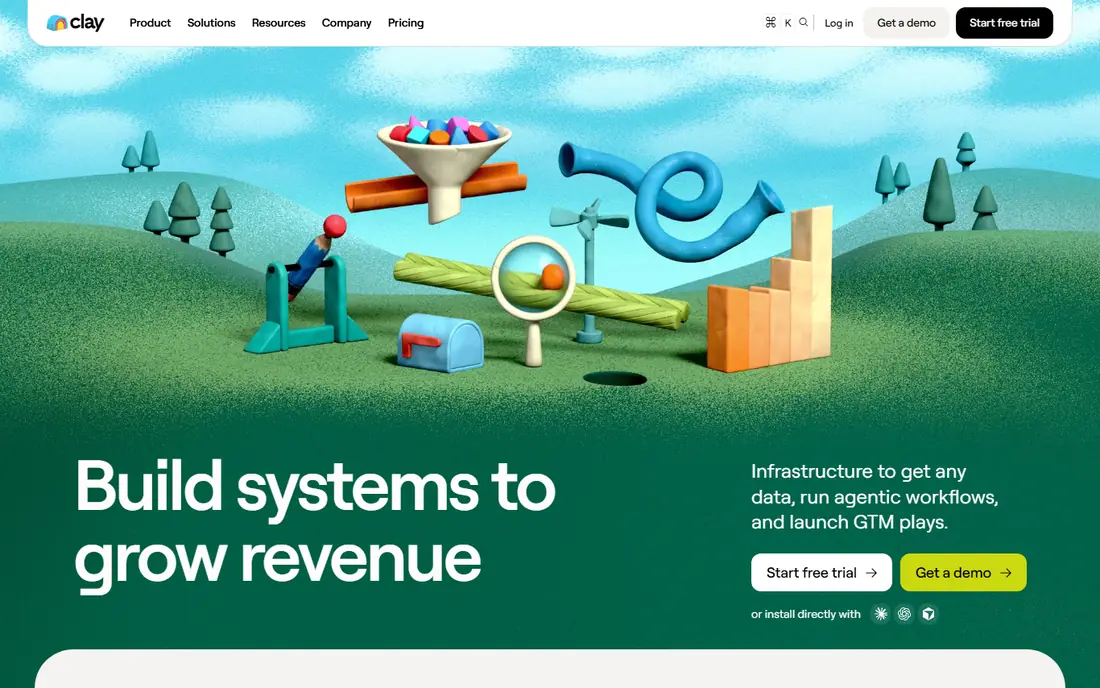
Clay was built for custom enrichment workflows. Waterfall enrichment pulls data from plenty of providers in sequence, AI research fills gaps, and custom workflows score, route, and sync results in a CRM or outreach tool. More specifically, Clay is a workflow tool for RevOps and growth teams that require lists no single database gives you.
For everyday use, non-technical users may also find the workflow builder daunting at first. As for the details, enrichment credits are charged per record and provider, so a large list can cost far more than the subscription alone. Reps who only need a straightforward prospect list should start with Apollo instead. What you pay to start with Clay: $185 per month. You can start on Clay without paying.
Main advantages: AI research at scale.
Where it is weaker: Needs a CRM or outreach tool alongside; Ramp-up time for non-technical users.
- Custom GTM workflows
- Waterfall enrichment across numerous providers
- Credit costs add up
Outreach
Ideal for: Outbound sequencing at scale

Outreach is designed for outbound sequencing at scale. Enterprise pricing and implementation are the costs. AI agents support account research, deal work, and personalization, whereas reporting presents sequence performance by rep, segment, and step.
Where it falls short: Implementation takes planning.
In practice, bigger teams should trial Outreach on one segment first, measure reply and meeting rates against the old process, and only then roll it out wider. More specifically, Outreach is aimed at structured outbound teams that run sequences across email, calls, and social touches at volume. Public comparisons describe per-seat pricing plus AI credits, with overage terms that require a close read. No starting price is listed for Outreach here; confirm pricing on the vendor site. Free access: Free trial.
- Capable Salesforce integration
- Multi-channel sequences at scale
- Quote-based pricing
Apollo.io
Ideal for: Prospecting plus data on a budget
For prospecting plus data on a budget, Apollo.io is a natural candidate. The free plan lets a team test data quality for its own market before paying.
Downsides: Advanced features need higher plans.
The premium entry point undercuts enterprise data products. For startups and small sales teams, that combination of data plus engagement is the primary draw. Price to start with Apollo.io: $49 per user/month. Free access exists with Apollo.io.
- Large contact database plus sequencing
- Lower entry price than enterprise data tools
- Credit and spend limits apply
HubSpot Sales Hub
Ideal for: All-in-one CRM with AI
Where HubSpot Sales Hub fits: all-in-one CRM with AI. Free tools handle entry-level CRM use, whereas Starter, Professional, and Enterprise levels add automation, AI features, and forecasting depth. For everyday use, public comparisons report mandatory onboarding fees on Professional plans and per-seat pricing that rises with team size, and AI credit limits vary by plan.
Where it is weaker: Advanced AI needs higher plans.
For everyday use, a bigger team should model seats, hubs, onboarding, and AI credits together before committing. Worth adding: a small team that only needs a CRM and light AI may find the free or Starter level enough. Starting cost for HubSpot Sales Hub: Free. Free access exists with HubSpot Sales Hub.
- CRM and AI in one system
- Breeze AI agents for research and prospecting
- Costs rise with seats and hubs
Lavender
Ideal for: Email coaching for reps
Lavender is aimed squarely at email coaching for reps. For reps who write their own outreach, Lavender can boost reply rates without changing the entire stack.
Downsides: Needs a CRM and sequencing tool alongside; Email only.
Teams that need full outbound automation should pair it with Apollo, Outreach, or Salesloft, and budget both costs. Lavender is not a CRM, a database, or a sequencing product, so it must sit alongside other tools. Starting cost for Lavender: $29 per month. Lavender has a free plan.
- Low entry price
- Email scoring inside Gmail and Outlook
- Team features cost more
ZoomInfo
Ideal for: Enterprise B2B data
Where ZoomInfo fits: enterprise B2B data. ZoomInfo supplies enterprise-scale B2B data, with hundreds of millions of contacts and tens of millions of businesses in public comparisons, plus buying signals, org charts, and intent data through Copilot features.
Watch-outs: Quote-based, consumption pricing.
On top of that, CRM integrations push that data into Salesforce and HubSpot workflows. As for the details, large sales teams use it to build territory lists, find decision makers, and time outreach around hiring, funding, and technology signals. Check the vendor site for ZoomInfo pricing; none is listed in this comparison. Free options: Free trial.
- Buying signals and intent data
- Very large contact and company database
- Expensive for small teams
How we chose
Ainotely looked at what each vendor publishes: pricing, plan limits, feature coverage for AI sales software for B2B and stated drawbacks. No hands-on testing is claimed. Where a vendor does not publish a price, the entry says quote. Where a price depends on seats or billing term, the entry says so. Position on the page reflects fit for a typical buyer first, with price clarity and free access breaking ties. Treat it as a guide, not a ruling.
Pre-purchase checklist
- Confirm the entry price on the vendor page. For Salesloft, Outreach and ZoomInfo that means a quote rather than a fixed price.
- Look at free plan limits closely: Clay, Apollo.io, HubSpot Sales Hub and Lavender have one, and the caps decide whether it is usable for real work.
- Take the trial from Salesloft, Outreach and ZoomInfo and push a live task through it before you pay.
- Before choosing Salesloft, weigh its main limit: quote-based pricing.
- Let daily users try ZoomInfo on real work; their feedback beats any feature checklist.
- Make sure Salesloft lets you export your data in a format another tool can read.
Frequently asked questions
Do these tools publish their prices?
Not all of them. Salesloft, Outreach and ZoomInfo publish no starting price, so expect a quote request for those. The rest, Clay included, show a starting price, though seats and billing terms still change the final cost.
Do I need Clay if I already have Apollo or ZoomInfo?
Clay helps when a single database does not handle your list, or when you need custom enrichment, scoring, and routing workflows. If a standard database list meets your needs, Clay layers on cost and complexity without clear benefit.
What is the cheapest option for AI sales software for B2B in this list?
On published monthly entry prices, Lavender is the lowest here at $29 per month. Entry price is only part of the cost, because seats, add-ons and billing terms can change the total.
Can Apollo replace ZoomInfo?
For small and mid-market prospecting, frequently yes, at a lower price. ZoomInfo gives you bigger data coverage, org charts, and intent signals that matter at enterprise scale, but Apollo spans the core prospecting job for plenty of teams.
Is Salesloft the right pick for everyone comparing AI sales software for B2B?
No single tool suits every team. Salesloft comes first because it fits engagement and coaching, while Clay suits custom enrichment workflows and Outreach suits outbound sequencing at scale. Match the tool to your own size, budget and workflow before deciding.
How are the tools for AI sales software for B2B ordered?
Salesloft sits first and ZoomInfo last because the order follows typical fit for AI sales software for B2B, then price clarity and free access. It is a judgement call, so read each profile for fit and limits.