Best AI Search Analysis Tools in 2026: 8 Tools Compared

- Otterly.AI is our pick for most small teams, with AI visibility tracking from 29 dollars per month and unlimited team members on its Lite plan.
- Profound suits enterprise brands that need deep reporting across many AI engines, though brand pricing is now custom and quote based.
- Peec AI suits mid-market competitive tracking, with multi-country and multi-language benchmarking, while Goodie suits teams that want prioritised fixes.
- Most tools measure visibility; they do not create it, so pair tracking with content, schema and third-party authority work that earns citations.
Quick comparison
| Product | Ideal for | Price from | Free version | |
|---|---|---|---|---|
 Otterly.AI | Affordable small-team tracking | $29 per month | No | Visit |
 Profound | Enterprise AI visibility | See website | No | Visit |
 Peec AI | Competitive benchmarking | $95 per month | No | Visit |
 Scrunch | Persona and funnel analysis | $250 per month | No | Visit |
 Goodie | Prioritised fix lists | See website | No | Visit |
 Semrush AI Toolkit | Suite users adding AI tracking | $99 per month | No | Visit |
 Ahrefs Brand Radar | Brand Radar in a suite | $199 per month | No | Visit |
 AthenaHQ | Enterprise GEO workflows | $295 per month | No | Visit |
The best ai search analysis tools
AI search analysis tools track whether AI engines such as ChatGPT, Gemini, Perplexity and Google AI answers mention, cite or recommend your brand, and how that changes over time. They replace the old rank tracker question, where do I sit on a results page, with a new one, do I appear in the generated answer at all. We compared engine coverage, prompt counts, reporting, fix workflows and pricing.
Otterly.AI
Ideal for: Affordable small-team tracking
Otterly.AI is the accessible entry point for AI visibility tracking. Its Lite plan covers a set of prompts across core engines such as ChatGPT, Google AI Overviews, Perplexity and Copilot, with daily tracking and unlimited team members, at a price small teams can justify. Published pricing lists Lite at 29 dollars per month, or 25 dollars per month on annual billing.
The catch is add-ons. Claude, Gemini and Google AI Mode cost extra, so a team that needs full engine coverage will pay more than the Lite headline price. Otterly suits a small team that mainly cares about ChatGPT and Google AI answers, and that wants affordable daily monitoring without an enterprise contract.
- Lowest entry price here
- Daily tracking with unlimited team members
- Clear prompt and engine structure
- Extra engines such as Claude and Gemini sit behind paid add-ons
- Prompt counts are limited on Lite
Profound
Ideal for: Enterprise AI visibility
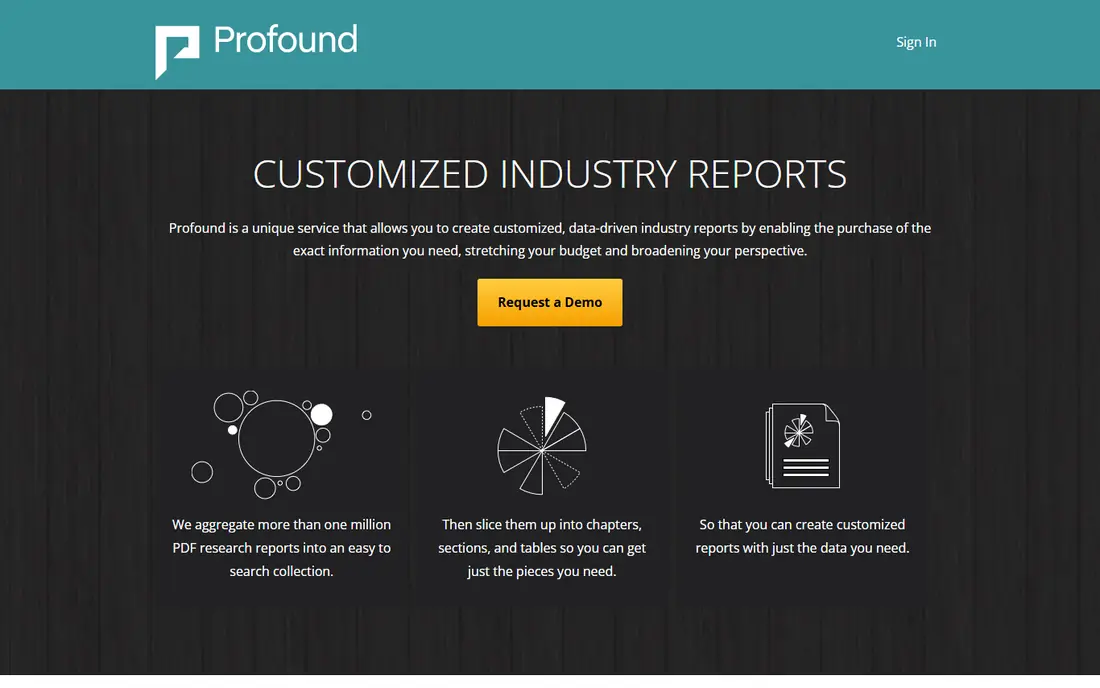
Profound is the enterprise-grade choice. It tracks around ten AI engines, offers deep reporting and persona modelling that shows how different buyer types see your brand in AI answers, and suits large teams that need data depth and API access. A trial covers a limited number of prompts for a week, which helps enterprise buyers evaluate before a sales conversation.
The weakness is price access. Brands now buy Profound on custom enterprise pricing, with no self-serve brand plan, while agencies face a separate plan plus per-workspace fees. Profound fits large brands that need the deepest AI visibility data and can fund an enterprise contract, not small teams looking for a quick tracker.
- Deep reporting across many engines
- Persona modelling
- Built for large teams and large budgets
- Brand pricing is custom enterprise only
- Agency pricing is separate and costly per client workspace
Peec AI
Ideal for: Competitive benchmarking
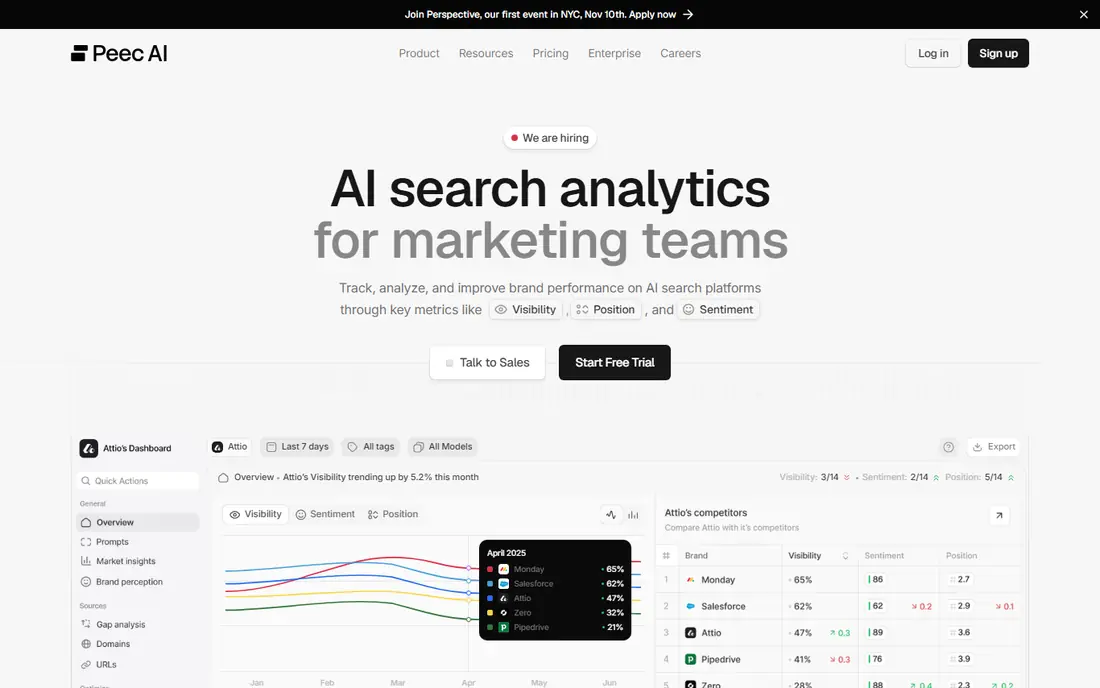
Peec AI suits mid-market teams in competitive markets. Its benchmarking compares your brand against competitors across AI engines, countries and languages, which helps European and global teams see where rivals win citations. Published summaries list Starter around 95 dollars per month, or about 85 euros monthly on some pages, with unlimited users and a set daily prompt count.
The catch is scaling cost. Higher prompt counts and projects sit on much pricier tiers, so a team tracking many prompts daily should price the tier it will actually need in six months. Peec fits competitive teams that value benchmarking clarity over the lowest entry price.
- Strong competitive benchmarking
- Multi-country and multi-language tracking
- Unlimited users on Starter
- Prices are in euros on some pages, so currency conversion matters
- Prompt counts rise steeply with tiers
Scrunch
Ideal for: Persona and funnel analysis
Scrunch suits midsize and larger teams that want analysis, not just measurement. Its workflow moves from monitoring AI answers to analysing personas and funnel stages, then to optimisation actions, which helps teams turn visibility gaps into content work. Published pricing lists Core around 250 dollars per month, with agency and enterprise tiers above that, and a trial for evaluation.
The weakness is entry cost. At 250 dollars per month, Scrunch is not a casual tracker, and teams that only need basic monitoring will find Otterly cheaper. Scrunch earns its price when persona and funnel insight changes what content you produce next.
- Monitor, Analyse and Optimise workflow
- Persona and funnel modelling
- Real crawler traffic insight in some reports
- Entry price is high for small teams
- Enterprise pricing is custom above Core tiers
Goodie
Ideal for: Prioritised fix lists
Goodie suits teams that want direction, not just a dashboard. It tracks visibility across many AI models and converts gaps into a prioritised list of fixes, such as pages to improve, facts to correct or schema to add, rather than leaving teams to interpret raw scores. That action focus is the main differentiator in a category where most tools only measure.
The catch is price transparency. Goodie pricing is less widely published than Otterly or Peec, so teams must request a quote to compare fairly. Goodie fits teams that have tried a pure tracker, felt stuck with data, and now want a clear next-action list each week.
- Tracks many AI models
- Turns visibility data into a prioritised fix list
- Action-oriented reporting
- Pricing is not as widely published as Otterly
- Smaller brand presence than Profound or Semrush
Semrush AI Toolkit
Ideal for: Suite users adding AI tracking
Semrush AI Visibility Toolkit suits teams already paying for Semrush. It adds AI prompt tracking, citation monitoring and research tools inside the suite SEO teams already use, so AI visibility joins keyword, backlink and site data in one place. Published summaries list the AI toolkit around 99 dollars per month per domain on annual billing, with a free checker for a few daily checks.
The weakness is stacking. If you do not already use Semrush, the combined suite plus toolkit cost exceeds a standalone tracker such as Otterly, and entry prompt counts are limited. Semrush fits SEO teams that want AI visibility as one more suite module, not as a standalone purchase.
- AI visibility inside a full SEO suite
- Prompt tracking plus research tools
- Familiar workflows for SEO teams
- AI toolkit price sits on top of suite costs for some plans
- Prompt counts are limited on entry tiers
Ahrefs Brand Radar
Ideal for: Brand Radar in a suite
Ahrefs Brand Radar suits SEO teams that already live in Ahrefs. It tracks brand visibility across AI engines, draws on a large prompt database, and in some reports indexes YouTube and Reddit mentions beside AI answers, which gives a broader brand picture than prompt tracking alone. Published summaries list Brand Radar from about 199 dollars per month per platform index, on top of a paid Ahrefs plan.
The catch is total cost. Brand Radar plus an Ahrefs plan is an expensive stack for a small team, and the most expensive at scale in some 2026 comparisons. Ahrefs fits established SEO teams that need brand radar depth inside a suite they already fund.
- Brand visibility plus a huge prompt database
- YouTube and Reddit indexing in some reports
- Strong SEO suite beside it
- Brand Radar pricing sits on top of Ahrefs plans
- Entry cost is high for small teams
AthenaHQ
Ideal for: Enterprise GEO workflows
AthenaHQ suits enterprise teams that run GEO, or generative engine optimisation, as a formal workflow. Its Starter plan covers tracking across several engines with credit-based prompts, plus workflow tools that help larger teams assign fixes and track progress. Published summaries list Starter around 295 dollars per month, with an Essential free tier for basic checks.
The weakness is entry cost and complexity. AthenaHQ is built for larger teams, so small teams will find Otterly simpler and cheaper. AthenaHQ fits organisations that treat AI visibility as a programme with owners, workflows and reporting, not as a single dashboard.
- Enterprise GEO workflows
- Credit-based tracking across engines
- Workflow tools for larger teams
- Entry price is high
- Free Essential tier is limited compared with paid Starter workflows
How we picked these
We compared engine coverage, prompt counts, reporting depth, fix workflows and pricing from vendor pages and October 2026 comparisons for tools still operating in October 2026. We kept budget, mid-market, suite and enterprise options in the list, since AI visibility budgets vary widely. We did not run live prompt tracking in each tool, and we did not repeat vendor visibility scores as proof of ranking gains.
What to check before you buy
Start with a free audit before paying. Free checkers and trials show whether you appear in AI answers at all, which engines matter for your buyers, and which content gaps are most urgent. If you barely appear anywhere, spend first on quotable pages, clear facts, schema and third-party mentions, since tracking an absence does not fix it.
Next, match engine coverage to your buyers. A tool tracking ten engines is wasted if your buyers only use ChatGPT and Perplexity, while a tool missing Gemini or Claude fails if those engines drive your audience. List the engines your buyers actually use, confirm they are included at your tier without add-on surprises, and check prompt refresh frequency.
Finally, check what happens after a gap is found. Ask whether the tool gives a prioritised fix list, citation workflows or content suggestions, or only a dashboard of scores. The best tool for your team is the one whose next actions your team will actually complete each week, not the one with the most engines on a pricing page.
Frequently asked questions
What is the best AI search analysis tool?
Otterly.AI is our pick for most small teams because of its low entry price and daily tracking. Profound suits enterprises, Peec AI suits competitive benchmarking, Goodie suits fix-focused teams, and Semrush or Ahrefs suit teams already paying for those suites.
How much do AI visibility tools cost?
Entry trackers start around 29 dollars per month, mid-market tools run around 95 to 250 dollars per month, and enterprise platforms are custom priced. Prices change fast in this category, so confirm current pricing on the vendor page before buying.
Do AI visibility tools improve my rankings?
No, on their own they only measure whether AI engines mention or cite you. Improvement comes from content work: clear, quotable pages, accurate facts, schema, reviews and third-party authority that AI engines trust enough to cite.
Which AI engines should I track?
Track the engines your buyers actually use, which usually means ChatGPT and Google AI answers first, plus Perplexity, Gemini, Claude or Copilot where relevant. Confirm each engine is included at your tier, since some tools gate engines behind add-ons.
What is the difference between AI visibility and SEO rank tracking?
SEO rank tracking measures where you sit on a search results page, while AI visibility measures whether you appear inside a generated answer, how you are framed, and who is cited instead. Both matter, but AI answers can recommend a competitor even when your classic ranking looks strong.