Best AI Security Platforms in 2026: 8 Options Compared

- 1
 DarktraceBehavior-based threat detectionVisit
- 2
 WizCloud security postureVisit
- 3
 CrowdStrike FalconEndpoint detection and responseVisit
- 4
 SentinelOneAutonomous endpoint protectionVisit
- 5
 Microsoft Defender for CloudMicrosoft and Azure shopsVisit
- Darktrace and Vectra AI lead for network and behavior-based threat detection.
- Wiz and CrowdStrike suit cloud and endpoint protection at scale.
- HiddenLayer and similar AI-specific tools address model and prompt risks that general tools miss.
- Define the risk first, since endpoint, cloud and AI-model security are different purchases.
Quick comparison
| Product | Ideal for | Price from | Free version | |
|---|---|---|---|---|
| Darktrace | Behavior-based threat detection | See website | No | Visit |
| Wiz | Cloud security posture | See website | No | Visit |
| CrowdStrike Falcon | Endpoint detection and response | See website | Free trial | Visit |
| SentinelOne | Autonomous endpoint protection | See website | Free trial | Visit |
| Microsoft Defender for Cloud | Microsoft and Azure shops | See website | Free trial | Visit |
 Vectra AI | Network attack signal detection | See website | No | Visit |
 HiddenLayer | AI model and application security | See website | No | Visit |
 Palo Alto Cortex XDR | Unified detection and response | See website | No | Visit |
The best best ai security platforms
AI security platforms use machine learning to spot threats, investigate alerts and protect AI systems themselves, but the term covers several different jobs. We compared detection, response, cloud protection, data safeguards and AI-specific risks, and we favored platforms with clear product scope, documented integrations and transparent pricing or trial access.
In this guide, we list eight best ai security platforms options and explain who each one suits best, what it costs to start, and where it falls short. We kept the list focused on products that are widely available in the United States and that a reader can actually sign up for today, rather than filling the list with niche tools that are hard to buy or that have stopped updating their product. Prices and free tiers are shown as we found them in October 2026, and we note where a price needs a check on the vendor site because it varies by plan, team size or region.
Note: Security needs vary by industry and regulation. Review each vendor's data handling, certifications and privacy terms, and test alert quality in a proof of concept before relying on any platform for critical protection.
Darktrace
Ideal for: Behavior-based threat detection
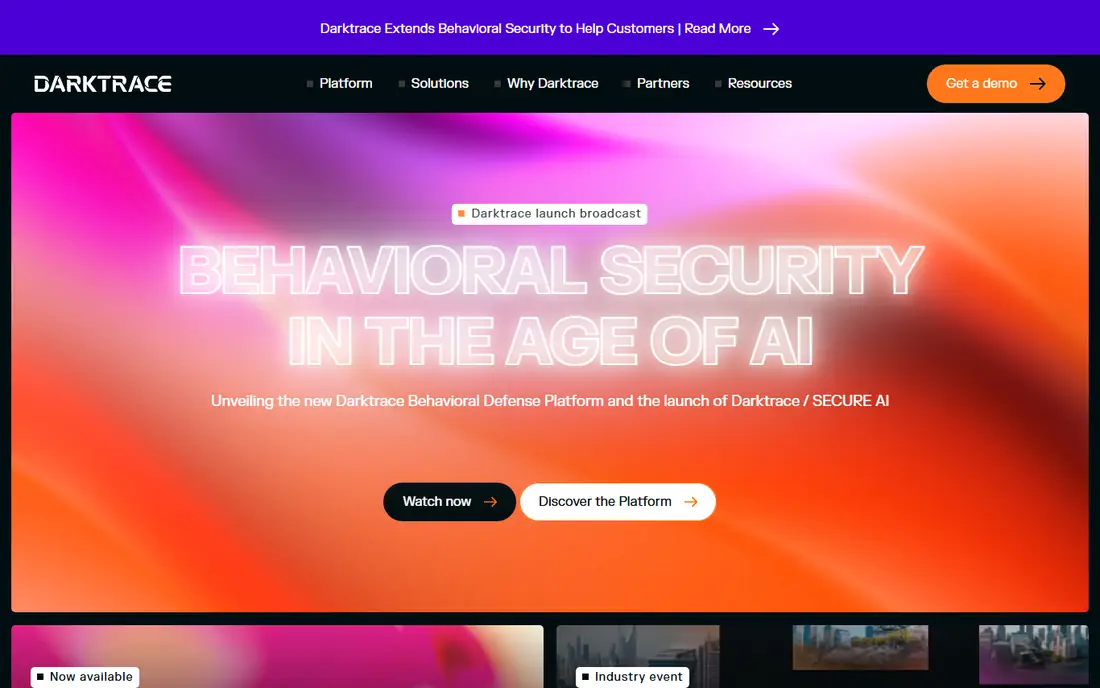
Darktrace uses self-learning models to learn normal network behavior and flag unusual activity, including novel attacks that signature tools miss. It covers network, email, cloud and endpoint signals, and it can take autonomous response actions when configured to do so.
The platform is quote-based and works best with a skilled security team that can tune alerts and review investigations. Smaller teams may find it heavy, but organizations with complex networks value its behavior-based view.
- Self-learning detection
- Network visibility
- Autonomous response options
- Quote-based pricing
- Needs tuning and skilled operators
Wiz
Ideal for: Cloud security posture
Wiz scans cloud environments for vulnerabilities, misconfigurations, exposed data and attack paths, then ranks risks by exploitability and business impact. Its graph view helps teams see how a single weakness could lead to a critical asset.
Wiz is cloud-focused, so endpoint detection needs a separate tool like CrowdStrike or SentinelOne. For cloud-heavy companies, Wiz is one of the clearest ways to prioritize fixes across many accounts and services.
- Cloud risk graph
- Vulnerability and misconfiguration checks
- Broad cloud coverage
- Quote-based pricing
- Cloud focus rather than endpoint depth
CrowdStrike Falcon
Ideal for: Endpoint detection and response

CrowdStrike Falcon combines endpoint detection, threat intelligence and response tools in a cloud-native platform. It is widely used by larger companies for stopping ransomware, detecting intrusions and investigating incidents quickly.
Pricing is quote-based and the platform assumes security expertise for full value. Small teams can still benefit from managed options, but Falcon shines when a security team uses its hunting and intelligence features daily.
- Strong endpoint detection
- Threat intelligence
- Fast investigation tools
- Quote-based pricing
- Best with a security team
SentinelOne
Ideal for: Autonomous endpoint protection
SentinelOne uses AI models on the endpoint to detect, block and roll back malicious activity, including ransomware encryption. Its Singularity platform extends to cloud, identity and data signals for broader investigation.
Pricing is quote-based and advanced features sit on higher tiers. SentinelOne suits teams that want strong autonomous response on endpoints without relying only on human analysts for every alert.
- Autonomous response
- Rollback for ransomware
- Broad platform coverage
- Quote-based pricing
- Some features need higher tiers
Microsoft Defender for Cloud
Ideal for: Microsoft and Azure shops
Microsoft Defender for Cloud protects Azure, hybrid and multi-cloud workloads with posture management, vulnerability assessment and threat protection. It integrates deeply with Microsoft Sentinel, Defender for Endpoint and Azure services.
It works best for organizations already committed to Microsoft, and pricing depends on usage and plans. For Azure-heavy teams, the integration advantage is significant. For multi-cloud teams, Wiz may offer a more neutral view.
- Cloud posture management
- Threat protection
- Microsoft integration
- Best inside Microsoft environments
- Pricing is usage-based
Vectra AI
Ideal for: Network attack signal detection
Vectra AI focuses on detecting attacker behavior across network, cloud, identity and SaaS signals, then prioritizing the alerts that matter most. Its attack signal intelligence aims to cut alert noise and show the progression of an attack.
Vectra AI is a detection platform, so response and remediation often need companion tools. It suits security teams drowning in alerts who need clearer prioritization across hybrid environments.
- AI attack signal intelligence
- Network and cloud detection
- Prioritized alerts
- Quote-based pricing
- Detection focus rather than full response
Palo Alto Cortex XDR
Ideal for: Unified detection and response
Palo Alto Cortex XDR brings endpoint, network, cloud and identity data into one detection and response platform, with automation playbooks for investigation and containment. It suits enterprises already using Palo Alto network security.
The breadth of the platform needs planning, integration work and skilled operators to reach full value. For large enterprises standardizing on Palo Alto, Cortex XDR offers a unified view that point tools cannot match.
- Endpoint, network and cloud data in one investigation view
- Automation
- Quote-based pricing
- Broad platform needs planning
How we picked these
We compared official feature pages, pricing pages, app store listings, privacy policies and public reviews for each option, and we checked that each product is still available and working in October 2026. We favored products that fit the topic directly, publish clear pricing or a clear free tier, and explain how they handle data and support. We left out products that looked discontinued, that did not match the topic, or whose official homepage we could not verify. Prices change often, so check the vendor page linked in each block before you pay.
We also paid attention to the details that decide daily satisfaction, not just headline features. That meant checking how a free plan actually limits use, whether a paid plan is priced per user, per device or per account, and what happens when you add team members or exceed a limit. Where a vendor only publishes quote-based pricing, we say so rather than guessing a number, and where a first-year discount differs from a renewal price, we flag that difference in the product write-up so the second year does not come as a surprise.
How to buy AI security without buying the same tool twice
Name the risk before the vendor. Endpoint attacks, cloud misconfigurations, identity abuse and AI-model risks need different tools, and a platform that claims to cover all four may be shallow in one area. List your top three risks and score each tool against those only.
Ask how the AI works in practice. Good vendors explain what data trains their models, how alerts are prioritized, what autonomous actions are allowed, and how analysts can override decisions. Vague AI claims without documented detection logic should raise questions.
Run a proof of concept with your own data. Measure alert volume, false positives, investigation time and integration effort over several weeks. A platform that looks strong in a demo can still overwhelm a small team with noisy alerts in production.
Before you commit, run a short trial with the work you actually do, not with demo data. Set up one real project, booking, routine or workflow, invite the people who will use the tool every day, and check support response time when you hit a question. A product that feels good in a sales demo can still fail on a busy day, so a trial that mirrors real use is the most reliable test. If two options feel close after that trial, choose the one with clearer pricing, simpler cancellation and better support, since those factors matter long after the novelty of a new tool fades. Keep a note of the trial end date, the renewal price and the cancellation steps, so a decision made in a hurry does not turn into a subscription you forgot to review. That small record, kept in the same place as your other subscription dates, makes the yearly renewal check a five-minute job rather than a surprise bill.
Frequently asked questions
What is the best AI security platform?
There is no single best platform, since endpoint, cloud and AI-model risks differ. Darktrace suits behavior detection, Wiz suits cloud posture, CrowdStrike suits endpoints, and HiddenLayer suits AI-specific risks.
What is AI security software?
AI security software uses machine learning to detect threats, prioritize alerts and sometimes respond automatically. It also includes tools that protect AI models and applications from prompt attacks, data leaks and malicious models.
How is AI application security different from normal security?
Normal security protects networks, endpoints and cloud workloads, while AI application security also protects models, prompts, training data and outputs. Companies deploying customer-facing AI need both layers.
Do small businesses need AI security platforms?
Small businesses benefit most from endpoint protection and cloud posture basics, often through managed services. Full AI security platforms suit larger teams with dedicated security staff or significant AI deployments.
How much does AI security software cost?
Most enterprise platforms in this list are quote-based, with pricing tied to endpoints, cloud workloads or data volume. Request a quote based on your actual environment, and ask what is included in each tier before comparing.