6 AI Tool for Research Papers Compared on Price and Fit

- 1
 Connected PapersMapping a field from one paperVisit
- 2
 Research RabbitFinding related work visuallyVisit
- 3
 SciteChecking how papers are citedVisit
- 4
 ElicitLiterature reviews and extraction tablesVisit
- 5
 ConsensusEvidence backed answersVisit
- Number one here is Connected Papers, a fit for mapping a field from one paper.
- What to know about Connected Papers first: one seed shapes the entire map, a biased seed provides a biased field.
- Semantic Scholar fits free discovery and skimming.
- Free plans are common here: 6 of 6 tools have one, including Connected Papers, Research Rabbit, Scite and Elicit.
- Elicit is the lowest-priced starter here at $11 per month.
Direct answer
If you need mapping a field from one paper, Connected Papers is the first tool to look at here. Alternatives: Research Rabbit for finding related work visually, and Scite for checking how papers are cited. The full list of 6 tools follows, with prices and free plan facts.
Quick comparison
| Product | Ideal for | Price from | Free version | |
|---|---|---|---|---|
| Connected Papers | Mapping a field from one paper | See website | Yes | Visit |
| Research Rabbit | Finding related work visually | Free | Yes | Visit |
| Scite | Checking how papers are cited | $20 a month | Yes | Visit |
| Elicit | Literature reviews and extraction tables | $11 a month | Yes | Visit |
| Consensus | Evidence backed answers | $12 per month | Yes | Visit |
 Semantic Scholar | Free discovery and skimming | Free | Yes | Visit |
The full AI tool for research Papers list
Ainotely put together this guide to AI tool for research Papers for readers who want a clear shortlist without reading every vendor page. It compares 6 tools on starting price, free plans, who each one suits and where each one falls short.
Connected Papers
Ideal for: Mapping a field from one paper
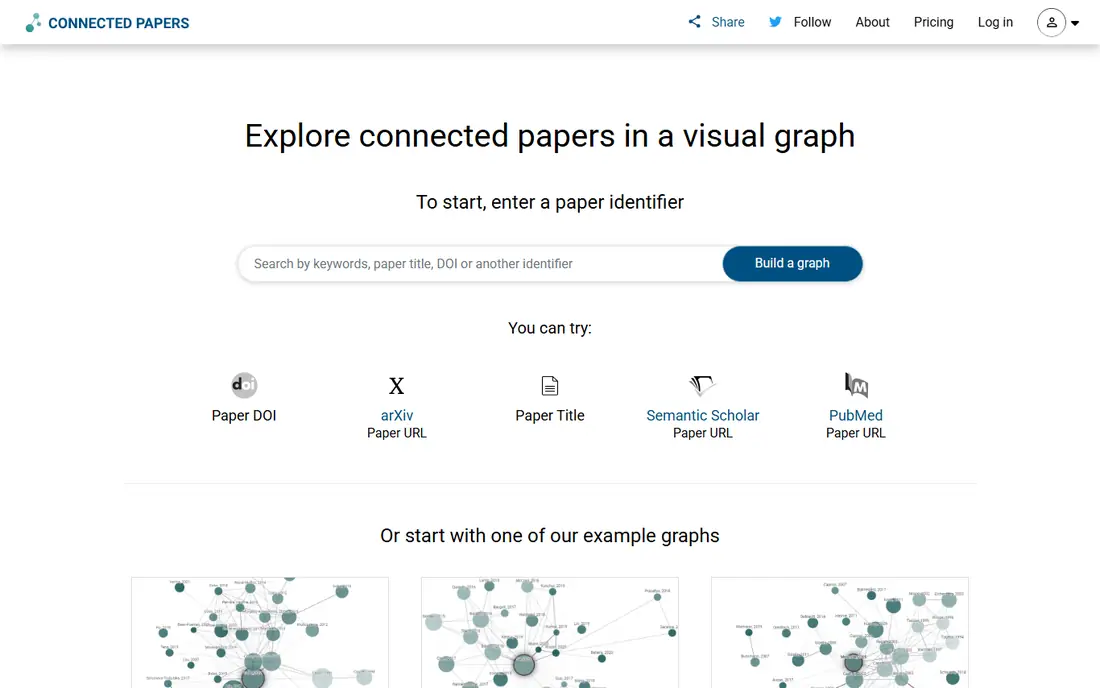
In short, Connected Papers is for mapping a field from one paper. For a researcher entering unfamiliar territory, or a supervisor checking a student's sense of the field, it is unmatched for speed.
Treat the map as a sketch, not a survey. Check the vendor site for Connected Papers pricing; none is listed in this comparison. Connected Papers includes a free tier.
Points against: One seed shapes the entire map; Graphs are exploration aids, not evidence.
- Prior and derivative work views separate foundations from follow ups
- Enter one paper and get a graph of the works most related to it
- No extraction, screening, or synthesis
Research Rabbit
Ideal for: Finding related work visually

Research Rabbit targets finding related work visually. For expanding a reading list beyond what keyword search finds, notably in fields where terminology differs between research groups, Research Rabbit is the best free specialist here.
Entry price for Research Rabbit: Free. A free plan is available with Research Rabbit.
Where it falls short: Exports and reference manager links are less central than in review tools; The graph approach has a ramp-up time.
- RR+ at $10 a month billed yearly raises seed limits for power users
- Free forever with unlimited searches across 310 million plus articles
- Recommendations can wander from a tightly defined question
Scite
Ideal for: Checking how papers are cited
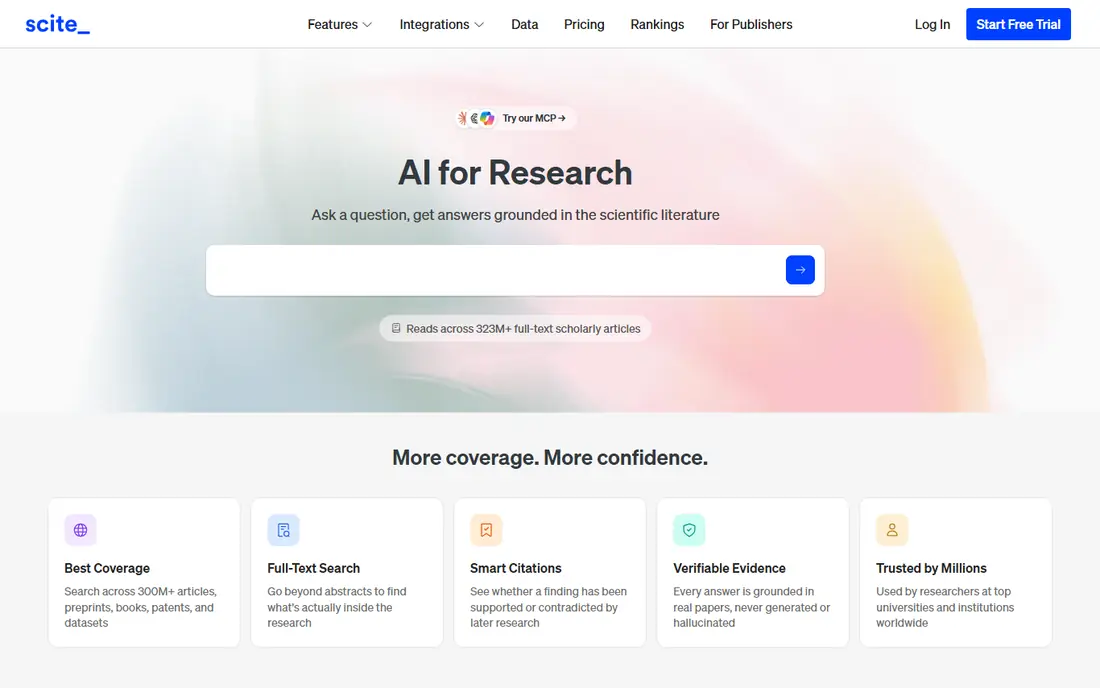
Scite was built for checking how papers are cited. Scite answers a question no search engine asks: after a paper was published, what did the field do with it. Its Smart Citations read the sentences where later papers cite a study and label them supporting, mentioning, or contrasting, drawn from a citation database in the billions.
Downsides: Many universities supply access, so check your library before paying; Entry-level at $20 a month billed yearly is the priciest entry here for individuals.
Main advantages: Smart Citations classify whether citing papers support, mention. More specifically, for anyone doing serious synthesis work, the citation context it supplies exists nowhere else at this scale. At $20 a month for Basic it is priced for active researchers instead of students, and institutional access is typical, so check your library login first. The starting price for Scite: $20 per month. A free plan is available with Scite.
- A database of over a billion citation statements
- The fastest way to spot a famous paper that later work undermined
- The free Connect level excludes the Assistant and full Search
Elicit
Ideal for: Literature reviews and extraction tables
Elicit makes the most sense for literature reviews and extraction tables. Used with that care, Elicit is the closest thing this category has to a standard recommendation.
Where it falls short: Extracted data still needs spot checking against the papers; Full text access relies on the papers being openly available.
Anyone who has built that spreadsheet by hand over three weeks understands the value immediately. More specifically, ask a research question and it returns relevant papers as a table, one row per study, with columns for the details you choose: population, method, outcome, limitation. Elicit pricing: $11 per month. A free plan is available with Elicit.
- Screening workflows suit systematic reviews
- Custom columns extract methods, samples
- Chat answers can smooth over disagreements between studies
Consensus
Ideal for: Evidence backed answers
Consensus is built with evidence backed answers in mind. Consensus answers the question every introduction starts with: what does the evidence actually say. Type a question and it searches its index of more than 200 million papers, reads the findings, and returns a synthesis where each claim points to the studies behind it.
Strengths: Answers questions by synthesising findings across real papers, with citations attached.
Trade-offs to know: Weaker on very niche topics with thin literature; Answers are only as decent as the underlying papers' quality.
More specifically, on yes or no questions its meter presents the split of supporting, mixed, and opposing results, which is a fast, honest picture of a settled or unsettled field. That speed is also the caution. On cost, Consensus starts like this: $12 per month. Consensus offers a free plan.
- Its Consensus Meter displays how studies line up on yes or no questions
- Deep Reviews assemble longer evidence summaries on premium plans
- Pro message and Deep Review allowances cap heavy use on free and entry levels
Semantic Scholar
Ideal for: Free discovery and skimming
Semantic Scholar works best for free discovery and skimming. Semantic Scholar is the free foundation under much of this category, multiple tools above draw on its index, and for plenty of researchers it is enough on its own.
Downsides: TLDRs compress aggressively and can drop key conditions; A search engine.
Its limits are scope, not quality. Semantic Scholar finds and skims; it does not extract comparison tables, track a review's screening decisions, or synthesise findings. Starting cost for Semantic Scholar: Free. Semantic Scholar has a free plan. Upsides: a nonprofit project from the Allen Institute.
- Fully free
- Search across more than 200 million papers with no account needed
- No synthesis across papers
How the list was put together
Ainotely looked at what each vendor publishes: pricing, plan limits, feature coverage for AI tool for research Papers and stated drawbacks. No hands-on testing is claimed. Prices and plan limits come from vendor pages and can change, so confirm them on the vendor site before you buy. The sequence is a judgement call: typical use case first, then pricing transparency, then free access. Use the profiles to check fit.
What to confirm before you sign up
- Get a written quote from Connected Papers; the list shows no starting price for them.
- Read the fine print on the free plans from Connected Papers, Research Rabbit, Scite and others; seat, project and feature caps differ.
- Before choosing Connected Papers, weigh its main limit: one seed shapes the entire map, a biased seed provides a biased field.
- Check how data leaves Consensus: formats, limits and whether exports are available on every plan.
- A short pilot of Connected Papers with your real workflow tells you more than a feature table.
Frequently asked questions
Do these tools publish their prices?
Not all of them. Connected Papers publishes no starting price, so expect a quote request for it. The rest, Research Rabbit included, show a starting price, though seats and billing terms still change the final cost.
What is the cheapest option for AI tool for research Papers in this list?
On published monthly entry prices, Elicit is the lowest here at $11 per month. Entry price is only part of the cost, because seats, add-ons and billing terms can change the total.
Is it allowed to use AI tools when writing a research paper?
It relies on your institution and your journal, and you must check both. Numerous journals now need an AI use disclosure statement, and universities treat undisclosed generative writing as misconduct. When in doubt, ask your supervisor and disclose.
Can these tools invent fake references?
General chatbots without database grounding are far worse, they fabricate whole references with invented authors and journals. If you have not opened it, do not cite it.
What is the difference between Elicit and Consensus?
Consensus is aimed at the evidence question: it reads across papers and synthesises an answer with a view of how the findings split.
Which AI tool for research Papers have a free plan?
6 of the 6 tools have a free plan, including Connected Papers, Research Rabbit, Scite and Elicit. Free plans usually cap users, projects or features, so check the limits on the vendor page.