7 Best AI Tools for Academic Research Automation Options for 2026

- 1
 Scite.aiSeeing how papers have been cited: supported, mentioned or contrastedVisit
- 2
 ResearchRabbitFree, unlimited visual literature mapping for discoveryVisit
- 3
 SciSpaceUnderstanding dense papers rapidly with AI explanations and a writing copilotVisit
- 4
 Connected PapersVisual exploration of related papers from a single seed paperVisit
- 5
 ElicitResearchers who want AI-synthesized answers with citations from the literatureVisit
- Scite.ai takes the first slot, best suited to seeing how papers have been cited: supported, mentioned or contrasted.
- Semantic Scholar suits free access to 200 million papers with an open API.
- Scite.ai, SciSpace, Connected Papers and Elicit: pricing is by quote only, so plan time for a sales conversation.
- The main caution on SciSpace: the plenty of features can feel scattered.
- 6 out of 7 tools include a free plan, among them ResearchRabbit, SciSpace, Connected Papers and Elicit.
Direct answer
This list puts Scite.ai first for seeing how papers have been cited: supported, mentioned or contrasted. Alternatives: ResearchRabbit for free, unlimited visual literature mapping for discovery, and SciSpace for understanding dense papers rapidly with AI explanations and a writing copilot. Prices, free plans and limits for all 7 tools follow.
Quick comparison
| Product | Ideal for | Price from | Free version | |
|---|---|---|---|---|
| Scite.ai | Seeing how papers have been cited: supported, mentioned or contrasted | See website | No | Visit |
| ResearchRabbit | Free, unlimited visual literature mapping for discovery | Free | Yes | Visit |
| SciSpace | Understanding dense papers rapidly with AI explanations and a writing copilot | See website | Yes | Visit |
| Connected Papers | Visual exploration of related papers from a single seed paper | See website | Yes | Visit |
| Elicit | Researchers who want AI-synthesized answers with citations from the literature | See website | Yes | Visit |
 Inciteful | Free citation-based paper discovery with no account needed | Free | Yes | Visit |
 Semantic Scholar | Free access to 200 million papers with an open API | Free | Yes | Visit |
The 7 tools in detail
If you are comparing AI tools for academic research automation, this page covers 7 tools in one place: what each is best for, what it costs to start, whether it has a free plan, and the main limit to know about.
Scite.ai
Ideal for: Seeing how papers have been cited: supported, mentioned or contrasted
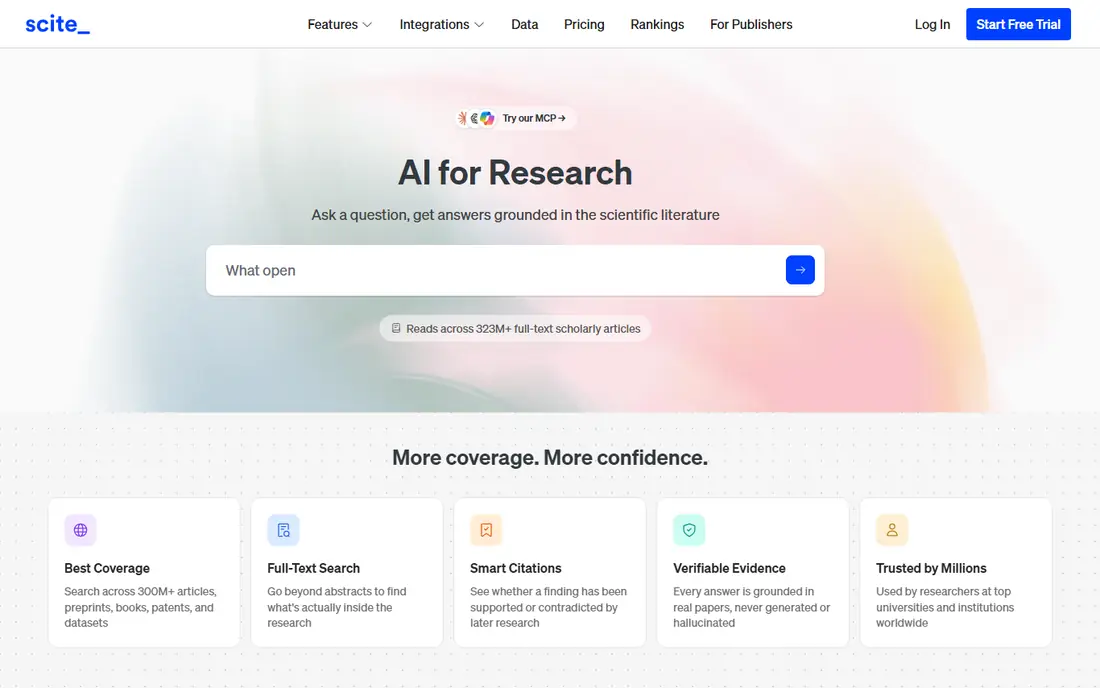
Scite.ai is built with seeing how papers have been cited: supported, mentioned or contrasted in mind. If your work relies on the reliability of prior findings, it is worth the subscription. Scite.ai solves a problem every researcher knows: a paper with 500 citations looks influential, but were those citations supportive or critical?
Where it is weaker: Coverage relies on its citation extraction.
Its Smart Citations classify each citing context as supporting, mentioning or contrasting. So you can see at a glance whether a finding has held up. It also gives you reference checks that scan your manuscript's citations for retractions, corrections and editorial notices. This makes Scite.ai uniquely valuable for due diligence: before building on a paper, check how the field has actually received it. It is a premium tool with no free level, geared toward serious researchers, institutions and publishers. Pricing for Scite.ai is not stated here, so ask the vendor for current figures. No free plan comes with Scite.ai.
- Reference check tools
- Smart Citations classify citation context
- No free plan
ResearchRabbit
Ideal for: Free, unlimited visual literature mapping for discovery
For free, unlimited visual literature mapping for discovery, ResearchRabbit is a natural candidate. ResearchRabbit is the beloved free tool of the category.
Beyond that, use it to build your reading list, then turn to Elicit, SciSpace or the papers themselves for depth. Beyond that, the interface is refined and the recommendations genuinely useful. What you pay to start with ResearchRabbit: Free. ResearchRabbit has a free plan.
What to check first: No AI synthesis or writing help.
- Well suited to continuing projects
- Elegant collections and visualizations
- Discovery only
SciSpace
Ideal for: Understanding dense papers rapidly with AI explanations and a writing copilot
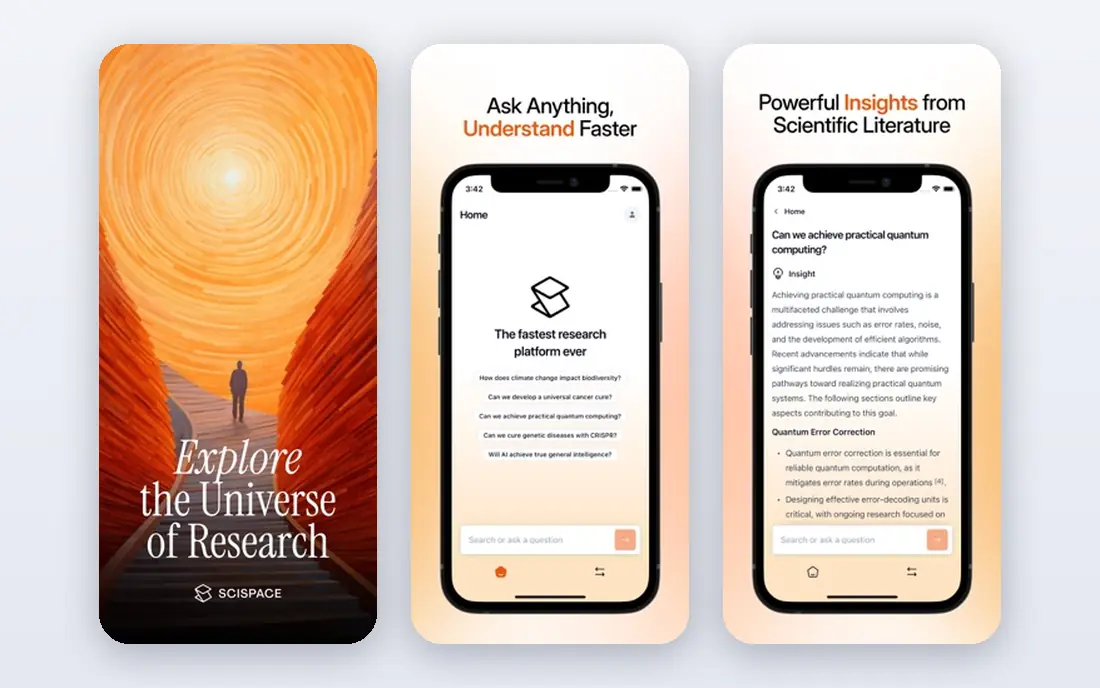
SciSpace is a good fit for understanding dense papers rapidly with AI explanations and a writing copilot. SciSpace, formerly Typeset, is the Swiss Army knife of AI research tools. Beyond that, the free plan lets you try the core features before paying.
For students and researchers who want one subscription including reading, understanding and writing assistance, though, it is a solid package. Beyond that, the breadth is both the strength and the weakness: SciSpace does a lot, but individual features may not match the best single-purpose tools. Check the vendor site for SciSpace pricing; none is listed in this comparison. You can start on SciSpace without paying.
Where it falls short: Free plan has usage limits.
- Formulas and tables in plain language
- Wide toolset in one place
- The plenty of features can feel scattered
Connected Papers
Ideal for: Visual exploration of related papers from a single seed paper
Connected Papers targets visual exploration of related papers from a single seed paper. Connected Papers builds a visual graph of the papers most related to a seed paper you offer, laying out prior works that influenced it and derivative works that built on it. It is the fastest way to get oriented in an unfamiliar literature.
Trade-offs to know: Restricted to graph exploration.
In practice, the free level permits a handful of graphs a month, which is enough for occasional deep dives. It does not synthesize or answer questions; it maps the field so you can explore. Connected Papers does not show a starting price in this comparison, so check the vendor site for current pricing. Connected Papers includes a free tier.
- Straightforward to use
- Beautiful citation graphs reveal a field's structure
- Free level caps the number of graphs
Elicit
Ideal for: Researchers who want AI-synthesized answers with citations from the literature
Elicit is designed for researchers who want AI-synthesized answers with citations from the literature. Ask a question in plain language and it searches the academic literature, extracts relevant findings and returns a structured table of papers with one-line summaries of their results.
What to check first: Synthesis quality relies on the underlying papers.
Worth adding: used that way, it compresses hours of database searching into minutes. Elicit does not show a starting price in this comparison, so check the vendor site for current pricing. Elicit offers a free plan.
- Returns structured answers with real citations
- Free plan with monthly credits
- Limited to what is in its corpus
Inciteful
Ideal for: Free citation-based paper discovery with no account needed
In short, Inciteful is for free citation-based paper discovery with no account needed. Researchers who distrust AI-generated summaries will appreciate that Inciteful presents you papers, not prose about papers.
Where it falls short: Minimal interface.
More specifically, Inciteful is refreshingly straightforward: paste a paper title or DOI and get a graph of similar papers based on citation analysis, with no account and no cost. It is maintained as a free academic resource, and its recommendations are powered by the same citation-graph logic as fancier tools. Inciteful starts at: Free. Inciteful includes a free tier.
- 100% free with no sign-up
- Quick graph-based recommendations
- No AI features or synthesis
Semantic Scholar
Ideal for: Free access to 200 million papers with an open API
Think of Semantic Scholar for free access to 200 million papers with an open API. Its corpus of over 200 million papers is free to search, plenty of entries contain AI-generated TLDR summaries.
Limits to weigh: Fewer workflow features than commercial tools.
Its open API lets developers and researchers build their own tools on top. Entry price for Semantic Scholar: Free. Free access exists with Semantic Scholar.
- TLDR summaries on plenty of papers
- Free API for programmatic access
- Search is keyword-based instead of conversational
Selection criteria
We compared the tools on published pricing, free plan or trial availability, feature coverage for AI tools for academic research automation, and the limits each vendor documents. Plan names, prices and limits change often. Treat the figures here as a starting point and verify them with the vendor. We ordered the tools by general fit, then by how clearly pricing is shown, then by free access. A buyer with unusual needs may reorder them.
What to confirm before you sign up
- Get a written quote from Scite.ai, SciSpace, Connected Papers and Elicit; the list shows no starting price for them.
- Read the fine print on the free plans from ResearchRabbit, SciSpace, Connected Papers and others; seat, project and feature caps differ.
- Before choosing Scite.ai, weigh its main limit: no free plan.
- Price Semantic Scholar for your actual team size; headline prices rarely include add-ons or overage.
- Run a one or two week pilot of Inciteful with the people who will use it every day.
Frequently asked questions
Do these tools publish their prices?
Not all of them. Scite.ai, SciSpace, Connected Papers and Elicit publish no starting price, so expect a quote request for those. The rest, ResearchRabbit included, show a starting price, though seats and billing terms still change the final cost.
Is Scite.ai the right pick for everyone comparing AI tools for academic research automation?
No single tool suits every team. Scite.ai comes first because it fits seeing how papers have been cited: supported, mentioned or contrasted, while ResearchRabbit suits free, unlimited visual literature mapping for discovery and SciSpace suits understanding dense papers quickly with AI explanations and a writing copilot. Match the tool to your own size, budget and workflow before deciding.
Can I try these tools before paying?
Often, yes. ResearchRabbit, SciSpace, Connected Papers and others have a free plan. Use your own data and a real task during the test, and check what the free tier or trial limits before you rely on it.
Do I still need Google Scholar?
Google Scholar remains handy for its enormous index and citation counts, but these AI tools offer capabilities it does not: conversational answers, citation context, visual mapping and automatic monitoring. Most researchers now use both: Scholar for full searching, AI tools for discovery and synthesis.
Which options for AI tools for academic research automation have a free plan?
On this list, 6 of 7 tools include a free plan, among them ResearchRabbit, SciSpace, Connected Papers and Elicit. Caps on seats, usage or features are common, so test the free plan against your real workload.