Best AI Visibility Tracking Tools in 2026: 7 Tools Compared

- 1
 ProfoundEnterprise programsVisit
- 2
 Peec AIMid-market trackingVisit
- 3
 Otterly.AIBudget trackingVisit
- 4
 Semrush AI Visibility ToolkitExisting Semrush usersVisit
- 5
 Ahrefs Brand RadarSearch-backed prompt researchVisit
- Profound is our pick for enterprise AI visibility programs, with prompt analytics and reporting built for larger teams.
- Peec AI suits mid-market teams that want clean tracking across several AI engines with unlimited seats.
- Otterly.AI is the budget pick, with daily mention tracking from a low monthly price.
- Semrush AI Visibility Toolkit suits teams already using Semrush, since AI reporting sits inside a wider SEO suite.
- AI visibility tools mostly measure, not fix, so budget separately for the content and authority work that earns recommendations.
Quick comparison
| Product | Ideal for | Price from | Free version | |
|---|---|---|---|---|
| Profound | Enterprise programs | See website | Free trial | Visit |
| Peec AI | Mid-market tracking | $95 per month | Free trial | Visit |
| Otterly.AI | Budget tracking | $29 per month | Free trial | Visit |
| Semrush AI Visibility Toolkit | Existing Semrush users | $99 per month | No | Visit |
| Ahrefs Brand Radar | Search-backed prompt research | $199 per month | No | Visit |
 Scrunch | Crawler and site readiness | $250 per month | Free trial | Visit |
 AthenaHQ | Action-focused tracking | $295 per month | Yes | Visit |
The best AI visibility tracking tools
AI visibility tools measure how your brand appears inside AI-generated answers from ChatGPT, Gemini, Perplexity and Google AI Overviews. They run a fixed set of prompts on a schedule, then record mentions, cited sources, sentiment and competitor presence. The tools below differ in engines covered, prompt limits and price, so compare entry plans carefully, since the cheapest tier often covers fewer engines than the homepage suggests.
Profound
Ideal for: Enterprise programs

Profound is our pick for enterprise AI visibility programs. Its reporting is polished, its prompt analytics help teams understand what buyers actually ask, and its workflows turn findings into assigned actions rather than leaving them in a dashboard. Larger teams with procurement processes and multi-brand programs will appreciate the structure.
Smaller teams face a harder path, since Profound has moved toward custom enterprise pricing, with a free trial for evaluation. Budget trackers cover the core measurement job for far less. For an enterprise program where reporting quality and scale matter, Profound is the strongest choice.
- Polished reporting for enterprise teams
- Prompt-demand data and analytics
- Projects and action workflows
- Now largely custom enterprise pricing, so small teams face a sales process
- Entry cost is higher than budget rivals
Peec AI
Ideal for: Mid-market tracking
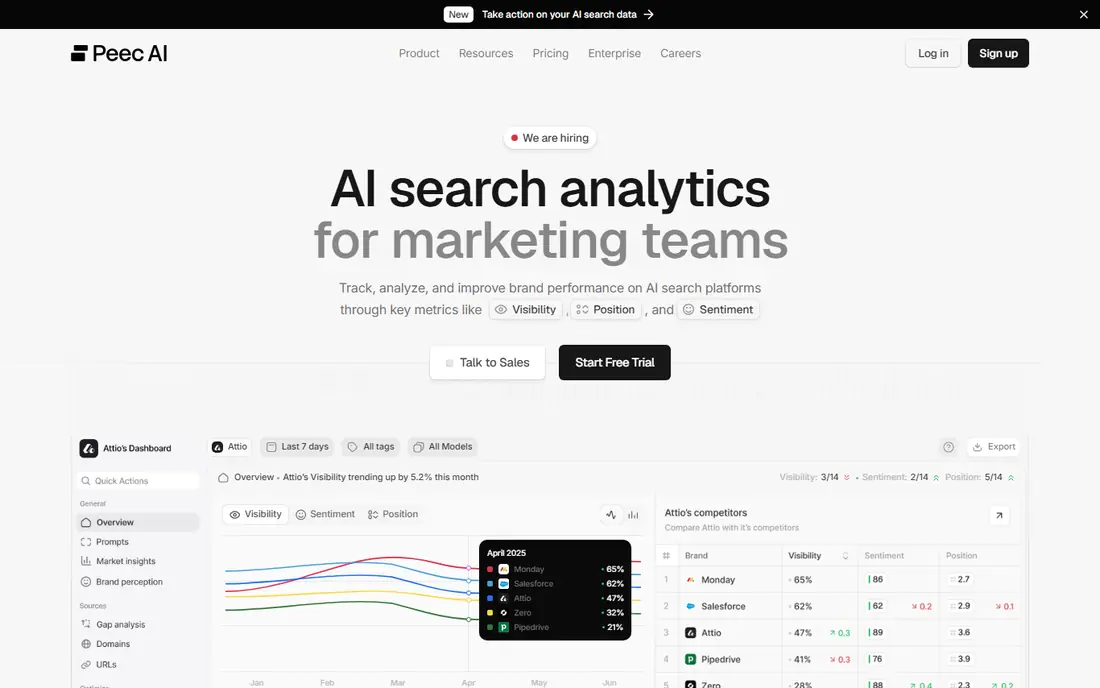
Peec AI suits mid-market SEO and marketing teams that want straightforward AI visibility tracking without enterprise complexity. It tracks brand mentions, position and sentiment per prompt across several engines, with unlimited seats so the whole team can use it. The interface is clean, and setup is faster than enterprise platforms.
The entry plan covers a limited engine set, with more engines on higher tiers, so check which engines your buyers actually use before choosing a tier. For lean teams that want reliable tracking at a mid-market price, Peec AI is a strong pick.
- Clean tracking across several AI engines
- Unlimited seats on paid plans
- Clear prompt, position and sentiment views
- Entry plan covers a limited set of engines
- Agency features sit on higher tiers
Otterly.AI
Ideal for: Budget tracking
Otterly.AI is the budget pick for testing AI visibility without a large commitment. Daily prompts track whether AI answers mention your brand, with a built-in audit that highlights basic site readiness issues. The low entry price makes it practical for startups, solo marketers and small agencies to start measuring.
Prompt limits are tight on the entry plan, and some engines cost extra, so growing programs will need a higher tier. For a first AI visibility tool, Otterly.AI offers the cheapest honest start, and it tells you whether deeper investment is justified.
- Lowest entry price on this list
- Daily mention tracking
- Built-in GEO audit features
- Entry plan covers a limited prompt count
- Advanced engines cost extra on some plans
Semrush AI Visibility Toolkit
Ideal for: Existing Semrush users
Semrush AI Visibility Toolkit suits teams already paying for Semrush, since AI visibility reporting sits alongside keyword, rank and site audit data in one platform. The prompt database is large, tracking covers major AI surfaces, and competitor views show who appears where you do not. For SEO teams, that integration saves tool-switching.
Pricing is per domain, billed annually at the entry level, and the toolkit may sit on top of a base Semrush plan, so confirm total cost. Teams without Semrush may find a standalone tracker cheaper. For existing Semrush users, the toolkit is the natural addition.
- AI reporting inside a full SEO suite
- Large prompt database
- Per-domain tracking with competitor views
- Price is per domain on top of Semrush plans in some cases
- No free trial on the toolkit itself in some offers
Ahrefs Brand Radar
Ideal for: Search-backed prompt research
Ahrefs Brand Radar suits teams that want prompt research at scale, with large prebuilt indexes of real questions people ask AI tools. Citation views link AI answers to backlink data, which helps SEO teams understand why certain pages get cited. For one-off market research and competitor analysis, Brand Radar is unusually deep.
Cost is the catch. Pricing is per AI index, so tracking all major engines costs several times the entry price, and a base Ahrefs plan may be required. For teams already using Ahrefs who need AI visibility research, Brand Radar is powerful. For simple ongoing tracking, cheaper tools cover the job.
- Large prebuilt prompt indexes
- Citation data linked to backlink data
- Strong for market research
- Price is per AI index, so covering all engines costs more
- Requires a base Ahrefs plan in many cases
Scrunch
Ideal for: Crawler and site readiness
Scrunch stands out by combining prompt tracking with real crawler data, showing how AI bots actually visit and read your site. That technical view helps teams fix the site-side problems that keep them out of AI answers, from blocked pages to missing structured data. Agent experience features extend that work toward AI agents, not just chat answers.
The entry price is higher than budget trackers, and the tool is more technical than a simple mention monitor. For SaaS and B2B teams that want to fix site readiness as well as measure visibility, Scrunch is the most complete option here.
- Real AI crawler logs plus prompt tracking
- Site readiness and agent experience features
- Covers major engines on entry tiers
- Higher entry price
- More technical than simple mention trackers
AthenaHQ
Ideal for: Action-focused tracking
AthenaHQ suits mid-market teams that want tracking plus a clear action layer. It samples several engines on a free credit basis for testing, then offers paid plans with prompt tracking, action guidance and, on some plans, revenue attribution through analytics and store integrations. That action focus separates it from tools that only report.
Full plans cost more than budget trackers, and credit-based pricing means heavy prompt volumes need budgeting. For teams that want measurement plus prioritized fixes, AthenaHQ is a strong mid-market choice.
- Free credit sampler for testing
- On-page and off-page action guidance
- Revenue attribution features for some plans
- Higher entry price for full plans
- Credit-based pricing needs careful budgeting
How we picked these
We compared official pricing pages, feature documentation and public reviews for AI visibility tools available in October 2026. We kept tools that query live AI engines on prompts you choose, show citations, and name competitors, and we checked entry prices and engine coverage as vendors state them. Prices in this fast-moving category change often, so confirm current terms before buying. We did not claim hands-on testing.
How to choose the right AI visibility tool
Start with your engines and prompts, not with a feature list. List the AI surfaces your buyers actually use, such as ChatGPT, Gemini, Perplexity and Google AI Overviews, then check which engines each entry tier covers. A cheap plan that excludes your main engine is not cheap at all.
Then count prompts honestly. Entry plans often cover 15 to 50 prompts, which suits one brand in one market but not an agency with many clients. Check prompt limits, seat limits and whether pricing is per brand, per domain or per workspace. Finally, remember that measurement alone does not improve visibility: budget time for quotable pages, structured data, third-party authority and factual corrections, since that work earns recommendations.
A useful discipline for AI visibility work is to keep the prompt set stable for at least a month before changing it, since changing prompts every week makes trend data meaningless. When you do add prompts, add them as a separate group so old trends stay comparable. Also record the date of any major site change, such as a redesign or a new content section, alongside the tracking data, so a rise or fall in mentions can be explained rather than guessed at.
Frequently asked questions
What is an AI visibility tracking tool?
It is a tool that measures how your brand appears inside AI-generated answers. It sends a fixed set of prompts to engines like ChatGPT, Gemini, Perplexity and Google AI Overviews on a schedule, then records mentions, cited sources, sentiment and competitor presence over time.
How much do AI visibility tools cost?
Self-serve trackers start around $29 to $99 per month, mid-market tools run around $95 to $295 per month, and enterprise platforms use custom pricing. Free options exist for a first look, including limited free tiers and one-off graders. Confirm engine coverage and prompt limits before comparing prices.
Do AI visibility tools improve my visibility?
Mostly they measure it. They show where you are absent and who gets recommended instead, which is essential, but the work that earns a recommendation, such as quotable pages, schema, third-party authority and factual corrections, remains yours. A few tools add action guidance to prioritize that work.
Which AI engines should I track?
Track the engines your buyers use most, typically ChatGPT, Google AI Overviews or AI Mode, Gemini and Perplexity, plus Copilot for some B2B audiences. Start with two or three engines and expand only if the data shows buyers use others.
Can I track AI visibility for free?
Yes, for a first look. Some tools offer free credit samplers, limited free tiers or one-off graders that check a handful of prompts. Ongoing tracking with daily prompts and competitor views needs a paid plan, starting around $29 per month.