The 7 Best AI Voice Agent Platforms to Shortlist in 2026

- 1
 SynthflowNon-technical operators who require a voice agent without codeVisit
- 2
 CloudTalkTeams that want AI call handling inside a complete business phone systemVisit
- 3
 VapiEngineering teams that want full control over their voice stackVisit
- 4
 GoodcallLocal service firms that require every call answeredVisit
- 5
 Retell AIProduction voice applications where predictable pricing mattersVisit
- This list starts with Synthflow, which is built for non-technical operators who require a voice agent without code.
- Neither Synthflow nor Bland AI, nor any of the other 5 tools, has a permanent free plan; trials and quotes are the norm.
- Bland AI is the one to check for high-volume programmable outbound calling.
- For the cheapest start, look at Synthflow: From $29/month.
Direct answer
For non-technical operators who require a voice agent without code, Synthflow is where this list starts. Alternatives: CloudTalk for teams that want AI call handling inside a complete business phone system, and Vapi for engineering teams that want full control over their voice stack. All 7 tools are compared below on price, free plan and limits.
Quick comparison
| Product | Ideal for | Price from | Free version | |
|---|---|---|---|---|
| Synthflow | Non-technical operators who require a voice agent without code | From $29/month (see website) | Free trial | Visit |
| CloudTalk | Teams that want AI call handling inside a complete business phone system | From 25 EUR/user/month (see website) | Free trial (14 days) | Visit |
| Vapi | Engineering teams that want full control over their voice stack | $0.05/min platform fee plus pass-through model and telephony costs | $10 free credits | Visit |
| Goodcall | Local service firms that require every call answered | From $79/month (see website) | Free trial | Visit |
| Retell AI | Production voice applications where predictable pricing matters | $0.07 to $0.31/min depending on configuration | $10 free credits | Visit |
 Thoughtly | AI voice agents for opted-in lead re-engagement and follow-up | Custom per-minute pricing (see website) | Free trial | Visit |
 Bland AI | High-volume programmable outbound calling | From $0.14/min (see website) | Free trial | Visit |
The full AI voice agent platforms list
Ainotely put together this guide to AI voice agent platforms for readers who want a clear shortlist without reading every vendor page. It compares 7 tools on starting price, free plans, who each one suits and where each one falls short.
Synthflow
Ideal for: Non-technical operators who require a voice agent without code
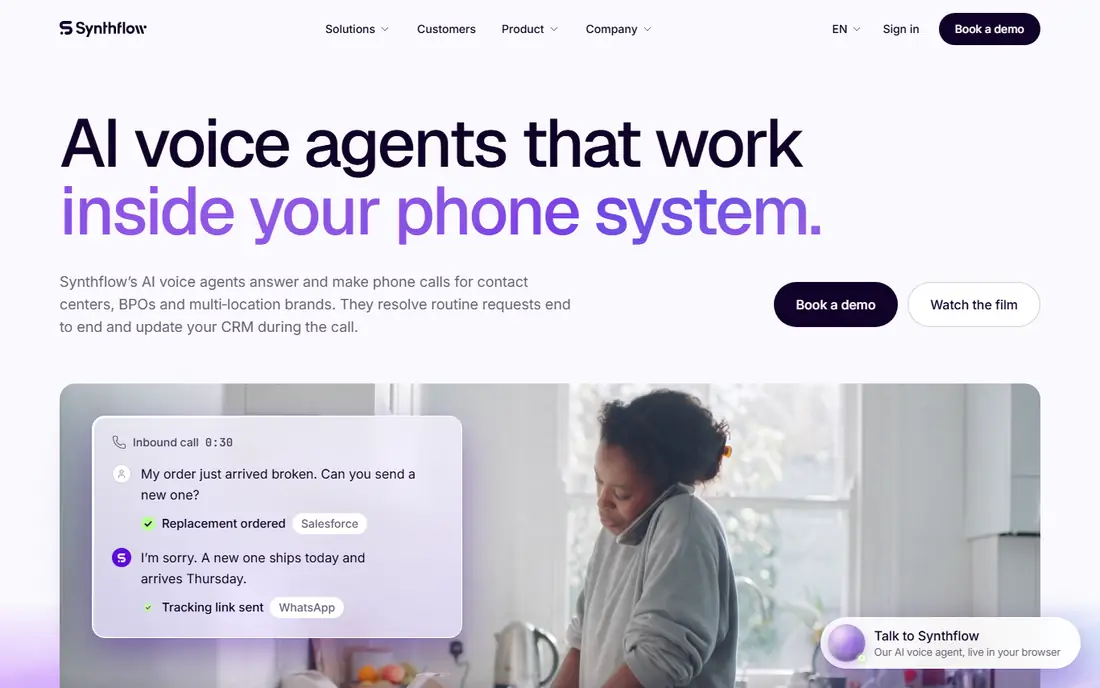
Synthflow is aimed squarely at non-technical operators who require a voice agent without code. The integration catalog covers the CRMs and calendars that matter for appointment and lead workflows.
Where it is weaker: less customization than API-first tools.
What users get: quick deployment for solo operators and agencies.
In practice, you pay for the convenience in per-minute rates that run higher than developer systems. For everyday use, high-volume teams should compare total cost against Retell or Vapi. On cost, Synthflow starts like this: From $29/month. Trial and free access: Free trial.
- In-house telephony
- Visual no-code builder
- White-label agencies should check margins
CloudTalk
Ideal for: Teams that want AI call handling inside a complete business phone system
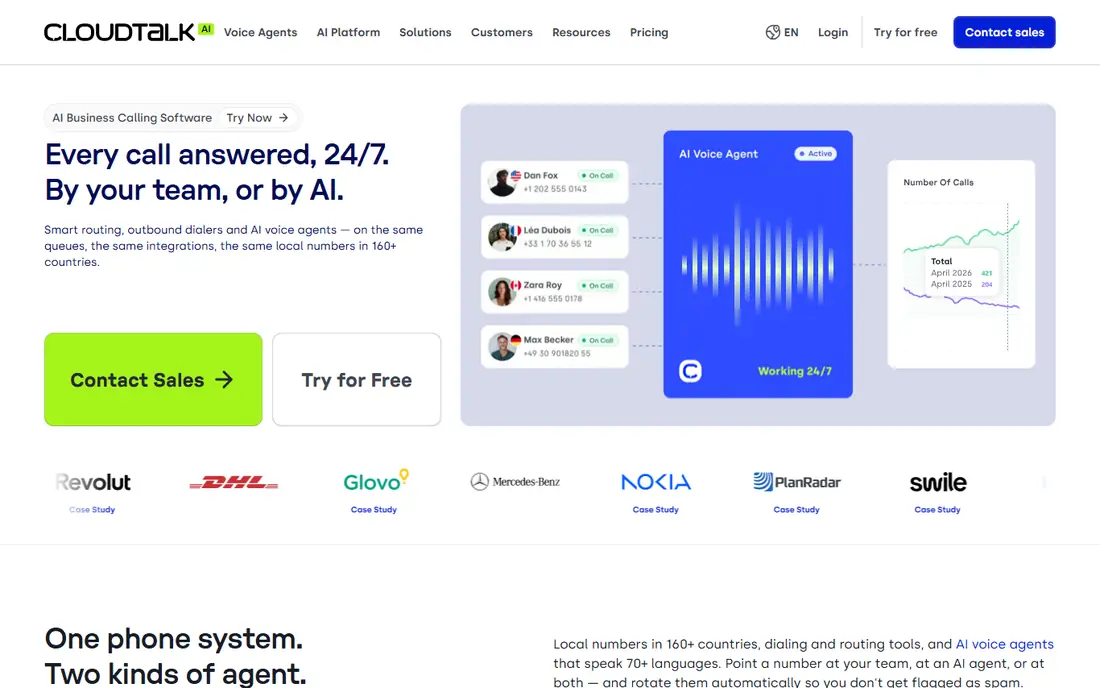
Where CloudTalk fits: teams that want AI call handling inside a complete business phone system. CloudTalk approaches from the opposite direction: it is a business phone system first, with AI agents as a step in the call flow. Worth adding: if you do not need a phone system, you are paying for one.
Drawbacks to consider: less programmable than API tools; per-seat costs add up for agent-heavy use.
More specifically, pure agent builders should look at the API-first tools instead. CloudTalk makes sense when the AI agent lives inside existing calling workflows. What you pay to start with CloudTalk: From 25 EUR/user/month. Free plan details: Free trial (14 days).
- AI Receptionist with free starter minutes
- Familiar per-seat pricing
- Not a standalone agent product
Vapi
Ideal for: Engineering teams that want full control over their voice stack
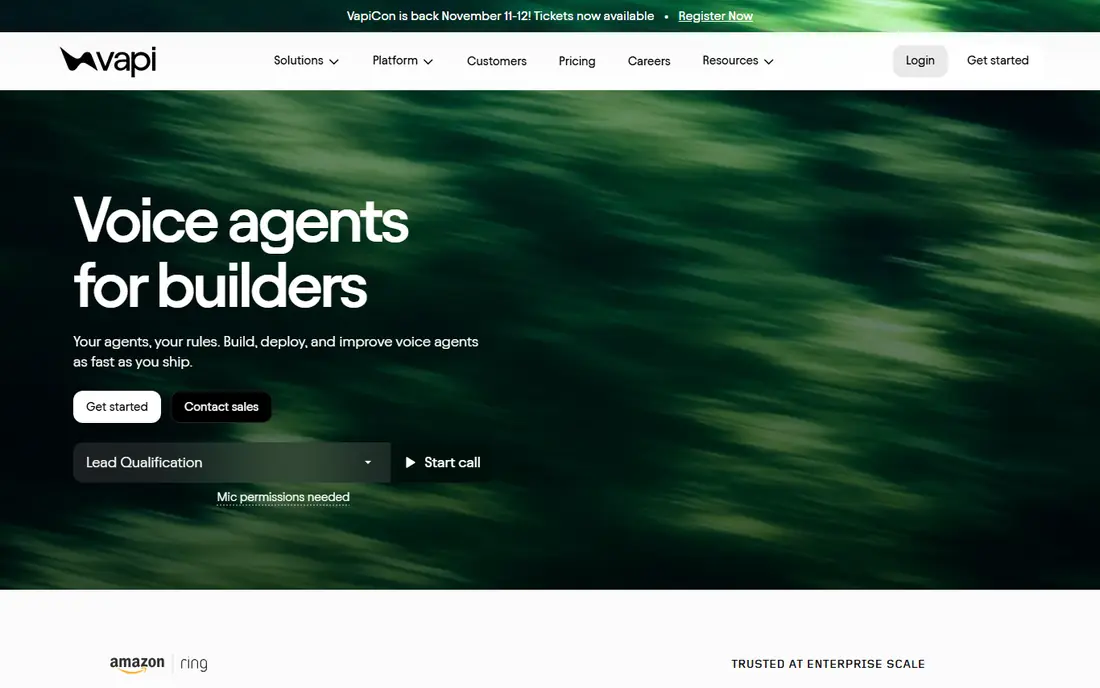
Vapi makes the most sense for engineering teams that want full control over their voice stack. For engineering teams with opinions about latency and voice quality, that control is the entire appeal. Worth adding: Vapi is the composable choice: you pick the speech-to-text, the language model, the voice and the carrier, and Vapi orchestrates them.
Also, choose something managed when you want a vendor to own the quality. Beyond that, choose Vapi when voice is a core product surface and you have engineers to own it. What you pay to start with Vapi: $0.05/min platform fee plus pass-through model and telephony costs. Trial and free access: $10 free credits.
Strengths: adaptable telephony choices. The main drawbacks: Real all-in costs run higher than the headline rate.
- Bring-your-own everything for STT
- Solid developer docs and community
- You assemble and maintain the stack
Goodcall
Ideal for: Local service firms that require every call answered
Think of Goodcall for local service firms that require every call answered. Goodcall is the anti-platform play: one job, done well.
Where it is weaker: Not programmable like developer systems.
For its target customer, that simplicity is the product. More specifically, there is no API to build custom call flows and no BYO-model adaptability. The starting price for Goodcall: From $79/month. Free options: Free trial.
- No-code setup in minutes
- Designed for plumbers
- Restricted to reception-style use cases, smaller integration catalog
Retell AI
Ideal for: Production voice applications where predictable pricing matters
Where Retell AI fits: production voice applications where predictable pricing matters. The complexity caveat is real.
Main advantages: Itemized per-minute pricing.
Worth adding: Retell AI sits between Vapi's raw composability and the no-code tools: still developer-led, but with more of the stack managed for you. Retell AI cost at the entry level: $0.07 to $0.31/min depending on configuration. Free access: $10 free credits.
Where it is weaker: support depth varies by plan; developer-led instead of no-code.
- Quick setup for a developer tool
- Decent latency characteristics
- Pricing gets complicated when stacking LLM, TTS and telephony
Thoughtly
Ideal for: AI voice agents for opted-in lead re-engagement and follow-up
Thoughtly makes the most sense for AI voice agents for opted-in lead re-engagement and follow-up. Thoughtly concentrates on the revenue side of voice AI: re-engaging cold leads, following up on quotes and running opted-in outbound with CRM sync in both directions.
Where it falls short: smaller ecosystem than leaders.
Highlights: voicemail detection and handling. On top of that, the voicemail detection and drop handling display a product built by people who have run real outbound campaigns. On top of that, Thoughtly is not a general agent builder; it is a revenue follow-up tool with voice AI inside. Thoughtly pricing: Custom per-minute pricing. On free options: Free trial.
- Native bidirectional CRM links
- Natural turn-taking
- Custom pricing needs a sales conversation, narrower use-case focus
Bland AI
Ideal for: High-volume programmable outbound calling
Bland AI makes the most sense for high-volume programmable outbound calling. For outbound sales and collections teams with engineering support, it is purpose-built. Also, owning its LLM, STT and TTS stack hands it control over the full pipeline.
Points against: Inbound latency and support get mixed reviews, developer-heavy setup.
The deployment choices bundle on-prem for regulated buyers. As for the details, Bland AI made its name on outbound: programmable AI callers that dial at volumes traditional dialers cannot touch. Bland is an outbound specialist first. Price to start with Bland AI: From $0.14/min. On free options: Free trial.
- Programmable API for custom call flows
- Owns much of its voice stack
- Pricing opacity at enterprise levels
A practical way to choose AI voice agent platforms
Every AI voice agent decision comes down to two questions. First, who builds it: your engineers or your operators? In practice, developer products provide you control over every component and bill per minute.
No-code systems get you live in an afternoon and bill per agent or a month. Second, what kind of calls: inbound service, outbound sales, or appointment-style reception work?
What went into this list
For each of the 7 tools we noted price, free plan or trial, fit for AI voice agent platforms and the main limit, using vendor pages and documentation. Where a price is missing, the vendor does not list one publicly or ties it to a quote. Always confirm before budgeting. The sequence is a judgement call: typical use case first, then pricing transparency, then free access. Use the profiles to check fit.
What to check before you buy
- Confirm the entry price on the vendor page: Synthflow starts at $29/month, but seat counts and billing terms change the total.
- Use real work to test the free trial from Synthflow, CloudTalk, Goodcall and others, rather than a demo project.
- Before choosing Synthflow, weigh its main limit: more costly per minute than developer products, less customization than API-first tools, white-label agencies should check margins.
- Let daily users try Goodcall on real work; their feedback beats any feature checklist.
- Before rolling out Synthflow, verify the integrations your workflow depends on.
Frequently asked questions
Can I try these options before paying?
Often, yes. Synthflow, CloudTalk, Goodcall and others offer a free trial. Use your own data and a real task during the test, and check what the free tier or trial limits before you rely on it.
Does any tool for AI voice agent platforms here have a free plan?
No tool in this list, Synthflow and Bland AI included, has a permanent free plan. Synthflow, CloudTalk, Goodcall, Thoughtly, Bland AI offer a trial. Trials and quotes are the usual route, so plan a short evaluation period.
How are the tools for AI voice agent platforms ordered?
The order follows typical fit for AI voice agent platforms, with Synthflow first and Bland AI last, then price clarity and free access. It is editorial judgement, not a score, so another team could rank the tools differently.
What is the cheapest option for AI voice agent platforms in this list?
On published monthly entry prices, Synthflow is the lowest here at $29/month. Entry price is only part of the cost, because seats, add-ons and billing terms can change the total.