Best AI Voice Agents for Customer Service

- 1
 VapiDevelopers building custom voice agentsVisit
- 2
 Bland AIHigh volume outbound and inbound callsVisit
- 3
 Retell AILow volume lines with no monthly feeVisit
- 4
 Synthflow AIEnterprise voice agents at scaleVisit
- 5
 ElevenLabsCheapest entry with voice qualityVisit
- Vapi is the best pick for teams that want to build a custom voice agent, with a Core package from $29 per month plus $0.05 per minute of hosting.
- Retell AI has the lowest per minute rate here at $0.07 per minute, with no monthly fee, which suits low volume support lines.
- Bland AI suits outbound and high volume calling, but its lowest Build tier starts at $299 per month plus $0.12 per minute.
- ElevenLabs is the cheapest entry point at $5 per month on annual billing, and its free tier includes 15 agent minutes per month.
- Synthflow AI, Air AI, PolyAI and Cognigy target larger operations, and three of the four do not publish a price, so expect a sales conversation.
Quick comparison
| Product | Ideal for | Price from | Free version | |
|---|---|---|---|---|
| Vapi | Developers building custom voice agents | $29 per month (plus $0.05 per minute) | Free trial ($5 in credits) | Visit |
| Bland AI | High volume outbound and inbound calls | $299 per month (plus $0.12 per minute) | Yes | Visit |
| Retell AI | Low volume lines with no monthly fee | $0.07 per minute | Free trial ($10 in credits) | Visit |
| Synthflow AI | Enterprise voice agents at scale | $2,500 per month (billed annually) | No | Visit |
| ElevenLabs | Cheapest entry with voice quality | $5 per month (billed annually) | Yes | Visit |
 Air AI | Long sales and support conversations | quote only | No | Visit |
 PolyAI | Large contact centres | quote only | No | Visit |
 Cognigy | Enterprise contact centres | quote only | No | Visit |
The best AI voice agents for customer service
Vapi
Ideal for: Developers building custom voice agents
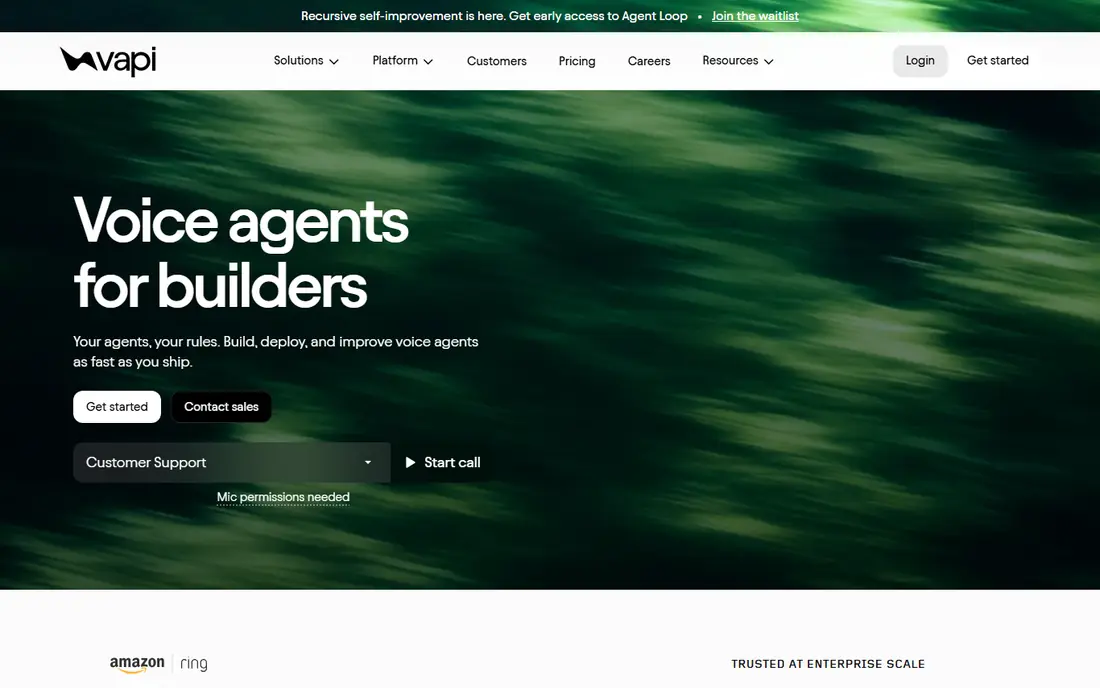
Vapi is a developer platform for building voice agents, and it gives a support team more control than any other tool in this list. You pick the speech to text model, the language model, the voice and the phone provider, then connect the agent to your CRM, helpdesk or booking system through functions and webhooks. The agent can answer common questions, check an order status, book an appointment and hand off to a human when a call goes beyond its script. That control is the main reason teams choose Vapi over a closed product.
The Core package costs $29 per month and includes hosting at $0.05 per minute, with model and telephony costs on top, so a team handling 1,000 calls a month should budget well above the $29 base. There is no free plan, only $5 in free credits to test with. Vapi suits a team with a developer on staff that wants a voice agent shaped exactly around its own support flows, and it is a poor fit for a team that wants a finished product with no code.
- Full control over prompts, models and phone numbers
- Large developer community and ready made examples
- Needs code to get the most from it
- Per minute costs add up fast on long calls
Bland AI
Ideal for: High volume outbound and inbound calls
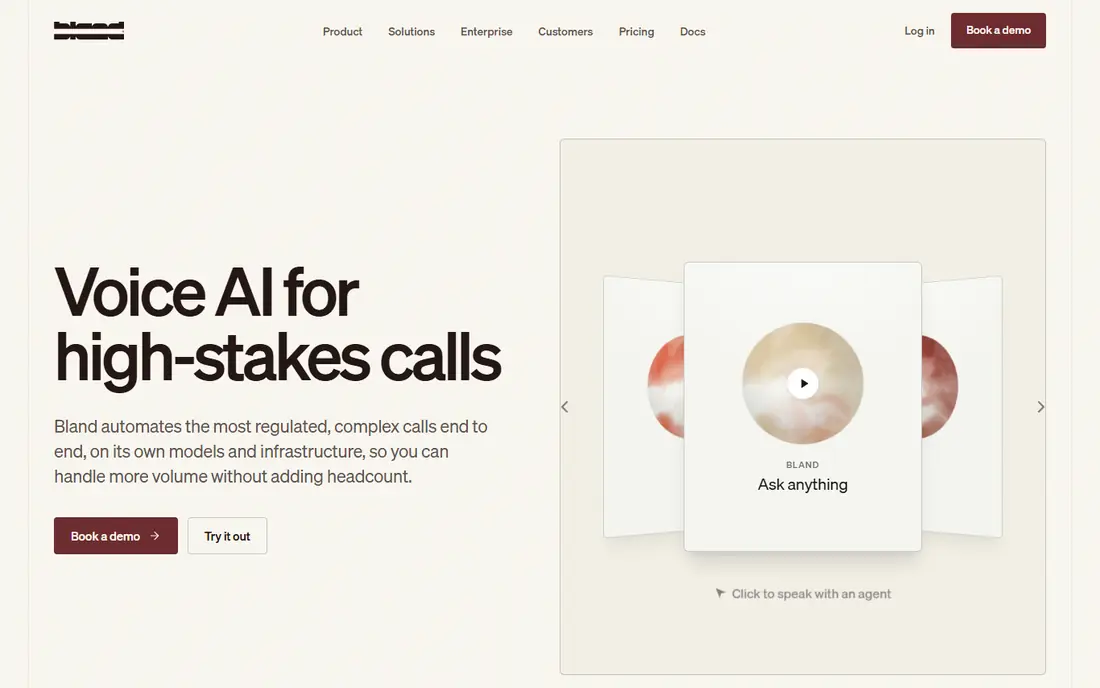
Bland AI is built for volume. Its agents answer inbound calls, make outbound calls, book meetings and follow up by SMS, and the platform is designed to run thousands of calls a day without a team managing servers. The Start tier is free, which lets a small team test call quality before committing, and the API covers the common tasks such as transferring a call, sending a text after a call and logging the result to a CRM. For a support team that also runs appointment reminders or payment follow ups, Bland AI covers both directions of the phone line in one tool.
The catch is the price. The Build tier, the lowest tier with real usage, costs $299 per month plus $0.12 per minute, so 1,000 minutes of calls adds $120 on top of the subscription. At that rate Bland AI costs more per minute than Retell AI or Vapi, and the free Start tier includes no free minutes. Bland AI is the right pick for a business that runs high call volumes and can spread the $299 base across thousands of minutes, and it is too expensive for a small support line with a few hundred calls a month.
- Free Start tier to test with
- Handles very high call volumes without extra setup
- Lowest Build tier costs $299 per month
- Per minute rate is the highest in this list
Retell AI
Ideal for: Low volume lines with no monthly fee
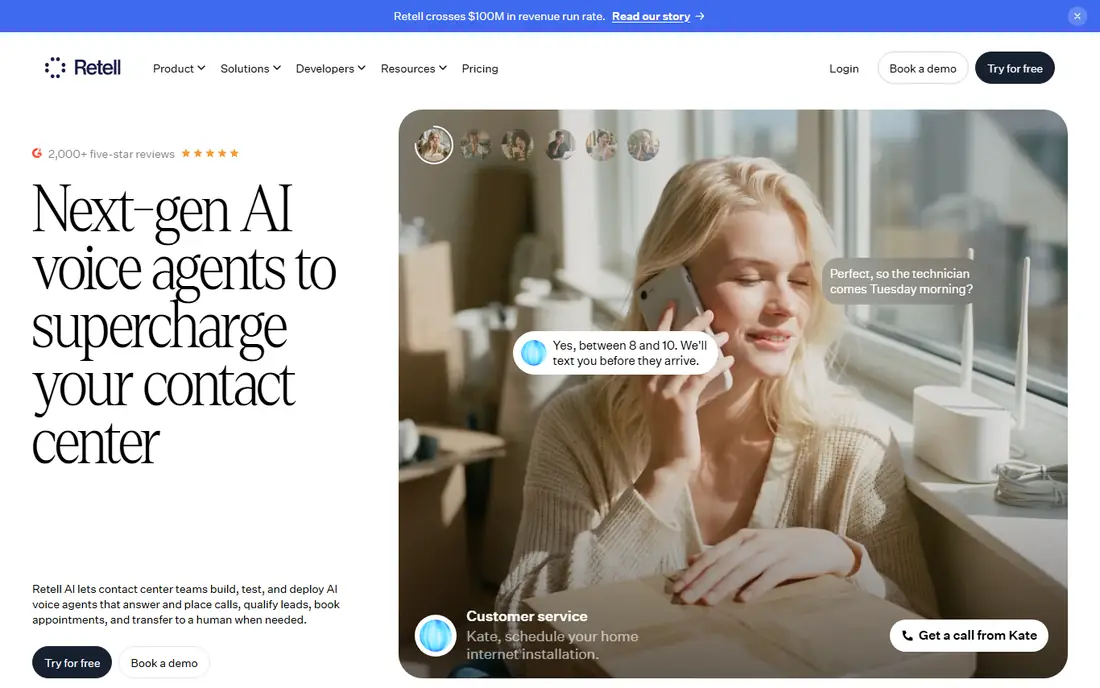
Retell AI charges per minute and nothing else, which makes it the simplest pricing in this list. Calls start at $0.07 per minute, and the rate rises to $0.31 per minute for the most advanced models and voices, so a team can start on the cheapest tier and move up only when call quality demands it. The platform includes a visual agent builder, call transfer, voicemail detection and integrations with common CRMs, and its voices are built for low latency, so callers do not wait through long pauses between sentences. For a small support line, the absence of a monthly fee is a real advantage.
The trade off is that there is no free plan, only $10 in credits to test with, and the cheapest $0.07 rate uses the basic models. A team that wants the best voices will pay closer to the top of the range, and at that level the cost per call can match or pass the monthly plans of other tools. Retell AI suits a support line with uneven call volume, where some weeks are quiet and others are busy, because the bill follows actual usage instead of a fixed monthly charge.
- No monthly fee, you only pay per minute
- Low latency voices that sound natural
- No free plan, only $10 in free credits
- Advanced features need higher usage tiers
Synthflow AI
Ideal for: Enterprise voice agents at scale
Synthflow AI is a no code platform for building voice agents, aimed at larger teams that need many agents running at once. The builder lets a support manager create an agent, connect it to a calendar, CRM or helpdesk, and watch call transcripts and analytics without writing code. The analytics cover call outcomes, common questions and agent performance, which helps a team spot the topics that still need a human. For a business that wants to roll out voice agents across several departments, Synthflow AI gives one place to build, deploy and measure them all.
The price puts it out of reach for small teams. Enterprise plans start at $30,000 per year, which works out to about $2,500 per month on annual billing, and there is no free plan or published trial. Synthflow AI is a solid pick for a mid size or large company that can justify the spend across several use cases, such as support, scheduling and outbound follow up, and it is not a fit for a small business that wants a single voice agent at a low monthly cost.
- No code builder with strong call analytics
- Built for teams running many agents at once
- Enterprise pricing starts at $30,000 per year
- No free plan or trial published
ElevenLabs
Ideal for: Cheapest entry with voice quality
ElevenLabs is best known for text to speech, and its conversational AI product brings the same voice quality to support calls. The Starter plan costs $5 per month on annual billing, or $6 per month billed monthly, and the free tier includes 10,000 credits and 15 agent minutes per month, so a small team can test a real agent on real calls before spending anything. The agent can answer questions from a knowledge base, take a booking and transfer a call, and the voices are the most natural sounding in this list, which matters when callers judge a business by the voice that answers.
The catch is that conversational AI minutes cost extra, at $0.08 to $0.11 per minute depending on the plan, so the $5 plan is only the starting point. A team handling 500 minutes a month would add $40 to $55 in usage fees, and the free tier runs out after 15 agent minutes. Even with that, ElevenLabs is the cheapest way into a voice agent that sounds genuinely human, and it suits a small business that wants a polished voice on its support line without a large monthly bill.
- Best sounding voices in this list
- Free tier includes 15 agent minutes per month
- Conversational AI minutes cost extra on top of the plan
- Agent minutes on the free tier are limited
Air AI
Ideal for: Long sales and support conversations
Air AI builds voice agents that can hold long conversations, and it is marketed for sales and support calls that run for many minutes. The agents can ask follow up questions, handle objections and keep a conversation on track, which suits support calls where the issue takes time to explain. The platform is phone first, with tools for call recording, transcripts and CRM logging, so a team can review what the agent said and how each call ended. For a business that takes long support calls, Air AI is one of the few tools built for that length.
The problem is transparency. Air AI does not publish a price, and there is no free plan or trial listed, so a team cannot budget for it without a sales call. Air AI suits a larger team with a budget for a sales led purchase and a need for long form voice agents, and it is a weak fit for a team that wants to test a tool and know the cost up front.
- Agents can hold long, unscripted conversations
- Built for phone first teams
- No published price, so costs are unclear
- No free plan or trial to test with
PolyAI
Ideal for: Large contact centres
PolyAI is an enterprise voice agent platform used by large contact centres, and its strength is scale and language coverage. The agents handle calls in many languages, understand accents and background noise better than most tools here, and integrate with the contact centre software that large teams already use. For a global business with support lines in several countries, PolyAI can run one agent across languages instead of a separate setup per market. Its case studies focus on large deployments, which tells a small team most of what it needs to know about who it is built for.
Pricing is quote only and per minute at enterprise rates, with no free plan or trial published, so a team must go through sales to get a number. PolyAI is the right pick for a large contact centre that needs multilingual agents and has the budget for an enterprise contract, and it is not a fit for a small support team that wants a self serve tool with a published price.
- Strong multilingual support for global teams
- Proven in large contact centre deployments
- Quote only pricing aimed at enterprise
- No free plan or trial for small teams
Cognigy
Ideal for: Enterprise contact centres
Cognigy is a conversational AI platform for enterprise contact centres, and it covers voice and chat in one system. Its design tools let a team build complex call flows with branching logic, connect to back end systems through APIs and hand off to a human agent with full context. The platform also includes analytics that show where callers drop off and which intents the agent handles well, which helps a large team improve its agents over time. For a company that already runs a large contact centre, Cognigy fits into the existing stack rather than replacing it.
Like the other enterprise tools here, Cognigy does not publish a price, and there is no free plan, only a demo. Cognigy suits a large organisation with a contact centre team and a budget for a platform purchase, and it is not a fit for a small business that wants a voice agent running this week at a known monthly cost.
- Deep integration with enterprise contact centre tools
- Strong conversational design tools
- Quote only pricing with no published starting point
- No free plan, demo only
Which tool fits your call volume
| Monthly call minutes | Best pick | Why | | Under 200 | ElevenLabs free tier | 15 free agent minutes per month, then $5 per month plus usage | | 200 to 1,000 | Retell AI | $0.07 per minute with no monthly fee keeps the bill low | | 1,000 to 5,000 | Vapi | $29 per month plus $0.05 per minute beats per minute only pricing at this volume | | 5,000 to 20,000 | Bland AI | $299 per month base spreads well across high volume | | Over 20,000 | Synthflow AI or PolyAI | Enterprise tools with analytics and multilingual support justify the contract |
How we chose
We compared the vendor pricing pages, product docs and feature lists for eight voice agent platforms, checking the starting price, the free plan or trial, the per minute rate and the setup effort. We looked at whether each tool publishes a price, whether it needs code, and whether it suits inbound support, outbound calls or both. We did not run live test calls, and we did not claim hands on results. Prices are from the vendor pricing pages checked on 2026-11-11, and quote only means the vendor does not publish a price.
What to check before you buy
Check the total cost per call, not just the monthly price, because per minute fees, model fees and telephony fees add up. Test the voice on a real phone line, since a voice that sounds good on a laptop can sound thin on a mobile call. Ask how the agent hands off to a human, and what context the human sees when the call transfers. Confirm which languages your callers use are covered, and whether the tool logs calls to your CRM. Read the data terms, since call recordings and transcripts may be stored in a region your business does not accept. Finally, run a small pilot with real callers before you move your main support line.
Frequently asked questions
How much does an AI voice agent cost per month?
A small support line can start for $5 to $29 per month plus usage, using ElevenLabs or Vapi, while a mid size team should budget $100 to $500 per month once per minute fees are included. Enterprise tools such as Synthflow AI start near $2,500 per month, and PolyAI and Cognigy are quote only. The honest way to compare is to multiply your monthly call minutes by the per minute rate, then add the monthly fee.
Can an AI voice agent replace my support team?
No, and it should not. A voice agent handles the common, repeatable calls, such as order status, opening hours and booking changes, and it passes the rest to a human. Teams that get the best results use the agent to clear the queue of simple calls, so human agents have more time for the calls that need judgement, empathy or a decision the agent cannot make.
Do these tools work with my CRM or helpdesk?
Most of them do. Vapi, Retell AI and ElevenLabs connect through APIs and webhooks, Bland AI and Synthflow AI list CRM integrations in their docs, and the enterprise tools integrate with contact centre software. Before you buy, check that your exact CRM is listed, and ask whether the integration is included in the plan you would buy or needs a higher tier.
What happens when a caller asks something the agent cannot answer?
A good agent transfers the call to a human and passes the transcript so the caller does not repeat the story. Ask each vendor how the handoff works, whether the caller can ask for a human at any point, and whether the agent can take a message and a callback number when no human is free. A tool that traps callers in a loop will cost you more in lost customers than it saves in minutes.
How long does it take to set up an AI voice agent?
A no code tool such as ElevenLabs or Synthflow AI can take a first call within a day if the knowledge base is ready. A developer platform such as Vapi takes longer, often one to two weeks, because the team must write the prompts, connect the systems and test the flows. Enterprise tools such as Cognigy can take a month or more, since they involve design, integration and training.