AIOps Platforms in 2026: A Guide to 7 Tools

- 1
 BMC Helix AIOpsBMC shops modernizing operationsVisit
- 2
 ServiceNow ITOMServiceNow customers unifying ops and ITSMVisit
- 3
 DatadogCloud-native teams consolidating toolsVisit
- 4
 Splunk ITSISplunk shops adding service intelligenceVisit
- 5
 DynatraceEnterprises wanting deterministic root causeVisit
- BMC Helix AIOps takes the first slot, best suited to BMC shops modernizing operations.
- 2 of 7 tools offer a free plan: Datadog, PagerDuty.
- The lowest published monthly entry price here is $15 per host/month, from Datadog.
- LogicMonitor is the one to check for hybrid infrastructure and MSPs.
- Splunk ITSI comes with a trade-off: pricing is quote-based and historically pricey at data scale.
Direct answer
BMC Helix AIOps leads the list, best for BMC shops modernizing operations. ServiceNow ITOM fits ServiceNow customers unifying ops and ITSM; Datadog fits cloud-native teams consolidating tools. The other 4 tools in the list cover narrower or pricier cases.
Quick comparison
| Product | Ideal for | Price from | Free version | |
|---|---|---|---|---|
| BMC Helix AIOps | BMC shops modernizing operations | See website | No | Visit |
| ServiceNow ITOM | ServiceNow customers unifying ops and ITSM | See website | No | Visit |
| Datadog | Cloud-native teams consolidating tools | $15 per host/month (Pro, billed annually) | Yes | Visit |
| Splunk ITSI | Splunk shops adding service intelligence | See website | Free trial (14 days) | Visit |
| Dynatrace | Enterprises wanting deterministic root cause | See website | Free trial (15 days) | Visit |
 PagerDuty | On-call teams adding AIOps to incident response | $21 per user/month (Professional, billed yearly) | Yes | Visit |
 LogicMonitor | Hybrid infrastructure and MSPs | $16 per Hybrid Unit/month (LM Essentials) | Free trial (14 days) | Visit |
Every option for AIOps platforms explained
If you are comparing AIOps platforms, this page covers 7 tools in one place: what each is best for, what it costs to start, whether it has a free plan, and the main limit to know about.
BMC Helix AIOps
Ideal for: BMC shops modernizing operations
BMC Helix AIOps is designed for BMC shops modernizing operations. BMC Helix AIOps brings service modeling discipline to AI-driven operations. The system makes most sense inside a BMC estate: paired with Helix Discovery, ITSM, and automation, it becomes a genuinely proactive operations loop.
Watch-outs: Full value needs the wider BMC Helix ecosystem.
Also, instead of correlating raw events, it builds dynamic service models from discovery data, then applies ML-based causal analysis to isolate root cause within the service topology. Bought standalone and bolted onto external tools, it is competent but less differentiated. Beyond that, the predictive side forecasts service outages from health trends, giving SRE teams a chance to act before users notice. It runs as SaaS or on-premises, which matters for regulated industries. This comparison lists no price for BMC Helix AIOps; ask the vendor. BMC Helix AIOps has no permanent free option.
- Outage prediction from health indicators
- Service-centric event correlation with knowledge-graph root cause isolation
- Quote-only pricing
ServiceNow ITOM
Ideal for: ServiceNow customers unifying ops and ITSM
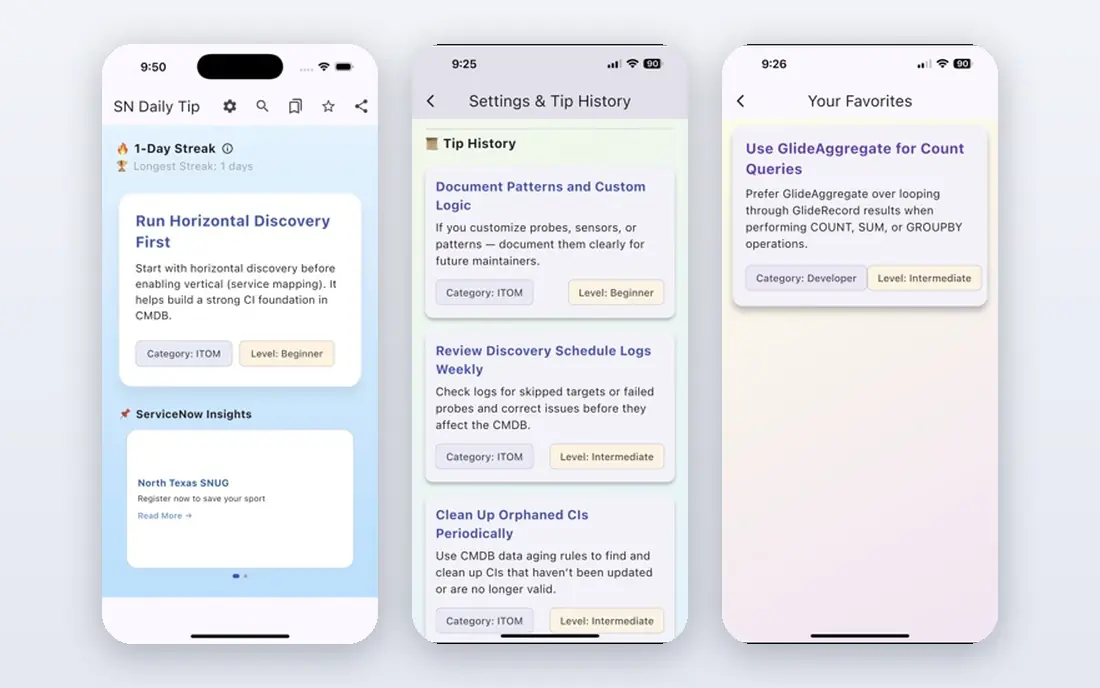
ServiceNow ITOM makes the most sense for ServiceNow customers unifying ops and ITSM. ServiceNow's Predictive AIOps is the AIOps story for the million-plus organizations already running the Now Platform. In daily use, since it lives inside ServiceNow, correlated incidents flow straight into incident, problem, and change workflows without integration projects.
What to check first: Enterprise pricing with high minimums.
It also assumes a healthy CMDB and service mapping practice; without those, the AI has thin context to work with. But if ServiceNow is already your system of record, adding Predictive AIOps is normally less expensive than introducing a fourth platform. This comparison lists no price for ServiceNow ITOM; ask the vendor. There is no free plan with ServiceNow ITOM.
- Remediation workflows run where tickets already live
- Predictive AIOps with Health Log Analytics cuts event noise dramatically
- Value relies on ServiceNow maturity
Datadog
Ideal for: Cloud-native teams consolidating tools
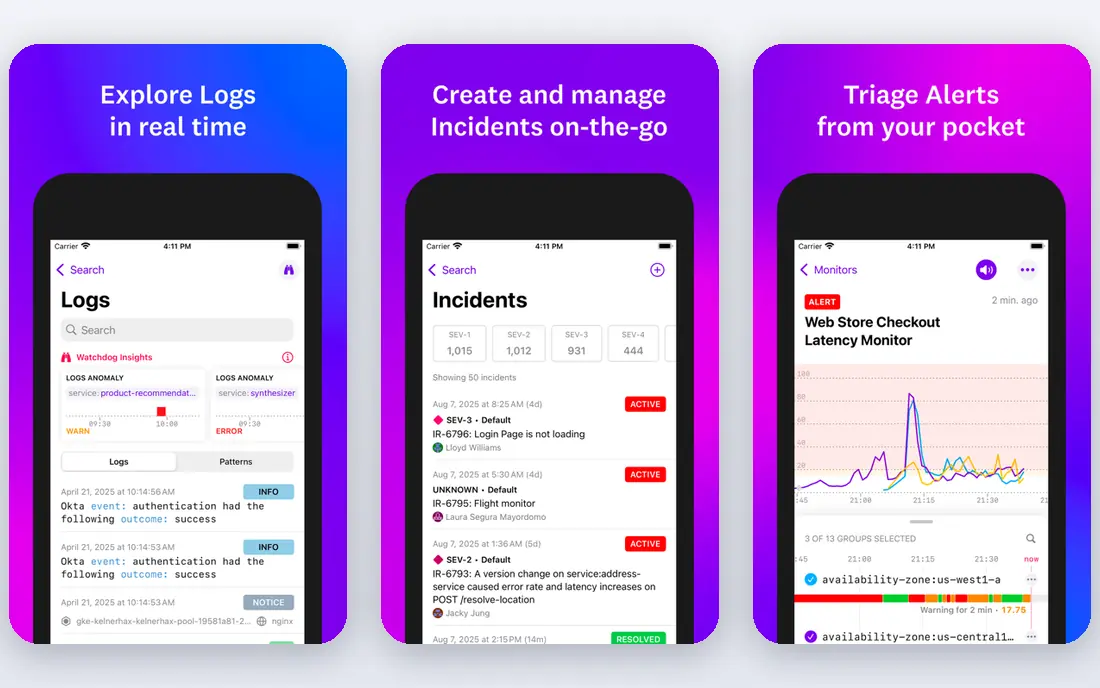
Choose Datadog for cloud-native teams consolidating tools. Infrastructure at $15 per host a month is just the entry ticket. APM, logs, RUM, and synthetics each carry their own meter, and hosts are billed at the monthly peak, so a traffic spike sets your entire month's rate.
Also, the bill is the recurring complaint, and it is a fair one. Watchdog flags anomalies across everything flowing into the product without manual threshold tuning, whereas Bits AI agents can investigate an incident, pull related telemetry, and suggest a cause. From a buyer's view, if your team already lives in Datadog dashboards, these capabilities feel like a natural extension. For everyday use, set up billing alerts early and treat observability spend like cloud spend: budgeted and reviewed. Starting cost for Datadog: $15 per host/month. You can start on Datadog without paying.
Where it falls short: Per-product meters stack up quick at scale.
- More than 800 integrations and one UI for metrics, logs, traces, RUM
- Bits AI agents help investigate incidents
- Log indexing costs force hard retention tradeoffs
Splunk ITSI
Ideal for: Splunk shops adding service intelligence
Splunk ITSI works best for Splunk shops adding service intelligence. Splunk IT Service Intelligence is the AIOps layer for organizations already running Splunk. Treat ITSI as an upgrade to an existing investment, not a first purchase.
Honest limits: Pricing is quote-based and historically costly at data scale.
For everyday use, ITSI applies machine learning to the logs, metrics, and events already flowing into Splunk: adaptive thresholding, anomaly detection, and service-level KPI modeling that rolls hundreds of underlying signals into a single health score per business service. The main limit is that Splunk pricing has always been data-volume driven, and ITSI does not change that equation. Worth adding: if you are not a Splunk shop, there is little reason to become one just for ITSI. Splunk ITSI shows no starting price here, so confirm the cost on the vendor site. Trial and free access: Free trial (14 days).
- Capable service topology and KPI modeling
- Predictive ML analytics on top of the Splunk data you already collect
- Best value needs existing Splunk investment
Dynatrace
Ideal for: Enterprises wanting deterministic root cause
Pick Dynatrace if this describes you: enterprises wanting deterministic root cause. For large shops running hundreds of microservices, that determinism matters: responders trust the answer and act on it. Its Davis AI engine works from a continuously updated map of your environment, so when something breaks it can trace the causal chain and name the actual root cause instead of handing you a probability ranking.
On top of that, the honest catch is the pricing model. As for the details, run the 15-day trial with production-like traffic, watch the consumption dashboard daily. You will know what the contract should look like. Dynatrace does not show a starting price in this comparison, so check the vendor site for current pricing. Trial and free access: Free trial (15 days).
- Causal Davis AI provides one likely root cause rather than a ranked guess list
- Automatic topology mapping with OneAgent
- Usage-based DPS pricing is hard to forecast without a trial
PagerDuty
Ideal for: On-call teams adding AIOps to incident response
PagerDuty is a good fit for on-call teams adding AIOps to incident response. PagerDuty approaches AIOps from the response side instead of the monitoring side. Its core job is still the best on-call scheduling and escalation engine in the business.
Points against: AIOps is a premium add-on.
The AIOps add-on layers intelligent alert grouping and noise suppression on top of the 700-plus integrations feeding it. In daily use, the result: fewer pages, and the pages that do fire arrive with context. Pricing deserves a careful read. That said, if your primary pain is paging instead of detection, PagerDuty's AIOps is the shortest path from alert storm to a quiet phone. Entry price for PagerDuty: $21 per user/month. A free plan is available with PagerDuty.
- AIOps grouping cuts alert noise before paging
- 700+ integrations and mature automation
- Per-seat pricing punishes large responder groups
LogicMonitor
Ideal for: Hybrid infrastructure and MSPs
In short, LogicMonitor is for hybrid infrastructure and MSPs. The pricing model changed recently to Hybrid Units, a normalized measure across resource types, with LM Essentials starting at $16 per unit a month, Advanced at $27, and Signature with Edwin AI at $53. That is transparent once you map your estate to units, but the mapping exercise is the work.
Ask for a sizing workshop before signing. Also know that deep APM and log analytics are separate services, so budget beyond the base monitoring price. Worth adding: LogicMonitor has quietly become the hybrid-infrastructure specialist, and its Edwin AI assistant is the current differentiator. From a buyer's view, the system discovers devices, cloud resources, Kubernetes pods, and network gear without agents, then Edwin helps operators investigate alerts, forecast capacity, and understand service impact in plain language. Entry price for LogicMonitor: $16 per Hybrid Unit/month. Trial and free access: Free trial (14 days).
Where it is weaker: APM and log analysis are extras to the core product.
- Agentless auto-discovery covers on-prem and cloud uniformly
- Edwin AI assists with troubleshooting and forecasting
- New Hybrid Unit pricing model takes effort to map to your estate
Our selection method
Ainotely looked at what each vendor publishes: pricing, plan limits, feature coverage for AIOps platforms and stated drawbacks. No hands-on testing is claimed. Plan names, prices and limits change often. Treat the figures here as a starting point and verify them with the vendor. The sequence is a judgement call: typical use case first, then pricing transparency, then free access. Use the profiles to check fit.
Things to verify first
- Confirm the entry price on the vendor page. For BMC Helix AIOps, ServiceNow ITOM, Splunk ITSI and Dynatrace that means a quote rather than a fixed price.
- Check what the free option really includes: Datadog and PagerDuty offer a free plan, and usage caps differ.
- Take the trial from Splunk ITSI, Dynatrace and LogicMonitor and push a live task through it before you pay.
- Read the limits listed for BMC Helix AIOps first: quote-only pricing.
- Check whether the features you need in LogicMonitor sit on the entry plan or only on higher tiers.
- The entry price of ServiceNow ITOM is only the starting point; model the full cost with seats and extras.
Frequently asked questions
Which options for AIOps platforms have a free plan?
On this list, Datadog and PagerDuty include a free plan. Caps on seats, usage or features are common, so test the free plan against your real workload. Several others offer a trial instead.
Do these tools publish their prices?
Not all of them. BMC Helix AIOps, ServiceNow ITOM, Splunk ITSI and Dynatrace publish no starting price, so expect a quote request for those. The rest, Datadog included, show a starting price, though seats and billing terms still change the final cost.
What is the cheapest option for AIOps platforms in this list?
On published monthly entry prices, Datadog is the lowest here at $15 per host/month. Entry price is only part of the cost, because seats, add-ons and billing terms can change the total.
Can I try these options before paying?
Often, yes. Datadog and PagerDuty have a free plan and Splunk ITSI, Dynatrace and LogicMonitor offer a free trial. Use your own data and a real task during the test, and check what the free tier or trial limits before you rely on it.