7 Best Anonymous Chat Apps for Private Conversations

- AntiLand is the best all-round pick, with topic rooms, one-to-one chats, and AI moderation.
- Wakie suits voice conversations, where you choose who to talk to rather than being matched at random.
- Yik Yak fits college communities, with anonymous local posts rather than private chats.
- Chatous, OmeTV, and Azar offer random text or video chats, which carry higher exposure risks than moderated rooms.
- Connected2.me suits casual chatting with people worldwide through profiles and follow features.
- Anonymous does not mean safe: never share your real name, address, school, workplace, photos, or payment details with strangers.
- Use block, mute, and report tools at the first sign of harassment, and leave any conversation that feels wrong.
Quick comparison
| Product | Ideal for | Price from | Free version | |
|---|---|---|---|---|
 AntiLand | Topic-based anonymous rooms and one-to-one chats | Free to use | Yes | Visit |
 Chatous | Random text and video chats matched by interest | Free to use | Yes | Visit |
 Yik Yak | Anonymous local posts within college communities | Free to use | Yes | Visit |
 Wakie | Voice conversations with people you choose | Free to use | Yes | Visit |
 Connected2.me | Casual chatting and meeting people worldwide | Free to use | Yes | Visit |
 OmeTV | Free random video chat with people worldwide | Free to use | Yes | Visit |
 Azar | Random video chat with people around the world | Free to use | Yes | Visit |
The best anonymous chat apps
AntiLand
Ideal for: Topic-based anonymous rooms and one-to-one chats
AntiLand is a privacy-first platform where you pick a nickname and start chatting, with no phone number or real name required. It offers thousands of public rooms across interest categories, plus one-to-one chats and small group chats, with AI moderation, content filters, and human review behind the scenes.
AntiLand is our pick for most readers because it combines choice with control: you pick the room, you set the pace, and you can block, mute, or report in one tap. Its safety pages state a zero-tolerance policy for abuse, though no moderation system catches everything, so stay cautious with strangers.
- No phone number or real name required, thousands of topic rooms, AI moderation, block, mute, and report tools
- Room quality varies, some rooms skew toward dating, optional purchases inside the app
Chatous
Ideal for: Random text and video chats matched by interest
Chatous matches you with random people or with people who share your interests, for text or video chat, with expiring photos and friend options for people you want to talk to again. It includes report and end-chat controls, and it asks college users to verify a student email for campus chats.
Random chat is unpredictable by design, so treat every new partner as a stranger. Keep video off until you are comfortable, never share identifying details, and end any chat that turns uncomfortable.
- Random or interest-matched chats, text and video options, expiring photos, report and end-chat controls
- Random matching means unpredictable partners, video chat raises exposure, some features need an account
Yik Yak
Ideal for: Anonymous local posts within college communities
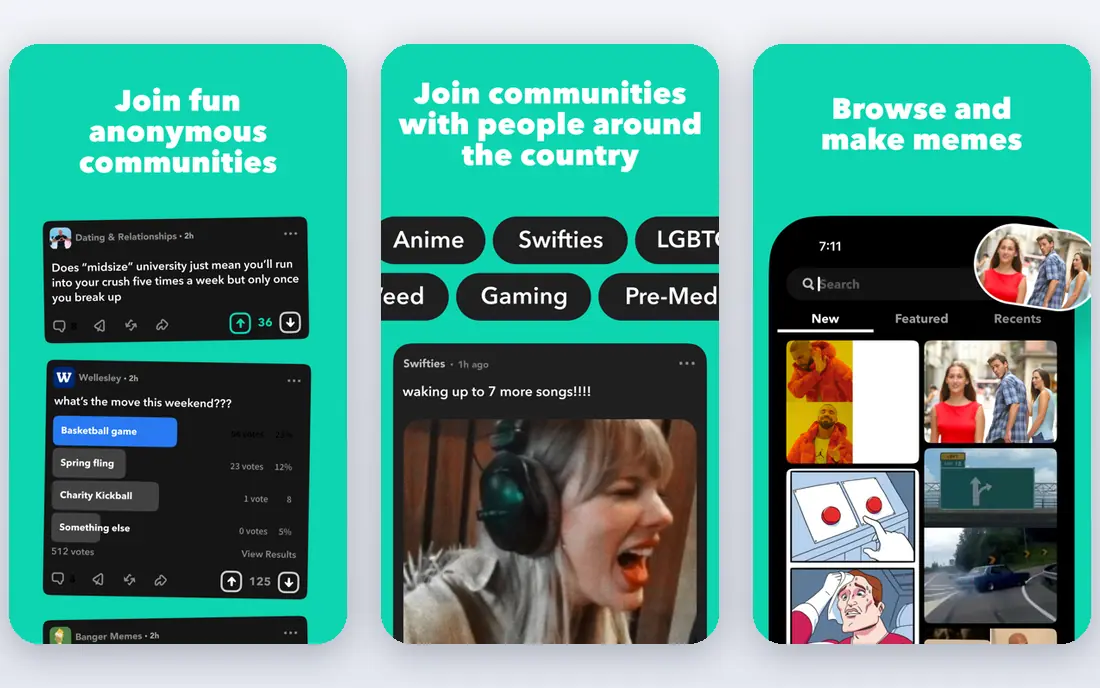
Yik Yak lets users anonymously connect with people at their college through a local feed of posts, rather than through private one-to-one chats. The appeal is local and low-pressure: you see what people nearby are saying without building a public profile.
Because posts are public within a community, avoid sharing anything that identifies you or others, and remember that anonymous posts can still be screenshotted and shared. Yik Yak suits campus chatter, not private conversation.
- Anonymous posting, local campus feed, no profiles or follower pressure, simple to use
- Campus-focused, public posts can attract harassment, limited private chat features
Wakie
Ideal for: Voice conversations with people you choose
Wakie is a voice chat app where you browse profiles and ratings, send a talk request, and have a voice conversation with someone you chose, rather than being matched at random. Topic clubs cover interests from music to language practice, and the app reports more than 10 million users worldwide.
Voice feels more personal than text, which is both the appeal and the risk: your voice, background sounds, and spoken details can identify you. Keep personal details out of early conversations, and use the app's controls to end calls that feel off.
- Voice-first chats, you choose who to talk to, ratings help judge partners, topic voice clubs, free access with optional premium
- Voice reveals more than text, community skews toward support chats, premium features cost extra
Connected2.me
Ideal for: Casual chatting and meeting people worldwide
Connected2.me is a chat app for meeting new people worldwide, with profiles that others can use to start conversations with you, plus follow features that notify you when favorite contacts are online. Its pitch is simple: chat and meet new people, with millions of users.
Profiles make Connected2.me less anonymous than nickname-only apps, so share only what you are comfortable with strangers seeing. It suits casual, low-stakes chatting rather than sensitive conversations.
- Simple chat with people worldwide, profile and follow features, free app, large user base
- Less moderation detail published, profiles reduce anonymity, quality varies by region
OmeTV
Ideal for: Free random video chat with people worldwide
OmeTV is a random video chat platform in the style of the former Omegle, connecting you instantly to strangers worldwide, with country selection, a translation feature, and a social network layer for browsing photos and followers. It is free, with no time limits on chats.
Video chat with strangers is the highest-exposure form of anonymous chat: your face, surroundings, and background can reveal far more than text. We list OmeTV because it is a major app in this category, but use it with extra care, keep identifying details out of frame, and end chats immediately when anything feels wrong.
- Free random video chat, no time limits, country selection, translation feature, mobile app and website
- Video chat with strangers carries high exposure risk, moderation varies, random partners are unpredictable
Azar
Ideal for: Random video chat with people around the world
Azar is a video chat app that connects you with new people around the world through random video matching. Its homepage is minimal, but the app itself is a well-known random video chat service with a large global audience.
The same video-chat cautions apply as with OmeTV: strangers, unpredictable partners, and exposure risk. Keep your surroundings neutral, share no personal details, and use block and report tools whenever needed.
- Random video matching worldwide, simple start, mobile-first experience, large global user base
- Video chat with strangers carries high exposure risk, random partners unpredictable, in-app purchases likely
How we picked these
We compared official homepages, feature pages, and public reviews for anonymous chat apps live in October 2026. We favored apps with clear moderation or safety tools, a working product, and a real user base, and we preferred apps that publish safety information. We kept only apps whose official homepages we could load and confirm. RandoChat was dropped because its domain now shows a for-sale page, and two other candidates were dropped because their domains were blocked or belonged to unrelated companies. We did not claim hands-on testing of moderation quality, and we treated vendor user counts and safety claims as claims, not verified results.
Staying safe on anonymous chat apps
Anonymous chat can be fun, but it is not private in the way people assume. Treat every stranger as untrusted, no matter how friendly they seem. Never share your real name, address, school, workplace, daily routine, photos of yourself or your home, or any payment details. Be careful with usernames that match your other accounts, since they can link your anonymous chats to your real identity.
Use the safety tools every app provides. Block, mute, and report at the first sign of harassment, pressure, or requests for personal content, and leave any room or chat that feels wrong without explaining yourself. On video apps, check what is visible behind you, keep your face out of frame until you choose otherwise, and never do anything on camera you would not want recorded, since video can be captured without your knowledge.
Parents should note that random chat apps are not designed for children, and teens should not use random video chat with strangers. If a conversation involves threats, blackmail, or requests for explicit content, stop engaging, save evidence, report it in the app, and consider reporting it to local authorities or a trusted adult. If you need support, contact a local helpline or crisis service rather than relying on strangers in a chat room.
Frequently asked questions
What is the best anonymous chat app?
AntiLand is our top pick for most readers, thanks to topic rooms, nickname-only signup, and published moderation tools. Wakie is the best voice option, while Yik Yak suits anonymous campus posts.
Are anonymous chat apps safe?
No app is fully safe. Moderation, block, and report tools help, but strangers can still harass, scam, or record conversations. Never share personal details, use safety tools early, and avoid random video chat if you are uncomfortable with exposure risk.
Do I need a phone number to use anonymous chat apps?
AntiLand states that no phone number or real name is required, since you start with a nickname. Other apps vary: some need an account or email, and Chatous asks college users to verify a student email for campus chats.
What is the best anonymous chat app for voice chat?
Wakie is built for voice conversations, letting you choose partners by profile and rating before talking. It feels more personal than text, so keep personal details out of early calls.
Can I chat anonymously without video?
Yes. AntiLand, Yik Yak, and Connected2.me are text-based, and Wakie is voice-based. Video apps like OmeTV and Azar are optional: you can stick to text and voice apps if you prefer not to appear on camera.
Should children use anonymous chat apps?
No. Random chat apps connect users with adult strangers and are not designed for children. Teens should avoid random video chat with strangers, and parents should check age ratings and safety settings on any chat app a teen uses.