Best API Developer Tools

- Postman restructured its plans in March 2026: the free plan now covers 1 user only, Solo costs $9 a month, and Team costs $19 per user per month billed annually.
- Bruno, Hoppscotch, and Apidog are the cheapest routes for small teams, with free tiers that cover real collaboration and entry seats from $6 to $9 per user per month.
- Stoplight and SwaggerHub charge flat monthly rates for design and docs work, starting at $44 and $90 a month, rather than per-seat prices.
- Free tiers differ sharply: Apidog covers up to 4 users, Insomnia covers Git Sync for up to 3 users, and Thunder Client free is limited to non-commercial use.
- Pick the tool that matches the job, a client for testing, a design platform for specs and docs, or a marketplace for third-party APIs, and test it on your own endpoints before you commit.
Quick comparison
| Product | Ideal for | Price from | Free version | |
|---|---|---|---|---|
 Postman | Full API platform for large teams | $19 per user/month (billed annually) | Yes | Visit |
 Insomnia | Open-source client with Git Sync | $12 per user/month | Yes | Visit |
 Apidog | All-in-one API design and testing | $9 per user/month (billed annually) | Yes | Visit |
 Bruno | Offline, Git-native API client | $6 per user/month (billed annually) | Yes | Visit |
 Hoppscotch | Browser-first API testing | $6 per user/month (billed annually) | Yes | Visit |
 Stoplight | Design-first API specs and docs | $44 per month (billed annually) | Yes | Visit |
 SwaggerHub | Team API design and docs | $90 per month (billed annually, 3 users) | Yes | Visit |
 Thunder Client | API testing inside VS Code | $3 per user/month (billed annually) | Yes | Visit |
The best API developer tools
Postman
Ideal for: Full API platform for large teams
Postman is the default API platform for large teams, and it fits organizations that need design, testing, docs, mocks, and monitoring under one roof. The free plan costs $0 for 1 user, with 50 Postman AI credits a month, 1,000 monitor requests, and 1-day collection recovery. Solo costs $9 a month billed annually for one user, Team costs $19 per user per month billed annually with unlimited viewers, and Enterprise is custom priced. The old Basic plan at $14 and Professional at $29 closed to new customers on 1 March 2026.
Team adds basic roles, SDK generation, custom branded docs, and 10,000 monitor requests, while Enterprise adds the API catalog, private API network, advanced roles, and 24 by 5 support. The limits to watch are the single-user free plan, the SSO and SAML add-on at $6 per user per month on Team, and AI credit overages at $0.04 to $0.05 per credit. Postman is the pick when your team already lives in its collections and flows, and it is the most expensive option here for a small team starting from scratch.
- Multi-protocol client with mocks, monitors, and docs in one place
- Unlimited viewers on Team
- Free plan covers 1 user only since March 2026
- SSO needs an add-on or Enterprise
Insomnia
Ideal for: Open-source client with Git Sync
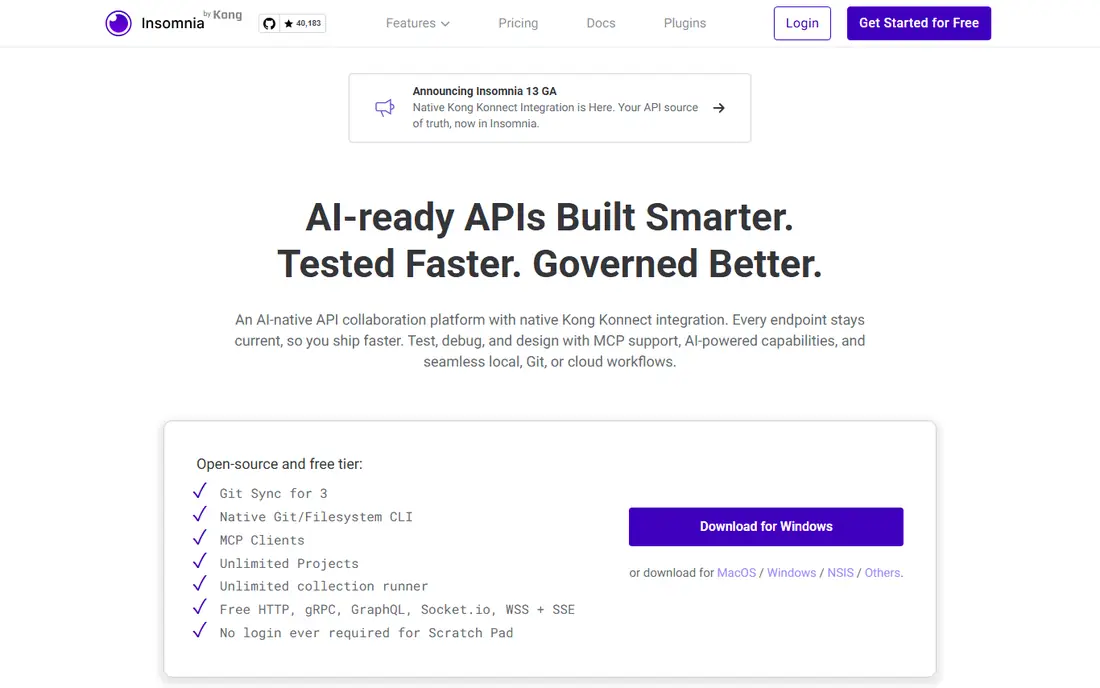
Insomnia is the open-source API client from Kong, and it fits teams that want a polished desktop client with a choice of local, Git, or cloud storage. The Essentials plan costs $0 per user per month and includes unlimited Git Sync projects for up to 3 users, unlimited cloud and local projects, Inso CLI for CI and CD, unlimited collection runs and environments, and 1,000 mock server requests a month. Pro costs $12 per user per month and adds unlimited users on Git Sync, unlimited organizations, role-based access control, and 10,000 mock requests a month. Enterprise costs $45 per user per month with SSO, SCIM, storage control, and vault integrations.
Insomnia covers REST, GraphQL, gRPC, SOAP, WebSocket, Socket.IO, and SSE in one client, with pre-request and after-response scripting and a Scratch Pad for local-only work. The 14-day Enterprise trial needs no credit card. The main limits are the 3-user Git Sync cap on Essentials and the $45 Enterprise seat for governance features. Insomnia is the pick for teams that want open-source roots with hosted collaboration when they need it.
- Open-source core with local storage and Git Sync
- Free Essentials covers up to 3 users
- RBAC and unlimited Git Sync need Pro
- SSO and SCIM need Enterprise at $45 per user
Apidog
Ideal for: All-in-one API design and testing
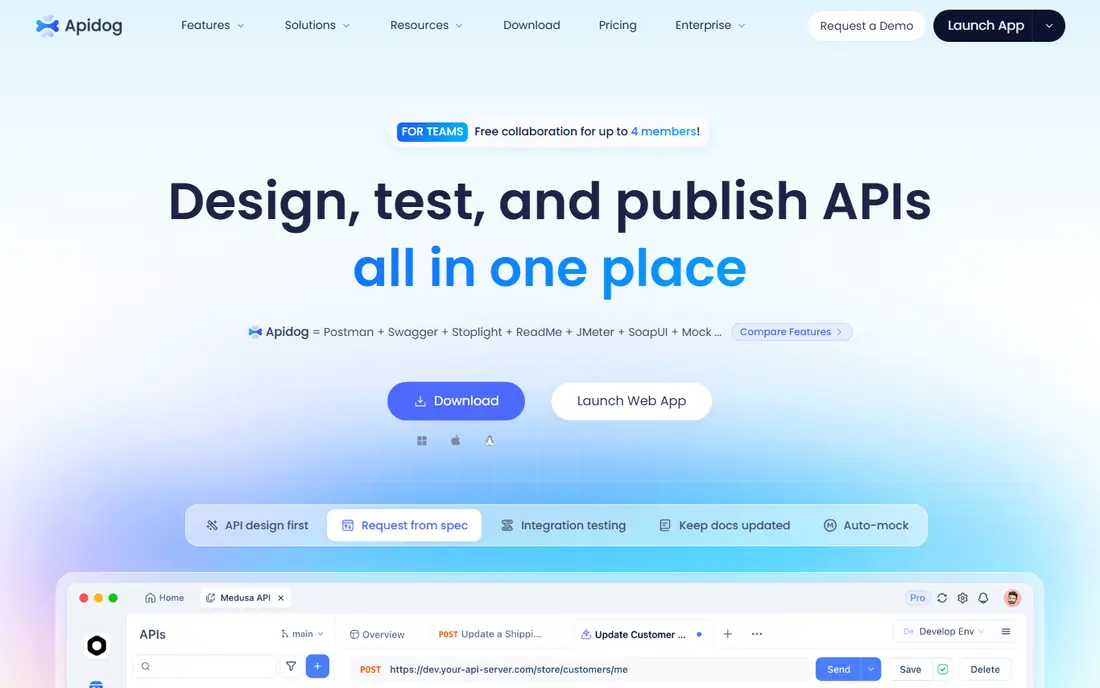
Apidog is an all-in-one API platform that covers design, debugging, mocking, testing, and documentation in one app, and it fits small teams that want one shared workspace instead of four separate tools. The free plan costs $0 for up to 4 users, with all core features, full API client support, unlimited test and collection runs, basic docs, and real-time collaboration. Basic costs $9 per user per month billed annually and adds unlimited team members, a 90-day API change history, NoSQL database operations, and up to 20 team projects. Professional costs $18 and Enterprise costs $27 per user per month, with longer history, doc IP allowlists, SSO, and SCIM.
Every plan includes a 14-day free trial, and the pricing page shows a 25 percent saving on annual billing. The limits to watch are the 20-project cap on Basic, the 10,000 cloud mock calls a month on Free against 50,000 on Basic, and the 100 MB test report storage on Free. Apidog is the cheapest way for a team of 2 to 4 people to share an API workspace at $0, and Basic at $9 a seat undercuts Postman Team by more than half.
- Free plan covers up to 4 users with real-time collaboration
- Design, mocks, tests, and docs in one app
- Team projects cap at 20 on Basic
- Advanced history and SSO need higher plans
Bruno
Ideal for: Offline, Git-native API client
Bruno is the Git-native API client for developers who want their collections in the same repository as their code, and it fits teams that review API changes through pull requests. The open-source core costs $0 with no account, no login, and no cloud sync, and every request lives as a plain text file on disk. Pro costs $6 per user per month billed annually and adds deeper Git integration, unlimited workspaces, unlimited OpenAPI syncs, data-driven testing, and a 48-hour support SLA. Ultimate costs $11 and Enterprise costs $18 per user per month billed annually, adding report generation, secret manager integrations, SSO, SCIM, and audit logs.
The free tier caps at 2 open workspaces and 5 OpenAPI syncs a month, with public Git providers only and no commit or push from the built-in Git panel. The old $19 one-time Golden Edition is no longer sold, so the deeper Git workflow is now a subscription. A 14-day Ultimate trial needs no credit card. Bruno is the pick when offline work and Git history matter more than a hosted workspace.
- Open-source core with no account and no cloud sync
- Collections stored as plain text files in Git
- Free tier caps at 2 open workspaces
- Git commit and push need Pro
Hoppscotch
Ideal for: Browser-first API testing
Hoppscotch is the browser-first API client, and it fits developers who want to test an endpoint in seconds without installing anything. The free plan costs $0 with unlimited individual requests, collections, and cloud sync, and the self-hosted Community edition is free with Docker. The Organization plan starts at $6 per user per month billed annually and adds team workspaces, shared collections and environments, role-based access control, an admin dashboard, and dedicated support. Enterprise adds SSO, audit logs, and on-premise deployment at custom pricing.
Hoppscotch covers REST, GraphQL, WebSocket, and SSE, with a desktop app for cases where the browser hits CORS limits and a mock server feature added in late 2025. The main limit is version control: collections live in a database rather than the file system, so they do not pair with Git the way Bruno collections do. Hoppscotch is the pick for quick ad-hoc testing and for teams that self-host, and the $6 team seat is among the cheapest here.
- Runs in the browser with no install
- Free for unlimited individual use and self-hosting
- Team features need the Organization plan
- Collections live in a database, not in Git
Stoplight
Ideal for: Design-first API specs and docs
Stoplight is a design-first API platform, and it fits teams that design and agree on an API before anyone writes code. The free plan costs $0 for 1 user and 1 project, with the visual OpenAPI editor, interactive docs, and instant mock servers. Basic costs $44 a month billed annually, or $56 month to month, with the first 3 users free and extra users at $11 a month. Startup costs $113 a month billed annually with the first 8 users free, private projects, and custom domains. Pro Team costs $362 a month billed annually with the first 15 users free, shared style guides, and workspace groups.
Stoplight is now part of SmartBear, and the hosted platform is still shipping, while the Studio Desktop app stopped receiving updates in February 2024, so new users should work in Studio Web. The flat pricing shape is the draw: the bill grows with the plan, not with every editor. The limits are the single-project free tier and the $362 step for governance features. Stoplight is the pick when design, docs, and mocks matter more than a test runner.
- Visual OpenAPI editor with hosted docs and mock servers
- Flat monthly price with users included
- Free plan covers 1 user and 1 project
- Style guides and governance need Pro Team
SwaggerHub
Ideal for: Team API design and docs
SwaggerHub, now sold as SmartBear API Hub, is a collaborative API design and documentation platform built on the OpenAPI Specification, and it fits teams that standardize how APIs are designed. The free plan costs $0 for 1 user, with basic API design and documentation and hosting limits of 3 public APIs. Team costs $90 a month billed annually for 3 users, or $108 month to month, with shared design, versioning, and integrations for code generation and deployment. Enterprise is custom priced for 3 users and up, with advanced governance.
SwaggerHub pushes designs to source control, deploys to API management platforms, and triggers Jenkins builds, which suits teams with a mature delivery pipeline. The limits are the per-user pricing, which grows with every editor on the team, and the 3-user floor on the Team plan. SwaggerHub is the pick for teams that already build around OpenAPI and want a governed design hub, while smaller teams will find Apidog or Stoplight cheaper.
- Purpose-built OpenAPI editor with code generation
- Free plan for 1 user
- Priced per user, so the bill grows with headcount
- Enterprise is custom priced
Thunder Client
Ideal for: API testing inside VS Code
Thunder Client is a lightweight REST API client that lives inside Visual Studio Code, and it fits developers who never want to leave their editor to test an endpoint. The free version costs $0 for non-commercial use, with 30 collection runs and basic request sending, but collections were removed from the free tier in August 2025, so sharing now needs a subscription. Starter costs $3 per user per month billed annually with 250 runs and up to 10 seats, Business costs $7 with 500 runs and team features, and Enterprise costs $16 with unlimited runs, SSO, and encrypted environments.
A 14-day free trial is available for business emails. The limits to watch are the non-commercial free tier, the run caps on the lower plans, and the Git sync paywall, which moved collections as JSON files into the Pro tier. Thunder Client is the pick for solo VS Code users who want the lightest possible client, and Starter at $3 a seat is the cheapest team entry on this list.
- Lightweight client that lives inside VS Code
- Cheapest team seat here at $3 per user
- Free tier is non-commercial only and no longer includes collections
- Git sync needs Pro
How we chose
We opened the pricing page of each vendor on 11 November 2026 and recorded the entry price, the free tier, and the limits that shape API tool buying, such as users, workspaces, mock requests, and collection runs. We compared three kinds of tools, API clients for testing, design platforms for specs and docs, and marketplaces for third-party APIs, and we checked feature lists and plan terms on vendor product pages. We favored tools with published pricing and a free tier or trial, and we left out tools whose pricing we could not confirm on the vendor site. No hands-on testing was done, and no vendor supplied data for this guide.
What to check before you buy
Check who counts as a billable user, since Postman charges per editor and gives viewers free on Team, while Stoplight and SwaggerHub bundle users into flat monthly plans. Confirm where your data lives, since Bruno stores everything locally and in Git, Insomnia offers local, Git, or cloud storage, and Postman and Apidog keep workspaces in the cloud. Check the free tier limits on users, workspaces, mock requests, and collection runs, and test with your own endpoints during the trial, since a demo collection tells you little about your own API.
| Team size | Best starting pick | Monthly cost | Watch out for |
|---|---|---|---|
| Solo developer | Bruno, Hoppscotch, Thunder Client Free | $0 | Collection and workspace caps |
| 2 to 4 people | Apidog Free, Insomnia Essentials | $0 | Git Sync caps and project caps |
| 5 to 10 people | Apidog Basic, Bruno Pro, Hoppscotch Organization | $45 to $60 | Per-seat billing adds up fast |
| Design and docs team | Stoplight Basic, SwaggerHub Team | $44 to $90 | Flat plans bundle users, not seats |
| Large or governed team | Postman Team, Insomnia Enterprise | $19 to $45 per user | SSO and audit logs cost extra |
Frequently asked questions
What is the best API developer tool for a small team?
Apidog is the best value for a team of 2 to 4 people, because the free plan covers 4 users with real-time collaboration and Basic costs $9 per user per month billed annually. Bruno Pro at $6 per user per month is the pick when your team works in Git, and Hoppscotch Organization at $6 per user per month is the pick when you want a browser-first client with self-hosting.
Is Postman still free?
Yes, but only for 1 user. Postman cut the free plan to a single user on 1 March 2026, so any shared workspace needs a subscription. Solo costs $9 a month billed annually for one user, and Team costs $19 per user per month billed annually. If your team shares collections, budget for Team seats, or move to Apidog Free, which covers up to 4 users at $0.
Which API tool is completely free?
Bruno and Hoppscotch are the closest to completely free. Bruno is open source under the MIT license with no account and no cloud sync, and Hoppscotch is free for unlimited individual use with a free self-hosted edition. Both charge for team features: Bruno Pro at $6 and Hoppscotch Organization at $6 per user per month billed annually.
Do I need a separate tool for API documentation?
Not always. Postman, Apidog, Stoplight, and SwaggerHub all generate interactive docs from your spec, so a separate docs tool is often unnecessary. Stoplight and SwaggerHub are the strongest when docs are the main job, since they are built around design and publishing. A separate docs platform only makes sense when your docs cover more than APIs.
Can I switch from Postman to another API tool?
Yes, and most tools publish migration guides. Bruno imports Postman collections and stores them as plain text files in Git, Insomnia offers a Postman migration guide from Kong, and Apidog imports specs and collections. Export your collections and environments first, test the import on a copy, and check that scripts, variables, and auth settings survive the move before you cancel.