8 Best API Generation Software Tools for 2026

- 1
 PostmanTeams that want one platform for APIs from design to testingVisit
- 2
 SwaggerHubTeams standardizing on OpenAPI with editor-based designVisit
- 3
 StoplightDesign-first API programs with reusable componentsVisit
- 4
 ApidogTeams that want design, debugging, mocking, testing, and docs togetherVisit
- 5
 InsomniaDevelopers who want a fast, focused API client with design toolsVisit
- "API generation" covers several jobs: designing a spec, generating client SDKs and server stubs, and generating docs and mocks from that spec.
- Spec-first tools such as Stoplight and Redocly suit teams that want the OpenAPI description to drive everything else.
- OpenAPI Generator is the free, open source workhorse for generating clients in more than 50 languages and server stubs in more than 40.
- All-in-one platforms such as Postman and Apidog suit teams that want design, testing, docs, and mocks in one project.
- Whichever tool you pick, keep the spec in version control and regenerate on every change, or the generated code will drift from the real API.
Quick comparison
| Product | Ideal for | Price from | Free version | |
|---|---|---|---|---|
| Postman | Teams that want one platform for APIs from design to testing | See website | Yes | Visit |
| SwaggerHub | Teams standardizing on OpenAPI with editor-based design | See website | Yes | Visit |
| Stoplight | Design-first API programs with reusable components | See website | Yes | Visit |
| Apidog | Teams that want design, debugging, mocking, testing, and docs together | See website | Yes | Visit |
| Insomnia | Developers who want a fast, focused API client with design tools | See website | Yes | Visit |
 OpenAPI Generator | Free, scriptable generation of clients, servers, and docs | Free | Yes | Visit |
 Redocly | API docs, SDKs, and mocks generated from an OpenAPI description | See website | No | Visit |
 Hoppscotch | Open source API development with a lightweight, fast client | See website | Yes | Visit |
The best API generation software
Postman
Ideal for: Teams that want one platform for APIs from design to testing
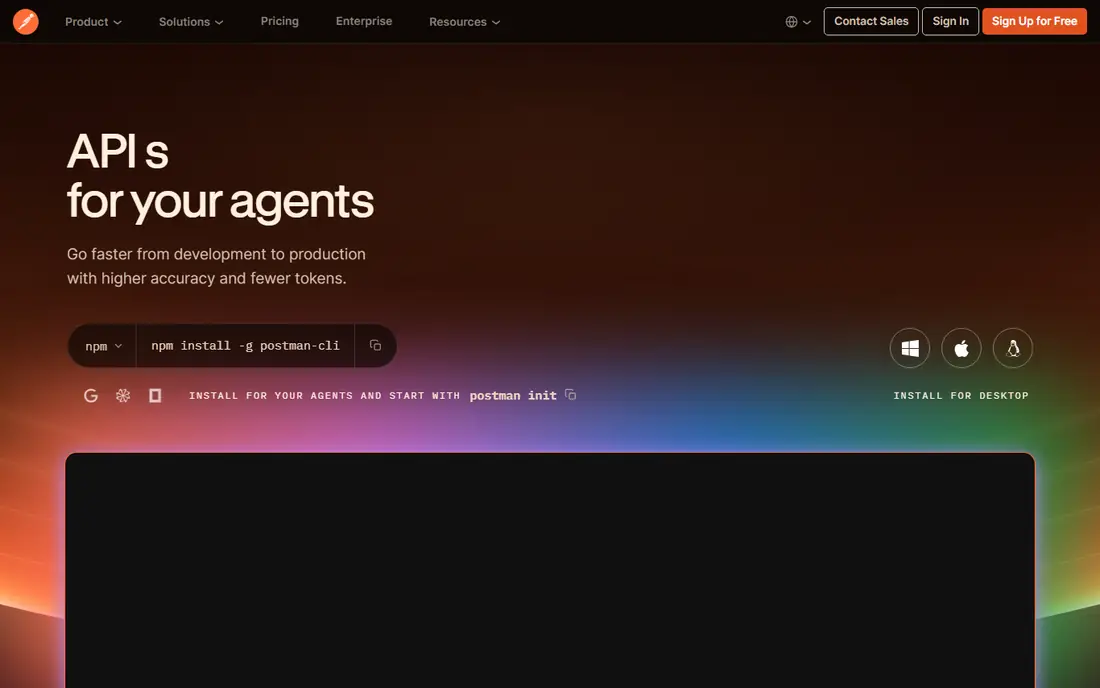
Postman is the best-known API platform, and its generation features cover the full lifecycle: design an API from a spec, generate collections from it, create mock servers, write tests, and publish documentation. Teams can import OpenAPI, GraphQL, and other formats, and Postman's code generation produces request snippets in many languages for consumers. Its strength is breadth: one project can hold the spec, the test suite, the mock, and the docs, and changes flow between them. The free tier covers individual use well, while team collaboration, governance, and advanced reporting sit on paid plans. The trade-off is weight: for a team that only needs to generate an SDK from a spec, Postman is more tool than the job requires. For teams that live in APIs every day, that breadth is the reason to choose it.
- Huge ecosystem, collections, testing, docs, and mock servers in one place
- Can feel heavy for simple jobs, collaboration features sit on paid plans
SwaggerHub
Ideal for: Teams standardizing on OpenAPI with editor-based design
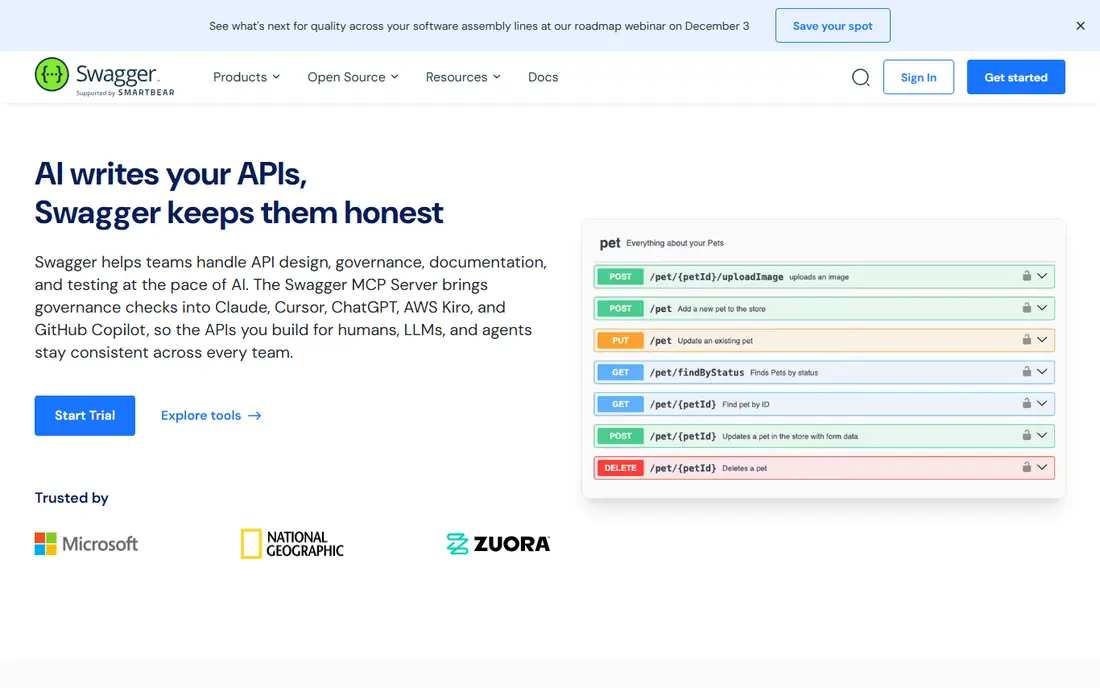
SwaggerHub, from the makers of the Swagger toolset, is a hosted platform for designing, documenting, and managing OpenAPI definitions. Its editor validates specs as you write, supports reusable domains and components, and keeps versions of every API so teams can track how a contract changed over time. From a finished spec, SwaggerHub generates client SDKs and server stubs, and it can publish interactive documentation for consumers. Collaboration features let reviewers comment on a design before it is finalized, which is the spec-first workflow at its best. The free tier suits individual designers, while team and enterprise features require paid plans. The limitation is scope: SwaggerHub is an OpenAPI tool, so teams working with AsyncAPI or GraphQL will need other tools alongside it. For OpenAPI-centered teams, it remains a strong standard choice.
- Purpose-built OpenAPI editor, versioning, collaboration, code generation
- OpenAPI focus only, advanced governance on higher plans
Stoplight
Ideal for: Design-first API programs with reusable components
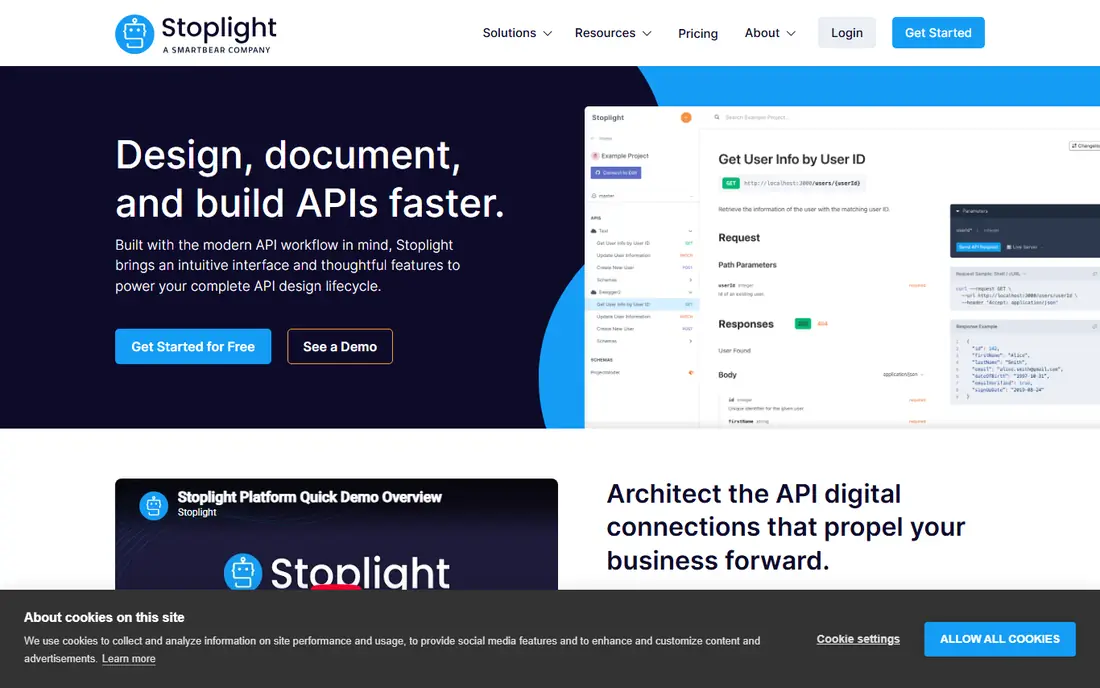
Stoplight takes a design-first approach to API programs, with a visual editor that helps teams create consistent OpenAPI descriptions without hand-writing YAML. Reusable models and components keep definitions consistent across an API portfolio, which matters when dozens of services share common patterns. Style rules and governance features help platform teams enforce standards before an API ships, reducing the review burden on senior engineers. Stoplight also generates documentation from the spec, so the published reference always matches the design. Its ecosystem is smaller than Postman's, and larger-team pricing requires a conversation with the vendor. For organizations that treat API design as a governed program rather than a one-off task, Stoplight's focus on consistency is a genuine advantage.
- Visual OpenAPI design, reusable models, style rules and governance
- Smaller ecosystem than Postman, pricing needs a quote for larger teams
Apidog
Ideal for: Teams that want design, debugging, mocking, testing, and docs together
Apidog describes itself as an all-in-one API platform covering design, debugging, mocking, testing, and documentation, and it imports from more than 15 formats, including Postman collections, OpenAPI and Swagger, Insomnia, and other common sources. That import breadth makes migration painless: a team can bring its existing work across in one step and start generating docs and mocks from it. From a single project, Apidog generates mock servers, runs tests, and publishes documentation, keeping every artifact tied to the same source of truth. The platform also supports exposing APIs through modern agent protocols, reflecting how APIs are increasingly consumed by AI tools as well as by developers. Apidog is newer than Postman and SwaggerHub, so its community and third-party ecosystem are smaller, but its free tier is generous and its unified workflow appeals to teams tired of stitching five tools together.
- Imports from many formats, one workflow for the full lifecycle, mock servers
- Newer brand than Postman, some depth still maturing
Insomnia
Ideal for: Developers who want a fast, focused API client with design tools
Insomnia, now part of Kong, is a collaborative API development platform with a reputation for speed and clarity. It supports design-first work from OpenAPI specs, with real-time preview, native mocking from collections or specs, and automated testing with scripting. A notable strength is storage choice: teams can work entirely offline with local storage, use Git as the backend for API assets, or collaborate in the cloud with optional end-to-end encryption. That flexibility suits security-conscious teams that do not want every collection in a vendor cloud. The free tier covers unlimited projects and the core HTTP, gRPC, GraphQL, and WebSocket clients, while team governance and enterprise features require paid plans. For individual developers and small teams, Insomnia is one of the most pleasant tools on this list.
- Clean interface, local and Git storage options, mocking and testing
- Team and governance features sit on paid plans, smaller marketplace than Postman
OpenAPI Generator
Ideal for: Free, scriptable generation of clients, servers, and docs
OpenAPI Generator is the open source engine behind much of the API world's generated code. Given an OpenAPI document, it generates client libraries in more than 50 languages and server stubs in more than 40, plus documentation formats and schema outputs. Templates are Mustache-based and replaceable, so teams can shape the generated code to their own conventions, and the tool runs through a command line, Docker image, or build plugins for Maven, Gradle, and other systems. Because it is free and scriptable, it fits naturally into continuous integration: every spec change regenerates the SDK and the build catches breaking changes early. The trade-off is that it is a generator, not a platform: there is no hosted editor, collaboration, or mock server built in, and customizing templates takes effort. For teams that want generation as part of an automated pipeline, it is the essential tool.
- More than 50 client generators, more than 40 server generators, fully open source
- Command-line tool, no hosted collaboration features, template learning curve
Redocly
Ideal for: API docs, SDKs, and mocks generated from an OpenAPI description
Redocly builds API documentation, mock servers, SDKs, and workflow tests from the OpenAPI description a team already keeps in its repository. Its core idea is that docs should never lie: because the reference, the try-it console, and the mock server all derive from the same description, a change to the description updates everything at once, and workflow tests run against production catch drift between docs and the real API. Linting and an agent-readiness score run on every pull request, flagging missing examples or undocumented errors before they reach consumers. SDK generation for TypeScript, Python, Go, and PHP is in early access, and the command-line tools are widely used. The cloud product offers a trial rather than a permanent free tier, and every plan includes unlimited seats. For teams whose public API docs are a product in themselves, Redocly is a strong choice.
- Docs that stay in step with the spec, mock servers, linting and scoring
- No permanent free tier for the cloud product, SDK generation in early access
Hoppscotch
Ideal for: Open source API development with a lightweight, fast client
Hoppscotch is an open source API development ecosystem built around a fast, lightweight client that runs in the browser. It covers requests, collections, environments, testing, and documentation, and teams can self-host it for full control over their data. Its open source nature appeals to teams that want to inspect, extend, or run the tool themselves without vendor lock-in, and its interface is notably quick for day-to-day API work. Generation features are lighter than those of OpenAPI Generator or Redocly: Hoppscotch excels at exploring and testing APIs, and it generates request code, but teams that need full SDK generation will pair it with a dedicated generator. For developers who want a free, fast, open tool for the daily work of building APIs, Hoppscotch earns its place here.
- Open source, fast browser-based client, self-hosting option
- Generation features are lighter than dedicated tools, enterprise features are newer
How we picked these
We defined API generation broadly but honestly: a tool had to generate something real from an API description, whether that is client code, server stubs, documentation, or a mock server. We covered the main approaches: all-in-one platforms, spec-first design tools, a pure open source generator, and a docs-led generator. We compared official feature pages, documentation, and public reviews, and we left out tools that only test APIs without generating anything, and tools whose current product has moved away from API generation. Prices change often, so where we could not confirm a current figure on the vendor site during this review, we wrote "See website" rather than guess.
How to choose the right generation approach
Start by deciding where your API description lives. If it does not live in version control yet, that is step one, because every generation workflow depends on a single source of truth. Next, decide what you need to generate: if SDKs are the priority, OpenAPI Generator in your pipeline is hard to beat; if published docs are the priority, Redocly or SwaggerHub fits better; if your team wants one tool for design, testing, and docs, Postman or Apidog is the shorter path. Check how each tool handles breaking changes, because regeneration that silently breaks consumers is worse than no generation at all. Finally, run a real API through the trial, generate every artifact you plan to ship, and show the output to the developers who will consume it. Their judgment matters more than any feature list.
Frequently asked questions
What is API generation software?
It is software that creates artifacts from an API description, such as client SDKs, server stubs, documentation, and mock servers, so teams do not hand-write code that a machine can produce consistently.
What is OpenAPI, and why does it matter for generation?
OpenAPI is a standard format for describing REST APIs in a machine-readable file. Because it is standardized, many tools can read the same description and generate code, docs, and tests from it.
Should I design the API first or generate from code?
Design-first suits public APIs and multi-team programs, because the contract is agreed before implementation. Code-first suits internal APIs where the code is the source of truth and the spec is generated from it.
Do generated SDKs replace hand-written clients?
For standard operations, generated SDKs save significant time and stay consistent with the API. Teams often hand-write a thin wrapper around a generated SDK for authentication, retries, and error handling.
How do I keep generated code from drifting out of date?
Regenerate on every spec change in continuous integration, version the spec, and treat breaking changes as a deliberate decision with a new API version, not an accident.
Can I generate a mock server before the backend is ready?
Yes. Tools such as Postman, Apidog, and Redocly generate mock servers from an OpenAPI description, so frontend teams and consumers can integrate against realistic responses early.