Best Application Lifecycle Management Software in 2026: 7 Tools Compared

- 1
 JiraAgile planning and trackingVisit
- 2
 Azure DevOpsMicrosoft-based deliveryVisit
- 3
 PolarionRegulated traceabilityVisit
- 4
 Jama ConnectRequirements managementVisit
- 5
 CodebeamerComplex product ALMVisit
- Application lifecycle management, or ALM, links requirements, code, tests, and releases so teams can trace every change to its reason.
- Jira and Azure DevOps suit agile software teams that want planning, tracking, and delivery in familiar developer tooling.
- Polarion, Jama Connect, Codebeamer, and Helix ALM suit regulated teams that need deep traceability, compliance, and audit evidence.
- Rally suits large enterprises that need portfolio visibility, linking strategy and funding to team delivery.
- Our pick for most software teams is a tool that fits current workflows and keeps traceability automatic, not manual.
Quick comparison
| Product | Ideal for | Price from | Free version | |
|---|---|---|---|---|
| Jira | Agile planning and tracking | See website | Yes | Visit |
| Azure DevOps | Microsoft-based delivery | See website | Yes | Visit |
| Polarion | Regulated traceability | See website | Free trial | Visit |
| Jama Connect | Requirements management | See website | No | Visit |
| Codebeamer | Complex product ALM | See website | Free trial | Visit |
 Rally | Enterprise agile portfolio | See website | No | Visit |
 Helix ALM | Regulated compliance ALM | See website | Free trial | Visit |
The best application lifecycle management software
Application lifecycle management covers the full journey from an idea to a released product and its later maintenance: requirements, design, coding, testing, release, and change control. Without ALM, requirements live in documents, tests live in spreadsheets, and no one can prove which test covered which requirement when an audit arrives. The best ALM tools keep those links live and automatic.
We compared official product pages for ALM tools used in the US, looking at requirements management, traceability, test management, agile planning, integrations, and compliance support. The list below covers agile teams, regulated engineering, and enterprise portfolios, so readers can match tool depth to their industry and process.
Jira
Ideal for: Agile planning and tracking

Jira is Atlassian's project platform for planning, tracking, and delivering work, now with AI agents that orchestrate tasks and a teamwork graph that gives agents context across tools. Its homepage stresses bringing design, marketing, HR, operations, and engineering into one place to plan work and track progress, with Confluence, Loom, and Rovo available for docs, video, and knowledge. For agile software teams, Jira is the most familiar ALM-adjacent tool, with boards, backlogs, roadmaps, and reporting built in.
The trade-off is ALM depth. Jira tracks work well, but deep requirements traceability and compliance matrices usually need add-ons, linked tools, or strict process discipline. Teams in regulated industries should check whether Jira plus their test and requirements tools can produce audit evidence. For agile teams that want a proven, flexible planning core, Jira is a strong pick.
- Familiar agile planning and tracking
- Broad integrations
- AI assistance and search in newer releases
- Full ALM traceability needs add-ons or discipline
- Regulated compliance needs extra tooling
- Admin can grow complex
Azure DevOps
Ideal for: Microsoft-based delivery
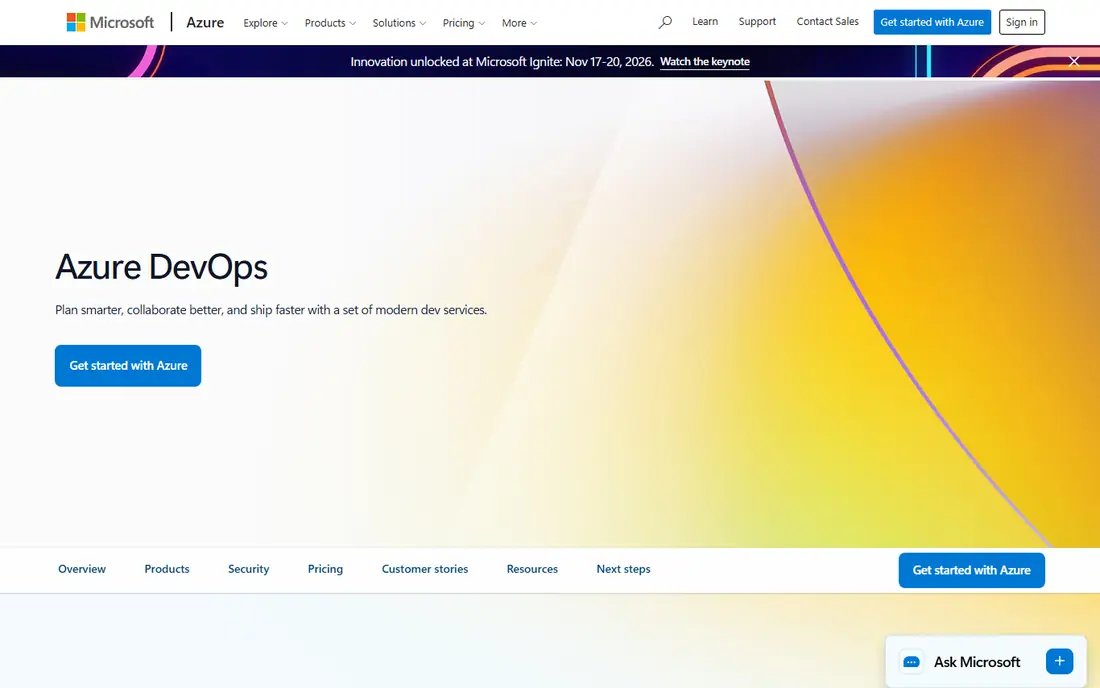
Azure DevOps is Microsoft's set of modern development services for planning, building, testing, and releasing software. Its homepage highlights agile tools to plan, track, and discuss work, pipelines that build, test, and deploy in any language to any cloud or on-premises target, and test plans for manual and exploratory testing, plus integrations with GitHub and GitHub Copilot. That breadth suits teams that want planning through release in one Microsoft-aligned suite.
The catch is setup. Azure DevOps covers a lot, and teams need to configure boards, pipelines, and test plans to fit their process rather than expecting one default ALM template. Smaller teams may find Jira simpler for planning alone. For Microsoft shops and teams that want delivery plus planning together, Azure DevOps is a leading choice.
- Boards, pipelines, repos, and test plans in one suite
- Strong Microsoft and GitHub integration
- Cloud or server options
- Breadth needs setup and admin
- Non-Microsoft teams may prefer neutral tools
- Reporting needs configuration
Polarion
Ideal for: Regulated traceability
Polarion, from Siemens, is an ALM platform built for traceability, compliance, and collaboration across complex systems. Its homepage stresses granular traceability that passes audits, secure collaboration with permission controls and workflow automation, reuse and branching for product lines, and unified requirements, coding, testing, and release management, with LiveDocs for structured specification documents. More than 200 extensions add integrations and features.
The trade-off is enterprise weight. Polarion suits automotive, aerospace, medical, and other regulated teams that need audit-ready traceability, but small agile teams will find it heavier than Jira or Azure DevOps. Implementation and training take planning. For regulated ALM, Polarion is a top pick.
- Granular traceability with automatic change control
- Requirements, testing, and release in one solution
- SaaS or private hosting
- Enterprise pricing and implementation
- Learning curve for complex projects
- Overkill for small agile teams
Jama Connect
Ideal for: Requirements management
Jama Connect is an engineering and requirements management platform for regulated multidisciplinary products, with AI-driven development features that generate requirements, test cases, and traceability. Its homepage stresses a product context layer that improves AI inference quality, parallel engineering branches, CI/CD automation, and governance, plus SOC 2 Type II certification, TISAX Level 2, and encrypted data transfer. That focus suits teams where requirements quality and compliance drive product success.
The catch is scope. Jama Connect leads on requirements, while code delivery and agile planning often live in companion tools such as Jira or Azure DevOps. Pricing is by quote and adoption benefits from expert onboarding. For requirements-led, regulated product teams, Jama Connect is a leading choice.
- Strong requirements and traceability focus
- AI-driven requirements and test generation
- Enterprise security and compliance
- Pricing by quote
- Requirements-led, so delivery tooling is separate
- Needs process design for best results
Codebeamer
Ideal for: Complex product ALM
Codebeamer, from PTC, is an ALM platform that extends lifecycle management with product line configuration, covering requirements and traceability, software risk and compliance, test and quality management, product variability, and DevOps release orchestration. Its homepage stresses browser-based ALM with full end-to-end traceability, out-of-the-box templates for automotive, medical, aerospace, and defense standards, and AI features for requirements and testing. A SaaS option, Codebeamer+, reduces infrastructure overhead.
The trade-off is complexity. Codebeamer's configurability is a strength for complex, safety-critical products, but it needs skilled admins and implementation planning. Simple software teams should compare Jira or Azure DevOps first. For complex product ALM with variants and compliance, Codebeamer is a top pick.
- End-to-end traceability across requirements, risks, tests, and variants
- Product line engineering
- Regulatory templates
- Enterprise pricing and implementation
- Configurability needs admin skill
- Heavy for simple software teams
Rally
Ideal for: Enterprise agile portfolio
Rally, from Broadcom, is an enterprise agile platform built for visibility and alignment, connecting every portfolio, program, and product to business strategy with real-time clarity on progress, spend, and value delivered. Its homepage stresses AI-powered insights for forecasting and risk, integration with Jira, CI/CD, ITSM, and portfolio tools, and availability on-premises or in the cloud as part of the ValueOps platform. That portfolio view suits large organizations with many teams and funding decisions.
The catch is enterprise scope. Rally is not a light team board; it works best when portfolio, program, and product layers are designed deliberately, and team execution may still happen in Jira. Pricing is by quote. For enterprises that need strategy-to-delivery visibility, Rally is a strong pick.
- Portfolio, program, and product visibility
- Links strategy and funding to delivery
- Integrations with Jira and CI/CD tools
- Enterprise pricing
- Team-level planning may still live in Jira
- Implementation needs portfolio design
Helix ALM
Ideal for: Regulated compliance ALM
Helix ALM, from Perforce, is an end-to-end ALM solution for managing requirements, test cases, issues, and workflows in a central platform, with traceability, compliance, and collaboration across the lifecycle. Its product page highlights configurable workflows that users can adjust without coding, an automatic traceability matrix as a single source of truth, and built-in traceability reports for baselines and audits. That profile suits medical device, aerospace, and automotive teams that need audit evidence without heavy customization.
The trade-off is modern feel and scale. Some teams prefer the newer interfaces of Jira or Codebeamer, and pricing is by quote. For regulated teams that want configurable, audit-ready ALM, Helix ALM is a solid choice.
- Central requirements, test cases, issues, and workflows
- Automatic traceability matrix
- Configurable without coding
- Interface feels dated to some users
- Enterprise pricing
- Smaller teams may prefer lighter tools
How we picked these
We compared official product pages for ALM tools used in the US, looking at requirements management, traceability, test management, agile planning, integrations, and compliance support. We favored tools that link lifecycle stages in one system over single-purpose trackers, and we kept a range from agile planning tools to regulated ALM platforms. We also favored tools with current homepages and active development in 2026.
We did not test these tools on live projects, and we did not review private contracts. Pricing, trial terms, and feature scope can change, so check the vendor site and trial each tool with a real project before buying.
What to check before you choose
Start with your audit and traceability needs. List what an auditor or customer will ask for: which requirements link to which tests, what changed and when, and who approved each change. Then test whether the tool produces that evidence automatically or only with manual exports and spreadsheets.
Next, check how the tool fits developer workflows. ALM fails when engineers work around it, so test integrations with code repos, CI pipelines, and issue trackers, and confirm that traceability updates without extra manual steps. A tool that developers avoid will leave gaps in the lifecycle record.
Finally, weigh admin and change effort. Configurable platforms such as Polarion, Codebeamer, and Helix ALM reward process design but need skilled admins, while Jira and Azure DevOps reward teams that already use their ecosystems. Choose the lightest tool that meets your compliance bar.
Frequently asked questions
What is application lifecycle management software?
ALM software manages an application from requirements and design through development, testing, release, and maintenance, keeping links between requirements, code, tests, and changes so teams can trace and audit work.
Is Jira an ALM tool?
Jira is primarily an agile planning and tracking tool, and teams use it as part of an ALM setup with test, requirements, and delivery tools. Regulated teams often pair Jira with dedicated ALM or requirements tools for full traceability.
Which ALM tool is best for regulated industries?
Polarion, Jama Connect, Codebeamer, and Helix ALM suit regulated industries with deep traceability, compliance templates, and audit reporting. The best choice depends on industry standards, product complexity, and existing tooling.
How is ALM different from DevOps?
ALM covers the full lifecycle including requirements and governance, while DevOps focuses on delivery practices such as CI/CD, automation, and operations. Many teams use both, with ALM for traceability and DevOps tooling for release speed.
How much does ALM software cost?
Jira and Azure DevOps offer free tiers for small teams, while Polarion, Jama Connect, Codebeamer, Rally, and Helix ALM price by quote or plan. Ask for totals that include users, hosting, integrations, and support.
Sources
- https://www.atlassian.com/software/jira
- https://azure.microsoft.com/en-us/products/devops
- https://polarion.plm.automation.siemens.com
- https://www.jamasoftware.com
- https://www.ptc.com/en/products/codebeamer
- https://www.broadcom.com/products/software/value-stream-management/rally
- https://www.perforce.com/products/helix-alm