Best Apps for Nursing Students in 2026: 8 Apps Compared

- 1
 Nursing.comNursing school coursesVisit
- 2
 UWorldNCLEX question practiceVisit
- 3
 PicmonicVisual mnemonicsVisit
- 4
 SimpleNursingSimple NCLEX videosVisit
- 5
 OsmosisVisual science videosVisit
- Nursing.com and SimpleNursing suit course study best, with videos and questions built around nursing school topics.
- UWorld and ATI suit exam prep, with question banks that mirror NCLEX style and difficulty.
- Picmonic and Osmosis suit visual learners, using pictures, stories, and short videos to make facts stick.
- Medscape and Lecturio suit clinical reference and deeper science, with drug data and detailed lectures.
Quick comparison
| Product | Ideal for | Price from | Free version | |
|---|---|---|---|---|
| Nursing.com | Nursing school courses | See website | Yes | Visit |
| UWorld | NCLEX question practice | See website | No | Visit |
| Picmonic | Visual mnemonics | See website | Yes | Visit |
| SimpleNursing | Simple NCLEX videos | See website | Yes | Visit |
| Osmosis | Visual science videos | See website | Yes | Visit |
 Medscape | Drug and clinical reference | Free | Yes | Visit |
 ATI | School testing and prep | See website | No | Visit |
 Lecturio | Detailed medical lectures | See website | Yes | Visit |
The best apps for nursing students
We compared official feature pages, pricing pages, and app listings to find nursing apps with current content, clear study tools, and a real fit for coursework, clinicals, or NCLEX preparation.
Nursing.com
Ideal for: Nursing school courses
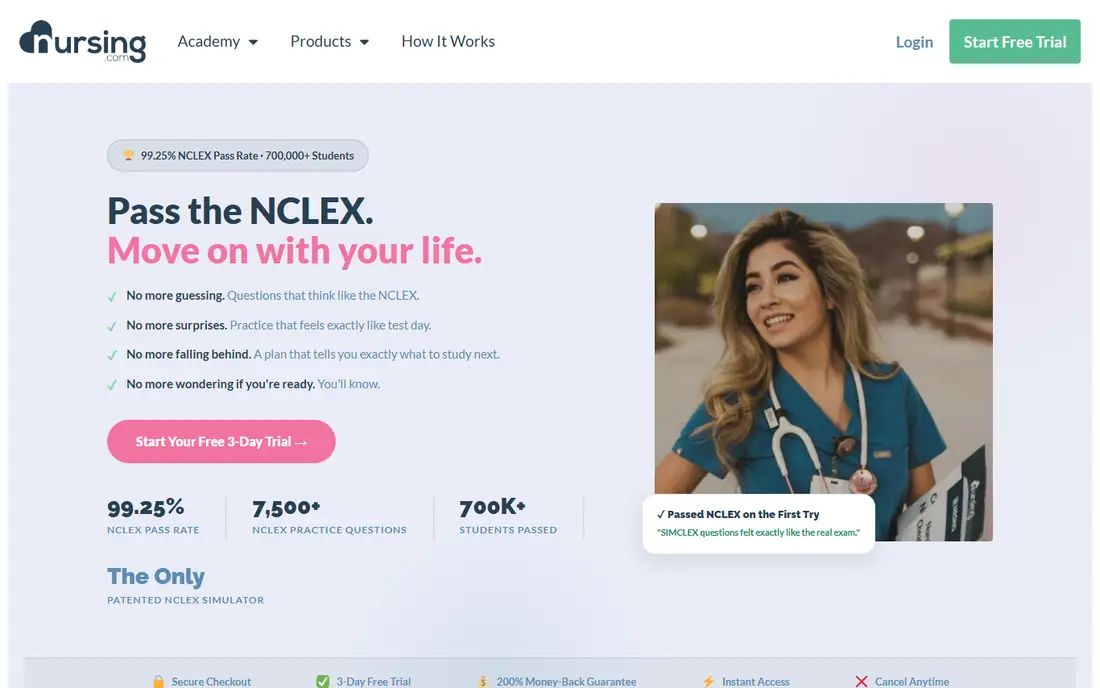
Nursing.com organizes study around the topics nursing students actually face, from fundamentals and pharmacology to med-surg and maternal health. Lessons pair short videos with notes and practice questions, so you can learn a concept and test it in the same session. Study plans help you pace work across a semester rather than cramming before an exam.
Full access requires a paid plan, and depth varies a little by topic, with core subjects covered more fully than niche ones. Still, the course structure makes it easy to match study to your current class. If you want one app that follows your syllabus, Nursing.com is our pick.
- Courses matched to nursing school topics
- Practice questions
- Study plans
- Full access needs a paid plan
- Content depth varies by topic
UWorld
Ideal for: NCLEX question practice

UWorld is widely used for NCLEX preparation because its questions closely mirror exam style, with detailed rationales that explain why each answer is right or wrong. That rationale matters more than the score, since it teaches the reasoning behind clinical judgment. Performance tracking shows weak areas by topic, so you can direct revision where it counts.
There is no free plan, and the price is higher than simpler apps, but many students treat it as the core NCLEX investment. If you are in your final year or preparing for the exam, UWorld is our pick for question practice, used alongside a content app for topics you have not yet covered.
- High-quality NCLEX-style questions
- Detailed rationales
- Performance tracking
- No free plan
- Price is higher than simpler question apps
Picmonic
Ideal for: Visual mnemonics
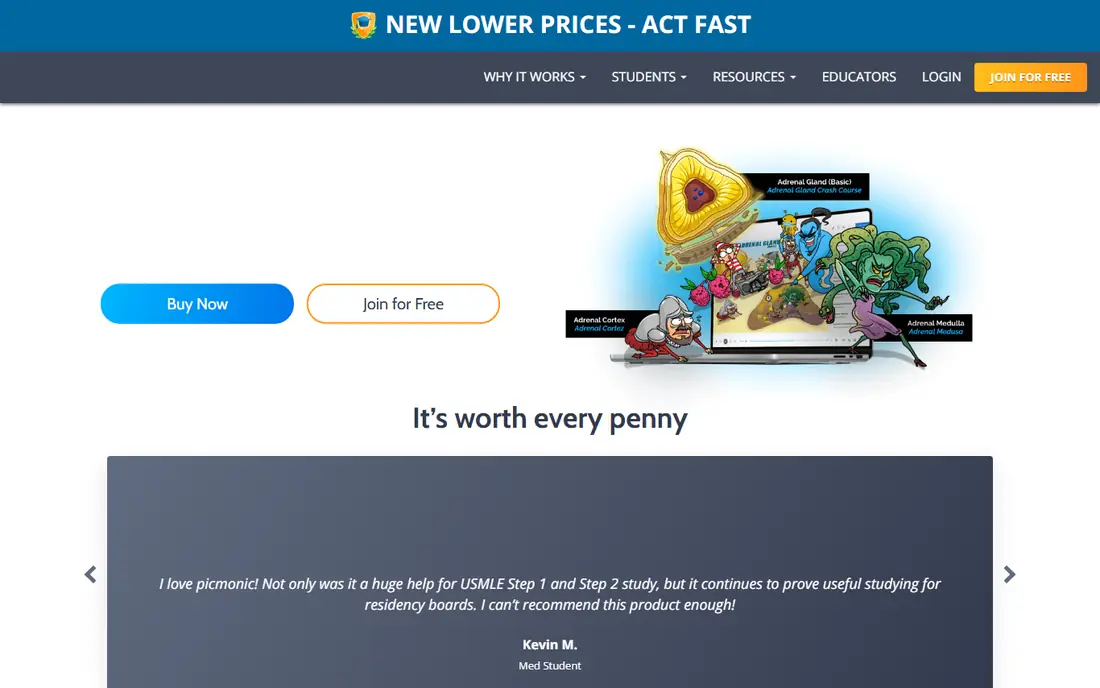
Picmonic turns facts into memorable pictures and stories, with characters and scenes that link drugs, diseases, and nursing concepts together. Each picture is followed by a quiz that uses spaced repetition, so facts return just as you are about to forget them. That method suits students who remember images better than plain text lists.
The visual style will not suit everyone, and some learners prefer straightforward notes. The full library also needs a paid plan beyond the free tier. For pharmacology and other fact-heavy topics, though, Picmonic is our pick for making recall easier.
- Picture-based mnemonics
- Spaced repetition quizzes
- Covers nursing and medical topics
- Visual style may not suit all learners
- Full library needs a paid plan
SimpleNursing
Ideal for: Simple NCLEX videos
SimpleNursing explains nursing topics in short, plain videos that cut through dense textbook language. That clarity helps when you need to grasp a concept quickly before clinicals or an exam, and the study guides give you a written version to review later. NCLEX-focused questions let you test understanding right after watching.
Depth is lighter than a textbook or a detailed lecture app, so it works best as a first pass or a revision tool rather than your only source. Full access needs a paid plan. If you want fast, clear explanations, SimpleNursing is our pick for everyday study.
- Short, clear videos
- Study guides
- NCLEX-focused questions
- Depth is lighter than textbook sources
- Full access needs a paid plan
Osmosis
Ideal for: Visual science videos
Osmosis offers animated videos that explain anatomy, physiology, pathology, and pharmacology in a visual, step-by-step way. Flashcards and questions follow each video, so you can test recall without leaving the app. That structure suits nursing students who want to understand the science behind a condition, not just memorize its signs.
Some content goes deeper than a nursing syllabus requires, since Osmosis also serves medical students. That extra depth can still help for tough topics, but it may slow revision if you use it for everything. For science-heavy subjects, Osmosis is our pick for clear visual teaching.
- Clear animated videos
- Flashcards and questions
- Strong science coverage
- Medical focus can go deeper than nursing needs
- Full access needs a paid plan
Medscape
Ideal for: Drug and clinical reference
Medscape is a free clinical reference that nursing students can use on placement and in study, with drug monographs, interaction checks, calculators, and clinical news. Checking a dose, a side effect, or an interaction before clinicals is faster here than in a textbook, and the reference stays current with new guidance. That makes it a daily tool, not just an exam app.
It is a reference, not a course, so it will not teach a topic from scratch or test you with a structured plan. Registration is needed, and ads appear in the free version. Still, for drug and clinical checks, Medscape is our pick and it costs nothing to use.
- Free drug reference
- Clinical news
- Calculators and interaction checker
- Reference tool, not a study course
- Ads and registration needed
ATI
Ideal for: School testing and prep
ATI, from Assessment Technologies Institute, provides the testing and remediation system used by many nursing schools, including practice and proctored assessments that predict NCLEX readiness. Its strength is the link between a test result and targeted remediation, so a weak score points you to specific content to review. Many students meet ATI through their school rather than buying it alone.
That school link is also the limit, since standalone access and pricing depend on your program. If your school uses ATI, treat it as a core tool and use its remediation plans fully. If not, a question bank like UWorld is a better standalone choice.
- Used by many nursing schools
- Proctored assessments
- Detailed remediation
- Access often comes through a school
- Less useful as a standalone app
Lecturio
Ideal for: Detailed medical lectures
Lecturio offers detailed video lectures across medicine and nursing, with a question bank, written notes, and study schedules to organize revision. The lectures suit students who want a thorough explanation of a topic, especially in anatomy, physiology, and pharmacology. Spaced repetition questions help lock in the detail after watching.
As with Osmosis, some medical content runs deeper than a nursing course requires, so use it selectively for hard topics rather than as a cover-to-cover course. Full access needs a paid plan beyond the free tier. For deep, lecture-style learning, Lecturio is our pick.
- Detailed video lectures
- Question bank
- Notes and study schedules
- Medical depth can exceed nursing needs
- Full access needs a paid plan
How we picked these
We compared official feature pages, pricing pages, and app listings for nursing apps live in October 2026. We favored apps with current nursing or medical content, a clear study method, and a fit for coursework, clinicals, or NCLEX prep. We left out generic study apps with no nursing content and apps whose sites showed no nursing focus.
What to check before you choose
Start with your stage. First-year students suit Nursing.com, SimpleNursing, and Picmonic, while final-year students suit UWorld and ATI. Clinical students should keep Medscape on their phone for drug checks, whatever else they use.
Next, check what your school already provides. Many programs include ATI or another platform in tuition, so paying twice for a similar question bank wastes money. Use school tools first, then add one content app for topics that still feel weak.
Finally, study actively. Watching videos without questions gives a false sense of progress, so pair every lesson with practice questions or flashcards. Track weak topics weekly and revisit them with spaced repetition rather than rereading notes.
Before you commit to one option, spend a short trial period with your top two choices from this list. Use each one for a real task from your own work or daily routine, not just a demo, and note where you get stuck, what feels slow, and which features you actually open twice. Check the official pricing page again at that point, since free plans and paid tiers change, and confirm that the plan you need covers the users, projects, or devices you will use. Read the privacy and support pages too, especially for tools that hold personal or work data, and confirm how to export your work if you later switch. A tool that fits your routine in a two-week trial is a far better choice than a more powerful option you avoid opening, so let daily use, not a feature list alone, decide your final pick for best apps for nursing students.
Frequently asked questions
What is the best app for nursing students overall?
Nursing.com is our pick for coursework, while UWorld is our pick for NCLEX question practice. Most students do best with one content app plus one question bank, plus Medscape for clinical reference.
Is there a free app for nursing students?
Yes, Medscape is free, and Nursing.com, Picmonic, SimpleNursing, Osmosis, and Lecturio all have free tiers. UWorld and ATI generally require paid access, often through a school for ATI. Start with free tiers before paying.
Which app is best for NCLEX prep?
UWorld is our pick for NCLEX-style questions and rationales, while ATI suits students whose schools use it for proctored assessments. SimpleNursing and Nursing.com add video teaching and questions for revision alongside a question bank.
Which app is best for nursing pharmacology?
Picmonic suits visual drug mnemonics, Medscape suits drug reference and interaction checks, and SimpleNursing suits clear drug videos. Use Picmonic to learn, Medscape to check, and questions to test recall.
Do nursing apps replace textbooks?
No, apps work best alongside textbooks and lectures, since they summarize and test rather than covering every detail. Use apps for revision, questions, and clinical checks, and use textbooks for depth on topics you find hard.
How do I pick between the free and paid plans in this list?
Start with the free plan or trial for any best apps for nursing students option that offers one, and use it for at least two weeks on real tasks. Upgrade only when you hit a clear limit, such as a missing feature, a user cap, or a storage limit, rather than paying on day one for features you may never use. Compare the paid tier against the next option in this list as well, since a different tool's free plan may already cover what the first tool charges for.