Best Apps for Workout Tracking in 2026: 8 Apps Compared

- Strong is the fastest plain log for barbell training, while Hevy offers the best value with a social feed.
- Fitbod suits users who want each session built for them, but it has no free tier beyond a trial.
- Jefit pairs a large exercise library with deep progress analysis, at a lower annual cost than Fitbod.
- This is not medical advice. Stop and seek care if you feel pain, and check with a clinician before starting a new training program.
Quick comparison
| Product | Ideal for | Price from | Free version | |
|---|---|---|---|---|
 Strong | Fast barbell and gym logging | $4.99 per month | Yes | Visit |
 Hevy | Best value strength logging with social features | $2.99 per month | Yes | Visit |
 Fitbod | Auto-generated sessions around your equipment | $15.99 per month | Free trial | Visit |
 Jefit | Gym logging plus deep progress analysis | $12.99 per month | Yes | Visit |
 Nike Training Club | Free guided workouts at home and in the gym | Free | Yes | Visit |
 Apple Fitness+ | Apple Watch-led classes and training | $9.99 per month | Free trial | Visit |
 Caliber | Coach-designed strength programs | See website | Yes | Visit |
 Garmin Connect | Workout tracking for Garmin watch owners | Free | Yes | Visit |
The best apps for workout tracking
We compared official feature pages, pricing pages, app store listings, privacy policies and public reviews to build this list of 8 options for best apps for workout tracking. Prices were checked in October 2026 and can change, so confirm the current price on the vendor site before you buy. Our pick for most people is the first option that fits your budget and workflow, not necessarily the most expensive tool on the list. Read the quick comparison first to narrow the field, then read the full write-ups for the two or three options that fit your needs best.
Strong
Ideal for: Fast barbell and gym logging

Strong is built for lifters who want to log sets fast and see progression clearly. The interface gets out of the way between sets, charts track personal records, and offline logging works in gyms with poor signal. For barbell programs, it is the most efficient log on this list.
The free tier caps routines, and there is no built-in program generator, so users must bring their own plan. Social features are also minimal. If you follow a set program and want speed, Strong is the pick.
- Fastest logging interface
- Progression charts
- Offline logging
- Free tier caps routines at three
- No built-in programming
- Social features are minimal
Hevy
Ideal for: Best value strength logging with social features

Hevy combines fast strength logging with a social feed, so training with friends feels more engaging. Pro is cheap, adds Hevy Trainer for progression, and a lifetime option exists for long-term users. The free tier covers unlimited workouts with capped routines, which is generous.
Routine caps on the free tier push heavy users to Pro, and the exercise library is smaller than Jefit. Trainer programming is also simpler than Fitbod. For value plus community, Hevy is hard to beat.
- Cheap Pro plan
- Social feed and leaderboards
- Hevy Trainer on Pro
- Free tier caps routines
- Trainer needs Pro
- Exercise library is smaller than Jefit
Fitbod
Ideal for: Auto-generated sessions around your equipment
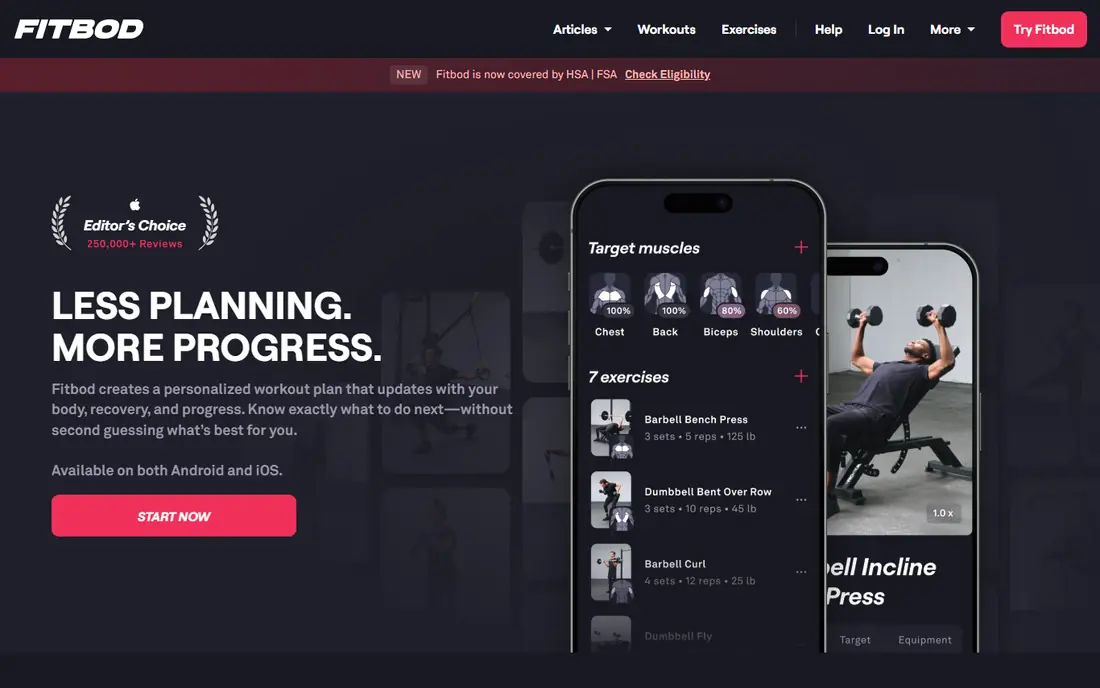
Fitbod builds every session around your goals, equipment, available time and recovery, so users never plan a workout. That automation suits people who want to walk into the gym and follow instructions. The exercise library is large, and progression is handled by the algorithm.
There is no free tier beyond a trial, and Fitbod is the most expensive app here. Users with a fixed program also get less control, since the app drives session design. For hands-off programming, Fitbod is the strongest choice.
- Builds each session for you
- Large exercise library
- Adapts to recovery and equipment
- No free tier beyond a trial
- Most expensive here
- Less control for users with a fixed program
Jefit
Ideal for: Gym logging plus deep progress analysis
Jefit pairs a huge exercise database with community programs and detailed progress analysis, including sets per muscle group and recovery tracking. Elite adds a structured 12-week plan, which suits lifters who want guidance without Fitbod's price. The free tier is usable for basic logging.
The free tier includes ads, and the interface is busier than Strong or Hevy. Full plans also need Elite. For lifters who want analysis depth and a large library, Jefit is a strong pick.
- 1,400+ exercises
- 12-week plans on Elite
- Per-muscle progress analysis
- Free tier has ads
- Interface is busy
- Elite needed for full plans
Nike Training Club
Ideal for: Free guided workouts at home and in the gym
Nike Training Club is fully free, with guided workouts, programs and coaching cues for home and gym training. That makes it the best starting point for beginners who want structure without a subscription. Workout variety covers strength, cardio, mobility and yoga.
It is not a detailed strength log: sets, loads and progression tracking are basic compared with Strong or Hevy. Programs are also Nike-led, with less customization. For free guided training, Nike Training Club is excellent.
- Fully free
- Guided workouts and programs
- No in-app purchases
- No detailed strength logging
- Programs are Nike-led
- No social training feed like Hevy
Apple Fitness+
Ideal for: Apple Watch-led classes and training
Apple Fitness+ puts Apple Watch metrics on screen during studio classes, which makes effort easy to read mid-workout. New workouts arrive weekly across strength, HIIT, yoga and more, and family sharing spreads the cost. For Apple Watch owners, the integration is smooth.
Full value needs an Apple Watch, and detailed barbell logging is not its job. It is also Apple only. For Watch owners who prefer classes to self-planned sessions, Fitness+ is a strong pick.
- Studio classes with Watch metrics on screen
- New workouts weekly
- Family sharing
- Needs an Apple Watch for full value
- No detailed barbell logging
- Apple ecosystem only
Caliber
Ideal for: Coach-designed strength programs
Caliber offers coach-designed strength programs with unlimited logging on its free tier, which suits lifters who want expert structure without planning it themselves. Programs are built around strength goals, and progress tracking covers the core lifts well.
Coaching depth varies by plan, and the community is smaller than Hevy. Pricing also needs checking on the vendor site, since plans have changed. For coach-led strength training at a lower cost, Caliber is worth a trial.
- Coach-designed programs
- Unlimited logging on free tier
- Strength focus
- Coaching depth varies by plan
- Smaller community
- Pricing needs checking
Garmin Connect
Ideal for: Workout tracking for Garmin watch owners
Garmin Connect is free for Garmin device owners and turns watch data into detailed activity, sleep and training records. Running, cycling and multisport tracking are deep, and training load views help athletes manage volume. For Garmin users, it is the natural hub.
Strength logging is basic compared with Strong, and full value needs a Garmin watch. The interface is also data heavy for casual users. For Garmin owners who train across sports, Connect is the obvious free pick.
- Free with a Garmin device
- Deep activity and health data
- Strong running and cycling tracking
- Needs a Garmin device for full value
- Strength logging is basic
- Interface is data heavy
How we picked these
We started from the topic and shortlisted products that exist and work today, then checked each vendor homepage, pricing page and free tier. We compared feature pages, app store listings, privacy policies and public reviews, and we dropped any product whose homepage could not be verified or whose price could not be checked. Where a price was unclear or varied by region, we wrote See website rather than guessing a number. That rule kept the list honest, even where a neat price would have made the comparison table look tidier.
We also weighed fit over fame. A well-known product stayed on the list only if it truly fits the topic, and smaller tools earned a place when they served a clear use case better. No product here was tested hands-on for this article, and no vendor paid for placement.
Price and free-tier details matter most when plans change often, so we favoured products with clear published pricing and a trial or free tier where one exists. If a vendor changed a plan after our check, the vendor site is the correct source, and the ranking here still reflects fit, not just price. That check takes extra time, but it prevents a shortlist built on outdated pricing or a product that no longer exists.
Choosing a workout tracker by how you actually train
Match the app to your training style, not to a feature list. Barbell lifters need fast logging and progression charts, while class users need a class library and schedule. Test logging during a real workout, because an app that slows you down between sets will be abandoned, however good its charts look.
Before you pay, run a trial on a real task from your own work, not a demo file. Check export formats, mobile access and support hours, because those details decide whether a tool survives daily use. Also check renewal terms and cancellation steps, since a cheap first year can become an expensive second year if renewal jumps. Finally, ask who will own setup and training, because a tool nobody is responsible for tends to fall out of use within a few months. Keep a short note on why you picked the winner, so a future review can judge it against the same criteria instead of starting from scratch.
A useful final test is to imagine the tool in six months, when the first excitement has faded and the work is routine. If the daily steps are still quick, the cost is still clear, and the support route is still obvious, the choice is likely sound. If any of those three answers is unclear, use the trial period to get a clear answer before committing to an annual plan.
Frequently asked questions
What is the best free workout tracking app?
Hevy and Strong both offer free tiers with capped routines, and Nike Training Club is fully free for guided workouts. Jefit offers a free tier with ads.
Is Fitbod worth paying for?
Fitbod is worth it if you want each session generated around your equipment, goals and recovery, without planning it yourself. If you already follow a program, Strong or Hevy cost less.
Do workout trackers work with Apple Watch?
Strong, Hevy and Apple Fitness+ offer Apple Watch logging, while Fitbod watch support is more limited. Check the current app listing for your watch model before subscribing.
Can I export my workout history?
Strong, Hevy, Jefit and Fitbod offer export options, but formats and ease vary. Export a sample before committing years of training data to one app.