Best Armory Management Software in 2026: 7 Tools Compared

- 1
 Softpal Weapon ManagementRFID defense armoriesVisit
- 2
 Hardcat Law EnforcementAgency asset controlVisit
- 3
 ArmoryAtlasPersonal collectionsVisit
- 4
 AIM Armory InventoryAgency accountabilityVisit
- 5
 APB360Issue plus trainingVisit
- AIM and APB360 lead for law enforcement agencies that must tie weapon issue to officer qualifications.
- ArmorerLink suits agencies that want a long-standing firearm management system with barcode tracking.
- Hardcat fits larger organizations that manage firearms alongside other critical assets such as vehicles and equipment.
- ArmoryAtlas is the best fit for individual owners who need a private, encrypted record of a personal collection.
- Softpal and ArmoryMaster Pro cover RFID-based tracking for defense and agency armories with larger inventories.
Quick comparison
| Product | Ideal for | Price from | Free version | |
|---|---|---|---|---|
| Softpal Weapon Management | RFID defense armories | See website | No | Visit |
| Hardcat Law Enforcement | Agency asset control | See website | No | Visit |
| ArmoryAtlas | Personal collections | Free | Yes | Visit |
| AIM Armory Inventory | Agency accountability | See website | No | Visit |
| APB360 | Issue plus training | See website | No | Visit |
 ArmorerLink | Agency firearm management | See website | No | Visit |
 ArmoryMaster Pro | Fast armory tracking | See website | No | Visit |
The best armory management software
Armory management software tracks firearms, ammunition, and gear, who holds them, when they were issued and returned, and whether maintenance and qualifications are current. Agencies use it for accountability and audits, while individual owners use it for insurance and personal records. The tools below serve those different users, so the right pick depends on whether you run an agency armory or manage a private collection.
Safety note: Follow all local, state, and federal firearms laws, store firearms securely, and use these tools only for lawful inventory and accountability purposes.
Softpal Weapon Management
Ideal for: RFID defense armories

Softpal offers a weapon management system built on RFID tracking, aimed at defense and law enforcement agencies. Its homepage presents weapon tracking alongside warehouse and courier tools, with role-based access and audit trails for regulated organizations. For a large armory, RFID scanning at issue windows can cut counting time and reduce manual errors.
The trade-off is that Softpal is a broad logistics vendor, not a niche armory firm, so buyers should confirm the weapon module covers their exact workflow, including maintenance and qualification tracking. For a defense organization already using Softpal logistics tools, the shared platform is a benefit.
- RFID-based weapon tracking with real-time visibility
- Audit trails for issue and return
- Part of a wider logistics platform
- Enterprise platform aimed at larger organizations
- Pricing and deployment need a direct quote
Hardcat Law Enforcement
Ideal for: Agency asset control
Hardcat is an enterprise asset management provider whose law enforcement platform covers firearm and armory management, including documented issue and return, qualification checks at issue, and maintenance alerts. Its site stresses central control for critical assets, which suits agencies that also manage vehicles, radios, and evidence in the same system.
The honest catch is generality. Hardcat manages many asset types well, but an agency that needs deep armory-only features should compare it with AIM or APB360 in a trial. For an organization that wants one asset system for everything, Hardcat is a strong choice.
- Long history in enterprise asset management
- Firearm issue tied to qualifications and checks
- Barcode and RFID tracking
- General asset platform, so armory-specific depth needs checking
- Enterprise pricing
ArmoryAtlas
Ideal for: Personal collections
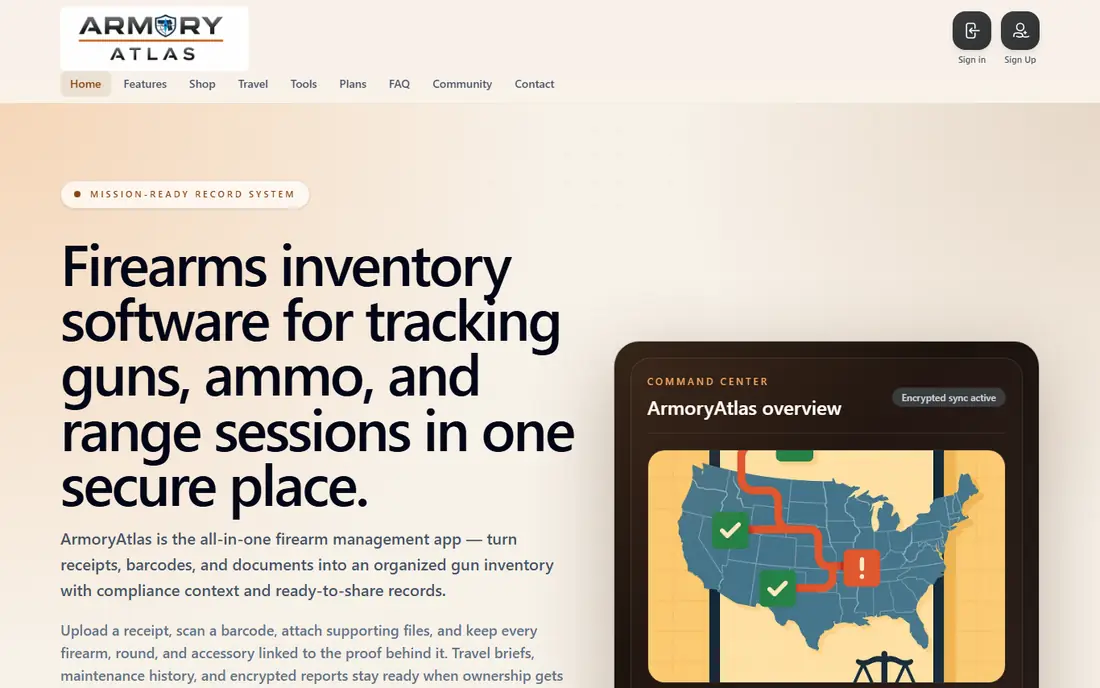
ArmoryAtlas is a firearms inventory app for individual owners, covering guns, ammunition, accessories, range sessions, and maintenance, with encrypted storage and offline access. Its homepage stresses privacy, travel briefings covering state rules, and insurance-ready reports, which are the jobs a private owner actually needs. The free tier lets owners start logging immediately.
The limit is audience. ArmoryAtlas is not designed to run a police armory with qualification enforcement and chain-of-custody workflows. For a collector, competitor, or traveler who wants a private, organized record, it is the best fit in this list.
- Encrypted storage with no advertising trackers
- Ammo, maintenance, and travel guidance in one app
- Offline access on mobile
- Built for individual owners, not agency armories
- Premium features need a paid plan
AIM Armory Inventory
Ideal for: Agency accountability
AIM, or Armory Inventory Management, is built for police agencies, with serialized tracking, enforced physical counts, lot-level ammunition tracking, and qualification forms. Its homepage stresses that an item marked as being inspected cannot be issued until confirmed, which is exactly the kind of control accreditation inspectors look for. Training records and service requests sit in the same system.
The drawback is narrow focus, which is also its strength. AIM is not for collectors or retailers. For an agency that needs to prove, at any moment, what it owns, who holds it, and who is qualified to carry it, AIM is one of the strongest options here.
- Built by law enforcement users for agencies
- Enforced physical counts and lot-level ammo tracking
- Qualification and training records included
- Agency focus means private owners should look elsewhere
- Pricing is quote based
APB360
Ideal for: Issue plus training
APB360 combines firearm asset management with training records, and its key idea is simple: the question is not only what an officer holds, but whether they are qualified to carry it. Its homepage notes alarms when an officer holds duty equipment without the required training record, plus automated notifications to the officer and supervisor. For manufacturers, it offers an ATF-compliant electronic bound book.
The limit is market focus. APB360 serves law enforcement and Type 7 and higher manufacturers, not retail dealers or pawnbrokers. Within those markets, the training link is a genuine differentiator, and agencies should test it with their own qualification rules.
- Inventory and training records in one platform
- Alarms when an officer lacks required training
- ATF-compliant bound book for manufacturers
- Two focused markets, so retail dealers are not served
- Pricing is quote based
ArmorerLink
Ideal for: Agency firearm management
ArmorerLink is a law enforcement firearm management system covering firearms, maintenance, ammunition, qualifications, equipment, and training. Its homepage stresses barcode tracking, real-time range qualifications, expiring qualification alerts, and one-click reports for audits. That combination has served agencies since 2013, which gives buyers a track record to check.
The catch is scale and polish. ArmorerLink is a specialist vendor, so buyers should confirm support, hosting, and integration options during evaluation. For an agency that wants a proven, focused system without enterprise platform complexity, ArmorerLink is a solid pick.
- Established since 2013
- Barcode tracking for firearms, maintenance, and qualifications
- One-click audit reports
- Smaller vendor footprint than Hardcat
- Interface reflects its long history
ArmoryMaster Pro
Ideal for: Fast armory tracking
ArmoryMaster Pro is a weapons tracking system built by Cenango, an RFID and asset tracking firm, aimed at military and police teams that need fast, clear armory records. Its homepage stresses knowing what is issued, returned, or still in stock, plus daily checks and audits without manual record books. Barcode and RFID scanning speed up counts in busy armories.
Buyers should ask for references from similar-sized organizations, since ArmoryMaster Pro is less widely known than Hardcat or AIM. On features, though, it covers the core armory jobs well, and it is worth including in an agency shortlist alongside the more established names.
- Fast issue, return, and stock checks
- Barcode and RFID scanning
- Audit records for military and police teams
- Newer brand presence than some rivals, so check references
- Pricing needs a quote
How we picked these
We compared official vendor pages, product listings, and public reviews for armory management tools still sold in October 2026. We kept tools with firearm issue, return, maintenance, or qualification tracking as core features, and we left out generic asset tools with no firearm features, tools with no clear vendor homepage, and tools whose homepage no longer matched the product. Because most agency tools are quote priced, we used See website for pricing rather than inventing figures.
How to choose for an agency
Start with the audit question. Ask what an inspector, a commander, or a court would need to see: who held each weapon, when, whether they were qualified, and when it was last serviced. The tool that answers those questions fastest, with the fewest manual steps, is usually the right one, even if another tool has a longer feature list.
Next, test the daily workflow at the issue window. A system that slows down shift change will be bypassed, no matter how good its reports are. Run a trial with real officers, real barcodes or RFID tags, and a real qualification check, and watch where the process stalls. Finally, confirm data control and export. Agency firearm records are sensitive, so check hosting, encryption, access controls, and how records export for audits or a future system change.
Frequently asked questions
What is armory management software?
Armory management software tracks firearms, ammunition, and gear in an armory, including who holds each item, when it was issued and returned, and whether maintenance and qualifications are current. Agencies use it for accountability and audits, while owners use similar apps for personal records and insurance.
Do police departments need special armory software?
Many departments benefit from it, because paper logs and spreadsheets make audits slow and errors easy. Dedicated software ties issue to qualifications, flags overdue maintenance, and produces audit reports quickly. Smaller departments may manage with a simpler tool, but the accountability benefit grows with inventory size.
Is ArmoryAtlas suitable for a police department?
ArmoryAtlas is built for individual owners, not agency armories, so departments should choose an agency tool such as AIM, APB360, or ArmorerLink. Individual owners, collectors, and competitors are the right audience for ArmoryAtlas, which focuses on private, encrypted personal records.
How does RFID help in an armory?
RFID tags let staff scan items quickly at issue windows and during counts, without handling each weapon individually. That speeds up shift changes and inventory checks, and it reduces counting errors. Barcode scanning offers similar benefits at lower cost, though it usually needs a closer, item-by-item scan.
What should we check before buying?
Check qualification enforcement, audit reporting, hosting and security, and support for your region. Run a trial with real items and real officers at a real shift change, and confirm how data exports. Price matters, but a system staff bypass because it is slow will cost more in audit risk than it saves in license fees.