Best asl learning app in 2026: 8 Options Compared

- Lingvano is the best all-round app for beginners, with daily video lessons from Deaf teachers.
- ASL Bloom suits beginners wanting certified instructors and an AI assistant.
- The ASL App is the best budget dictionary-style app, while Lifeprint is free for self-study.
- Apps teach vocabulary and grammar, but conversation with Deaf signers is what builds fluency.
Quick comparison
| Product | Ideal for | Price from | Free version | |
|---|---|---|---|---|
 Lingvano | beginners wanting daily gamified lessons | $17.99 per month | Yes | Visit |
 ASL Bloom | beginners wanting certified instructors | $98.99 per year | No | Visit |
 The ASL App | budget dictionary and phrase learning | $9.99 per year | No | Visit |
 HandSpeak | dictionary and grammar reference | See website | Yes | Visit |
 Start ASL | structured online ASL courses | See website | No | Visit |
 SignIt ASL | immersive video courses for beginners | See website | No | Visit |
 ASLdeafined | classroom-style lessons with quizzes | See website | No | Visit |
 Lifeprint | free self-study from a respected teacher | Free | Yes | Visit |
The best asl learning apps
Here is our shortlist for best asl learning app, ordered from the most broadly useful picks to the more specialised ones. Every entry below is a real product you can sign up for or buy today, with pricing taken from the vendor site or app store listing where we could verify it.
Lingvano
Ideal for: beginners wanting daily gamified lessons

This one is aimed at beginners wanting daily gamified lessons. Lingvano teaches ASL and BSL through short daily video lessons from Deaf teachers, with quizzes, a vocab trainer and a Sign Mirror for practice feedback. Lessons build cumulatively, so new signs reuse earlier vocabulary.
There is no live instructor to correct you, and the best value comes from the $119.99 annual plan rather than $17.99 monthly. For self-paced beginners, it is the most complete app here.
- Daily video lessons from Deaf teachers
- Gamified practice and vocab trainer
- ASL, BSL and Austrian sign
- No live instructor feedback
- Annual plan is the best value at $119.99 a year
ASL Bloom
Ideal for: beginners wanting certified instructors

Think of ASL Bloom as the pick for beginners wanting certified instructors. ASL Bloom offers daily video lessons, quizzes and games from instructors with credentials including Certified Deaf Interpreter status, plus an AI assistant for practice. The yearly plan at $98.99 suits committed beginners.
There is no free plan, so testing it means paying. For learners who value instructor credentials, that trade is reasonable.
- Video lessons from certified instructors
- Quizzes and flashcards
- AI learning assistant
- No free plan
- Yearly subscription only for full access
The ASL App
Ideal for: budget dictionary and phrase learning
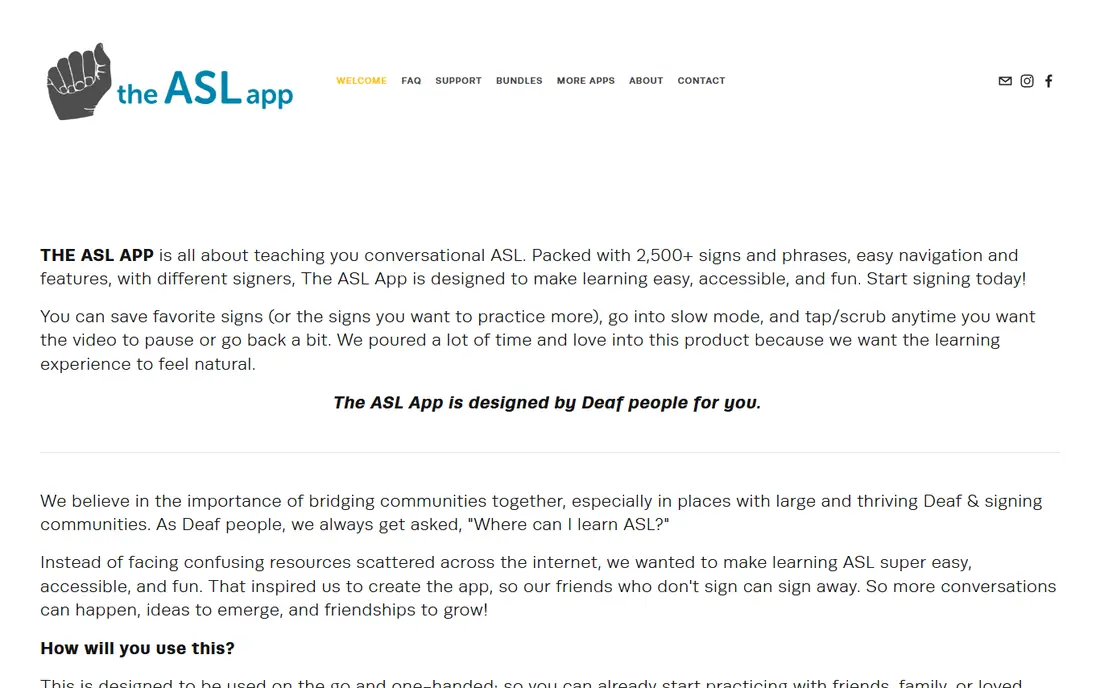
For budget dictionary and phrase learning, The ASL App deserves a close look. The ASL App packs over 2,500 signs and phrases into categories with video flashcards, slow-motion playback and a favourites feature, all for $9.99 a year or $4.99 a month. It suits learners who want a pocket dictionary more than a course.
It is less structured than Lingvano or ASL Bloom, with no course path or live feedback. As a cheap reference to pair with a course, it is excellent value.
- Over 2,500 signs and phrases
- Slow-motion video
- Favourites and search index
- Less structured than a course app
- No live feedback
HandSpeak
Ideal for: dictionary and grammar reference
This is the option we would point dictionary and grammar reference toward first. HandSpeak is a long-running ASL dictionary and reference site with video signs plus grammar and culture articles that explain how ASL works, not just what signs mean. Much reference content is free.
It is not a structured course, and the design is dated. As a reference to check a sign or a grammar point, it is a trusted resource.
- Large ASL dictionary with video
- Grammar and culture articles
- Free reference content
- Not a structured course
- Design is dated
Start ASL
Ideal for: structured online ASL courses
Start ASL earns its place here for structured online ASL courses. Start ASL offers full online courses from beginner to advanced levels, with video lessons, practice exercises and Deaf culture content. It suits learners who want a classroom-style path rather than gamified daily lessons.
Courses are paid, and the experience is more website than mobile app. For a structured curriculum, it is a solid choice.
- Full course levels from beginner to advanced
- Video lessons and practice
- Deaf culture content
- Paid courses
- Less app-like than Lingvano
SignIt ASL
Ideal for: immersive video courses for beginners
If your shortlist is built around immersive video courses for beginners, start with SignIt ASL. SignIt ASL teaches through immersive video lessons designed for beginners, with cultural context woven into the learning path. It suits visual learners who want a clear, gentle start.
Courses are paid, and the catalogue is smaller than larger platforms. For a focused beginner course, its clarity is a strength.
- Immersive video lessons
- Beginner-friendly path
- Cultural context
- Paid courses
- Smaller catalogue than larger platforms
ASLdeafined
Ideal for: classroom-style lessons with quizzes
Among the options here, ASLdeafined speaks most directly to classroom-style lessons with quizzes. ASLdeafined offers structured lessons with a video dictionary, quizzes and progress tracking, plus teacher resources for classrooms. It suits learners and schools wanting a traditional lesson structure.
It is a paid subscription with a functional interface. For a school-style path with tracking, it covers the bases well.
- Structured lessons with video dictionary
- Quizzes and progress tracking
- Teacher resources
- Paid subscription
- Interface is functional
Lifeprint
Ideal for: free self-study from a respected teacher
For readers focused on free self-study from a respected teacher, Lifeprint is a strong match. Lifeprint, also known as ASL University, offers free lessons, dictionary and grammar resources from Dr. Bill Vicars, a respected ASL teacher. It is the best free self-study resource here and a staple recommendation in the community.
It is self-study only, with no gamification or progress tracking. Pair it with an app like Lingvano for practice, and Lifeprint for depth.
- Free lessons from Dr. Bill Vicars
- Extensive dictionary and grammar resources
- Respected in the community
- Self-study only
- No app-style gamification or tracking
How we picked these
We compared official feature pages, pricing pages, app store listings, privacy policies and public reviews for each product on this list, and we kept only products that exist and work today and that truly fit the topic. Where a price had changed between sources or we could not verify it on the vendor site, we wrote See website rather than print a number we could not stand behind. We also weighed who each product is really for, not just how long its feature list runs. A product with a smaller set of features can be the better buy when it matches your workflow, your budget and the size of your team, and we say so plainly in each write-up. We also checked what each product costs over a full year, not just the headline monthly price, since annual billing, seat minimums and add-on fees can change the real total by a wide margin. Free plans were judged against their limits too: a free tier that caps the exact feature you need most is not really free for your use case, and we say so in the write-up when that is the case. Where prices differed between the vendor site and review listings, we trusted the vendor site, and where we could not confirm a figure on the vendor site at all, we wrote See website rather than repeat a number from a third party. That caution is deliberate, because a wrong price is worse than no price when you are building a budget.
How to learn ASL well with an app
Use the app daily in short sessions, but practise with people as soon as you can: apps teach vocabulary and grammar, while conversation teaches speed, facial grammar and cultural norms. Look for local Deaf events, community classes or practice partners once you know basic phrases.
Also learn about Deaf culture alongside signs, since ASL is a language of a community, not just hand movements. Respectful learning means listening to Deaf teachers and signers, crediting their work, and using your skills to communicate, not to perform.
Finally, before you commit to one of the options above, run it on a real task from your own work rather than a polished demo project. Use the free tier or trial for a full week, invite the people who will actually use it every day, and test the one workflow you cannot live without, whether that is exporting your data, inviting a teammate, sharing a result with a client or getting help when something breaks. Note how long each step takes and where you get stuck, since those friction points are what you will live with for months. The product that handles your real task with the least friction is the right one, even if another option looks stronger on a feature comparison page.
Frequently asked questions
What is the best app to learn ASL?
Lingvano is the best all-round beginner app, ASL Bloom suits learners wanting certified instructors, and The ASL App is the best budget dictionary. Lifeprint is the best free self-study resource.
Is Lingvano free?
Lingvano is free to download with limited features, while full access costs $17.99 a month, $47.99 for three months, or $119.99 a year. The annual plan works out near $9.99 a month.
Can I learn ASL from an app alone?
Apps teach vocabulary, grammar and basic conversation, but fluency needs practice with Deaf signers and the community. Pair an app with classes, events or practice partners for real progress.
What is the best free ASL app?
Lifeprint is free with extensive lessons and dictionary resources, while HandSpeak offers free reference content. Lingvano and The ASL App offer limited free access before paying.