Best Automated Penetration Testing Tools in 2026: 8 Tools Compared

- Pentera and Horizon3.ai lead on continuous automated pentesting that safely tests networks like a real attacker, without waiting for annual tests.
- Intruder and Detectify suit smaller teams that want continuous scanning plus vulnerability checks at a manageable price.
- Cobalt and NetSPI blend automation with human testers, which suits teams that need validated findings rather than raw scanner output.
- Probely and Astra Security focus on web applications, with developer-friendly workflows and API testing.
- Automated testing finds real weaknesses, but it does not replace scoped manual testing for complex logic flaws. Use automation for continuous coverage and humans for depth.
Quick comparison
| Product | Ideal for | Price from | Free version | |
|---|---|---|---|---|
 Pentera | Enterprise automated pentesting | See website | Free trial | Visit |
 Horizon3.ai | Attacker-style continuous testing | See website | Free trial | Visit |
 Intruder | Continuous scanning for smaller teams | See website | Free trial | Visit |
 Detectify | Web app attack surface checks | See website | Free trial | Visit |
 Cobalt | Pentesting with human experts | See website | Free trial | Visit |
 NetSPI | Enterprise pentest platform | See website | Free trial | Visit |
 Probely | Developer-friendly web scanning | See website | Free trial | Visit |
 Astra Security | Web app and API pentesting | See website | Free trial | Visit |
The best automated penetration testing tools
We compared official feature pages, pricing pages, documentation, and public reviews for the tools below. Our pick for most security teams is Pentera, because it runs safe, continuous automated attacks across networks and validates exploitable paths rather than just listing possible issues.
Pentera
Ideal for: Enterprise automated pentesting
Pentera runs automated penetration tests that mimic real attackers, chaining vulnerabilities to show which paths actually lead to critical assets. That validation matters, because a list of possible issues is far less useful than proof of what an attacker could reach. Reports prioritize fixes by real risk.
The platform is enterprise-oriented, with pricing to match, and setup works best with a security team to scope tests safely. For organizations that want continuous assurance between annual manual tests, Pentera is our pick.
- Continuous automated testing across networks
- Validates exploitable attack paths
- Detailed remediation guidance
- Enterprise pricing
- Setup needs security team involvement
- Best value for larger environments
Horizon3.ai
Ideal for: Attacker-style continuous testing

Horizon3.ai offers NodeZero, an autonomous pentesting platform that discovers your attack surface, finds weaknesses, and safely exploits them to show real impact. It covers internal and external networks plus cloud environments, and it runs on a schedule so security posture is tested continuously rather than once a year.
Autonomous testing demands careful scoping to avoid disrupting production systems, and pricing is handled by quote. For teams that want an attacker's view of their network on a regular basis, Horizon3.ai is one of the strongest options available.
- NodeZero runs autonomous pentests
- Shows exploitable impact with proof
- Cloud and on-prem coverage
- Pricing is quote-based
- Autonomous testing needs careful scoping
- Smaller teams may find it heavy
Intruder
Ideal for: Continuous scanning for smaller teams
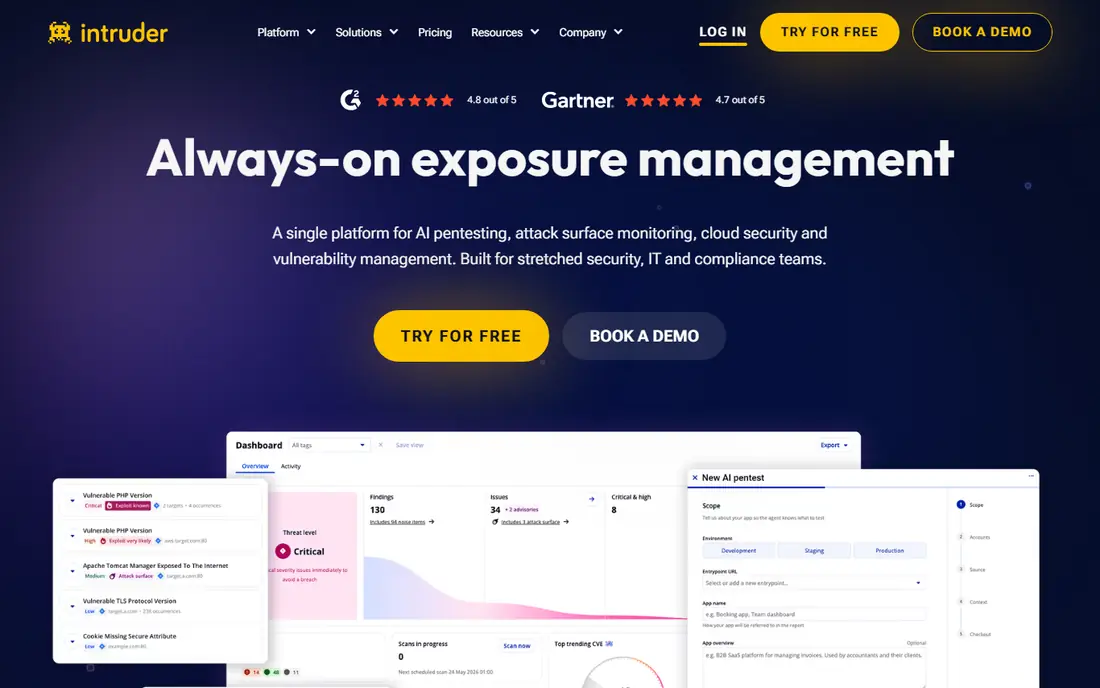
Intruder focuses on continuous vulnerability scanning that keeps watch between manual tests. It scans networks, cloud systems, and web apps, flags new exposures as threats emerge, and presents findings in clear reports that smaller teams can act on without a dedicated security staff.
It does not chain exploits as deeply as autonomous pentest platforms, so it is better seen as continuous assurance than a full pentest replacement. For small and mid-sized teams that need affordable, always-on scanning, Intruder is a practical choice.
- Continuous vulnerability scanning with clear reports
- Checks for emerging threats
- Simpler pricing than enterprise platforms
- Less deep exploitation than Pentera or Horizon3.ai
- Advanced pentest features need higher tiers
- Best for cloud and web assets
Detectify
Ideal for: Web app attack surface checks
Detectify monitors your web attack surface, including subdomains and applications you may have forgotten, and tests them with checks built from real hacker research. Its crowdsourced approach means new techniques reach customers quickly, and remediation advice helps developers fix issues.
The focus is web assets rather than internal networks, so it complements rather than replaces network pentesting. For teams with many public web apps and APIs, Detectify is a strong way to keep the external surface under watch.
- Attack surface monitoring for web apps
- Crowdsourced checks from ethical hackers
- Clear remediation advice
- Web-focused, not full network pentesting
- Pricing scales with asset count
- Some findings need manual validation
Cobalt
Ideal for: Pentesting with human experts
Cobalt runs pentests through a platform that pairs automation with human security researchers, so findings are validated by people who understand context. Clients see findings in real time, collaborate with testers, and get retests to confirm fixes, which speeds up the whole remediation cycle.
Human expertise costs more than pure automation, and tester scheduling adds lead time. For teams that need credible, validated results for compliance or customer trust, Cobalt blends speed with human judgment well.
- Combines automated testing with vetted human pentesters
- Real-time findings and collaboration
- Retesting included
- Human-led testing costs more than pure automation
- Scheduling depends on tester availability
- Platform pricing varies
NetSPI
Ideal for: Enterprise pentest platform
NetSPI offers penetration testing as a platform, covering networks, web apps, mobile apps, and cloud environments, with tools that track findings from discovery through remediation. Its tester teams bring deep experience, and the platform gives security leaders a clear view of risk over time.
It is built for enterprises, with pricing and onboarding to match. Smaller teams may prefer lighter tools, but for large organizations that need consistent, program-level pentesting, NetSPI is a strong choice.
- Enterprise pentesting across networks, apps, and cloud
- Platform tracks findings and remediation
- Experienced tester teams
- Enterprise pricing and sales process
- Best for larger organizations
- Smaller teams may find it heavy
Probely
Ideal for: Developer-friendly web scanning
Probely is a web vulnerability scanner designed to fit developer workflows. It scans web applications and APIs, integrates with continuous integration pipelines so checks run on every release, and explains each finding with fix guidance developers can use at once.
The scope is web and API security, not internal networks or cloud infrastructure. For development teams that want scanning inside their release process without a heavy enterprise platform, Probely is an easy, effective pick.
- Web and API scanning built for developers
- Integrates with CI pipelines
- Clear vulnerability details with fix guidance
- Web-only focus
- Smaller feature set than enterprise platforms
- Advanced scanning needs paid plans
Astra Security
Ideal for: Web app and API pentesting
Astra Security pairs an automated scanner with manual penetration testing for web applications and APIs, so teams get both continuous checks and human-validated depth. A dashboard tracks vulnerabilities, fixes, and retests in one place, which helps teams prove progress to auditors and customers.
Pricing depends on testing scope, and manual tests need scheduling. For web-focused teams that want automation plus expert review without managing two vendors, Astra Security is a solid option.
- Combines automated scanning with manual pentests
- API and web app coverage
- Dashboard tracks fixes and retests
- Pricing varies by scope
- Manual pentest availability depends on scheduling
- Smaller community than larger rivals
How we picked these
We compared official feature pages, documentation, pricing pages, and public reviews for each tool, and we favored products still operating in October 2026 that automate real attack or scanning work, not just checklist audits. We left out manual-only consultancies with no platform and scanners with no pentesting depth. Note that homepage checks for this article were limited by a browser rate-limit error during our work, so readers should confirm current pricing and features on each vendor site.
Running automated tests safely
Scope every automated test before it runs. Define which systems, networks, and time windows are in range, and exclude production systems that cannot handle aggressive testing. Even safe exploitation can cause load or lockouts, so tell operations teams in advance and have a stop plan.
Treat findings as a queue, not a report to file away. Fix exploitable paths first, then high-severity issues, and use retests to confirm each fix. Track repeat findings over time, since the same issue returning after a fix usually points to a process problem, not a tool problem.
Scoping an automated pentest starts with knowing what you are testing and what you must not touch. List production systems, staging environments, and third-party services separately, and confirm which targets are in scope before the first scan runs. Rate limits, fragile legacy systems, and shared test data can all break under aggressive testing, so schedule scans in maintenance windows where possible and warn service owners in advance. A tool that finds issues without context is only half the job.
Reporting is where value shows up. A good report ranks findings by real risk, explains how each issue was found, and gives developers steps they can follow to fix it. Retesting matters just as much, since a fix that is never verified leaves the same hole open. Build retesting into the schedule, track how long fixes take, and review trends each quarter to see whether the same classes of issues keep returning. Teams that close that loop steadily reduce their exposure, while teams that only collect reports do not.
Frequently asked questions
What is the best automated penetration testing tool?
Pentera is our pick for most security teams, with continuous automated testing that validates real attack paths. Horizon3.ai is a close alternative for autonomous, attacker-style testing.
Is automated pentesting as good as manual pentesting?
Automated testing is better for continuous coverage and finding known weaknesses at scale, while manual testing is better for complex logic flaws and business-specific risks. Most mature teams use both.
Can automated pentesting damage production systems?
Safe tools are designed to avoid damage, but aggressive tests can still cause load or lockouts. Always scope tests carefully, exclude fragile systems, and run intensive tests in maintenance windows when possible.
How often should automated pentests run?
Continuous or weekly testing suits most teams, since new vulnerabilities and assets appear constantly. Annual manual tests alone leave long gaps where exposures go unnoticed.
What is the difference between vulnerability scanning and pentesting?
Scanning finds known weaknesses, while pentesting tries to exploit them to show real impact. Automated pentest platforms do both, which is why their findings are easier to prioritize.