Best Ballistic Calculator App in 2026: 8 Apps Compared

- 1
 Applied Ballistics MobileSerious long-range precisionVisit
- 2
 Hornady Ballistics 4DOFHornady bullet usersVisit
- 3
 Kestrel LiNK BallisticsField use with a Kestrel meterVisit
- 4
 Lapua BallisticsLapua bullet and rimfire dataVisit
- 5
 Federal Ballistics CalculatorFederal load dataVisit
- Applied Ballistics is our pick for serious long-range shooters because its solver and custom drag models are built for precision work.
- Hornady 4DOF suits hunters and shooters who already use Hornady bullets and want a free, well-supported solver.
- Kestrel LiNK Ballistics is the best match for shooters who pair a phone with a Kestrel weather meter in the field.
- The right app depends on your bullet library, your weather data source, and how much you trust a phone solver at distance.
Quick comparison
| Product | Ideal for | Price from | Free version | |
|---|---|---|---|---|
| Applied Ballistics Mobile | Serious long-range precision | See website | No | Visit |
| Hornady Ballistics 4DOF | Hornady bullet users | Free | Yes | Visit |
| Kestrel LiNK Ballistics | Field use with a Kestrel meter | See website | No | Visit |
| Lapua Ballistics | Lapua bullet and rimfire data | Free | Yes | Visit |
| Federal Ballistics Calculator | Federal load data | Free | Yes | Visit |
 Winchester Ballistics Calculator | Winchester load data | Free | Yes | Visit |
 Berger Ballistics Calculator | Berger bullet shooters | Free | Yes | Visit |
 Strelok Pro | Budget solver with wide rifle support | See website | No | Visit |
The best ballistic calculator apps
A ballistic calculator turns your rifle, bullet, and weather data into a firing solution, usually a drop and wind chart for a given distance. Small input errors grow with distance, so the best apps make profiles easy to build and easy to check. We compared official feature pages, app-store listings, and public reviews for the options below.
Applied Ballistics Mobile
Ideal for: Serious long-range precision
Applied Ballistics Mobile is the solver many competition and long-range shooters name first. It supports custom drag models for specific bullets, which can matter beyond typical hunting distances, and it offers tools for range cards, moving targets, and multiple wind zones. The bullet library is broad, and profiles can be tuned with observed drops from real shooting sessions.
The trade-off is cost and complexity. This is a paid app, and new users face a dense set of inputs that reward careful setup. If you shoot mostly inside 300 yards, a free brand calculator will serve you well. If you stretch past that and want the most detailed solver on a phone, Applied Ballistics is the standard to compare against.
- Advanced solver with custom drag models
- Large bullet library
- Range-card and target tools
- Paid app with a learning curve
- Setup takes time to get right
Hornady Ballistics 4DOF
Ideal for: Hornady bullet users
Hornady Ballistics uses a four-degrees-of-freedom model that accounts for aerodynamic jump and other effects that simpler solvers skip. For shooters using Hornady bullets, the built-in data is a major plus, since bullet dimensions and drag data come from the maker. Range cards are clear, and the app is free, which makes it an easy first solver.
Its limits show up when you shoot other brands. You can enter custom bullets, but the experience is smoothest inside the Hornady catalog. Shooters who want deep custom drag tuning will still look at Applied Ballistics. For hunters and club shooters using Hornady loads, this is a strong free pick.
- Free solver with 4DOF modeling
- Strong Hornady bullet data
- Clean range-card output
- Best data covers Hornady bullets
- Advanced tuning is limited
Kestrel LiNK Ballistics
Ideal for: Field use with a Kestrel meter
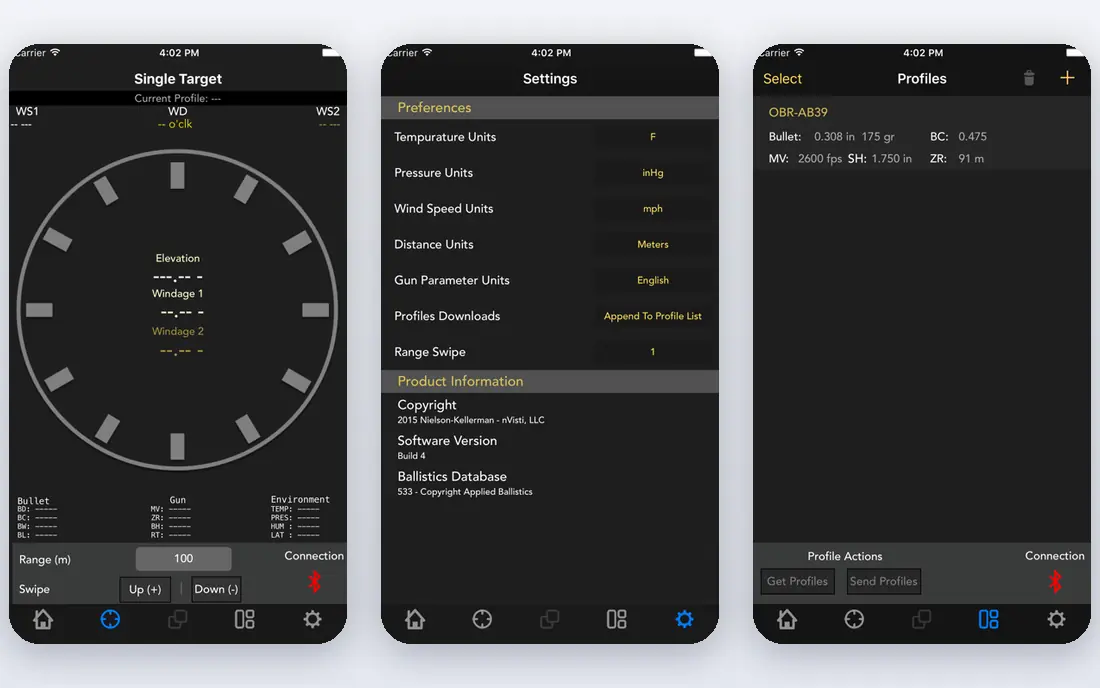
Kestrel LiNK Ballistics connects your phone to a Kestrel weather meter, pulling live wind, temperature, pressure, and humidity into the solver. That live link is the point: conditions change through a match or a hunt, and hand-typed weather data goes stale fast. Some Kestrel meters run the Applied Ballistics engine on the device itself, which adds confidence for long-range work.
The catch is the hardware cost. The app alone is less compelling without a meter, and the total setup costs more than any standalone app here. If you already own a Kestrel or plan to buy one, this pairing is hard to beat in the field. If you do not, start with a free solver and add a meter later.
- Pairs with Kestrel weather meters
- Live wind and atmosphere data
- Applied Ballistics engine option
- Best value needs a Kestrel device
- Pricing varies by meter and app tier
Lapua Ballistics
Ideal for: Lapua bullet and rimfire data
Lapua Ballistics is a free calculator built around Lapua bullets, including rimfire options that many solvers treat as an afterthought. Profiles are simple to build, and the app covers the core outputs most shooters need: drop, wind drift, velocity, and energy at distance. For Lapua shooters, having maker data in the app removes guesswork.
Outside the Lapua catalog, the app is less rich than Applied Ballistics or Hornady 4DOF. Advanced users may miss custom drag modeling and multi-wind tools. Still, as a free, focused solver for Lapua loads and rimfire shooting, it earns its place.
- Free with Lapua bullet data
- Rimfire support
- Simple profile setup
- Narrowest value outside Lapua loads
- Fewer advanced tools
Federal Ballistics Calculator
Ideal for: Federal load data
Federal offers a free ballistics calculator tied to its factory loads, which suits hunters who shoot Federal ammunition and want quick answers. You can compare loads side by side, see drop and drift at common distances, and check energy figures for hunting decisions. The web version means no app install is needed for a quick check.
Depth is the limit. Custom handload entry and advanced solver tuning are thinner than in dedicated solver apps. Treat this as a fast, reliable reference for Federal loads, and pair it with a deeper solver if you handload or shoot long range.
- Free with Federal factory load data
- Easy comparison of loads
- No install hassle on the web
- Web-first experience
- Limited custom bullet depth
Winchester Ballistics Calculator
Ideal for: Winchester load data
Winchester Ballistics Calculator works the same way as its brand rivals: pick a Winchester load, set your zero and conditions, and read drop, drift, and energy. Hunters comparing two Winchester loads for a deer rifle will get answers in minutes. The interface stays simple, which helps when you are checking loads at a shop counter or at camp.
The catalog is the constraint. Shooters using other brands or handloads will need a solver with broader custom entry. Winchester shooters who want a free, quick reference will find it solid, and competition shooters will likely keep a deeper app alongside it.
- Free with Winchester load data
- Simple interface
- Useful for hunters comparing loads
- Brand-focused catalog
- Fewer pro-level features
Berger Ballistics Calculator
Ideal for: Berger bullet shooters
Berger Bullets offers a free ballistics calculator built on its bullet line, which has a loyal following among long-range handloaders. Outputs cover the essentials, and the data quality for Berger bullets is the selling point. Handloaders who already trust Berger projectiles can build profiles around real maker data rather than generic coefficients.
As a web tool, it lacks some field features of phone-first solvers, such as meter pairing and offline range cards. It also centers on Berger bullets. Use it as a trusted reference for Berger loads, and keep a phone solver for field work if you need live weather inputs.
- Free with Berger bullet data
- Trusted by long-range handloaders
- Clear outputs
- Brand-focused data
- Web-based tool with fewer field features
Strelok Pro
Ideal for: Budget solver with wide rifle support
Strelok Pro has long been the budget favorite among shooters who want a real solver without a subscription. Its reticle database is unusually large, which helps shooters using scopes from many makers, and the app works offline, a real plus at remote ranges. Profiles cover many rifles, cartridges, and bullets.
The interface shows its age, and the learning curve is steeper than the free brand calculators. Some users report uneven update pacing across app stores. Even so, for the price, Strelok Pro gives ordinary shooters a capable solver with broad hardware support, and it remains a smart buy for shooters who want depth without a monthly fee.
- Affordable one-time style pricing
- Huge reticle and rifle database
- Works offline
- Interface feels dated
- Support and updates vary by platform
How we picked these
We compared official feature pages, app-store listings, and public reviews, and we kept only solvers that work in October 2026 and produce real drop and wind outputs for rifles. We favored apps with maker-verified bullet data, clear profile tools, and honest limits about input accuracy. We left out dead apps, generic calculators with no bullet data, and tools that only estimate without a real solver.
What to check before you trust a firing solution
Start with your inputs. Muzzle velocity from a chronograph beats a box figure, and your true zero distance matters more than any solver brand. Enter bullet data from the maker when you can, and confirm your scope height and twist rate, since small errors grow with distance.
Next, check your weather source. A phone solver with typed-in wind is only as good as your wind call, which is why meter pairing helps at long range. Finally, verify at the range. Shoot at two or three distances, compare real drops with the app output, and tune velocity or drag data until they match. A solver is a starting point, not a substitute for confirmed data.
Frequently asked questions
What is the best ballistic calculator app for beginners?
Hornady Ballistics 4DOF is a strong free start, since it pairs a capable solver with maker bullet data and clear range cards. Federal, Winchester, and Lapua calculators are also simple if you shoot those brands. Start free, learn your inputs, and move to a paid solver only when you need deeper tuning.
Is there a best ballistics calculator app for long-range shooting?
Applied Ballistics Mobile is our pick for serious long-range work, thanks to custom drag models and detailed solver tools. Kestrel LiNK Ballistics with a Kestrel meter is the best field pairing when live weather data matters. Both reward careful setup and range verification.
Do I need a weather meter for a ballistic calculator app?
No, but it helps at distance. You can type in wind, temperature, and pressure by hand for short and medium ranges. Beyond that, live meter data reduces guesswork, especially for wind, which is the hardest input to judge by feel.
Can a free ballistic calculator app be accurate?
Yes, if your inputs are right. Free brand calculators use real maker data and sound solvers for common distances. Accuracy depends more on true muzzle velocity, zero, and wind calls than on the app price. Verify every solver at the range before you trust it on a hunt or in a match.
What is the difference between a ballistics calculator and a rangefinder app?
A ballistics calculator computes drop and drift from your rifle and bullet data. A rangefinder measures distance, sometimes with angle compensation. Many shooters use both: the rangefinder supplies distance, and the calculator turns that distance into a firing solution.