Benefits Management Software: 7 Options Side by Side (2026)

- 1
 JustworksSmall companies that want a PEO without a long enterprise sales cycleVisit
- 2
 PlanSourceHR teams that want a dedicated benefits partner instead of just softwareVisit
- 3
 BenepassGlobal teams that want adaptable lifestyle benefits on one cardVisit
- 4
 NamelyMidsize firms that want HCM software plus managed servicesVisit
- 5
 GustoSmall teams that want payroll and benefits in one placeVisit
- Top of the list is Justworks, which targets small firms that want a PEO without a long enterprise sales cycle.
- Rippling suits expanding firms that want HR, IT and finance on one employee record.
- A permanent free plan is missing from all 7 tools, Justworks and Rippling included; plan for a trial or a premium start.
- Gusto has the lowest monthly starting price in this list: $49/month + $6 per employee/month.
- One limit worth knowing about Benepass: it does not administer health insurance.
Direct answer
Our first pick is Justworks, best for small firms that want a PEO without a long enterprise sales cycle. PlanSource fits HR teams that want a dedicated benefits partner instead of just software; Benepass fits global teams that want flexible lifestyle benefits on one card. The remaining 4 options are covered below with prices and limits.
Quick comparison
| Product | Ideal for | Price from | Free version | |
|---|---|---|---|---|
| Justworks | Small companies that want a PEO without a long enterprise sales cycle | $50/month + $8 per employee/month (Payroll plan) | No | Visit |
| PlanSource | HR teams that want a dedicated benefits partner instead of just software | See website (quote-based) | No | Visit |
| Benepass | Global teams that want adaptable lifestyle benefits on one card | See website (quote-based) | No | Visit |
| Namely | Midsize firms that want HCM software plus managed services | See website (quote-based) | No | Visit |
| Gusto | Small teams that want payroll and benefits in one place | $49/month + $6 per employee/month (Simple plan) | Free trial | Visit |
 TriNet Zenefits | Small firms that want software plus access to real HR experts | See website (quote-based) | No | Visit |
 Rippling | Expanding firms that want HR, IT and finance on one employee record | See website (quote-based, per-employee modular pricing) | No | Visit |
Benefits Management Software profiles
Ainotely compared 7 tools for benefits management software. The goal is a practical shortlist: published prices, free plan facts, best-fit use cases and honest limits for every entry.
Justworks
Ideal for: Small companies that want a PEO without a long enterprise sales cycle
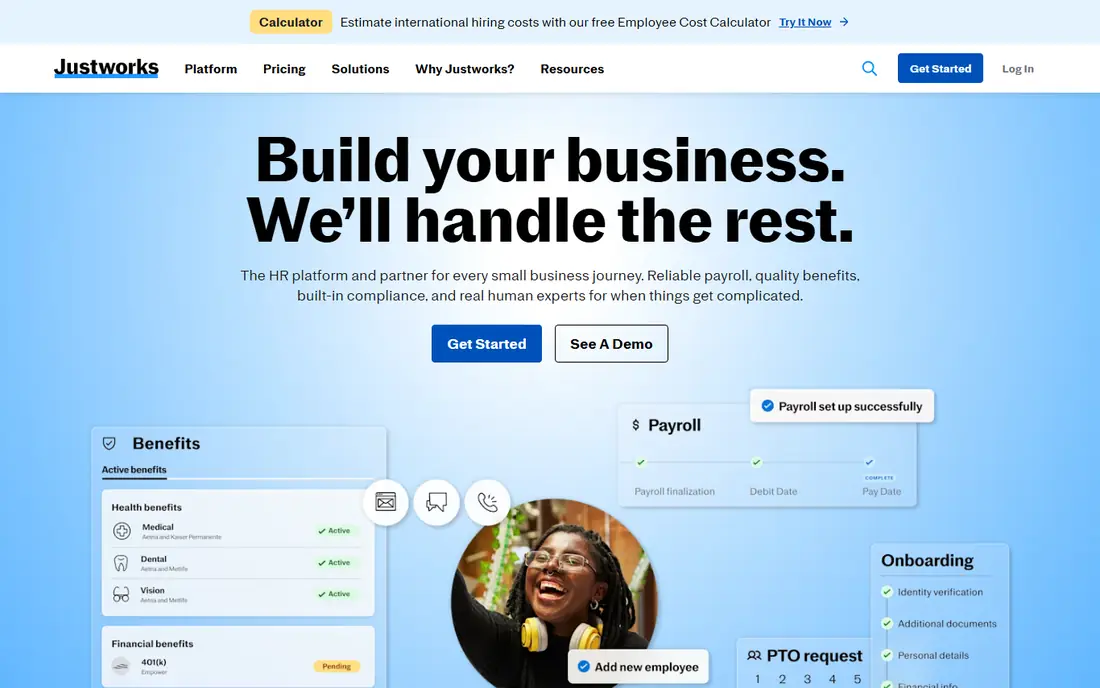
Justworks targets small companies that want a PEO without a long enterprise sales cycle. The Payroll plan runs $50 per month plus $8 per employee. From a buyer's view, support is a genuine differentiator, with 24/7 coverage on PEO plans.
The company processed over $31 billion in payroll in 2025 and supports more than 4,000 tax localities, so multi-state compliance is handled. Worth adding: the math is the catch. A 40-person company pays over $3,000 per month on PEO Basic before premiums. What you pay to start with Justworks: $50/month + $8 per employee/month. Justworks has no permanent free option.
Limits to weigh: Time tracking costs $8 per employee a month additional.
- PEO plans contain access to carriers like Aetna
- Rare published pricing for a PEO
- PEO Basic at $79 per employee a month adds up rapidly
PlanSource
Ideal for: HR teams that want a dedicated benefits partner instead of just software

PlanSource works best for HR teams that want a dedicated benefits partner instead of just software. PlanSource does one thing: benefits administration. That focus presents in the enrollment experience, carrier connections and compliance tooling.
Points against: Quote-only pricing.
For everyday use, the company positions itself as a partner instead of a vendor, with service teams that stay involved after go-live. It refreshed its brand and product in 2026. That multi-sided model is why its EDI connections and enrollment data quality tend to be solid. No starting price is listed for PlanSource here; confirm pricing on the vendor site. PlanSource has no permanent free option. Where it shines: Serves HR leaders, brokers.
- Benefits-only focus with deep enrollment expertise
- Solid decision support and employee communication tools
- No payroll or HRIS of its own, so integration is required
Benepass
Ideal for: Global teams that want adaptable lifestyle benefits on one card
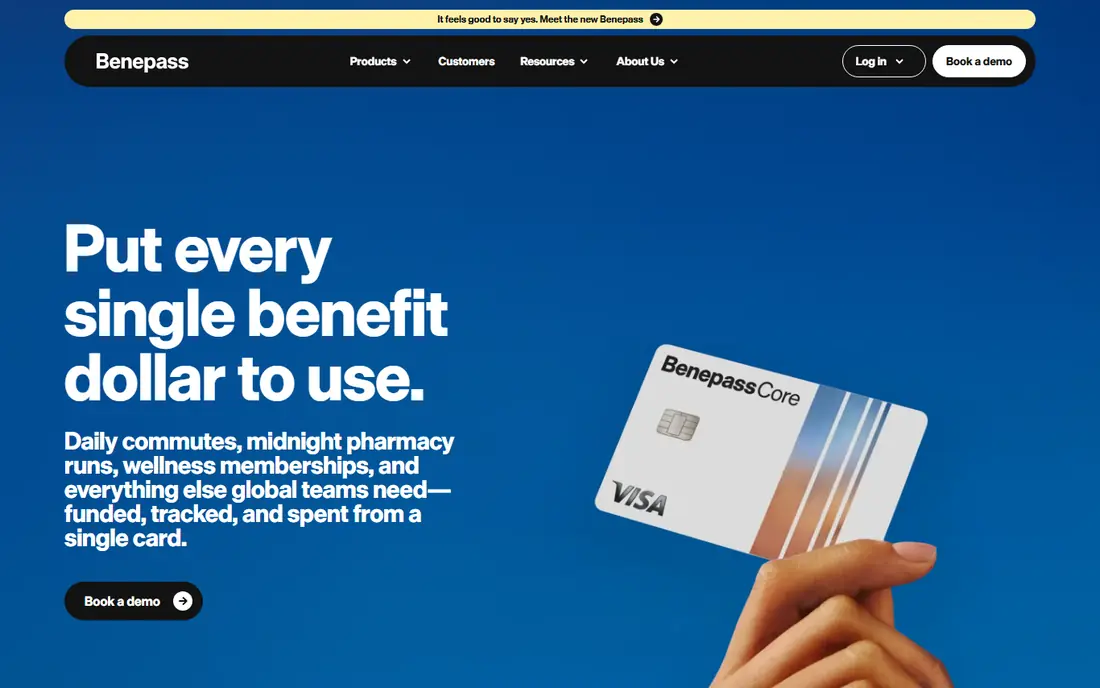
Benepass is designed for global teams that want adaptable lifestyle benefits on one card. Traditional ben-admin products are US-centric. From a buyer's view, employees get a Benepass Visa card, tap to pay, and claims reconcile automatically.
For distributed and global teams, this solves a real problem. Benepass supports employees in more than 100 countries with localized web and mobile experiences. Admins get live spend tracking down to the penny. Pre-tax accounts like FSA and commuter benefits run through the same system. On top of that, you still need something else for medical, dental and vision enrollment. Benepass shows no starting price here, so confirm the cost on the vendor site. There is no free plan with Benepass.
Strengths: Works in 100+ countries with 50+ languages.
Watch-outs: Quote-only pricing.
- Penny-precise tracking and reporting
- One Visa card spans pre-tax and lifestyle benefits
- Overkill if you only need US medical, dental and vision
Namely
Ideal for: Midsize firms that want HCM software plus managed services
Where Namely fits: midsize businesses that want HCM software plus managed services. The product handles core HCM, payroll and time, and benefits administration arrives as an enhanced module. In daily use, for a 150-person company with one HR leader, that matters: open enrollment, carrier renewals, ACA measurement and employee questions get handled by people who do it all day, with solid self-service apps and reporting.
Its carrier connections and benefits depth do not match a pure ben-admin system or a large PEO. And everything is quote-based with a real implementation timeline. In practice, what sets it apart is the managed services layer. No starting price is listed for Namely here; confirm pricing on the vendor site. Namely has no free tier.
Downsides: Quote-only pricing.
- Capable compliance support for multi-state employers
- Managed Benefits puts real specialists on your account
- Smaller carrier network than ADP or TriNet
Gusto
Ideal for: Small teams that want payroll and benefits in one place
Gusto works best for small teams that want payroll and benefits in one place. Keep your own broker and pay $6 per eligible employee a month instead. If you need deep benefits consulting instead of clean administration, a PEO or broker-driven system serves you better.
For everyday use, as your broker, it administers medical, dental, vision, life and disability plans for nothing beyond the premiums. As for the details, the main limit is the plan ladder: Straightforward is single-state payroll. So a second state forces you to Plus at $80 plus $12 per person. And Gusto is still payroll software first. You pay nothing until that first payroll runs, and every plan is month-to-month with no setup fee. Gusto cost at the entry level: $49/month + $6 per employee/month. As for free access: Free trial.
Highlights: Published pricing with month-to-month terms.
Downsides: Straightforward plan includes single-state payroll only.
- Commonly under an hour
- Health insurance admin included at no additional cost when Gusto is your broker
- Real HR advisory needs the Premium plan
TriNet Zenefits
Ideal for: Small firms that want software plus access to real HR experts
Where TriNet Zenefits fits: small companies that want software plus access to real HR experts. The Zenefits name still exists, but the company is now TriNet.
On top of that, the PEO route makes TriNet the co-employer, letting a 20-person company buy at large-group rates and offload ACA, COBRA and compliance work. As for the details, for benefits quality per dollar, the PEO is typically the more solid play under 100 people. TriNet Zenefits does not show a starting price in this comparison, so check the vendor site for current pricing. TriNet Zenefits has no permanent free option.
Watch-outs: Pricing is opaque and varies by industry.
- Serves more than 22,000 companies
- HR experts available by phone
- The PEO route means co-employment
Rippling
Ideal for: Expanding firms that want HR, IT and finance on one employee record
For expanding businesses that want HR, IT and finance on one employee record, Rippling is a natural candidate. For benefits specifically, that shared record pays off at open enrollment and onboarding. From a buyer's view, the tradeoff is cost and complexity: modular pricing climbs with every app you switch on.
You cannot get a number without talking to sales. Elections flow into payroll deductions without re-entry, and offboarding revokes access and ends coverage in the same workflow. On top of that, Rippling sells a different idea than Gusto. Rather than payroll with benefits attached, it is a workforce system where HR, IT and finance share one data layer. Rippling does not show a starting price in this comparison, so check the vendor site for current pricing. Rippling has no permanent free option.
Watch-outs: No published pricing, so budgeting needs a sales call.
- One employee record drives HR
- Benefits administration automates open enrollment and new-hire elections
- Support responsiveness is a recurring complaint in reviews
What went into this list
Each tool was reviewed on what its vendor publishes: price, plan limits, core features and stated drawbacks. We did not run hands-on tests. Seat minimums, billing terms and add-ons can move the real cost, so the starting prices here are a guide and not a quote. We ordered the tools by general fit, then by how clearly pricing is shown, then by free access. A buyer with unusual needs may reorder them.
What to check before you buy
- Confirm the entry price on the vendor page. For PlanSource, Benepass, Namely and others that means a quote rather than a fixed price.
- Run a trial of Gusto with real work before paying for a year; your own workflow is the best test.
- Before choosing Justworks, weigh its main limit: the Payroll plan bundles no health insurance.
- Find out whether the entry plan of Rippling covers your must-haves or only a trimmed-down version.
- Test the integrations you rely on with TriNet Zenefits before committing; some connectors sit on upper tiers.
Frequently asked questions
Can a small business get large-company insurance rates?
Through a PEO, yes. PEOs like TriNet and Justworks co-employ your workers, which lets them buy health insurance as one large group and pass those rates to small clients. That rate difference is frequently the real financial case for a PEO.
How much does benefits management software cost?
Broker-sold products are usually bundled into the broker relationship. Always add EDI fees, ACA filing charges and insurance premiums to get the real number.
What is the cheapest option for benefits management software in this list?
On published monthly entry prices, Gusto is the lowest here at $49/month + $6 per employee/month. Entry price is only part of the cost, because seats, add-ons and billing terms can change the total.
How are the tools for benefits management software ordered?
The order follows typical fit for benefits management software, with Justworks first and Rippling last, then price clarity and free access. It is editorial judgement, not a score, so another team could rank the tools differently.
Can I try these options before paying?
Often, yes. Gusto offers a free trial. Use your own data and a real task during the test, and check what the free tier or trial limits before you rely on it.
Does any tool for benefits management software here have a free plan?
A permanent free plan is not offered by Justworks, Rippling or the other tools here. Gusto offer a trial. Plan a short evaluation period instead.