For application data with AI retrieval, MongoDB Atlas is where this list starts. Listed starting prices: Confluent from $385 a month. Elasticsearch is the stronger choice for search and analytics at scale, while Amazon Redshift suits managed cloud data warehousing. The full list of 6 tools follows, with prices and free plan facts.
If you are comparing big data software for startups, this page covers 6 tools in one place: what each is best for, what it costs to start, whether it has a free plan, and the main limit to know about.
Key takeaways
This list starts with MongoDB Atlas, which is built for application data with AI retrieval.
Google BigQuery fits serverless analytics with automation.
The cheapest monthly starting price in the list is $385 per month, offered by Confluent.
One limit worth knowing about MongoDB Atlas: document model differs from SQL warehouses.
MongoDB Atlas is designed for application data with AI retrieval. Atlas is oriented around application data and retrieval, so teams whose primary need is large-scale SQL reporting may prefer a dedicated warehouse.
More specifically, pick Atlas when your startup builds applications that require adaptable data plus AI retrieval. No starting price is listed for MongoDB Atlas here; confirm pricing on the vendor site. A free plan is available with MongoDB Atlas.
Where it falls short: Document model differs from SQL warehouses.
Elasticsearch serves search and analytics at scale. Startups that require quick search across documents, logs or product data can use it as a core building block, and its open source nature provides teams a transparent starting point.
Points against: Search focus instead of general warehousing.
Amazon Redshift serves managed cloud data warehousing. Redshift centers on warehousing, so teams that require search, streaming or document storage will pair it with other services.
Confluent is designed for live data streaming pipelines. Confluent is built around streaming, so it complements instead of replaces a warehouse for historical analysis.
Where it falls short: Brings a layer beyond batch analytics.
On top of that, Confluent supplies a unified, resilient and open data streaming system for streaming, connecting, processing, governing and querying live data. More specifically, consider Confluent when live data movement is central to your product. Entry price for Confluent: $385 per month. Confluent offers a free plan. Reasons to shortlist it: Open and resilient design.
For unified data, analytics and AI work, Databricks is a natural candidate. Databricks presents itself as a unified product for data, analytics and AI, with a data-centric approach to building AI. Its documented scope spans simplifying ETL, data warehousing, governance and AI on a single system.
The main drawbacks: Wide surface area to learn.
Startups with a narrow, single-purpose need may find a focused warehouse or database more straightforward. In daily use, consider Databricks when you expect analytics and AI workloads to grow together and want one governed environment. This comparison lists no price for Databricks; ask the vendor. Free options: Not stated.
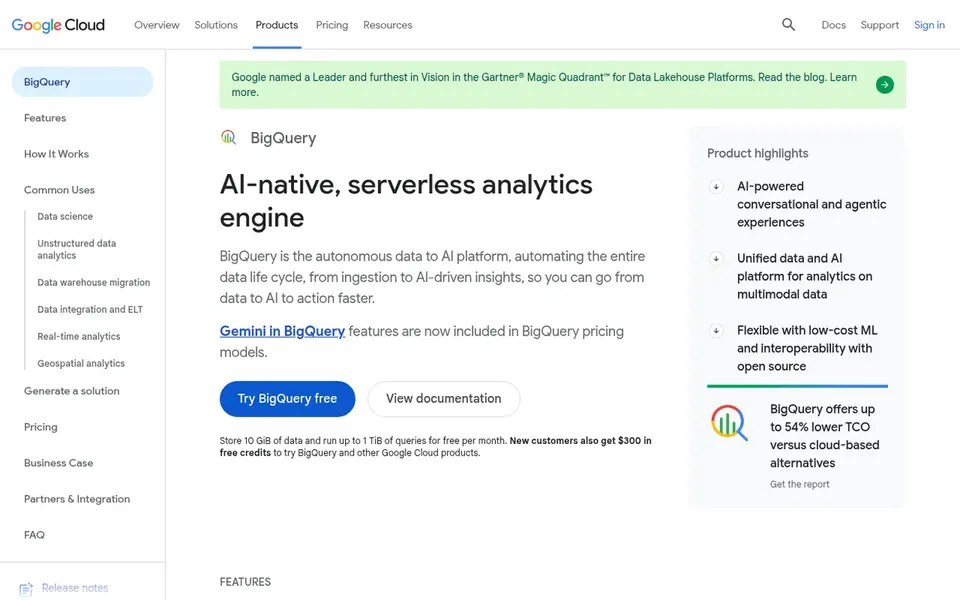
Google BigQuery serves serverless analytics with automation. For startups, the appeal is less infrastructure management: the system takes care of much of the operational work, letting a small team focus on queries, reporting and models instead of cluster upkeep.
In practice, cost behavior also relies on how you query and store data, so review your expected workload patterns. Check the vendor site for Google BigQuery pricing; none is listed in this comparison. Free access: Not stated.
What to check first: Best value relies on query patterns.
Confirm the entry price on the vendor page. For MongoDB Atlas, Elasticsearch, Amazon Redshift and others that means a quote rather than a fixed price.
Check what the free option really includes: MongoDB Atlas and Confluent offer a free plan, and usage caps differ.
Read the limits listed for MongoDB Atlas first: document model differs from SQL warehouses.
Pick one real project and run it in Amazon Redshift first; a small pilot shows fit faster than a checklist.
Look at the help docs and support options for Databricks before you commit.
How we picked
Pricing pages, product documentation and feature lists were the main sources, and every entry carries at least one honest drawback. Seat minimums, billing terms and add-ons can move the real cost, so the starting prices here are a guide and not a quote. We ordered the tools by general fit, then by how clearly pricing is shown, then by free access. A buyer with unusual needs may reorder them. Keep it in mind while reading the 6 big data software for startups profiles on this page.
Every price and plan detail on this page comes from the vendors’ own websites. We did not run hands-on tests unless the text says so, and we do not publish star ratings or review scores. See how we score and our disclosure.
Keep your shortlist in one place
Paste prices, trial dates and notes from this guide into Ainotely, our AI note app. It files them into a topic and pulls out tasks like “cancel trial by Friday”. Free 7-day trial, no card needed.
Which options for big data software for startups have a free plan?
MongoDB Atlas and Confluent offer a free plan in this list. Free plans usually cap users, projects or features, so check the limits on the vendor page.
What is the cheapest option for big data software for startups in this list?
On published monthly entry prices, Confluent is the lowest here at $385 per month. Entry price is only part of the cost, because seats, add-ons and billing terms can change the total.
Can I try these tools before paying?
Often, yes. MongoDB Atlas and Confluent have a free plan. Use your own data and a real task during the test, and check what the free tier or trial limits before you rely on it.
Should a startup choose a warehouse or a full product?
A broader product like Databricks makes more sense when analytics and AI workloads are expected to grow together and you want one governed environment.
How are the tools for big data software for startups ordered?
The order follows typical fit for big data software for startups, with MongoDB Atlas first and Google BigQuery last, then price clarity and free access. It is editorial judgement, not a score, so another team could rank the tools differently.