Best Birding Apps in 2026: 8 Apps Compared

- 1
 Merlin Bird IDPhoto and sound identificationVisit
- 2
 eBirdLogging and bird scienceVisit
- 3
 AudubonBird guide and communityVisit
- 4
 iNaturalistNature identification broadlyVisit
- 5
 BirdaCommunity bird loggingVisit
- Merlin Bird ID is the best birding app for most people, with photo and sound identification from the Cornell Lab in a free app.
- eBird, also from Cornell, is the best app for logging sightings and contributing to real bird science.
- Audubon and iNaturalist suit broader nature lovers, with bird guides, community sightings, and wildlife identification.
- Birda, BirdNET, Warblr, and ChirpOMatic cover community logging, sound identification, and UK-focused birding.
- Start with Merlin for identification and eBird for logging. That pair covers most birding needs for free.
Quick comparison
| Product | Ideal for | Price from | Free version | |
|---|---|---|---|---|
| Merlin Bird ID | Photo and sound identification | Free | Yes | Visit |
| eBird | Logging and bird science | Free | Yes | Visit |
| Audubon | Bird guide and community | Free | Yes | Visit |
| iNaturalist | Nature identification broadly | Free | Yes | Visit |
| Birda | Community bird logging | Free | Yes | Visit |
 BirdNET | Sound identification research | Free | Yes | Visit |
 Warblr | UK bird song identification | See website | Free trial | Visit |
 ChirpOMatic | Bird song identification | See website | Free trial | Visit |
The best birding apps
We compared official feature pages, pricing pages, app store listings, and public reviews for the apps below. Our pick for most birders is Merlin Bird ID, because it identifies birds by photo or sound for free, with guidance from the Cornell Lab of Ornithology.
Merlin Bird ID
Ideal for: Photo and sound identification
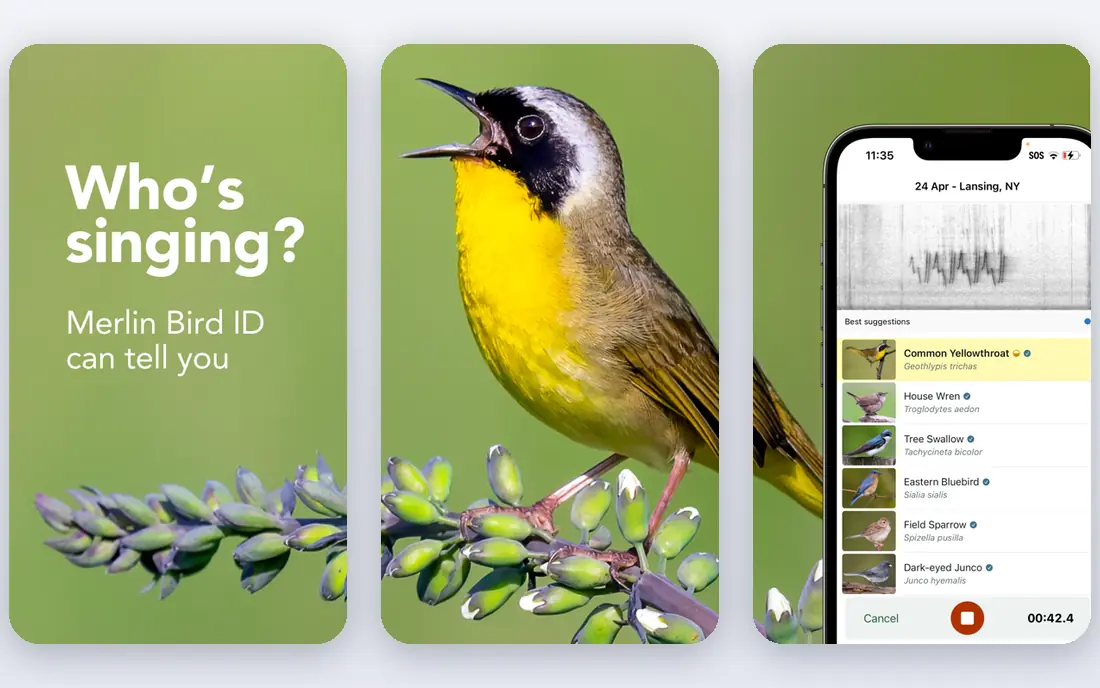
Merlin Bird ID answers the question every beginner asks: what bird is that? Point your camera at a bird or a photo, or let Sound ID listen and list the birds singing around you in real time. Regional bird packs keep identification accurate for your area, and the app is free.
Sound ID works best with clear songs and little background noise, and rare or similar species can still confuse it. For identification in the field, Merlin is the essential app, and it pairs perfectly with eBird for logging.
- Photo ID and Sound ID in one free app
- Bird packs for regions worldwide
- From the Cornell Lab of Ornithology
- Sound ID needs a quiet moment and a clear song
- Rare birds can confuse the model
- No social logging features
eBird
Ideal for: Logging and bird science
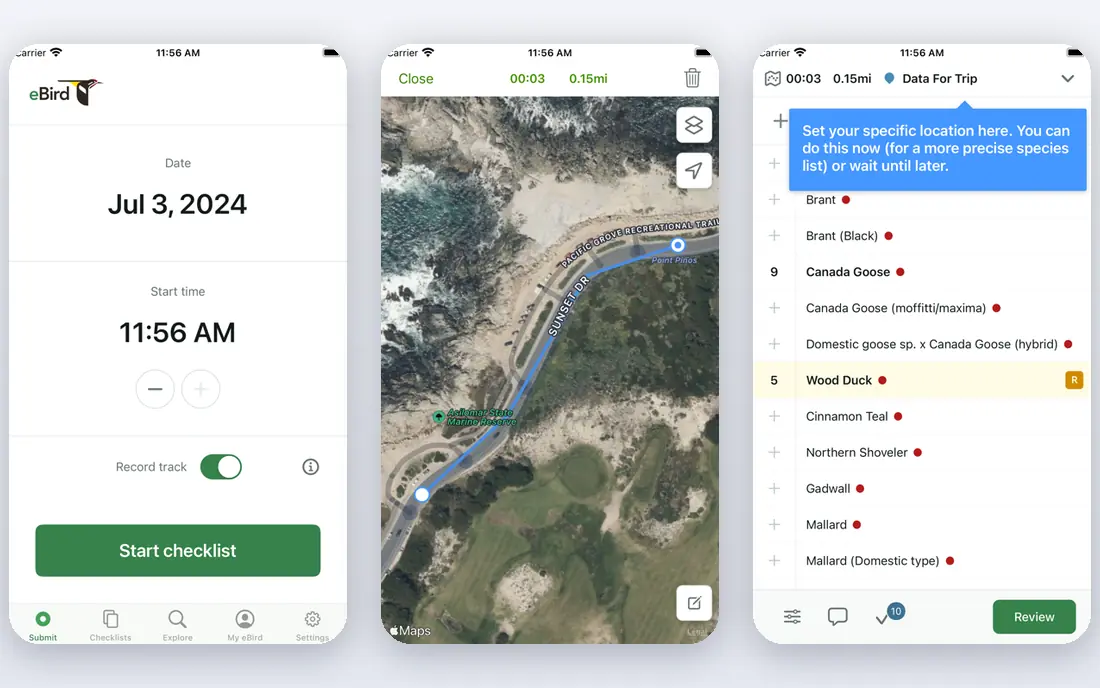
eBird, also from Cornell, is where birders log what they see. Checklists record species, counts, and locations, maps show hotspots and recent sightings, and your data feeds real research on bird populations and migration. It is the standard logbook for serious birders worldwide.
The checklist format takes a little learning, and careful entry matters since the data is used by scientists. For logging, exploring, and contributing to bird science, eBird is unmatched, and it is free.
- Log sightings with checklists and maps
- Contributes to real bird research
- Explore hotspots and species ranges
- Checklist style takes learning
- Data quality depends on careful entry
- No photo or sound ID built in
Audubon
Ideal for: Bird guide and community
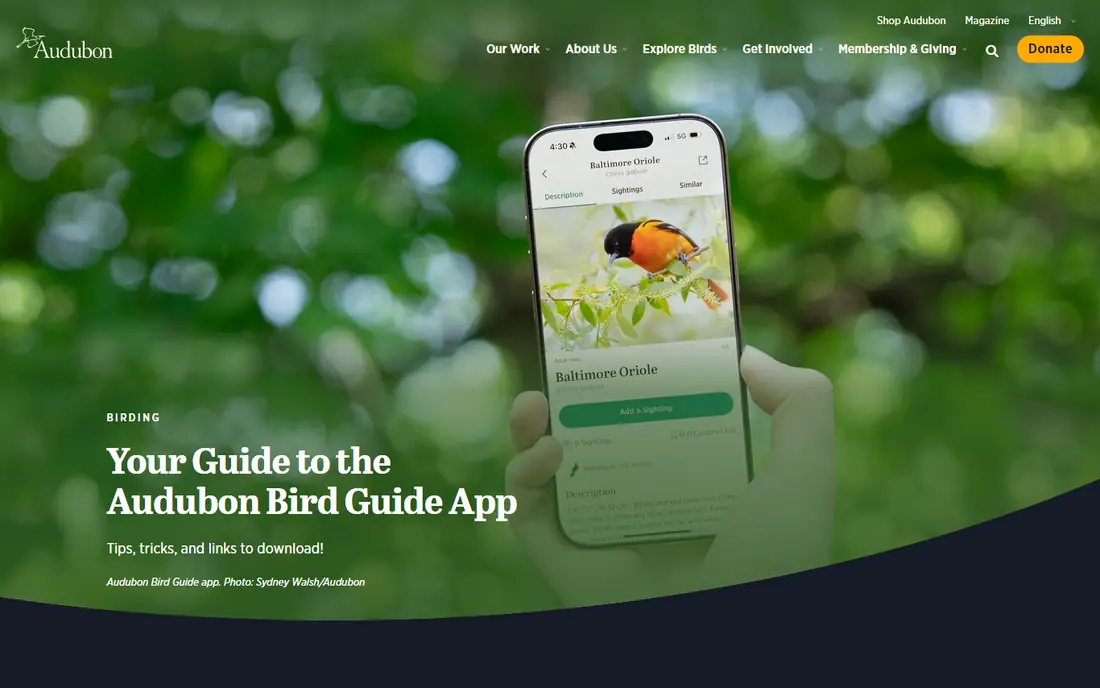
The Audubon Bird Guide app packs a full field guide into your phone, with photos, sounds, range maps, and descriptions for hundreds of North American species. Community sightings and conservation news keep birders connected to local bird life and issues.
It is heavier than Merlin for quick identification, and some features need an account. For a rich guide plus community, Audubon is a great companion to Merlin and eBird.
- Full bird guide with photos, sounds, and range maps
- Community sightings
- Conservation news and alerts
- Guide depth varies by species
- App is heavier than Merlin
- Some features need an account
iNaturalist
Ideal for: Nature identification broadly
iNaturalist identifies almost anything alive, from birds and plants to fungi and insects, using photo recognition plus community confirmation. Observations feed biodiversity research, and the community helps correct and confirm identifications.
Bird features are thinner than Merlin or eBird, since iNaturalist covers all of nature. For birders who also love wildflowers, butterflies, and tracks, it is the best broader nature app.
- Identifies birds, plants, insects, and more
- Community helps confirm identifications
- Contributes to biodiversity science
- Bird-specific features are thinner than Merlin
- Identification needs community confirmation
- App covers all nature, not just birds
Birda
Ideal for: Community bird logging
Birda is a social birding app where you log sightings, follow other birders, join challenges, and share your birding life. Species guides and feeds make it feel like a birding community, not just a logbook.
The user base is smaller than eBird, so hotspot data is thinner in some regions, and identification tools are lighter than Merlin. For birders who enjoy the social side of the hobby, Birda is a fun complement to eBird.
- Social bird logging with challenges and feeds
- Species guides
- Community of birders worldwide
- Smaller user base than eBird
- Identification tools are lighter
- Some features are newer
BirdNET
Ideal for: Sound identification research
BirdNET, from a university research project, identifies birds by their songs and calls with research-grade accuracy. Record a song, and the app analyzes it against a large sound database, showing likely species with confidence scores.
The interface feels like a research tool rather than a polished consumer app, and coverage varies by region. For sound identification enthusiasts and researchers, BirdNET is a fascinating and powerful tool.
- Research-grade bird sound identification
- Records and analyzes songs
- From a university research project
- Interface is research-focused, not polished
- Species coverage varies by region
- Needs a clear recording
Warblr
Ideal for: UK bird song identification
Warblr automatically recognizes bird songs, with a focus on UK species that makes it especially useful for British birders. Record a song and the app lists likely species, with a simple workflow that works well on a walk.
The UK focus limits its use in North America and elsewhere, and the species set is smaller than Merlin's global packs. For UK birders who want song identification, Warblr is a handy specialist.
- Automatic bird song recognition for UK species
- Simple recording workflow
- Built for British birders
- UK focus limits use elsewhere
- Smaller species set than Merlin
- Pricing varies by platform
ChirpOMatic
Ideal for: Bird song identification
ChirpOMatic identifies bird songs for UK and European species, with a simple interface and some offline capability. It suits birders who want a quick song check without the full feature set of Merlin or BirdNET.
Regional coverage is its limit, and updates are less frequent than bigger apps. For European birders who want a simple song identifier, ChirpOMatic is worth trying alongside Merlin.
- Song identification for UK and European birds
- Works without an internet connection for some features
- Simple interface
- Regional focus limits global use
- App updates are infrequent
- Identification accuracy varies with recording quality
How we picked these
We compared official feature pages, pricing pages, app store listings, and public reviews for each app, and we favored apps still operating in October 2026 that identify, log, or guide birding in a real way. We left out generic nature apps with no bird features and paid guides with no app component. Note that homepage checks for this article were limited by a browser rate-limit error during our work, so readers should confirm current pricing and features on each vendor site and app store page.
Birding with apps without spoiling the birds
Use sound identification sparingly. Playing recorded songs to attract birds can stress them, especially in breeding season, so listen and identify rather than broadcasting calls. Keep a respectful distance, stay on paths, and never disturb nests.
Log what you see carefully. Accurate counts, locations, and times make your eBird data useful to researchers, while vague or guessed entries weaken the science. Finally, carry a backup: phones die, signals fail, and a small field guide or notebook still saves a good birding day.
Identifying birds by ear is a skill that grows with practice, and apps that play songs and calls help you learn faster than pictures alone. Start with the common species in your area, learn their songs one at a time, and test yourself on walks before moving to rarer birds. Sound identification tools can suggest matches, but treat them as hints, since similar species and background noise cause mistakes, and confirming with field marks, size, and habitat keeps your life list honest.
Birding ethics protect the birds you enjoy. Keep a respectful distance from nests and roosting birds, avoid playing recorded calls repeatedly near sensitive species, and stay on paths in fragile habitats. Early mornings and migration seasons offer the best sightings, but local parks in any season hold surprises, so a short regular walk often beats rare long trips. Record your sightings consistently, even the common ones, since long-term records help scientists track population changes, and your own list becomes a journal of places and seasons you will enjoy revisiting. Choosing binoculars matters as much as choosing an app. A pair with 8x magnification suits most birders, offering a steady image and wide view, while 10x brings distant birds closer but shakes more and narrows the view. Try binoculars before buying, since weight, eye relief for glasses wearers, and grip comfort vary, and a pair you enjoy carrying will be used far more than a powerful pair left at home. Keep lenses clean with a soft cloth, store binoculars dry, and use a comfortable strap, since neck strain cuts walks short.
Keeping a field notebook alongside your app deepens the hobby. Note date, place, weather, and behavior, not just species names, since behavior notes help you identify similar birds later and make old entries fun to reread. Join a local bird walk or online group to learn from experienced birders, who can point out songs and field marks that apps describe but cannot demonstrate. Citizen science projects welcome sightings from beginners too, so your regular walks can contribute to real research, and sharing sightings connects you with a community that notices the same seasonal changes you do.
Frequently asked questions
What is the best birding app?
Merlin Bird ID is our pick for most birders, with free photo and sound identification from Cornell. Pair it with eBird for logging sightings and contributing to bird science.
Is Merlin Bird ID free?
Yes, Merlin Bird ID is free, including Photo ID, Sound ID, and regional bird packs. It is funded by the Cornell Lab of Ornithology rather than subscriptions.
Can apps identify birds by song?
Yes. Merlin Sound ID, BirdNET, Warblr, and ChirpOMatic all identify birds from recordings, with accuracy depending on song clarity, background noise, and regional coverage.
Do I need eBird if I use Merlin?
Merlin identifies birds, while eBird logs them. Most birders use both: Merlin for identification in the field and eBird for checklists, hotspots, and science.
What is the best birding app for the UK?
Merlin works well in the UK with regional packs, and Warblr and ChirpOMatic specialize in UK and European song identification. Birda also has a growing UK community.